
Staff Rostering Software in Australia: Features, Costs and Build vs Buy
This guide helps Australian employers decide whether to keep using ready-made staff rostering software or build their own. It covers core features, award rules by industry, compliance checks and AI rostering, then compares three years of per-user fees with the cost of a custom build.


Summarise with AI
Short on time? Let AI do the work. Get the key points.


Key Takeaways
- Rostering is now a compliance job: Award rules, pay records and payroll reporting all start with the roster, so a roster error quickly becomes a pay error.
- Underpayment risk is real: The Fair Work Ombudsman recovered AUD$358 million for more than 249,000 underpaid workers in 2024-25.
- Award rules differ by industry: Retail requires 12 hours off between work days, while Hospitality, SCHADS, Nurses and Aged Care require 10.
- Per-user fees compound: A 500-person team paying AUD$13 per user each month spends about AUD$234,000 over three years.
- Ready-made tools hit limits: They struggle with enterprise agreements, mixed awards, multi-state teams and care-minutes reporting.
- Custom builds cost less than many expect: A focused MVP starts from about AUD$29,000 and takes 12-16 weeks, with no per-user fees.
Most staff rostering software works well when your rosters are simple.
But things get more complicated when employees work under different awards, an enterprise agreement, or across multiple states. Your software may apply the wrong pay or break rules, leaving someone to check and fix the payroll manually. Care providers feel this most, because aged care, NDIS and nursing rosters also follow care-minutes, screening and ratio rules. Our custom healthcare software development team builds rostering around those extra rules.
Getting pay wrong is a bigger risk now. Since 1 January 2025, intentionally underpaying employees can be a criminal offence under the Fair Work Act. Casual workers add another layer of complexity. The Australian Bureau of Statistics counted 2.4 million casual employees in August 2025, or 19% of all employees. Casual shifts can also involve different pay rates, penalty rates and break rules.
This guide from SolGuruz is for people who manage rosters and payroll in aged care, NDIS, healthcare, hospitality and retail. It will help you decide whether a ready-made tool is enough or whether you should build your own. You will learn:
- How rostering software handles Australian awards
- What checks your rostering tool should pass
- Signs that your current tool no longer fits
- How the cost of custom software compares with three years of monthly software fees
If you already know a standard tool won’t meet your needs, our team offers custom software development in Australia built around your awards, pay rules and business processes.
What Is Staff Rostering Software?
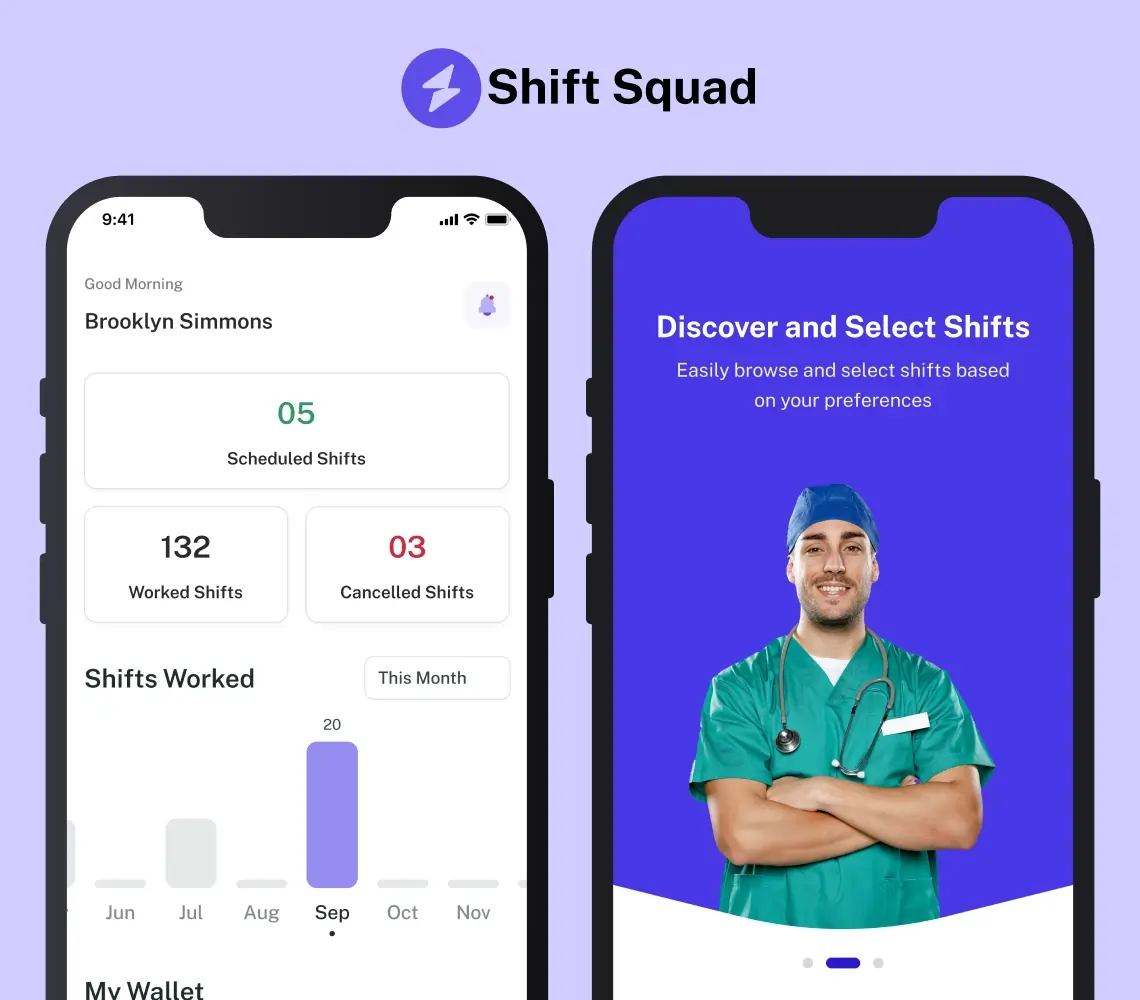
Staff rostering software is a tool that builds and publishes employee shift rosters, applies award and leave rules, lets staff swap shifts or set availability on their phones, records the hours actually worked and sends approved timesheets to payroll. In the US, it is usually called staff scheduling software.
You will also see it called employee rostering software, roster software or a rostering system. The idea is the same.
If you are asking what rostering is in simple terms, it is deciding who works which shift, where and for how long. The software makes that decision faster. It also keeps a record of it.
Roster vs Timesheet: What’s the Difference?
A roster is the plan, while a timesheet records what actually happened, including late starts, extra hours and missed breaks.
Payroll pays from the approved timesheet, not the roster. That is why good systems compare the two and flag any gap before the pay run.
Key Features of Staff Rostering Software
Most tools share the same core features. You use these every day, before any award rules come into play.
1. Drag-and-drop roster builder
Managers build shifts on a visual grid and move them in seconds. Templates copy last week or repeat rotating patterns.
2. Auto-scheduling
The system fills open shifts by availability, skills and cost. Managers then review a draft instead of starting from a blank week.
3. Availability and leave requests
Staff set the times they can work and apply for leave in the app. Approved leave blocks those shifts automatically.
4. Shift swaps and open shifts
Staff swap shifts or claim open ones, subject to manager approval. This cuts the phone calls on a busy morning.
5. Instant publishing and notifications
One click sends the roster to every staff member’s phone. Changes trigger alerts, so nobody misses a shift.
6. Time and attendance
Staff clock on and off from the app or a kiosk, often with a location check. Actual hours then flow into timesheets.
7. Payroll integration
Approved timesheets move to payroll without retyping. This removes most data-entry errors before the pay run.
8. Labour cost forecasting
Wage costs update live as you build. You can check them against sales or budget before publishing.
9. Reporting
Dashboards show overtime, fill rates, late starts and labour cost by site.
The rostering app matters more than most buyers expect. If staff find it clunky, swaps move back to group chats and your records break. Teams that need a better staff experience on top of an existing system can work with a mobile app development company in Australia to build one.
How Rostering Software Works, From First Draft to Payroll
The features above connect in a set order. Here is how one shift moves from forecast to the Australian Taxation Office (ATO), the government agency that collects tax. Under Single Touch Payroll (STP), your payroll system sends each employee’s pay and tax details to the ATO every time you pay staff.
Step 1. Demand forecast
Sales, bookings or resident numbers show how many staff each shift needs.
Step 2. Draft roster
Shifts are built by hand or by auto-scheduling.
Step 3. Award rules check
The system flags breaks, rest periods, minimum engagements and overtime before publishing.
Step 4. Publish and confirm
Staff receive the roster on their phones and clock on and off against it.
Step 5. Approved timesheet
The manager approves actual hours, and loadings and penalties are applied.
Step 6. Payroll
Approved hours flow into the payroll system.
Step 7. STP Phase 2
Payroll reports each pay run to the ATO.
The last step matters more than most buyers think. Under STP Phase 2, employers must report overtime, paid leave, allowances, and other amounts as separate items. The ATO calls this disaggregation of gross.
Your rostering software doesn’t file STP itself. However, its timesheet data must keep those categories separate, or payroll cannot report them correctly. This is why buyers often search for rostering and payroll software as one system.
What AI Can and Can’t Do in Rostering
AI rostering software can forecast demand, draft a first roster that respects award rules and staff availability, and suggest who should fill an open shift. What it can’t do is take responsibility. A manager still reviews and approves every roster, because consultation duties and pay obligations stay with the employer.
Behind the “AI” label, three different technologies do the work, and each one fits a different job.
1. Constraint Solvers Do the Heavy Lifting
Most proven AI rostering runs on constraint optimisation. Researchers have studied staff scheduling for decades as the “nurse rostering problem.”
A solver weighs hard rules, such as rest breaks, against soft goals, such as fairness and cost. It then searches for the best roster that meets both.
2. Chat Assistants Handle Quick Edits
Newer tools add a chat layer on top. A manager can type a change in plain English, such as “move Sam to Friday close,” and the tool updates the roster.
These assistants save time on small edits. However, they are only as reliable as the rules engine underneath them.
3. AI Agents Fill Open Shifts
The fastest-growing use is AI agents that offer open shifts to the best-fit staff, then confirm cover without a manager chasing replies. Businesses adding this to an existing system usually start with AI agent development for filling open shifts rather than replacing their whole roster tool.
Check Your Privacy Duties Before You Automate
From 10 December 2026, organisations covered by the Privacy Act must explain in their privacy policy when automated decisions significantly affect people. The employee records exemption makes this less clear for staff. Rostering vendors and employers rostering contractors or job applicants should check whether the rule applies to them. For health and care providers, our guide to healthcare IT and AI compliance in Australia explains how this rule sits alongside breach reporting and TGA rules for AI.
Why Rostering Is Harder Under Modern Awards and Fair Work Rules
In most countries, a roster is a timetable. In Australia, it is a legal document shaped by awards, the National Employment Standards and enforcement rules that changed sharply in the last two years. Below are the rules that apply to almost every employer.
You Must Consult Before You Change a Roster
Every modern award must include a consultation term for roster changes. This comes from section 145A of the Fair Work Act.
Before changing an employee’s regular roster or ordinary hours, the employer must:
- Give the employee information about the change
- Invite their views, including on family or caring responsibilities
- Consider those views
Good software keeps a record of that process. Spreadsheets rarely do.
Your Rosters and Timesheets Become Legal Records
Employers must keep prescribed employee records for seven years under section 535 of the Fair Work Act. Records must include:
- Hours worked by casual and irregular part-time staff
- Loadings and penalty rates
- Overtime hours for each day
Pay slips must go out within one working day of payment.
Missing records also shift the burden of proof. If records are absent, the employer may have to disprove an underpayment claim.
The 2025 Federal Court ruling in the Woolworths and Coles salaried-manager cases ([2025] FCA 1092) shows why this matters. The court held that annualised salaries cannot be offset across pay periods against award entitlements. Accurate hours per pay period, which is exactly what rostering and timesheet data provides, sat at the centre of that case.
What Australian Rostering Law Changes Do Employers Need to Know?
Several law changes now affect how rosters and timesheets must work.
1. New casual definition (26 August 2024)
A casual is someone with no firm advance commitment to continuing work who receives a casual loading.
2. Employee choice pathway
Casuals can ask to convert after 6 months, or 12 months with a small business employer.
3. Right to disconnect
Employees can refuse unreasonable out-of-hours contact. This started on 26 August 2024 for most employers and 26 August 2025 for small businesses.
4. Criminal underpayment (1 January 2025)
Intentional underpayment can mean up to 10 years’ jail. Fines can reach three times the underpayment, or 5,000 penalty units for individuals and 25,000 for companies, whichever is greater. Honest mistakes are not covered.
5. Penalty rate protection (29 August 2025)
Award penalty and overtime rates cannot be reduced.
6. Two changes in 2026
Award minimum wages rose 4.75% from 1 July. From 1 June, SCHADS part-time and casual overtime starts after 10 hours a day, or 12 hours with a sleepover.
7. Fatigue code of practice (September 2025)
Safe Work Australia released a new model Code of Practice for managing fatigue. A model code only has legal effect in states and territories that adopt it.
Even so, the direction is clear. Back-to-back closes and opens, long runs of night shifts and short turnarounds are now safety risks, not just staff complaints. Your roster tool should make these patterns visible before you publish.
How Award Rules Change Rostering Across Five Industries
The table below compares the rostering rules that trip employers up most often. Rates follow each award as currently consolidated. Dollar loadings are left out because they change every 1 July.
| Award | Roster notice | Break between shifts | Casual minimum and Sunday rate (FT/PT) |
| General Retail | 7 days’ written notice, 14 if the employee disagrees | 12 hours (10 by agreement) | 3 hours; Sunday 150% |
| Hospitality | Change by agreement or 7 days’ notice | 10 hours (8 at a roster changeover) | 2 hours; Sunday 150% |
| SCHADS | Posted 2 weeks ahead; 7 days’ notice of change | 10 hours | 2 or 3 hours by stream; Sunday 200% |
| Nurses | Displayed 7 days ahead; 7 days’ notice | 10 hours (8 by agreement) | See the award |
| Aged Care | Displayed 2 weeks ahead; 7 days’ notice | 10 hours | See the award |
One common myth falls apart here. Sunday is not double time everywhere, because Retail and Hospitality pay 150%.
The table covers the headline award rules. Each industry also has rostering needs that go beyond the award, and those are covered below.
1. Aged Care Rostering Software
The Aged Care Act 2024 commenced on 1 November 2025. Residential homes work towards a sector average of 215 care minutes per resident per day, including 44 minutes from a registered nurse. Each home has its own target based on resident mix, and enrolled nurses can cover up to 10% of the RN target.
A registered nurse must also be onsite 24/7. RN coverage is reported monthly, and care time is reported quarterly through the Quarterly Financial Report.
Aged care rostering software therefore has to track minutes by role, not just shifts filled. If you are building for this sector, our guide to an aged care staffing app for Australian providers covers the marketplace side.
2. NDIS Rostering Software
SCHADS rosters have rules that generic tools often handle poorly:
- Broken shifts: They have a maximum span of 12 hours, with double time beyond it.
- Sleepovers: They carry their own span and allowance.
- Client cancellations: Home care and disability services have specific rules for cancellations made within 7 days.
Registered providers must also make sure workers in risk-assessed roles hold an NDIS Worker Screening Check clearance. Good NDIS rostering software blocks unscreened workers from those shifts automatically. Screening checks last up to five years, and the first renewals are now due. Our NDIS software development guide for Australian providers shows how rostering, claims and screening alerts work together in one system.
Many providers run rostering inside a broader care platform. Our guide on how to build care management software like Shiftcare shows how those systems fit together, and our home care software development work covers visit scheduling.
3. Nurse and Healthcare Rostering Software
Under the Nurses Award, work started without the 10-hour rest break is paid at 200% until the employee gets that break. Ratio laws add another constraint:
- Victoria: The nurse ratio law was fully phased in on 1 July 2026. It includes a 1:1 ICU ratio in the state’s largest hospitals.
- Queensland: Public medical-surgical wards require average ratios of 1:4 on morning and afternoon shifts and 1:7 at night.
Nurse rostering software must check skill mix and ratios shift by shift. Hospitals and agencies with these needs often look at purpose-built healthcare staffing and scheduling software.
4. Hospitality Rostering Software
Hospitality demand moves with bookings and weather, so the best hospitality rostering software forecasts from POS data. Several award rules also need to be built in:
- Elective meal break: For shifts over 5 and up to 6 hours, the meal break is elective, and the employee must request it in writing.
- Consecutive days: Full-time staff cannot work more than 10 consecutive days without a rostered day off.
- Public holiday minimums: Full-time and part-time staff must be paid at least 4 hours on a public holiday, and casuals at least 2 hours.
5. Retail Rostering Software
Retail rostering software must handle these rules:
- Break times on the roster: Break timing must appear on the roster itself.
- Meal break limit: No one can work more than 5 hours without a meal break.
- Short turnarounds: Work that starts before the required break ends is paid at 200%.
- Daily overtime: Overtime is calculated daily, not weekly.
- Roster records: Completed rosters must be kept for at least 12 months, on top of the seven-year rule for time and wage records.
Whatever your industry, these rules only protect you if your software applies them before the roster goes out, not after the pay run. The checks below show what to look for.
8 Compliance Checks Your Rostering Software Must Pass
Core features keep the week running. The checks below decide whether your pay records hold up under Fair Work rules.
| Feature | Why it matters | Red flag |
| Award interpretation engine | Applies penalties, loadings and overtime across multiple awards and enterprise agreements | Supports only one award per employee |
| Roster notice and change log | Records 7- and 14-day notice and consultation | Changes overwrite the old roster with no history |
| Break and rest alerts | Flags short turnarounds before publishing | Alerts appear only after the pay run |
| Qualification and screening checks | Blocks staff without required clearances, such as NDIS screening | Qualifications stored as free text |
| Public holidays by work location | Applies each state’s holidays where the shift is worked | Uses the head office state for everyone |
| STP-ready pay categories | Keeps overtime, leave and allowances separate on the way to payroll | Exports one lump “hours” figure |
| Quiet-hours notifications | Respects the right to disconnect | Pushes shift offers at midnight |
| Audit trail and seven-year retention | Keeps records that meet section 535 | Data purged after 12 months |
No off-the-shelf tool clears every one of these checks, and the gaps rarely show up in a demo. They surface months later, in a pay run that doesn’t reconcile or an audit that asks for records you can’t produce. The honest way to find out is to test a tool against your actual awards and sites before you commit, not after. That check takes an afternoon and can save a rebuild.
Types of Rostering Software and Who Each One Suits
There is no single best rostering software. Most options fall into one of six types, and the right one depends on your industry, headcount and awards.
| Type | Typical pricing | Built for |
| Standalone rostering apps | Per user, roughly AUD$4 – AUD$13 a month | Small to mid-sized shift-based teams with standard awards |
| All-in-one HR, payroll and rostering suites | Bundled per-user price, higher than rostering alone | Businesses that want one vendor for HR, pay and rosters |
| Care-sector platforms | Per user, often with a minimum number of staff | NDIS, home care and aged care providers |
| Enterprise workforce management suites | Custom quotes | Large workforces with complex rules |
| Free rostering apps | Free for very small teams, with limits | Micro teams with simple rosters |
| Custom rostering software | One-off build, then hosting and support | Enterprise agreements, mixed awards, multi-state teams and deep integrations |
Ready-made tools are built for the common case: standard awards, one payroll system and a fixed set of features. If your business falls outside that, the next two sections show how to test a tool properly and how to spot when it will stop fitting.
8 Questions That Show Whether Ready-Made Rostering Software Will Fit
Before you sign up for or renew a ready-made tool, ask these questions. How a vendor answers tells you more than any feature list about whether the tool can handle your rosters.
1. Can you rebuild one real week of our rosters live?
Bring your messiest week, with sick calls, swaps and a public holiday. A polished sample roster proves nothing.
2. Which awards and agreements do you cover, and who updates them each 1 July?
Ask how fast rate changes reach your account and whether you can see the rules applied.
3. Can you show a pay run with separate STP categories?
Ask to see it on a live pay run, not in a slide.
4. Is the price per user, per employee or per active staff member?
Also ask about monthly minimums. These units change your real cost.
5. What do payroll, HR and AI add-ons cost on top?
Starting prices often exclude the features you need most.
6. How long does setup take, and who configures our award rules?
Some vendors leave award setup to you, which is where most pay errors begin.
7. Can we export all rosters, timesheets and audit logs if we leave?
Your record-keeping duty continues after you switch tools.
8. Where is our data hosted, and do you support us in AEST hours?
Same-day help matters when a roster breaks on a Sunday.
If a vendor can’t answer questions 2, 3 or 7 clearly, a ready-made tool may not fit your business. The next section shows the signs to look for.
When to Build Custom Rostering Software Instead of Using Off-the-Shelf Tools
Before looking at the signs, it helps to be clear on what the two options mean.
- Off-the-shelf rostering software is a ready-made product you subscribe to, usually paying per user each month. Every customer gets the same features, and the vendor decides what changes and when.
- Custom rostering software is built for one organisation around its own awards, agreements and systems. You pay once to build it, then pay for hosting and support, and you own it.
Watch for these signs that your current tool no longer fits.
1. Enterprise agreements with unusual clauses
The vendor’s award library doesn’t model your agreement, so payroll staff fix pay by hand.
2. Staff across several awards or classifications
One person works under two awards in the same week, and the tool can’t split the hours correctly.
3. Staff in several states
Ratio laws and payroll tax differ by state, and the tool treats everyone the same.
4. Care-minutes or nurse-ratio reporting
You build compliance reports in spreadsheets because the tool only tracks shifts.
5. FIFO or complex rotating rosters
Patterns like two weeks on, one week off don’t fit a weekly roster grid.
6. Deep links into your own systems
You need live data from your ERP, care platform, POS or job system, not a nightly CSV file.
7. Data ownership or local hosting rules
Your board or contracts require data held in an Australian cloud region under your control.
8. Per-user fees climbing past the build cost
Three years of fees for your headcount exceed what a focused build would cost.
9. Spreadsheet workarounds on top of the tool
If your team keeps a shadow spreadsheet, the tool has stopped fitting.
If three or more of these apply, it is time to look at custom rostering software or at extending your current tool.
What Does Rostering Software Cost Over Three Years?
Monthly prices look small. Published SaaS starting prices run from about AUD$4 – AUD$13 per user or employee each month, before payroll and HR add-ons. Over three years, at real headcounts, they become a capital decision.
Three-Year SaaS Cost by Team Size
The table below is illustrative only. It uses typical published starting prices for popular rostering tools, excludes GST and add-ons, and covers 36 months.
| Staff | Entry plan (AUD$8.75 per user/month) | Advanced plan (AUD$13 per user/month) |
| 50 | AUD$15,750 | AUD$23,400 |
| 200 | AUD$63,000 | AUD$93,600 |
| 500 | AUD$157,500 | AUD$234,000 |
| 1,000 | AUD$315,000 | AUD$468,000 |
At 500 staff, the gap between the two plans alone is AUD$76,500 over three years.
What a Custom Build Costs
A custom system costs more upfront. However, you own it and pay no per-user licence. Typical ranges look like this:
| Build scope | Typical timeline | Cost (AUD) |
| MVP: one or two awards, rules engine, manager web app, staff app, one payroll integration | 12-16 weeks | AUD$29,000 – AUD$50,000 |
| Mid-size: multiple awards and sites, auto-rostering, POS or care-system integration | 16-20 weeks | AUD$50,000 – AUD$64,000 |
| Enterprise: enterprise agreements, multi-state rules, AI forecasting, audit reporting, local hosting | 20+ weeks | AUD$72,000+ |
Hosting and ongoing support come on top. We scope these during discovery. For a line-item figure, you can estimate your staffing software cost with our calculator.
The key point is simple: weigh the cost over three years, not month one. Above a few hundred staff, per-user fees often pass the cost of a focused build.
Should You Buy, Configure or Build a Staff Rostering Software? A Decision Matrix
There are three realistic paths. The right one depends on how complex your awards, sites and systems are.
| Option | Best when | Time and cost | Main risk |
| Configure a SaaS tool | One or two awards, standard payroll, under a few hundred staff | Days to weeks; per-user monthly fee | Fees grow with headcount, and you work within the vendor’s rules |
| Extend a SaaS tool with APIs and custom add-ons | The tool fits most needs, but you need links to your ERP, POS or care system | Weeks; subscription plus integration build | Vendor API changes can break your add-ons |
| Build custom rostering software | Enterprise agreements, multi-award or multi-state staff, care or ratio reporting, data ownership | 12-20+ weeks; upfront build, then hosting and support | Needs clear rules upfront and an owner for annual award updates |
Being honest saves everyone time. If your business has one site, one award and fewer than 50 staff, buy a tool and move on.
If you are weighing the bigger paths, our complete guide to custom software development explains the trade-offs in depth.
How SolGuruz Approaches Custom Rostering Software
SolGuruz is an AI-native product engineering company with a team of 90+ engineers. We see rostering as one of the clearest examples of a rules problem disguised as a scheduling problem. Here is how we build it.
1. We map your awards and agreements before writing code
Award rules are never hard-coded in our builds. We store them as configurable data, test them against the worked examples in each award and update them every 1 July. The software applies the rules you configure. Your organisation stays responsible for checking them with your payroll or IR adviser.
2. We treat auto-rostering as an optimisation problem
Our builds use a constraint solver to draft each roster against your award rules. AI forecasting feeds demand into that solver, never in place of it, so pay accuracy always comes from fixed rules.
3. We build two apps, not one
Managers get a web app for planning, approvals and reporting. Staff get a mobile app for availability, swaps, open shifts and clocking on. Our engineers use AI-assisted software development with human code review, which speeds up delivery by 30-50% without cutting testing.
4. We connect payroll without losing STP categories
We handle the work of integrating with your payroll and accounting systems, such as Xero, MYOB and other Australian payroll platforms. We also connect POS and care platforms. Overtime, leave and allowances stay separate all the way to payroll.
5. We build audit trails and offer local hosting
Every roster change is logged with who, what and when. You can host in an Australian cloud region and keep records for as long as the law requires.
The proof is in a similar build. For a US healthcare staffing agency, our staffing app solution helped cut manual scheduling effort by more than 60% and made shift fulfilment three times faster than the legacy system.
If you would rather run the build with your own product team, you can hire dedicated developers from us to work inside it.
The Bottom Line
Staff rostering software decides more than who works on Saturday. It decides whether your pay records stand up when the Fair Work Ombudsman asks for them.
For businesses with enterprise agreements, mixed awards, care-minutes targets or deep system links, custom rostering software often costs less over three years and fits how you actually work.
SolGuruz builds those systems for Australian employers, with award rules you own and payroll links that keep your data clean. If you are unsure which path fits, book a consultation with our team.
FAQs
1. What is the best rostering app in Australia?
There is no single best app. Standalone apps suit small shift-based teams, care platforms suit NDIS and aged care, and enterprise suites suit large workforces. If none fits your awards, custom rostering software is the alternative.
2. Is staff rostering software Fair Work compliant?
No software is compliant on its own. Staff rostering software applies the award and agreement rules you set up. The employer stays responsible for classifying staff, consulting on roster changes and paying correct rates.
3. Can one rostering system handle staff on different awards?
Yes, if its award engine supports several awards and agreements per employee. Many tools handle one or two awards well. Mixed workforces under several instruments are where configuration gets hard and custom rules help.
4. How do I move from a spreadsheet roster to rostering software?
Start with one site. Load staff, classifications and availability, then set up award rules. Run the old and new rosters side by side for two pay cycles and check pay before switching every site.
5. Does rostering software work for staff in several states?
Good tools do. Ask whether the tool applies holidays, nurse ratios and pay rules by the state where each shift is worked, not where head office sits.
6. How long does it take to roll out rostering software?
A configured SaaS tool can go live in days or weeks for one site. A custom rostering system usually takes 12-16 weeks for an MVP and 20 weeks or more for an enterprise build.
7. How much does custom rostering software cost?
A focused MVP typically costs AUD$29,000 - AUD$50,000. Builds with multiple awards and integrations run AUD$50,000 - AUD$64,000, and enterprise systems start at around AUD$72,000. Your awards, sites and integrations decide where you land.
8. Will AI replace roster managers?
No. AI can forecast demand, draft rosters and offer open shifts to suitable staff. Managers still approve rosters, consult staff on changes and make the judgement calls that rules and data miss.
9. Who owns the data and code in custom rostering software?
With a SolGuruz build, you own the code and your data, and you can host in an Australian cloud region. With SaaS tools, the vendor controls the platform, so check data export terms.





 How we Work