




Digital Media Streaming Web App
How SolGuruz Built a Digital Media Streaming Web App
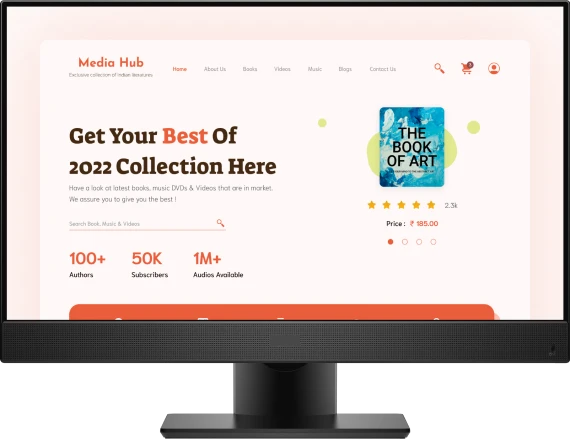
This case study covers Media Hub, a digital literature and entertainment web app SolGuruz designed and built for iMusti Inc., a digital media distribution company. The platform unifies books, audiobooks, video content, and music streaming under one user experience with personalised recommendations, multi-language support, content partnerships, and a content management system for editorial curation.
Project Snapshot
Project
Media Hub, Digital Literature and Entertainment Web App with books, audiobooks, video streaming, music, personalised recommendations, content partnerships, and CMS panel
Industry
Digital Literature & Entertainment / Media Streaming / B2C
Client
iMusti Inc. - digital media distribution company specialising in books, audiobooks, and digital content
Platform
Responsive Web App + CMS Panel + Backend
Project Timeline
6 months - covering discovery, UX/UI design, full-stack web development, CMS integration, security implementation, QA, launch
Core Tech
React + Next.js + Node.js + PostgreSQL + AWS + Figma + JavaScript + TypeScript
Content Types Supported
Books, audiobooks, video content, music streaming - unified cross-format catalog
Built By
SolGuruz - Full-Stack AI Product Engineering Company (Ahmedabad, India). ISO 27001:2022 + 9001:2015 certified
Project Overview
iMusti Inc. partnered with SolGuruz to build Media Hub, a digital media platform that combines books, audiobooks, video content, and music streaming into one web experience. The goal was to eliminate the need for users to switch between multiple apps and subscriptions for different content formats. The biggest challenge was managing cross-format content systems, including licensing, DRM, recommendations, and content discovery across books, audio, video, and music. SolGuruz built a scalable architecture using React, Next.js, and Node.js to support SEO-friendly content pages, fast browsing, and personalized recommendations. The project included UX/UI design, CMS integration, premium subscription flows, backend development, security implementation, and launch support. The platform was delivered over 6 months with ongoing maintenance and scalability planning.
What Is a Media Hub Web App?
A media hub web app is a unified digital platform that brings multiple content formats, such as books, audiobooks, video streaming, music, and podcasts, under one user experience with shared content discovery, personalised recommendations, and a single account or subscription. Unlike single-format streaming apps (Audible for audiobooks, Netflix for video, Spotify for music), a media hub web app treats cross-format content as first-class citizens; buyers can browse books, audiobooks, and video about the same topic in the same session without switching apps.
The category is divided into four primary models:
Single-brand media hubs
Brand-owned platforms representing a digital media distributor with a curated cross-format catalog
Library media hubs
Institutional platforms for libraries and educational institutions providing free access to books, audiobooks, and video content (Hoopla, Libby)
Subscription media hubs
Paid-subscription cross-format platforms with rotating catalog access (Scribd / Everand for books + audiobooks + magazines)
Marketplace media hubs
Multi-publisher platforms aggregating content from multiple distributors (Kobo, Smashwords, BookBub for books)
iMusti Media Hub is a single-brand media hub web app, unified platform representing iMusti's digital media distribution catalog with books, audiobooks, video, and music under one account.
How Does a Media Hub Web App Work?
A media hub web app flows from content ingestion to user consumption across six stages:
Content Ingestion & Catalog Management
Publishers, audiobook narrators, video creators, and music labels upload content through a CMS panel with metadata capture (title, creator, genre, language, release date, content type, rights agreement). Cover art and rights documentation attach to each upload. Editorial teams curate playlists, reading lists, and watch lists for cross-format discovery.
Content Discovery & Browse
Users land on the homepage and browse curated collections (best books of the month, trending audiobooks, new releases) or search the full catalog using filters, content type (book / audiobook / video / music), genre, language, release year, format (ebook / hardcover / streaming / download). Each content piece surfaces high-resolution cover art, creator details, length / runtime, language, and price or subscription tier.
Personalised Recommendations Engine
Recommendation engine surfaces cross-format suggestions based on user behaviour: "because you read X book, try this audiobook by the same author", "because you watched X documentary, try this related book". Cross-format recommendations are the structural advantage of media hubs over single-format platforms. Engine uses collaborative filtering plus content-based filtering across format boundaries.
Content Consumption & Streaming
Users consume content through format-specific players: ebook reader (with annotation, highlight, bookmark, font size, dark mode), audiobook player (with playback speed control, sleep timer, chapter navigation), video player (with quality selection, subtitle support, picture-in-picture), music player (with playlist support, queue management, lyrics display). Cross-device sync resumes content where the user left off across web, tablet, and mobile.
User Account & Library Management
Users create accounts to build personal libraries saved books, downloaded audiobooks, watched video history, music playlists. Account features support cross-format favouriting, reading goals, watch lists, and social sharing of content recommendations. Account types may include free-tier (limited catalog access) and premium (full catalog, offline downloads, ad-free).
Payment Processing & Royalty Distribution
Premium subscriptions and individual content purchases route through PCI-DSS compliant payment gateway. Per-consumption logging tracks book reads, audiobook listens, video views, and music plays for royalty distribution to publishers, audiobook narrators, video creators, and music labels. Audit-ready royalty reports flow to rights holders monthly.
Why Did iMusti Need a Custom Media Hub Web App?
iMusti identified four operational gaps that off-the-shelf single-format platforms couldn't solve:
Cross-Format Content Distribution Under One Brand
iMusti distributes books, audiobooks, video content, and music, four content types that commodity platforms force into separate apps. Building a unified media hub under the iMusti brand let the company own the customer relationship across all four formats rather than splitting the audience across Audible (for audiobooks), Kindle (for books), YouTube (for video), and Spotify (for music). Brand-owned multi-format distribution is the core business case.
Cross-Format Recommendation Engineering
Single-format platforms cannot recommend across format boundaries. Audible can't recommend the print version of the audiobook, Kindle can't recommend the audiobook, Netflix can't recommend the book the documentary was based on. A unified media hub with shared metadata structures across formats lets the recommendation engine surface "because you read X, try this audiobook" suggestions that materially increase content consumption per user.
Editorial Curation Across Content Types
Editorial teams at media distributors curate themes that cut across formats, "Summer reading best books, audiobooks, and documentaries", "Author spotlight, books, video interviews, and audiobooks." Single-format platforms can't support this editorial pattern because they only carry one format. A unified media hub with editorial CMS surfaces curated multi-format collections that drive content discovery.
Multi-Language Support for International Audiences
Digital media distribution increasingly serves multi-language international audiences. Single-format platforms typically default to English-first or single-language curation, undersurfacing regional-language content. A custom media hub with multi-language UI, multi-language content catalog, and multi-language editorial curation serves international audiences with the cultural depth that global platforms systematically under-serve.
What Solutions Did SolGuruz Deliver?
SolGuruz delivered Media Hub as a complete engagement covering design, build, CMS integration, payment processing, and launch. The solution had five core components:
Cross-Format Catalog Architecture
Unified content database supporting books, audiobooks, video, and music with shared metadata structures (title, creator, genre, language, release date) plus format-specific metadata (book page count, audiobook runtime, video resolution, music bitrate). Cross-format relationships modeled as graph edges (book ↔ audiobook ↔ movie adaptation) to power cross-format recommendations. PostgreSQL relational integrity for rights and royalty data plus document store for flexible metadata.
React + Next.js Web App
Server-side rendered React application using Next.js for SEO-friendly content discovery pages, fast page-load performance on the homepage and category pages, and route-based code splitting for performance. Dynamic content rendering for the catalog browse, search results, and personalised recommendation surfaces. Responsive design covering desktop, tablet, and mobile web.
Node.js Backend & Recommendation Engine
Node.js API layer handling authentication, catalog search, cross-format recommendations, content metadata management, royalty tracking, and notification fan-out. Event-driven model handles real-time recommendation updates as users interact with content. Recommendation engine combines collaborative filtering (users who consumed X also consumed Y) with content-based filtering (similar genre, similar author, similar language).
CMS Panel for iMusti Editorial Team
Web-based CMS for the iMusti editorial team to ingest publisher and creator catalogs, manage content metadata (title, creator, genre, language, release date, format), attach cover art and rights agreements, curate cross-format editorial collections ("Summer reading", "Author spotlight"), schedule content releases, and handle takedown requests. Role-based access for editorial leads, content ingestion teams, and rights management.
Payment Infrastructure & Security
Payment gateway integration for premium subscription tier and individual content purchases with PCI-DSS compliance. AWS hosting with HTTPS / TLS 1.3 for all data in transit, automated backup with point-in-time recovery, and DDoS protection. Firebase Authentication for user accounts and real-time content sync across devices.
From content architecture to licensing workflows and CMS, SolGuruz builds scalable media platforms for modern content businesses. Get a clear technical roadmap, timeline, and team plan based on your requirements.


SolGuruz Media Hub Development Process - From Discovery to Launch
Media Hub was delivered using SolGuruz 10-stage development lifecycle, scaled for cross-format content architecture and editorial CMS depth.
Stage 01
Discovery & Content Licensing Analysis
Stakeholder interviews to understand iMusti's content distribution business, publisher and creator relationships, target audiences, and digital transformation goals. Content licensing analysis covering book publishing rights, audiobook narrator agreements, video creator agreements, and music label partnerships. Competitor teardowns across single-format leaders (Audible, Kindle, Netflix, Spotify) and multi-format platforms (Scribd, Hoopla, Everand). Deliverable: discovery document, content licensing matrix, prioritised feature list.
Stage 02
Requirement Analysis & Documentation
User stories and acceptance criteria for every workflow across consumer, editorial, and rights management roles. Cross-format content discovery user flows, personalised recommendation flows, content consumption flows for each format type. Data flow diagrams for content ingestion, catalog search, recommendation engine, and royalty distribution.
Stage 03
UX/UI Design
Information architecture, wireframes, interactive prototypes, and full design system in Figma. Designed against three primary personas: the cross-format consumer (reads books, listens to audiobooks, watches video, plays music), the discovery-first browser (explores curated collections, follows editorial recommendations), and the library-builder (saves favourites, builds reading lists). Visual design system with cross-format consistency, the same content card pattern works for books, audiobooks, video, and music with format-specific accent treatments.
Stage 04
Architecture & Cross-Format Database Design
System design covering React + Next.js component architecture, Node.js backend service decomposition, recommendation engine architecture, and cross-format database schema. Database design with shared content metadata plus format-specific extensions, relational integrity for rights and royalty data, and graph edges for cross-format relationships. CDN architecture for content delivery.
Stage 05
Frontend Development (React + Next.js)
React + Next.js build for the consumer-facing web app. Server-side rendering for SEO-critical pages (content detail pages, category pages, search results). Component library covering catalog browse, content cards (cross-format), content detail views (format-specific players for ebook reader, audiobook player, video player, music player), search interface, recommendation surfaces, and account management. Responsive design across desktop, tablet, and mobile web.
Stage 06
Backend & Recommendation Engine Development
Node.js API layer handling authentication, catalog search, cross-format recommendations, content metadata management, royalty tracking, and notification orchestration. PostgreSQL for relational integrity. Recommendation engine combining collaborative filtering and content-based filtering with cross-format awareness. Firebase for real-time content sync across devices.
Stage 07
CMS Integration & Editorial Workflows
CMS configuration for the iMusti editorial team. Content ingestion workflows for bulk catalog upload from publishers and creators. Editorial curation tools for cross-format collections. Rights agreement capture per content piece. Release scheduling for coordinated launches. Takedown request handling with audit trail.
Stage 08
Quality Assurance & Cross-Browser Testing
Functional testing across desktop browsers (Chrome, Safari, Firefox, Edge), tablet, and mobile web (iOS Safari, Chrome Android). End-to-end testing of catalog browse, content discovery, format-specific consumption (ebook reader, audiobook player, video player, music player), payment, and CMS publishing flows. Performance testing for page-load speed and content streaming reliability.
Stage 09
Launch & SEO Foundation
Production deployment with AWS hosting, CDN configuration, SSL certificate setup, and search console submission. SEO foundation includes structured data, meta tags, Open Graph tags, sitemap, and robots.txt. Initial Google Search Console and Google Analytics 4 configuration for performance tracking.
Stage 10
Post-Launch Support & Iteration
2-week sprint cadence for performance fixes, UI refinements, and feature additions based on iMusti team feedback and consumer behaviour. Critical bugs are fixed within 24 hours, high-priority within 72 hours. Quarterly performance reviews covering organic traffic, recommendation engine performance, content consumption per user, and subscription conversion.
Key Features Built for Media Hub
Cross-Format Content Catalog
Unified catalog of books, audiobooks, video content, and music under one searchable interface. Format filters let users narrow to a specific content type or browse cross-format. Each content card shows format-specific metadata (book page count, audiobook runtime, video resolution, music bitrate) alongside shared metadata (title, creator, genre, language, release date).
Personalised Cross-Format Recommendations
Recommendation engine surfaces cross-format suggestions based on user behaviour and content metadata. Algorithm combines collaborative filtering (users who consumed X also consumed Y) with content-based filtering (similar genre, similar creator, similar language). Cross-format relationships (book ↔ audiobook ↔ movie adaptation) power "because you read X, try this audiobook" suggestions.
Editorial Curation & Collections
Editorial team curates cross-format collections (Summer Reading, Author Spotlight, Trending This Week, New Releases by Category) that surface on the homepage and category pages. Editorial collections are the primary content discovery surface for users who don't arrive with a specific search intent.
Format-Specific Content Players
Ebook reader with annotation, highlight, bookmark, font size, dark mode, and reading progress sync. Audiobook player with playback speed control, sleep timer, and chapter navigation. Video player with quality selection, subtitle support, and picture-in-picture. Music player with playlist support and queue management.
Multi-Language Support
Multi-language UI for international audiences. Multi-language content catalog with language filters and language-specific editorial curation. Internationalisation across the entire user experience-navigation, search, content discovery, and account settings.
User Library & Favourites
Personal library with saved books, downloaded audiobooks, watched video history, and music playlists. Cross-format favouriting lets users save "all content by author X" across books, audiobooks, and video. Reading goals, watch lists, and listening history support consumption tracking.
Search & Discovery
Full-text search across content titles, creators, genres, and metadata. Search supports cross-format queries and filters by content type, language, release year, and format. Typo tolerance for content title and creator name searches.
CMS Panel for Editorial Team
Web-based CMS for the iMusti editorial team to ingest content from publishers and creators, manage metadata, attach cover art and rights agreements, curate editorial collections, schedule releases, and handle takedown requests. Role-based access for editorial leads, content ingestion, and rights management.
Security & Compliance Implemented
Media hub web apps processing user accounts, payment data, and content licensing have meaningful security obligations. SolGuruz implemented multi-layered security covering network, data, cloud, application, and endpoint layers.
Data Encryption
All user data is encrypted in transit using HTTPS with TLS 1.3 and at rest using AES-256 full-disk encryption. Content metadata and rights documentation encrypted in storage.
OAuth 2.0 Authentication
OAuth 2.0 governs authentication flows across consumer, editorial, and rights management roles. Scope-based permissions prevent a consumer token from accessing editorial data.
AWS Firewall Rules
Configured firewalls on AWS instances and databases with allow-listed services. Inbound access restricted to essential ports. Admin endpoints require multi-factor authentication and IP allowlisting.
Source Code Obfuscation
Frontend JavaScript minified and obfuscated for production builds to make production code harder to reverse-engineer. Sensitive keys (API secrets, payment credentials) stored in AWS Secrets Manager, never bundled in client code.
Automated Backup & Rollback
Cloud instances take scheduled backups every 4 hours with automated rollback capability for safe deployment recovery. Content catalog and rights data replicated across availability zones.
GDPR Compliance
EU user data flows comply with GDPR right-to-erasure for user library, consent capture for personalisation, data portability export, lawful basis documentation.
PCI-DSS for Payments
Tokenized payment card storage-platform never stores raw PAN data. Payment processing through PCI-DSS Level 1 compliant gateway.
Competitive Analysis
The 2026 digital media platform market is led by single-format specialists with massive scale and a smaller cohort of cross-format media hubs serving consumers who want unified access. Here is a high-level snapshot of the market research and competitor analysis we conducted during the project discovery phase, aimed at identifying opportunities, gaps, and strategic differentiators.
Platform
Core Strength
Market Position
Gap or Limitation

Core Strength
Massive Scale & Ecosystem Lock-In
Largest audiobook catalog globally; original audiobook content; Amazon ecosystem integration
Market Position
Established Market Monopoly
Audiobook category leader. Owned by Amazon since 2008.
Gap or Limitation
No Cross-Format Capabilities
Single-format only-no books, video, or music. Limited cross-format discovery.

Core Strength
Seamless Cross-Device Reading
Largest ebook catalog; cross-device reading sync; Kindle Unlimited subscription tier
Market Position
Ebook Market Dominance
Ebook category leader. Owned by Amazon.
Gap or Limitation
Siloed Content Format
Books-only (with Audible add-on); no integrated video or music.

Core Strength
Unified Multi-Format Access
Cross-format subscription covering books + audiobooks + magazines + sheet music
Market Position
Proven Multi-Format Model
Multi-format subscription leader. Renamed to Everand in 2024.
Gap or Limitation
Subscription-Only Economics
Limited video content. Subscription model only-no individual purchase tier.

Core Strength
Regional International Scale
Audiobook + ebook subscription with a strong international (Nordic, European) presence
Market Position
Strong European Foothold
European audiobook + ebook leader.
Gap or Limitation
Geographically Constrained
Limited US market presence. No video or music integration.

Core Strength
Institution-Driven Content Access
Library-affiliated cross-format platform-books + audiobooks + video + music + comics through public library cards
Market Position
Institutional Partnership Moat
Library partnership leader in North America.
Gap or Limitation
Consumer Reach Limited by Gatekeeping
Library-card dependency limits direct consumer reach. Borrow-not-own model with hold queues.
Project Outcome
Media Hub was delivered as a complete engagement covering design, build, CMS integration, payment processing, and launch. Outcomes:
Web app delivered in 6 months across UX/UI design, full-stack development, CMS integration, security implementation, and QA
React + Next.js + Node.js + Firebase + AWS foundation deployed with full CMS panel for iMusti editorial team
Cross-format catalog operational with books, audiobooks, video, and music under unified user experience
Personalised cross-format recommendation engine live
Editorial curation tools live for cross-format collections
Multi-language support implemented for international audiences
Substantial user base reached within first year of launch
Multi-layered security implemented (HTTPS / TLS 1.3, OAuth 2.0, AWS firewalls, code obfuscation, automated backup, GDPR + PCI-DSS, ISO 27001:2022 + 9001:2015)
What Our Client Has To Say
A verified Clutch review from Samir Khandwala, CEO of iMusti, Inc., after we launched the Media Hub web app across a six-month engagement covering cross-format catalog architecture, frontend and backend development, and CMS integration.
Custom Software Dev for Digital Media Distribution Company
SolGuruz delivered the project in a timely manner that met the client's expectations. The service provider ensured excellent communication via email and virtual meetings. Their accommodating and empathetic approach was impeccable.

Summarized from Samir Khandwala's Clutch review
Samir Khandwala, CEO, iMusti, Inc.
 Fremont, California, United States
Frequently Asked Questions
Quick answers to the questions our clients and prospects ask most. If yours is not here, our team is one click away.
Need advice tailored to your project?
FAQs cover the common ground. For decisions specific to your tech stack, timeline, and team, talk directly to a senior engineer who has shipped what you are planning.
A media hub web app combines books, audiobooks, videos, music, and other digital content into one platform. Users can access multiple content formats through a single account and unified experience.
You need a scalable content catalog, recommendation system, CMS, payment integration, and streaming infrastructure. SolGuruz helps businesses design and build custom streaming platforms end-to-end.
A basic media platform with content upload, playback, and user accounts typically costs $15,000-$40,000. Advanced cross-format streaming platforms with CMS, subscription billing, recommendation engine, and multi-device support typically range from $60,000-$150,000+. Final cost depends on content formats supported, DRM and licensing requirements, third-party integrations, and AI-powered features like personalization or content tagging.
A focused MVP with core playback, content upload, and user accounts typically ships in 6-10 weeks. A production-ready multi-format media hub with streaming, CMS, subscription billing, and recommendation engine typically takes 14-20 weeks. Timeline depends on the number of content formats, third-party integrations, DRM requirements, and whether AI-powered features like personalization or content tagging are included.
Core features include content streaming, search, recommendations, user profiles, subscriptions, CMS, and multi-language support. Advanced platforms may also include DRM and offline access.
React and Next.js provide fast performance, SEO-friendly pages, scalable UI architecture, and smooth content browsing experiences for media-heavy platforms.
These platforms track licensing agreements, geo-restrictions, royalties, and usage analytics across different content types like books, music, and videos.
Yes. Media hubs can support multi-language UI, content filtering, localized recommendations, and region-specific content discovery for global audiences.
Yes. Platforms handling payments and user data often require GDPR, PCI-DSS, and regional privacy compliance depending on audience location and payment workflows.
Yes. SolGuruz develops custom streaming and media hub platforms with scalable architecture, CMS workflows, subscriptions, and cross-format content experiences.
SolGuruz designs high-performance media systems built for 10M+ user interactions, seamless streaming, and global content delivery with a clear architecture and execution roadmap.
Related Projects
More Projects We Have Delivered
SolGuruz has shipped 102+ products across 14 industries. See other media and content apps our team has built - language translation tools, music and podcast platforms, and storytelling apps that reflect the same streaming, content management, and audience engagement thinking we brought to this media hub.
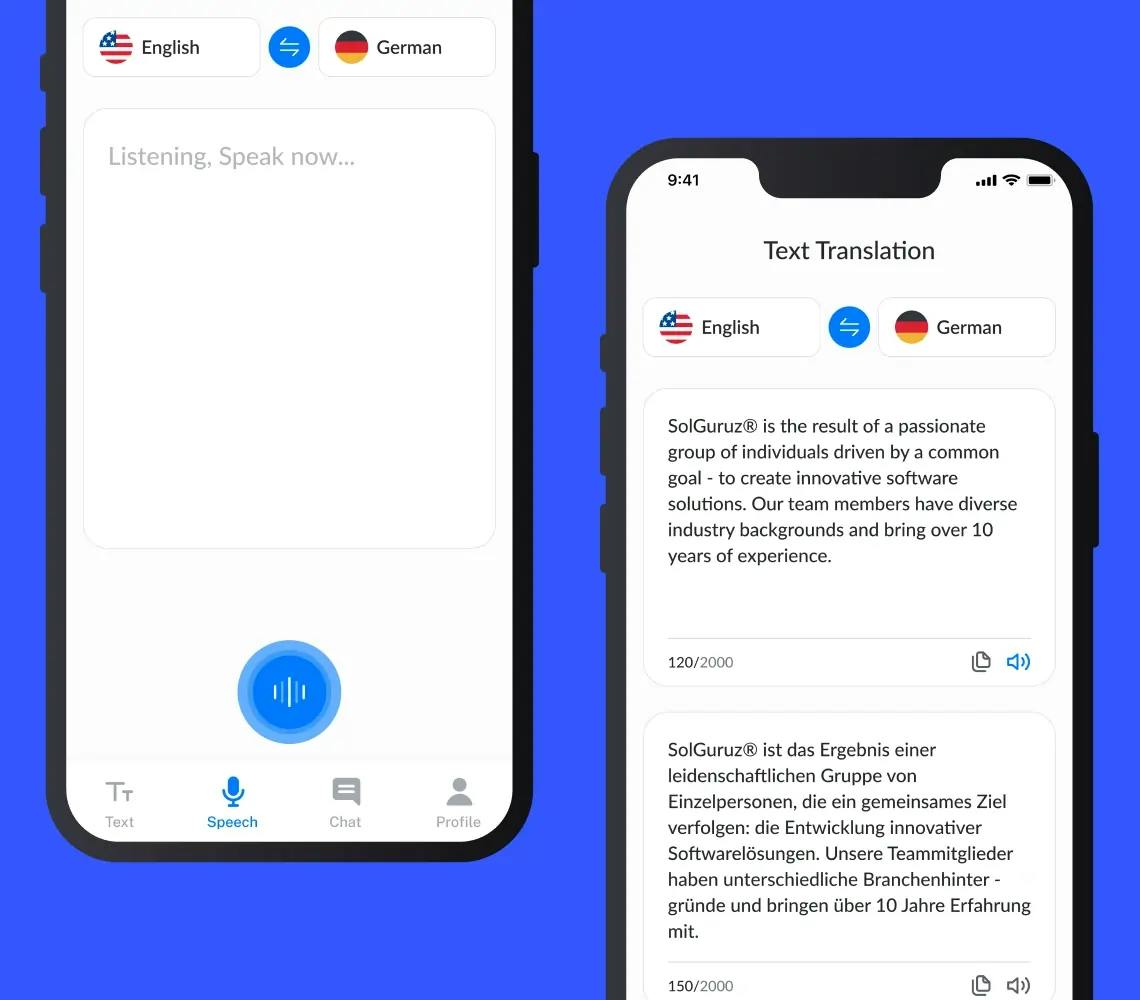
AI-Powered Language Translator App
We built a highly intuitive AI and machine learning powered app that helps facilitate the translation of text or speech from one language to another.
Key Outcomes
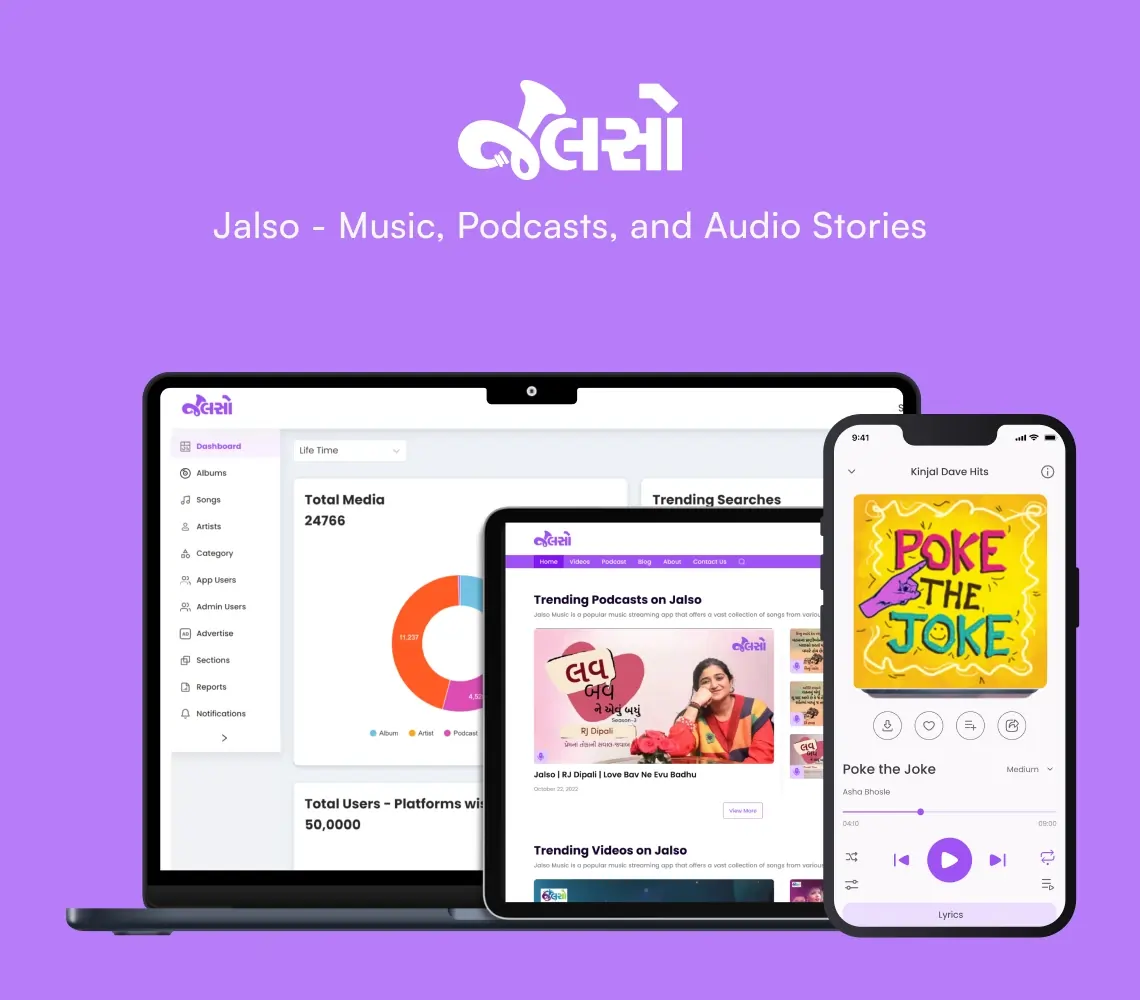
Music, Podcasts, and Audio Stories App
Jalso was designed as an overall audio streaming app offering online music streaming, Podcast streaming, video streaming, and audiobook streaming. From celebrities to common users, everyone loved the application and found it user-friendly and helpful for enhancing the importance of Gujarati music.
Key Outcomes

AI Journaling App Development Solution
Discover with us how we built Dream Story, an AI-powered journaling application that helps manage daily notes by capturing your thoughts and emotions. A one-stop solution for those who love noting down daily summaries!
Key Outcomes
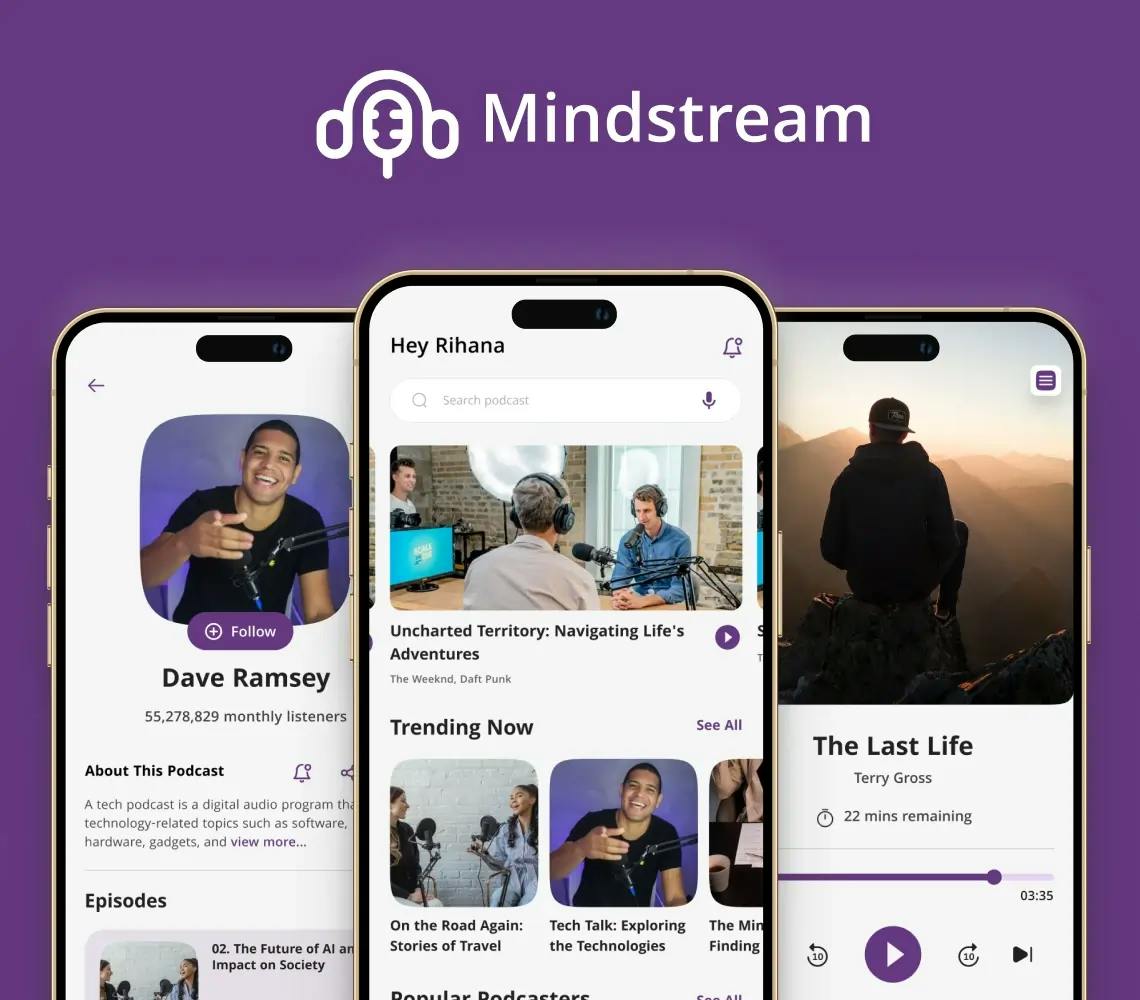
Podcast App Development
Dive into our podcast app case study. Witness SolGuruz’s mastery in crafting dynamic solutions for podcast listening that just works.
Key Outcomes