



What are Neural Networks?
Neural networks are layered models that learn by adjusting the connections between their nodes rather than by following rules someone wrote. This topic covers how they work, the eight main types including CNNs, RNNs, LSTMs, transformers and GANs, and how to choose an architecture for the shape of your data.

Summarise with AI
Short on time? Let AI do the work. Get the key points.


A neural network is the basic building block of any artificial or generative AI model. Layers of connected neurons make up neural networks, and these networks learn by varying the weights of the connections among the neurons. To put it simply, it is computer systems mimicking the human brain.
Why Neural Networks?
The design borrows loosely from biology. In the brain, neurons pass signals to one another, and connections that fire together strengthen over time. Artificial neural networks copy that one idea and nothing else: simple units, connected in layers, with the strength of each connection adjusted as the network learns.
In practice, wherever there is AI, there is a neural network underneath it.
Working of Neural Network
An array of nodes makes up a neural network. There are at least three layers in which the nodes are dispersed.
There are three layers:
- Input Layer
- Hidden Layer
- Output Layer
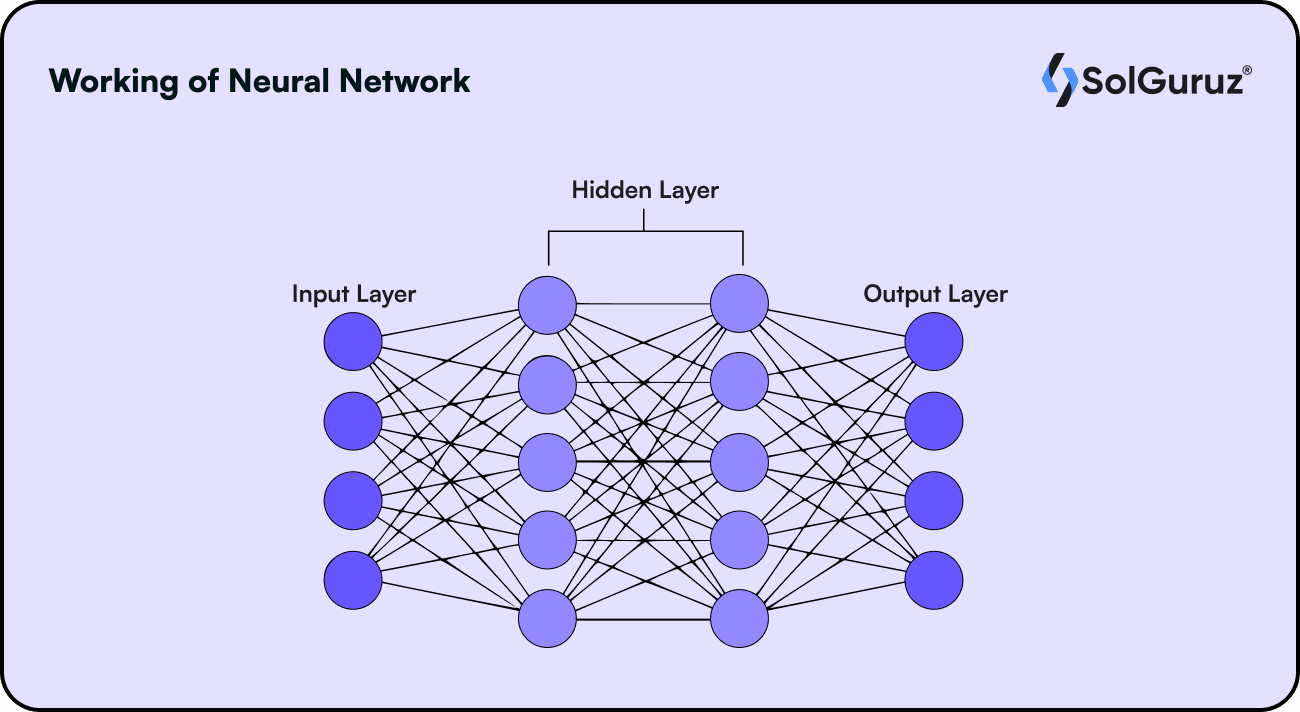
These three layers are the bare minimum. A neural network can have multiple hidden layers in addition to the input and output layers.
Each node, regardless of the layer it belongs to, processes the input it receives from the preceding node (or from the input layer) in some way. In essence, every node has a mathematical formula with distinct weights assigned to each of its variables.
The node moves data to the next if the result of using that mathematical formula on the input is greater than a predetermined threshold. If the output is below the threshold, then no data will be transmitted to the next layer.
Types of Neural Networks
Neural networks are classified two ways. The first is by depth: a network with a single hidden layer is shallow, and one with more than one hidden layer is deep. The second is by architecture, which is the distinction that drives design decisions, and it is what the eight types below describe.
1. Artificial Neural Networks (ANNs)
ANNs are neural networks with several hidden layers. Standard artificial neural networks are composed of multiple interconnected processing nodes, or neurons, that exchange information with one another via synapses. Each neuron, or node, in a typical neural network takes input from a number of other neurons and generates an output that is then transmitted to other neurons in the network.
2. Convolutional Neural Networks (CNNs)
CNNs are a particular kind of neural network that work well for tasks involving the classification of images. CNNs operate by applying a number of filters to an image that is intended to identify one or more particular characteristics.
3. Recurrent Neural Networks (RNNs)
RNNs are a type of deep neural network that can perform sequential processing on data by storing and forwarding information from earlier calculations. The fresh input and the output from the previous timestep are both used as input for the current timestep.
4. Long Short-Term Memory (LSTM)
An LSTM is a type of deep neural network that has the capacity to store data for extended periods of time. As a result, it can gain knowledge from encounters spanning numerous time steps. An artificial neural network type called LSTM is utilized to analyze sequential data.
5. Multi-Layer Perceptrons (MLPs)
Perceptrons are stacked in linked layers to form a multi-layered perceptron (MLP). The input layer gathers patterns entered. The output layer may use input patterns to map to output signals or classifications.
6. Feed-Forward Neural Networks
One of the more basic varieties of neural networks is feed-forward neural networks. Through the input nodes, information is transmitted in a single path, where it is processed until it reaches the output mode. The most common application for feed-forward neural networks is in facial recognition technology. These networks may contain hidden layers for functionality.
7. Transformers
Transformers process a whole sequence at once rather than one step at a time, using attention to weigh which parts of the input matter for each output. That change is what made modern language models practical, and it is the architecture behind every large language model in use today. They have largely displaced RNNs and LSTMs for text.
8. Generative Adversarial Networks (GANs)
A GAN pairs two networks against each other: a generator that produces candidate data and a discriminator that tries to tell real from generated. Training them in competition pushes the generator toward output that is hard to distinguish from the real thing. Generative adversarial networks are used for image synthesis and for producing synthetic training data.
Comparing the Main Types
Most of the design decision is choosing the right architecture for the shape of your data.
| Type | Suits | How it works, briefly | Typical use |
| Feed-forward / MLP | Structured, tabular data | Information moves in one direction, input to output | Classification, scoring, prediction |
| CNN | Images and spatial data | Filters slide across the input to detect local features | Image classification, detection, medical imaging |
| RNN | Sequences | Carries state forward from one step to the next | Time series, early speech and text work |
| LSTM | Long sequences | An RNN with gates that decide what to keep and what to forget | Forecasting, speech, longer-range sequences |
| Transformer | Text, and increasingly everything | Attention over the whole sequence at once | Language models, translation, multimodal systems |
| GAN | Generating realistic data | Two networks trained in competition | Image synthesis, synthetic training data |
ANN vs CNN vs RNN
The three get compared constantly, and the distinction is simply what shape of data each is built for. A plain ANN treats every input independently, which suits tabular data. A CNN assumes nearby values are related, which is why it suits images. An RNN assumes order matters, which is why it suits sequences. Choosing wrongly is expensive: an image problem handed to a plain ANN will train, and will underperform a CNN badly.
Use Cases of Neural Networks
One of the most known uses is generative AI. Generative AI models implement neural networks as their base models. Other applications include:
1. Image Classification
Real world image classification like classifying images with humans, or objects. The various applications may include X-Ray, CT-scan, MRI, image tagging or surveillance.
2. Weather Prediction
Using RNNs to predict the weather. A time-series based data is used so CNNs or RNNs can be used.
3. Speech Recognition
Deep learning models like neural networks are used in speech recognition. The input data can be audio or video, and the output can be a text transcript.
4. Face Recognition
Deep-learning neural networks have become a viable option for face recognition. When compared to previous machine learning algorithms and methodologies, deep neural network models have significantly improved accuracy levels and provide a workable solution for the picture categorization problem.
5. Self-Driving Cars
To create a variety of models that can be utilized for autonomous driving, a custom neural network architecture made up of CNN, ANN, etc., would be needed.
Wrapping up
From having an idea of "a thinking machine" to "generative AI" and AI that makes decisions and recognises patterns. With so much progress made, the future of neural networks is bright. With more advancements and newer innovations, the application of neural networks will become more apt and widespread.
FAQs
1. What is the difference between a neural network and deep learning?
A neural network is a layered system that processes data. Deep learning uses multi-layer neural networks to solve complex tasks like image recognition, speech processing, and generative AI.
2. Why are neural networks important in generative AI?
They help models learn patterns from large datasets and generate new outputs, powering LLMs, image generation tools, and AI copilots.
3. Which industries use neural networks the most in 2026?
Healthcare, finance, retail, manufacturing, automotive, and media use them for fraud detection, diagnostics, recommendations, automation, and predictive systems.
4. How are CNN and RNN different in neural networks?
CNNs are used for image tasks like classification and detection. RNNs handle sequential data such as speech, text, and time-series forecasting.
5. Can neural networks work without large amounts of data?
Yes, but performance is better with large, high-quality datasets. Smaller datasets can reduce accuracy and increase overfitting risk.
Looking for an AI Development Partner?
SolGuruz helps you build reliable, production-ready AI solutions - from LLM apps and AI agents to end-to-end AI product development.

Strict NDA

Trusted by Startups & Enterprises Worldwide

Flexible Engagement Models

1 Week Risk-Free Trial
Next-Gen AI Development Services
As a leading AI development agency, we build intelligent, scalable solutions - from LLM apps to AI agents and automation workflows. Our AI development services help modern businesses upgrade their products, streamline operations, and launch powerful AI-driven experiences faster.


Why SolGuruz Is the #1 AI Development Company?
Most teams can build AI features. We build AI that moves your business forward.
As a trusted AI development agency, we don’t just offer AI software development services. We combine strategy, engineering, and product thinking to deliver solutions that are practical, scalable, and aligned with real business outcomes - not just hype.
Why Global Brands Choose SolGuruz as Their AI Development Company:

Business - First Approach
We always begin by understanding what you're really trying to achieve, like automating any mundane task, improving decision-making processes, or personalizing user experiences. Whatever it is, we will make sure to build an AI solution that strictly meets your business goals and not just any latest technology.
Custom AI Development (No Templates, No Generic Models)
Every business is unique, and so is its workflow, data, and challenges. That's why we don't believe in using templates or ready-made models. Instead, what we do is design your AI solution from scratch, specifically for your needs, so that you get exactly what works for your business.
Fast Delivery With Proven Engineering Processes
We know your time matters. That's why we follow a solid, well-tested delivery process. Our developers follow AI-Assisted Software Development principles to move fast and stay flexible to make changes. Moreover, we always keep you posted at every step of the AI software development process.
Senior AI Engineers & Product Experts
When you work with us, you're teaming up with experienced AI engineers, data scientists, and designers who've delivered real results across industries. And they are not just technically strong but actually know how to turn complex ideas into working products that are clean, efficient, and user-friendly.
Transparent, Reliable, and Easy Collaboration
From day one, we keep clear expectations on timelines, take feedback positively, and share regular check-ins. So that you'll always know how we are progressing and how it's going.
From Our Portfolio
AI Projects We Have Shipped to Production
SolGuruz has shipped 102+ products across 14 industries. See how SolGuruz built production AI applications - LLM-powered clinical documentation, AI travel planning, healthcare staffing intelligence, and AI journaling - using GPT-4, Claude, and custom ML models at real-world scale.

AI Clinical Notes Platform That Turns 2-Hour Documentation Into One Click
NoteCliniq transforms clinical conversations into HIPAA-compliant SOAP notes in seconds, eliminating 2+ hours of manual documentation daily for busy clinicians.
Key Outcomes

AI-Powered Trip Planner App Solution
Explore how SolGuruz created an AI-powered trip planner app. It is an exclusive AI vacation planner that helps with finding hotels, cabs, places, and complete itineraries.
Key Outcomes
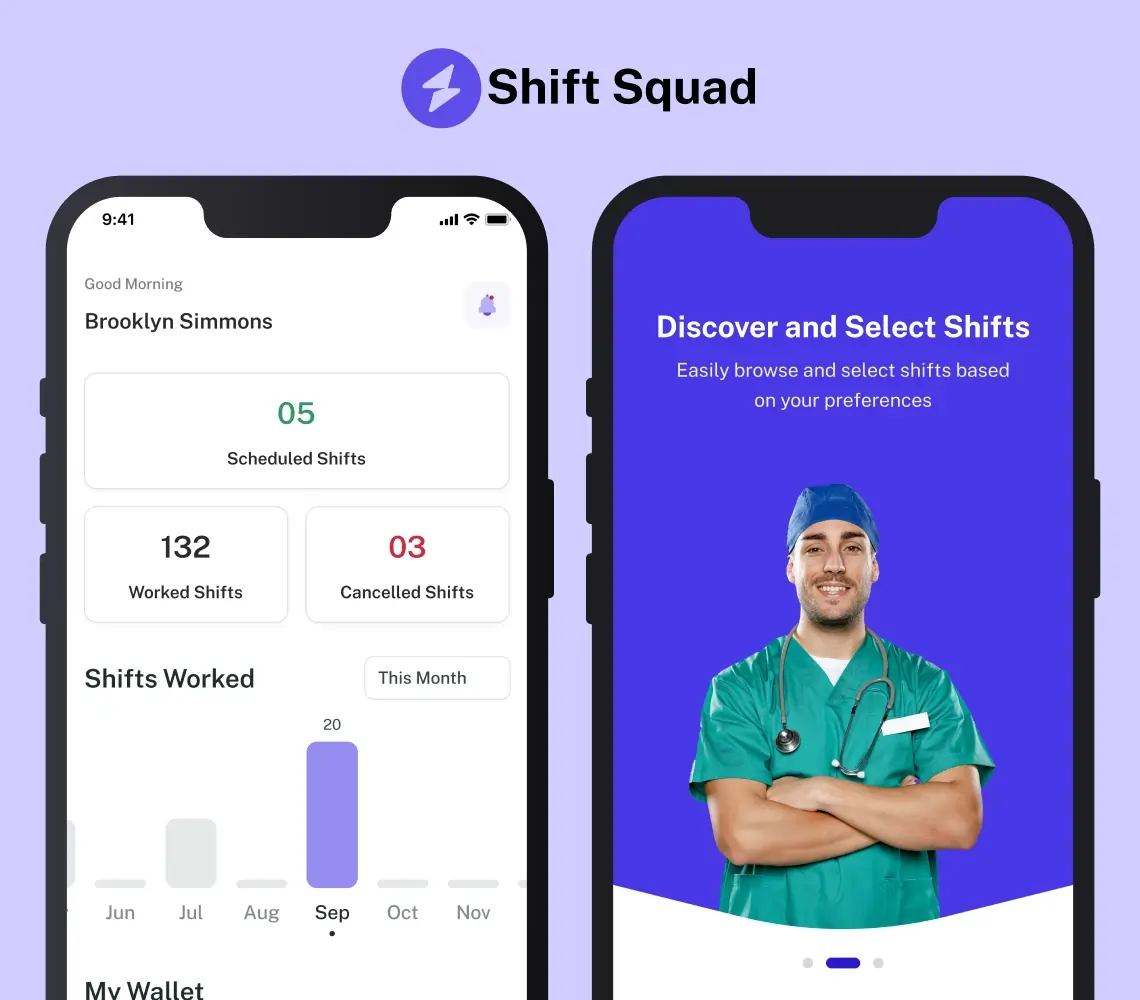
AI-Powered Healthcare Staffing App Solution
Explore our AI-powered healthcare staffing app case study. See how SolGuruz's expertise turns nurse staffing challenges into a system that holds up on a live rota.
Key Outcomes

AI Journaling App Development Solution
Discover with us how we built Dream Story, an AI-powered journaling application that helps manage daily notes by capturing your thoughts and emotions. A one-stop solution for those who love noting down daily summaries!
Key Outcomes
Whether you’re modernizing a legacy system or launching a new AI-powered product, our AI engineers and product team help you design, develop, and deploy solutions that deliver real business value.

