
Buy Now Pay Later App Development: How to Build a BNPL App
How to build a Buy Now Pay Later app: how BNPL works, the two build paths, features, architecture, cost, and compliance (Reg Z, KYC/AML, PCI-DSS).


Summarise with AI
Short on time? Let AI do the work. Get the key points.


Buy Now Pay Later app development means building the software behind a simple promise: buy now, pay in installments.
The app lets a shopper split a purchase into scheduled payments. It approves them in real time. It pays the merchant in full. Then it collects the repayments.
So a BNPL app is really three products in one. It is part payments app, part short-term lender, and part compliance product.
This guide for BNPL app development covers how a BNPL app actually works, the two ways to build one, what it costs, the compliance you cannot skip, and the step-by-step build process. It is drawn from delivering a production BNPL app end to end.
The rise of BNPL has moved it from a checkout novelty to a mainstream payment method. That demand is why so many teams are now planning a BNPL build.
| Key takeaways |
|
What a BNPL app is, and how the money actually moves
A Buy Now Pay Later app lets a user split a retail purchase or a bill into scheduled installments. Plans are commonly 3 to 6 payments spread across 6 weeks to 12 months.
The BNPL app sits between the shopper and the merchant as a short-term credit layer. It handles four jobs: credit decisioning, payment scheduling, merchant settlement, and repayment collection.
Here is the BNPL process flow end to end, because the money movement is the part most guides skip.
- The shopper picks BNPL at checkout and is scored for approval in real time, usually in seconds.
- On approval, the merchant is paid in full immediately by the BNPL provider. The merchant carries no repayment risk.
- The shopper receives an installment schedule. This is commonly 4 equal payments over 6 weeks (Pay-in-4), or monthly installments for larger baskets.
- The app auto-debits each installment from a linked card or bank account on the scheduled dates, with retry logic and late-fee handling for failed payments.
- Repayment behavior is logged for internal scoring and, where applicable, reported to credit bureaus.
That is the whole product in five steps. It is why a BNPL app is closer to a lending platform than to a wallet.
It is also how BNPL differs from a credit card. A credit card is revolving credit from a bank. A BNPL plan is a fixed, short-term installment agreement tied to a single purchase. The shopper does not fully own the goods until the plan is paid off.

Two ways to build BNPL: your own platform or a checkout integration
Before you scope anything, decide which of two products you are actually building. The effort is very different.
- Build your own BNPL platform. Here you are the credit provider. You own the shopper app, the credit-decisioning engine, merchant onboarding, settlement, and collections. You also carry the credit risk and the regulatory obligations. This is the path for a fintech launching a Klarna-style or Affirm-style product, and it is the larger build. It is the build our buy now pay later app development team does.
- Add BNPL into an existing store or checkout. Here you are a merchant or platform that wants to offer installment payments without becoming a lender. The build is an integration: you connect an existing BNPL provider or a white-label credit rail into your checkout, keep your own storefront, and let the provider carry the credit decisioning and risk. This answers a common merchant question, how do I offer BNPL options on my site, and it is the faster route to market.
Most of this guide covers the first path, building the platform, because that is where the real engineering lives. If you only need the integration, the sections on features, architecture, and the build process still apply at a smaller scale.
How BNPL apps make money
A BNPL app makes money in three main ways. The mix decides whether the business works, and getting the unit economics right matters more than any single feature.
- Merchant fees (the main engine). The merchant pays a discount fee on each BNPL sale, often called the merchant discount rate (MDR). It is usually higher than a standard card fee because the provider takes on the credit risk and pays the merchant upfront. Merchants accept it because BNPL lifts conversion and average order value, and reduces cart abandonment.
- Late fees and interest. Short Pay-in-4 plans are usually interest-free to the shopper, so revenue there leans on late fees where they are legally allowed. Longer installment plans for higher-ticket purchases can carry interest, which becomes a second revenue line. Both are tightly regulated.
- Interchange and ancillary revenue. Card-linked and virtual-card BNPL products can earn interchange. Mature platforms add revenue from merchant marketing placements, in-app offers, and data-driven services.
The point for anyone planning a build is simple. Model MDR, late fees, default rate, and cost of capital together before you write a line of code. A BNPL product with weak underwriting and thin margins does not survive its own default losses.
The credit and risk engine: the real core of a BNPL app
The credit and risk engine is what actually makes a BNPL app a BNPL app. It is also the piece most teams underestimate.
A polished shopper app with weak decisioning will lose money on defaults. Strong decisioning is the moat.
A production BNPL risk stack covers the full lifecycle:
- Real-time credit decisioning, to approve or decline in seconds at checkout.
- Spending limits assigned per user.
- Fraud detection at both application time and transaction time.
- Repayment monitoring, with retry logic and structured dunning for missed payments.
- Late fees where legal, and collections on defaults.
- Credit-bureau reporting where applicable, with every decision explainable for dispute handling.
You do not always build all of this from scratch.
Many teams integrate a third-party underwriting or credit-decisioning provider for the scoring model. Then they build the orchestration, limits, and lifecycle around it.
That build-versus-integrate call on the risk engine is one of the biggest scope and cost decisions in the whole project. It is worth making early, with people who have shipped a BNPL product before.
Compliance is the hard part of BNPL app development
Compliance is where BNPL projects get slow or get stopped. Treat it as an architecture input from day one, not a checklist at the end.
A BNPL app is regulated consumer credit. The obligations are real, and there are four you cannot skip:
- CFPB Regulation Z (US). BNPL lenders in the US must now provide consumer protections similar to credit cards, including dispute resolution and refund handling. Your product flows, not just your legal terms, have to support this.
- State money transmitter laws. Moving and settling funds across state lines can trigger money transmitter licensing requirements. These vary by state, and they shape your legal setup and sometimes your go-to-market sequencing.
- KYC and AML. Know Your Customer verification and Anti-Money-Laundering checks are mandatory. The user provides identity and eligibility information at signup, the app verifies it before granting credit, and ongoing monitoring flags suspicious activity. This usually means integrating specialist providers rather than building identity verification in-house.
- PCI-DSS. Any app touching payment card data must meet the Payment Card Industry Data Security Standard. On our own FlexiPe BNPL build we followed PCI-DSS Level 1 practices, the strictest tier, with a segmented cardholder-data environment. For most products the practical answer is to minimize what card data you ever touch by using a tokenizing payment gateway.
For a deeper technical treatment, see our answer on the PCI-DSS requirements for fintech apps, and the fintech secure product building playbook.
Must-have features of a BNPL app
The features that matter divide cleanly across three surfaces: the shopper app, the merchant console, and the risk and admin back office.
These are the features to consider when choosing a BNPL provider, or when planning your own BNPL app development.
Shopper app
- Fast, secure signup. Strong authentication with multi-factor and biometric options, and KYC verification built into onboarding.
- Real-time approval. An instant approve-or-decline decision at checkout, with a clear view of the plan, due dates, and remaining balance.
- Flexible repayment. Pay-in-4, monthly plans, and autopay from a linked card or bank account.
- Real-time notifications. Alerts for approvals, upcoming installments, and missed payments, to cut late payments.
- Purchase and repayment history. Clear, at-a-glance spending and repayment views the shopper can trust.
Merchant console
- Merchant onboarding and checkout SDK. Plugins for major storefronts and point-of-sale systems, so a merchant can add BNPL to an existing site.
- Settlement dashboard. A clear view of what was sold, what was paid out, and when.
- Reporting and analytics. Conversion, average order value, and repayment performance in one place.
Risk and admin back office
- Credit decisioning and limits engine. The scoring and limit-setting described above, with fraud checks at application and transaction time.
- Repayment lifecycle. Scheduling, auto-debit with retry logic, late-fee handling where legal, and collections.
- Reconciliation and reporting. Ledgering for finance and compliance, including credit-bureau reporting where applicable.
BNPL architecture and integrations
The BNPL architecture is a set of services around a ledger.
It includes a shopper app, a merchant and checkout layer, a credit-decisioning service, a payment and settlement service, and a repayment and collections service. All of these tie to an auditable transaction ledger, and they are exposed through a clean BNPL API so merchants can integrate.
A well-built BNPL API is what lets a merchant drop your installment option into their checkout in days rather than months.
The integrations that a BNPL platform depends on are consistent across the market:
- Payment gateways and processors (for example Stripe or a bank gateway) to move funds, and to tokenize card data so you minimize PCI scope.
- KYC and AML providers for identity verification and screening.
- Credit bureaus and scoring providers (for example Experian, TransUnion, Equifax) for decisioning inputs and, where applicable, repayment reporting.
- Accounting and reconciliation systems to track repayments, fees, and merchant payouts accurately.
This is also where the mobile and web BNPL application development choices get made. Native iOS and Android suit the shopper app when performance and device features matter. A web surface suits merchants and marketing. The backend owns the ledger and the decisioning.
The step-by-step BNPL app development process
Here is the build process end to end. It is the same backbone for the full platform and for a lean first version.
- Market and regulatory research. Define the target user, the merchant category, and the geographies. Map the compliance obligations for each, because regulation shapes scope from the start.
- Concept and planning. Lock the feature set, the build-versus-integrate calls (especially on the risk engine), the budget, and the release scope. Decisions made cheaply here are expensive to change later.
- Design and user experience. Design the shopper flow, the merchant console, and the admin tooling for clarity and trust. Friction in a finance app costs conversions and repayments.
- Development. Build the shopper app, the merchant and checkout layer, and the backend services around the ledger. Wire in KYC, gateway, and decisioning integrations. Security and a reliable backend come first, because you are moving real money.
- Testing and quality assurance. Test data protection and encryption, the full repayment lifecycle including failure paths, usability, and performance under load.
- Launch and deployment. Ship to the App Store and Google Play, onboard the first merchants, and stand up monitoring before real transactions flow.
- Post-launch optimization. Watch approval rates, default rates, repayment performance, and conversion, and iterate. A BNPL product is tuned continuously, not shipped once.
What it costs to build a BNPL app
BNPL app development cost tracks scope more than anything else. The single biggest driver is how much of the credit and risk engine you build versus integrate.
As a planning guide:
- A lean first version (one platform, a simple Pay-in-4 flow, and an integrated decisioning provider) sits at the lower end. It can reach an early launch in a few months.
- A production-grade, regulated platform (native apps, a merchant console, in-house decisioning, and full compliance) runs 8 to 12 months and costs several times more.
The cost drivers to budget for are:
- The number of surfaces (shopper app, merchant console, admin).
- Native versus cross-platform builds.
- The build-versus-integrate call on decisioning and KYC.
- The depth of compliance work.
- The integrations list above.
We break the numbers down further in our cost to develop a BNPL app like Affirm guide. Treat any single number as a starting point, and scope against your own feature list.
Tech stack for BNPL app development
The stack is not where BNPL apps are won or lost, so keep it boring and proven. Choose the stack your team can operate securely, not the trendiest one.
That said, a full-fledged BNPL app and web solution touches a lot of layers. The table below covers the complete stack for a production build, from the shopper app to the compliance and infrastructure tooling. The vendor names are representative examples, not the only options; on our FlexiPe build the shopper apps were native iOS and Android, with a Python web surface and a Python backend on AWS using OAuth 2.0.
| Layer | Typical technology choices | What it does in a BNPL app |
| Shopper mobile app | Native iOS (Swift) and Android (Kotlin), or cross-platform (Flutter, React Native) | The consumer app: checkout, approval, plans, and repayments. Native suits biometric login and secure storage; cross-platform trades some of that for one codebase. |
| Merchant and marketing web | React or Next.js with TypeScript | The merchant console (onboarding, settlement, analytics) and the public marketing site. |
| Backend and API | Python (Django, FastAPI) or Node.js, exposing REST or GraphQL | The core services and the BNPL API that owns the ledger, decisioning, and settlement logic. |
| Transactional database | PostgreSQL or MySQL | The system of record. A relational, ACID database is used for money, plans, and the repayment ledger where integrity is non-negotiable. |
| Cache and sessions | Redis | Fast lookups, session state, rate limiting, and short-lived decisioning data. |
| Async jobs and events | Kafka, RabbitMQ, or AWS SQS or SNS | Event-driven repayment scheduling, auto-debit retries, notifications, and settlement events. |
| Payments and card handling | Stripe, Adyen, or a bank gateway, with card tokenization | Moves funds, runs auto-debit, and tokenizes card data so raw card numbers never hit your systems (shrinking PCI scope). |
| KYC, AML, and identity | Onfido, Jumio, or Persona | Verifies identity at signup and screens for Anti-Money-Laundering compliance before credit is granted. |
| Credit decisioning and bureaus | An in-house scoring engine or a decisioning provider, plus Experian, TransUnion, or Equifax | Real-time approve or decline, spending limits, and, where applicable, repayment reporting to bureaus. |
| Notifications | Firebase Cloud Messaging and APNs (push), Twilio (SMS), SendGrid (email) | Approval alerts, installment reminders, and missed-payment and dunning messages. |
| Authentication and access | OAuth 2.0 and OpenID Connect | Secure sign-in for shoppers, merchants, and admins, with role-based access control. |
| Cloud and infrastructure | AWS, GCP, or Azure (compute, managed database, object storage) | Scalable, compliant hosting for the whole platform, with firewall rules and automated rollback. |
| DevOps and CI/CD | Docker, Kubernetes, Terraform, GitHub Actions or GitLab CI | Reproducible builds, infrastructure as code, and safe, repeatable deployments. |
| Security and secrets | WAF, TLS, encryption at rest, a secrets manager (for example AWS KMS or HashiCorp Vault) | Protects data in transit and at rest, and keeps keys and credentials out of the codebase. |
| Monitoring and observability | Datadog or Prometheus and Grafana, plus Sentry | Uptime, transaction health, error tracking, and the audit trail a regulated product needs. |
| Analytics and reporting | A data warehouse such as BigQuery, Redshift, or Snowflake, with a BI tool | Approval rates, default rates, conversion, and the financial reporting compliance requires. |
BNPL models in the market
It helps to place your product against the leaders before you build.
Leading BNPL apps in 2026 include Klarna, Afterpay, Affirm, Zip, and PayPal Pay Later globally. Regional players include Simpl and LazyPay in South Asia, and Tamara in the Middle East.
Most focus on retail checkout. Underserved angles, such as utility-bill installments or B2B trade credit, are where new entrants differentiate.
| Provider | Core model | Typical plan |
| Klarna | Retail BNPL, broad merchant network | Pay-in-4 and monthly financing |
| Affirm | Larger-ticket installment financing | Monthly plans, interest on longer terms |
| Afterpay | Retail checkout BNPL | Pay-in-4, interest-free |
| Tamara | Regional retail BNPL and split payments | Pay-in-4 and monthly |
| Sezzle | Retail BNPL | Pay-in-4, interest-free |
For build-focused walkthroughs of specific models, see our guides to building a BNPL app like Klarna and a split payments app like Tamara.
How SolGuruz builds BNPL products
We build BNPL products end to end, and we have shipped one to production.
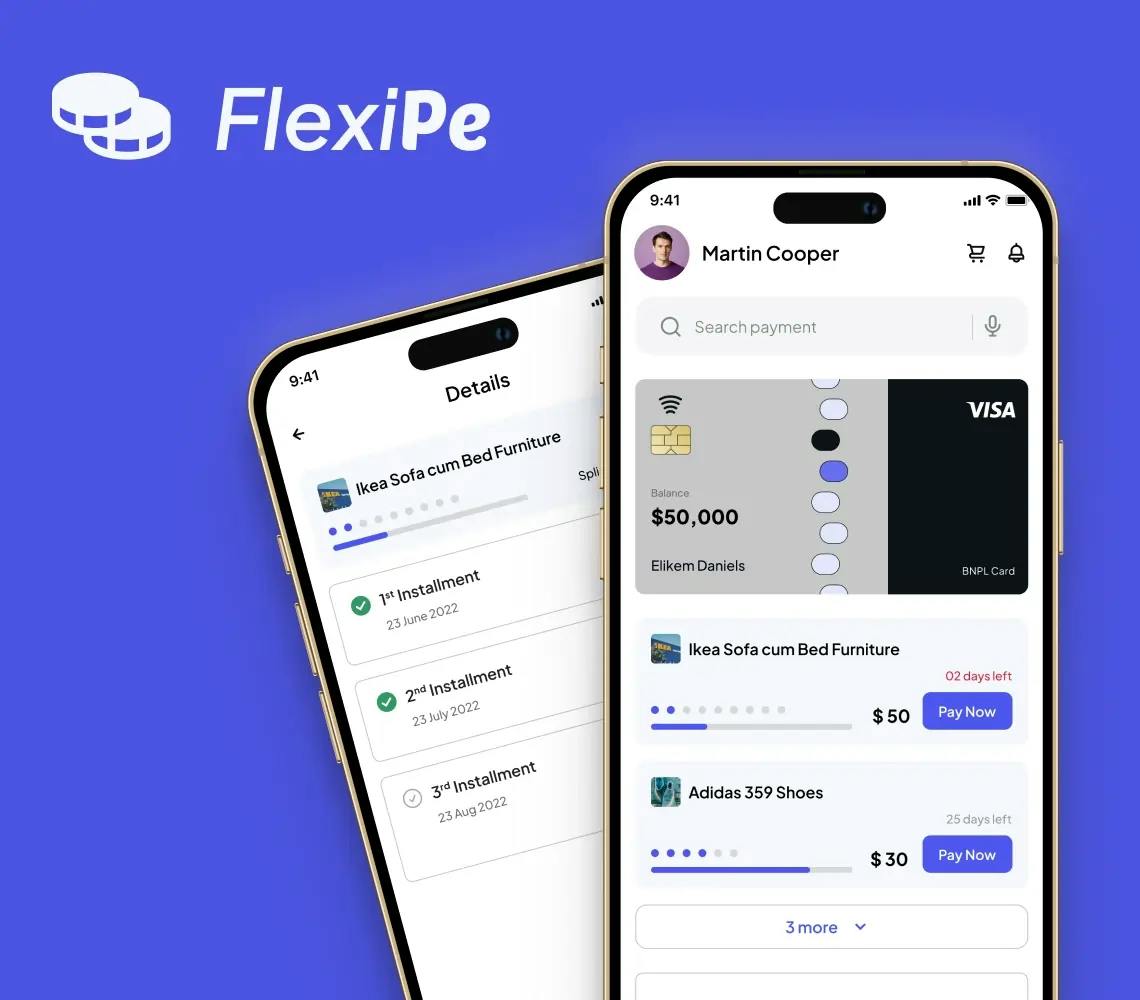
FlexiPe is a BNPL app SolGuruz built for a US-based fintech in Oakland, California. We delivered it in 8 to 10 months, from concept to launch.
It runs on native iOS and Android apps, a Python-powered web surface, and a Python backend on AWS with OAuth 2.0. It was built against the realities of 2026 BNPL regulation: CFPB Reg Z, state money transmitter laws, KYC and AML, and PCI-DSS Level 1 practices with a segmented cardholder-data environment.
What made FlexiPe distinctive is a good example of finding an underserved angle. It combines traditional retail checkout BNPL with a utility-bill installment flow in a single product. Users can split both purchases and bills into scheduled installments, with real-time approval and instant settlement.
Read the full FlexiPe BNPL app case study for the architecture and compliance detail. If you are planning a build, our fintech app development team can help you scope it.
Choosing a partner is a separate decision from the build itself.
When you evaluate a BNPL app development company, or weigh different BNPL app development services, look for real payments and credit experience, a shipped BNPL product, and compliance depth. A generic app portfolio is not enough.
Our roundup of BNPL app development companies lays out the field. It is the same short list to check for full BNPL software development, a lean build, or BNPL development services to extend an in-house team. A specialist BNPL development company, or a provider of buy now pay later app development services, will scope the credit and compliance work realistically. That is the part generalist teams tend to underestimate.
FAQs
1. How do BNPL companies make money?
BNPL companies earn mainly from merchant fees (a merchant discount rate charged on each BNPL sale), late fees where they are legally allowed, and interest on longer installment plans. Card-linked BNPL products can also earn interchange. Merchants accept the fee because BNPL raises conversion and average order value.
2. How does BNPL work for merchants?
The merchant adds a BNPL option at checkout through the provider's SDK or plugin. When a shopper is approved, the provider pays the merchant in full immediately and takes on the repayment risk, so the merchant gets paid upfront and carries no credit exposure while offering flexible payments to customers.
3. How much does it cost to build a BNPL app?
Cost tracks scope. A lean first version with a simple Pay-in-4 flow and an integrated decisioning provider sits at the lower end and can reach an early launch in a few months. A production-grade, regulated platform with native apps, a merchant console, in-house decisioning, and full compliance runs 8 to 12 months and costs several times more. The biggest cost driver is how much of the credit and risk engine you build versus integrate.
4. How long does it take to build a BNPL app?
A lean version can launch in a few months. A full, regulated BNPL platform typically takes 8 to 12 months from concept to production. SolGuruz delivered the FlexiPe BNPL app end to end in 8 to 10 months.
5. What licences and compliance are required to launch a BNPL app?
A BNPL app is regulated consumer credit. In the US that means CFPB Regulation Z consumer protections, possible state money transmitter licensing for moving funds, mandatory KYC and AML checks, and PCI-DSS for any card data. Treat compliance as an architecture input from the start, not a final checklist.
6. Do you build the credit and underwriting engine, or integrate a third party?
Both approaches are valid. Many teams integrate a third-party underwriting or credit-decisioning provider for the scoring model and build the limits, orchestration, and repayment lifecycle around it, while others build in-house for full control. This build-versus-integrate call is one of the biggest scope and cost decisions in a BNPL project and is best made early.
7. Can you add BNPL to an existing store or checkout instead of building a full platform?
Yes. If you do not want to become a lender, you integrate an existing BNPL provider or a white-label credit rail into your checkout. You keep your storefront and the provider carries the credit decisioning and risk. This is faster to market than building your own BNPL platform.
8. How is BNPL different from a credit card?
A credit card is revolving credit from a bank. A BNPL plan is a fixed, short-term installment agreement tied to a single purchase, often interest-free for short Pay-in-4 plans, with the goods not fully owned by the shopper until the plan is paid off.
9. What happens if a BNPL payment is missed?
The app retries the auto-debit on a defined schedule, sends structured reminders, and applies a late fee where it is legally allowed. Continued non-payment moves the account into collections, and repayment behavior may be reported to credit bureaus depending on the market and the provider's policy.
10. What IT professionals are required to build your own BNPL app?
A typical BNPL team includes iOS and Android developers, UI/UX designers, backend and API developers, a security or compliance-aware architect, and QA engineers, supported by a product owner who understands payments and credit.
11. How does KYC verification work in a BNPL app?
During onboarding the user submits identity and eligibility information, such as identity documents and proof of residence. The app verifies this through an integrated KYC and AML provider before granting credit, and ongoing monitoring screens for suspicious activity to meet Anti-Money-Laundering obligations.
12. What are the common challenges in developing a BNPL app?
The hard parts are credit decisioning and default risk, regulatory compliance (Reg Z, money transmitter licensing, KYC/AML, PCI-DSS), secure handling of payment and personal data, accurate settlement and reconciliation, and getting the unit economics right so default losses do not exceed fee revenue.
13. Can I build a custom BNPL solution tailored to my business needs?
Yes. A custom BNPL solution can be shaped around your market, plan types, merchant model, and vertical, for example retail checkout, utility-bill installments, or B2B trade credit. It requires payment, credit, and compliance expertise alongside app development, which is exactly the kind of build SolGuruz delivers.
14. How does SolGuruz support companies building a BNPL platform?
SolGuruz builds BNPL products end to end, from discovery, design, and architecture through development, security and compliance, testing, launch, and post-launch iteration. We have shipped a production BNPL app (FlexiPe) against CFPB Reg Z, KYC/AML, and PCI-DSS Level 1 practices, so we scope from experience rather than theory.





 How we Work