




Types of AI Agents in 2026: Which One Will Transform Your Business?
Understanding the types of AI agents is crucial for businesses that want to move from basic AI chatbots to true automation. This guide explains different types of AI agents with practical examples, their strengths and limitations, and how agentic AI is transforming workflows, decision-making, and operations across industries.

Summarise with AI


79% of businesses are already using AI agents, a clear signal of where the market is heading.
Competitors are automating tasks and scaling faster than ever, and many of us are still waiting for the right time.
But here’s the catch: AI will only work if you select the right type of agent.
Picking wrong: Leads to wasted budget.
Picking right: Results in higher productivity.
In 2026, AI agents aren’t just chatbots; they’re autonomous decision machines.
So let’s break down the various types of AI agents and help you find the one that is suitable for your product, startup, or workflow.
Table of Contents
What Are AI Agents?
AI agents are systems that perceive their environment, process information, and take actions to achieve specific goals. Depending on their design, they can be rule-based, learning-based, or fully autonomous with memory, reasoning, and planning capabilities.
As adoption scales, understanding the different types of AI agents helps companies choose the right architecture instead of blindly deploying generic AI.
What Makes AI Agents Different in 2026?
Things have transformed dramatically with the evolution of AI, IoT and Generative AI. Now, AI agents are autonomous systems that evolve as per the environment, analyse inputs, and take action without continuous human presence. Unlike traditional automation that follows rigid if-then rules, modern AI agents use machine learning, natural language processing, and generative AI to adapt and improve at a continuous level.
It has been observed that AI adoption has risen to 282% among CIOs, driven by the shift from reactive chatbots to proactive agentic AI.
The AI and IT landscape is transforming at a fast pace. 40% of enterprise applications will integrate task-specific AI agents by 2026, up from less than 7% today.
The breakthrough? AI agents are now in use in continuous perception-decision-action loops, making them truly autonomous instead of just responsive.
Types of Agentic AI Agents in 2026 (Complete Breakdown with examples)
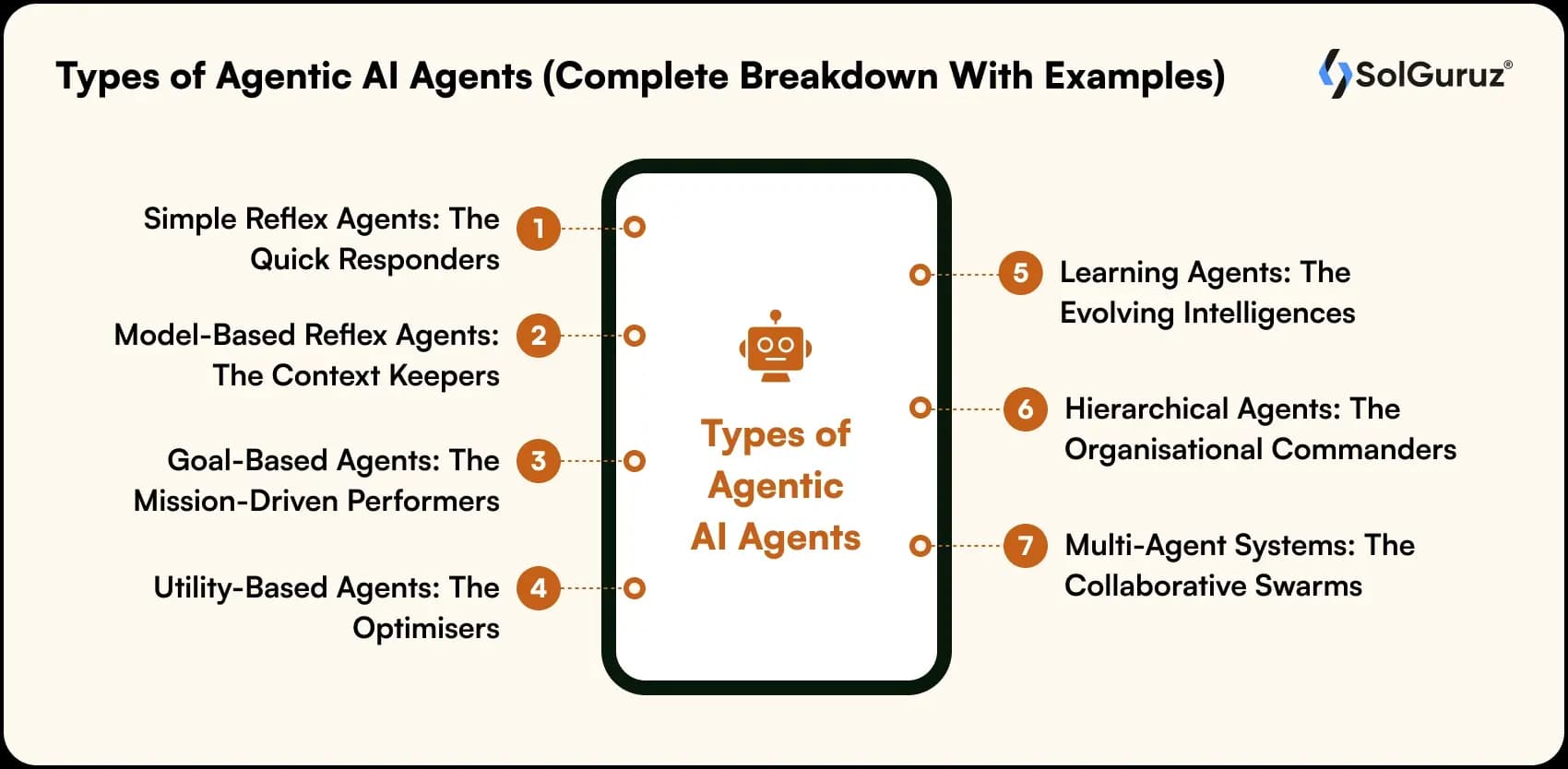
Are you aware of different types of AI agents rolling out in the market? If not, let me help you in exploring some of them below;
1. Simple Reflex Agents: The Quick Responders
What They Do: Simple reflex agents respond quickly to specific environmental stimuli using predefined condition-action rules. They observe the current situation, match it to a rule (if-then), and simply execute the corresponding action.
Real-World Examples:
- Spam filters scan emails for irrelevant keywords
- Industrial safety sensors that immediately shut down machinery when detecting obstructions
- Automated sprinkler systems activate on smoke detection
Strengths:
- Faster response with near-zero processing delay
- More reliable in stable environments
- Low computational cost and easy to deploy at a large scale
Limitations:
- Can’t learn from mistakes due to the absence of memory
- Fails in unpredictable or dynamic environments where rules change
- Risk of incorrect actions if triggers are noisy or misinterpreted.
Best For: Safety systems, basic automation, and environments with transparent, unchanging rules.
2. Model-Based Reflex Agents: The Context Keepers
What They Do: Model-based reflex agents maintain an internal model of the world, enabling them to understand what is happening globally. It helps make informed decision-making. These are considered more flexible compared to simple reflex agents.
Real-World Examples:
- Virtual assistants that remember user preferences, context, and past interactions
- Self-driving cars tracking obscured objects
- Smart home systems predicting energy needs
Strengths:
- Uses stored internal models to handle incomplete data
- Continues to operate even when sensors have blind spots
- More adaptable than simple reflex agents while maintaining a fast response time
Limitations:
- Based on the internal mode, the level of performance depends.
- Updating and maintaining models enhances computational cost.
- Becomes difficult to operate when the environment changes beyond the programmed model.
Best For: Environments with incomplete information where contextual awareness matters for customer service, navigation, and predictive maintenance.
3. Goal-Based Agents: The Mission-Driven Performers
What They Do: These Goal-Based Agents are known as mission-driven performers because they think ahead. They properly understand the situation in depth and take necessary actions, and plan step-by-step in a sequence.
Real-World Examples:
- Route planning systems find optimal paths
- Game-playing AI strategising moves toward victory
- Project management agents allocating resources
Strengths:
- Can plan multi-step actions to achieve final objectives
- Works efficiently in dynamic environments by adapting strategies
- Can be used for complex workflows that need decision-making to be effective
Limitations:
- The main aim is only on goal completion instead of resource quality
- Needs complex planning and computing, which leads to slow response time
- Can are chances of poor performance due to unclear goals
Best For: Strategic planning, logistics optimisation, game AI, and any scenario requiring step-by-step problem decomposition.
4. Utility-Based Agents: The Optimisers
What They Do: These types of agents focus on evaluation actions based on how well they enhance the utility function. By assigning utility scores to different outcomes, they consider trade-offs, risks, and advantages before making decisions. This allows them to optimise performance in complex scenarios.
Real-World Examples:
- Investment portfolio managers balancing risk and reward
- E-commerce recommendation engines optimising conversion
- Supply chain systems minimise costs while meeting deadlines
Strengths:
- Makes informed decisions by evaluating costs, risks, and benefits
- Finds the best possible outcome among many valid alternatives
- Best for real-world economic trade-offs
Limitations:
- Making utility functions is difficult and time-consuming
- Even small utility miscalculations can cause biased outcomes
- Higher computational demand due to the constant evaluation of multiple options
Best For: Financial services, resource allocation, recommendation systems, and scenarios where better matters as much as done.
5. Learning Agents: The Evolving Intelligences
What They Do: As the name suggests, these agents learn from their own experience. They analyse patterns and make data-driven decisions, which leads to more accurate outcomes for tasks that also need advanced data analysis.
Real-World Examples:
- Fraud detection systems are recognising new scam patterns
- Personalised shopping assistants adapting to preferences
- Medical diagnosis agents are improving accuracy with case exposure
Strengths:
- Improves automatically over time without reprogramming.
- Adapt quickly when new patterns or threats emerge
- Effective for environments with continuous data flow and unpredictability
Limitations:
- Need additional training data and computational resources
- Performance at the early stage can be unreliable until sufficient learning occurs
- Risk of bias and security vulnerabilities if trained on low-quality data
Best For: Dynamic environments, personalisation engines, predictive analytics, and growth-driven AI development pipelines.
6. Hierarchical Agents: The Organisational Commanders
What They Do: Hierarchical agents are organised into layered structures where higher-level agents make decisions and assign subtasks to lower-level agents.
Real-World Examples:
- Warehouse robotics, where orchestrator agents oversee inventory management while subordinate agents handle physical tasks
- Search-and-rescue operations with top-level regional coordinators, mid-level local managers, and specialised navigation agents
- Manufacturing quality control systems with inspection hierarchies
Strengths:
- Divide complex goals into smaller subtasks for fast execution of results
- Allow for specialisation at different levels, which enhances accuracy and efficiency
- Minimises the system failure by the allocation of responsibilities across layers
Limitations:
- It is not flexible and more rigid, which makes the key system slow to adapt
- Too much decentralisation leads to poor communication and misalignment
- Higher coordination overhead when tasks expand at multiple layers quickly
Best For: Complex operations requiring coordination across departments, robotics, enterprise automation, and large-scale logistics.
7. Multi-Agent Systems: The Collaborative Swarms
What They Do: Multi-agent systems consist of multiple AI agents working collectively to perform tasks, with each agent specialising in handling parts of the task for which they’re best suited. Think of orchestras where every instrument plays its part.
Real-World Examples:
- Transportation systems coordinating railroad networks, truck assignments, and marine vessels
- Healthcare epidemic prediction using specialised data analysis agents
- Defence systems where agents work in teams to simulate attacks and monitor network threats
Strengths:
- New agents can be added without redesigning the system
- Converts massive problems into smaller, independent workloads for faster execution
- Shared knowledge allows for better accuracy and problem-solving capability than a single AI
Limitations:
- Higher communication and synchronisation number of agents enhances the cost as it increases
- The chances of risk are more
- Debugging failures is difficult because responsibility is distributed among several agents.
Best For: Distributed systems, smart cities, complex simulations, cybersecurity, and problems requiring diverse expertise.
Quick Comparison Table
Here’s the quick comparison table showing types of agents and key differences:
| Type of AI Agent | Autonomy Level | Memory | Learning | Real-World Example |
| Simple Reflex | Low | x | x | Lane assist in cars |
| Model-Based Reflex | Low-Medium | ✔ | x | Customer chatbot |
| Goal-Based | Medium | ✔ | x | Delivery robots |
| Utility-Based | Medium-High | ✔ | x | Dynamic pricing engines |
| Learning Agent | High | ✔ | ✔ | Netflix recommendations |
| Hierarchical Agents | Medium–Very High | ✔ | ✔ | Warehouse orchestration, search-and-rescue command stacks |
| Agentic AI Agent | Very High | ✔ | ✔ | AI developer copilots |
Key Note: Every type of AI agent works differently as per the environment. There is no single best agent. The right choice relied on the complexity of the task and the predictability of the environment.
Application of AI Agents in Different Sectors
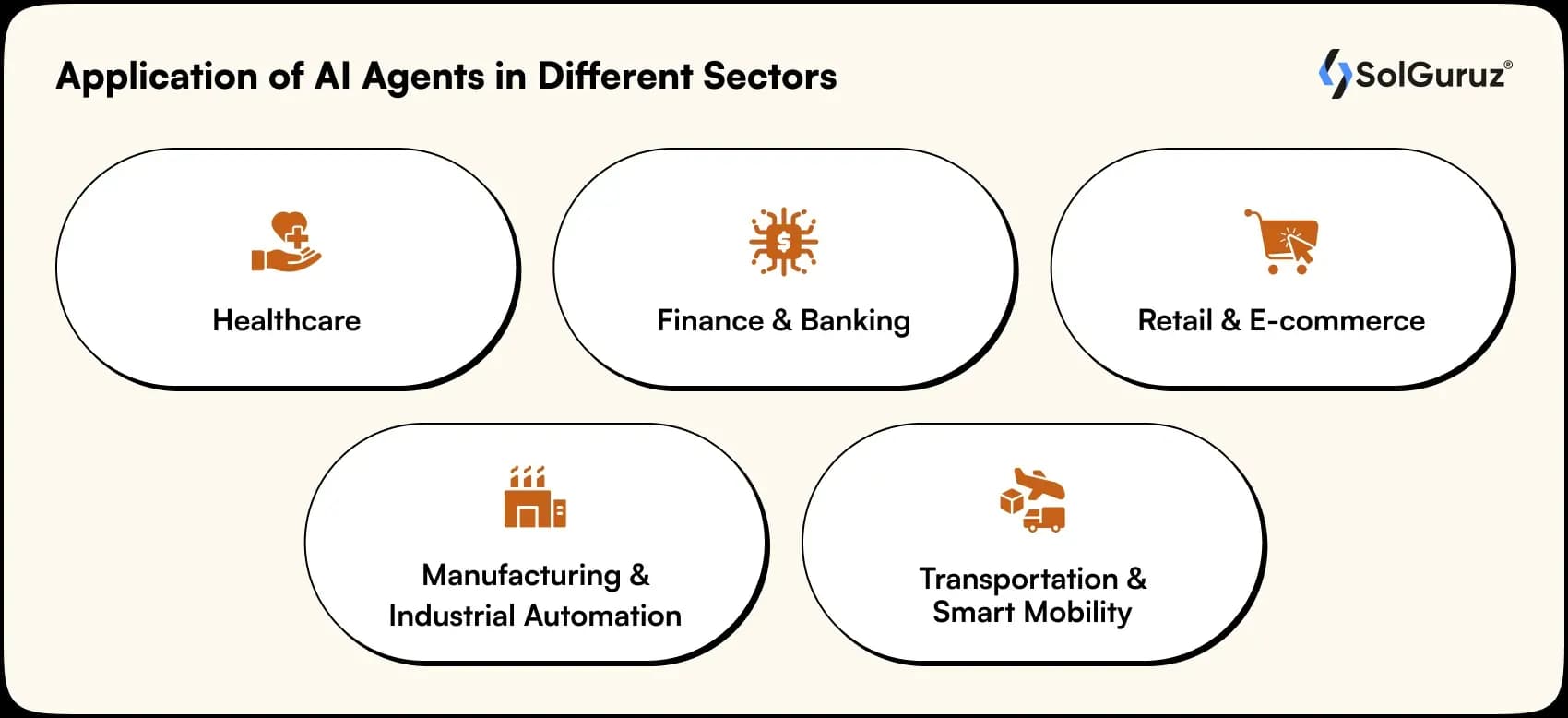
Every sector is using AI agents in different sectors, but which one to choose is still the question that comes to mind, right? Let’s see below how AI agents are used in different sectors:
1. Healthcare
The healthcare industry has been evolving with the use of advanced technology and AI Models. With the help of AI agents, they can now enhance diagnosis accuracy and treatment decisions in a much better way. Through learning agents and using imaging systems like Google DeepMind, achieve at least 94% breast cancer detection accuracy. This proves how AI Integration is now improving patient outcomes, operational efficiency, and preventive care.
2. Finance & Banking
Talking about the finance and banking sector, utility-based agents excel here. These agents optimise investment portfolios, make critical decisions with the help of a robo advisor like Wealthfront to deliver portfolios to 15% effective risk-adjusted returns if compared to manual trading. Learning agents can catch fraud across billions of transactions, and reflex agents instantly freeze cards on abnormal behaviour, minimising the financial fraud by up to 30% for most banks.
3. Retail & E-commerce
In retail, Amazon has reported that 35% of total sales come from AI-driven suggestions, thus showing the need for learning agents that drive the product recommendations. Utility-based agents are dynamically based on demand and competitor analysis, while multi-agent systems engage with warehouses, delivery fleets, and inventory in real time.
4. Manufacturing & Industrial Automation
Ever thought about how your machines can be improved and protected from accidents? This is all possible through Reflex agents. Cutting workplace events by up to 22% in automated plants. Whereas hierarchical agents coordinate robotic arms, assembly lines, and inspection bots, while learning agents power predictive maintenance to minimise equipment downtime by up to 50%.
5. Transportation & Smart Mobility
Highly in trend, in transportation, or say the automobile industry, model-based agents are used especially for self-driving vehicles. These agents can understand blocked lanes, weather conditions, and pedestrian behaviour, improving safety.
Choosing the Right Types of Agents in AI for Your Business
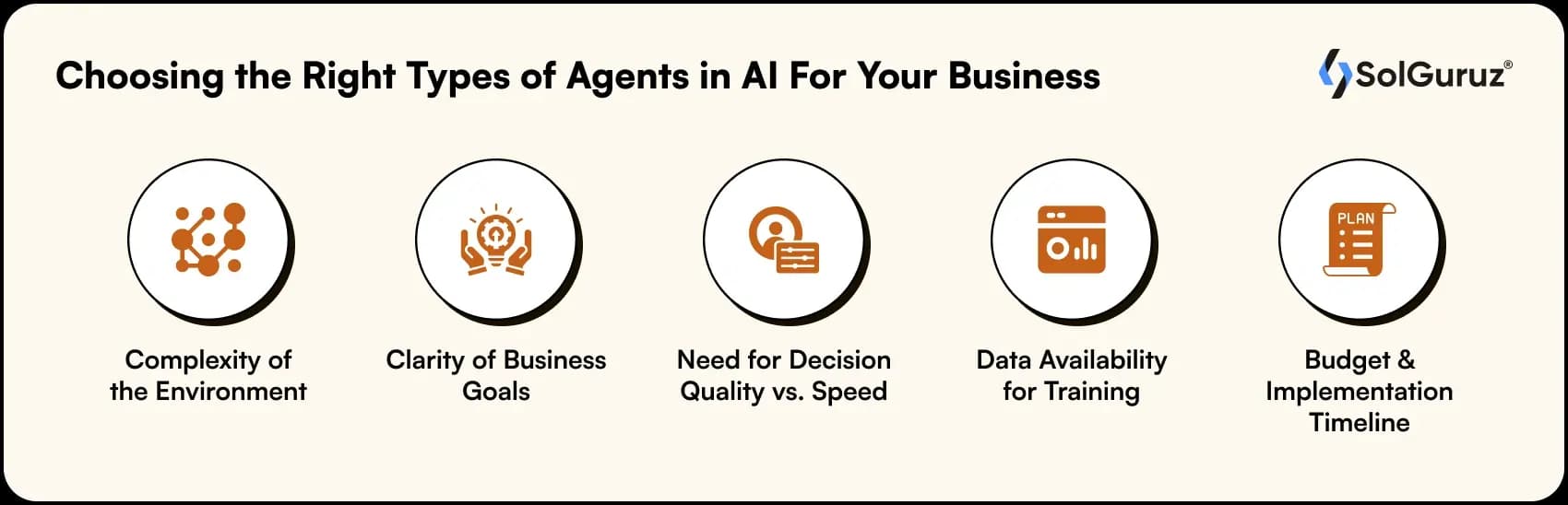
Looking forward to choosing the agents for your business development? Here are the important tips to consider before deploying any agent within a workflow:
1. Complexity of the Environment
You should check and evaluate the unpredictable environment before choosing an agent. If the environment is stable, it works well with reflex or model-based agents, whereas if the environment is highly dynamic, learning agents need to be deployed.
2. Clarity of Business Goals
It is necessary to define your goals and have a clear understanding of them. If the success criteria are defined properly, then goal-based agents can be more suitable. When goals evolve or depend on multiple variables, learning agents are better equipped to optimise outcomes.
3. Need for Decision Quality vs. Speed
The choice of adopting the type of agent also depends on whether your business needs decision quality or speed-based results. If a quick decision is the priority, reflex agents should be adopted, whereas hierarchical and utility agents can take time to calculate some actions.
4. Data Availability for Training
This means that if you have in-depth information on past data and sufficient credentials are available, in that case learning agents’ performance is more accurate. Limited datasets favour rule-based or goal-based agents that depend on logic instead of training. The richer your historical and real-time data, the greater the opportunity for agents to learn and to improve.
5. Budget and Implementation Timeline
Higher investment is needed in infrastructure, engineering when it comes to complex agents like hierarchical. Businesses with lean budgets and tight timelines may benefit from simpler agent architectures that can provide value. Select the smartest, not the most sophisticated, agent your business can support.
Remember: Choosing the right AI agent depends on your business needs, speed vs accuracy, environments, and more. The smartest choice isn’t the most complex agent, but the one that matches up with your real-world goals.
The Bottom Line
Are you aware of which type of AI agents will suit your business? It is essential in today’s date to be updated and know how to choose the type of agents. This will help you in determining your competitive position in the marketplace.
The types of AI agents you choose today determine your competitive position tomorrow. With 40% of enterprise applications integrating task-specific AI agents by 2026, the question isn’t whether to adopt its how strategically you’ll deploy them.
And that’s where SolGuruz creates the real difference.
We don’t just deploy AI, we help businesses choose, design, and develop the exact agentic architecture that matches up as per industry standards, data ecosystem, and vision.
Whether you need reflex agents for instant decisions, learning agents for personalisation, we build future-ready AI systems engineered for real results.
FAQs
1. Which type of AI agent is most commonly used in 2026?
There is no most used AI agent, but with evolution and disruption in industry, utility and learning agents are dominating enterprise additions in 2026.
2. How do I choose the right type of AI agent for my business?
It is a very common question that comes to mind when going with selecting an AI agent for business. You can choose the type of AI agent relying on different factors, such as whether a stable environment is the focus, then a reflex agent to be used or also use model-based agents. Evaluating the Types of agents in AI helps match capabilities with business needs effectively.
3. Can AI agents work together instead of using only one type?
Yes. Many modern systems use hybrid and multi-agent architectures where multiple agent types collaborate. For example, reflex agents ensure safety, learning agents optimise decisions, and goal-based agents plan workflows, simultaneously enhancing efficiency all around.
4. Are AI agents and chatbots the same thing?
No. A chatbot is just one application of an AI agent. Modern agentic AI systems are more than just a conversation model; they plan, reason, take autonomous actions, integrate tools, trigger workflows, and collaborate with other agents without continuous human intervention.
5. What industries benefit the most from AI agents?
AI agents are creating a change in healthcare, banking, retail, manufacturing, logistics, and transportation. Learning agents improve diagnostics and fraud detection, utility agents optimise pricing and investments, and hierarchical/multi-agent systems orchestrate supply chains and smart mobility.

Paresh Mayani is the Co-Founder and CEO of SolGuruz, a global custom software development and product engineering company. With over 17+ years of experience in software development, architecture decisions, and technology consulting, he has worked across the full lifecycle of digital products, from early validation to large-scale production systems. He started his career as an Android developer and spent nearly a decade building real-world mobile applications before moving into product strategy, technical consulting, and delivery leadership roles. Paresh works directly with founders, scaleups, and enterprise teams where technology choices influence product viability, scalability, and long-term operational success. He partners closely with founders and cross-functional teams to take early ideas and turn them into scalable digital products. His work revolves around AI integration, agent-driven workflow automation, guiding product discovery, MVP validation, system design, and domain-specific software platforms across industries such as healthcare, fitness, and fintech. Instead of solely focusing on building features, Paresh helps organizations adopt technology in a way that fits business workflows, teams, and growth stages. Beyond delivery, Paresh is also an active tech community contributor and speaker, contributing to global developer ecosystems through Stack Overflow, technical talks, mentorship, and developer community (Google Developers Group Ahmedabad and FlutterFlow Developers Group Ahmedabad) initiatives. He holds more than 120,000 reputation points on Stack Overflow and is one of the top 10 contributors worldwide for the Android tag. His writing explores AI adoption, product engineering strategy, architecture planning, and practical lessons learned from real-world product execution.





From Insight to Action
Insights define intent. Execution defines results. Understand how we deliver with structure, collaborate through partnerships, and how our guidebooks help leaders make better product decisions.
 How we Work
Transform Operations with AI-Driven Agents
Turn your processes autonomous with powerful AI agent integration.

Strict NDA

Trusted by Startups & Enterprises Worldwide

Flexible Engagement Models

1 Week Risk-Free Trial
Real-World Examples of Our Expertise
Explore how real-world challenges were turned into opportunities with our success stories and case studies, showcasing impactful solutions and measurable results.
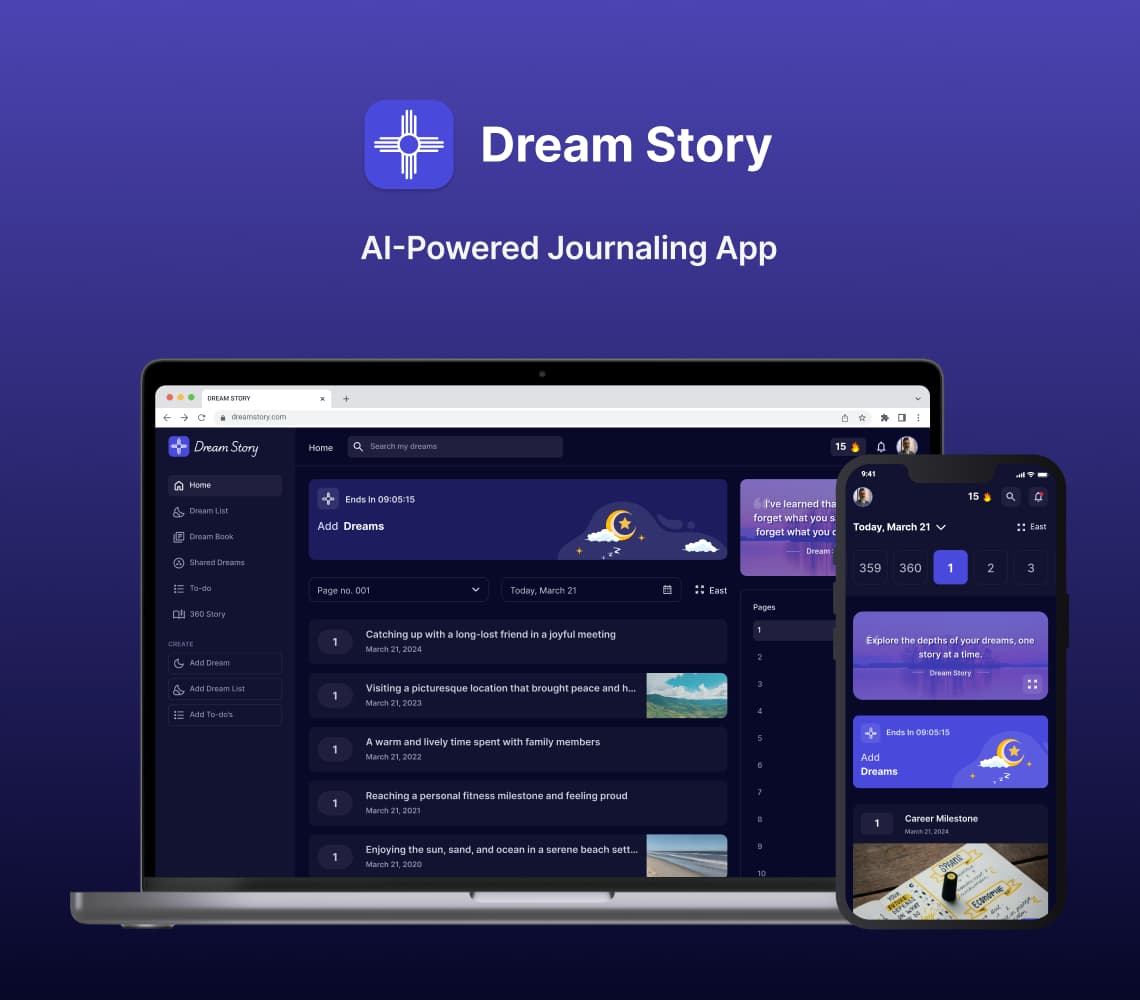
AI Journaling App Development Solution
Discover with us how we built Dream Story, an AI-powered journaling application that helps manage daily notes by capturing your thoughts and emotions. A one-stop solution for those who love noting down daily summaries!
Generative AI
Prompt Engineering
AI Integration
Mobile App
Flutter
Android
iOS
Web App
Desktop
Website
UI/UX
Backend
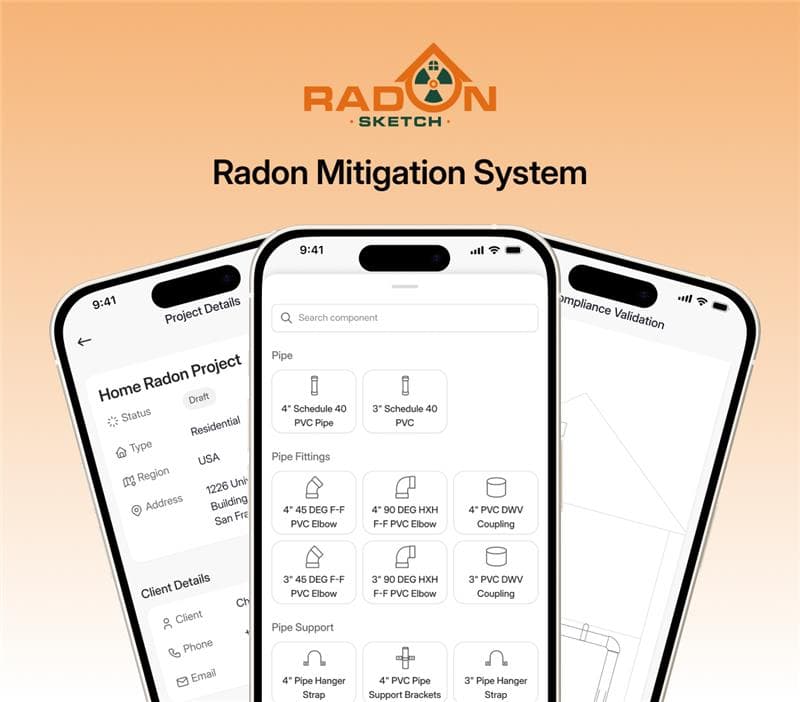
Radon Mitigation System for Mitigators And Enterprise
SolGuruz designed and developed RadonSketch, a smart radon mitigation system solution for mitigators and enterprises. It modernizes outdated workflows with automation, guided compliance, and a powerful visual builder - built end-to-end by our expert team.
Real Estate
UI/UX
MVP Development
Mobile App
Flutter
Android
iOS
Backend
Launch & Maintenance
Digital Transformation
Digital Marketing