
Travel App Development 2026 Guide: Features, Types, Cost & Process
This guide covers travel app development cost, app types, must-have features, the step-by-step development process, monetization models, and the trends shaping travel apps today. It is written for founders, CTOs, and product leaders planning their next travel app.


Summarise with AI
Short on time? Let AI do the work. Get the key points.


Key takeaways
- 7 travel app types: Travel app development spans seven build types, from booking platforms to AI travel companions. Pick the type before choosing features.
- Mobile dominates: Mobile accounts for around 70% of online travel traffic, with over 20 billion hours spent in travel apps globally in 2024.
- Timeline matters: A basic MVP takes 3-4 months, while a full-featured platform can take 8-12 months. Timeline often impacts travel app development cost more than feature count.
- Developer rates: India: <$25–$45/hour | Europe: $65-$100/hour | USA: $80–$150/hour.
- Revenue models: Commission, subscription, in-app purchases, advertising, and listing fees are the five main models. Most apps combine two or three.
- Start with an MVP: Validate the product with real users before scaling. Over-building before product-market fit is one of the costliest mistakes.
You are sitting in a cab, scrolling through your phone, and within minutes your flights are booked, hotels are sorted, and your full itinerary is ready. That is what effective travel app development can deliver: a connected digital experience that removes friction from every step of the journey.
Travel app development is no longer limited to large travel brands. Startups, travel agencies, tour operators, hospitality businesses, and new travel-tech companies are investing in custom travel apps to increase direct bookings, improve customer loyalty, automate operations, and reduce dependence on third-party platforms.
International tourism set a new record in 2025. An estimated 1.52 billion people travelled internationally, up 4% on 2024 and almost 60 million more travellers, according to UN Tourism. Total export revenues from international tourism reached USD 2.0 trillion, about 15% above pre-pandemic levels. That demand runs through apps. Travel app downloads hit 4.2 billion in 2024 and time spent passed 20 billion hours for the first time, up 7.3% year on year.
This guide explains travel app development from planning to launch, covering travel app types, essential features, development costs, timelines, the step-by-step development process, monetization models, and emerging trends. It is designed for founders, CTOs, and product leaders planning to build a scalable travel app.
Why Travel App Development Matters Now
Travelers today expect more than a booking platform. They want speed, personalization, real-time updates, and a single app that manages everything from flights to local recommendations. This is why travel app development is becoming a priority for businesses looking to deliver connected, personalized travel experiences.
Here is what is driving the demand:
1. Online and mobile-first travel dominance
Online channels are now the default way people book, and mobile carries most of that traffic. Over 20 billion hours were spent using travel apps globally in 2024, a 7.3% year-on-year increase.
2. Preference for single-app experiences
Surveys and industry reports indicate that roughly 60-70% of travelers prefer using a single, integrated app or super-app for most of their travel planning, rather than switching between multiple OTAs and websites.
3. App downloads and engagement
In 2024, global downloads of travel apps across iOS and Android reached around 4.2 billion, with active users spending significant time on booking, planning, and navigation apps. Reaching both stores from one build is why most travel products now start with custom mobile app development rather than a single-platform release
Demand is not the question. What matters is which part of the journey you build for, and that starts with picking your app type.
Types of Travel Apps You Can Build

Travel apps are not one-size-fits-all. Each type solves a different part of the traveler’s journey. Knowing which type fits your business model is the first decision you need to make.
1. Travel Itinerary and Planning Apps
These apps help users organize an entire trip in one place. Flights, hotels, activities, restaurants, and day-wise schedules. Planning apps often integrate with email to auto-import booking confirmations and sync with calendars. Building a trip planner app like TripIt or Wanderlog means solving collaboration and offline access before anything else.
2. Booking and Reservation Apps
The most common type. Booking apps aggregate flights, hotels, car rentals, and activities from multiple providers. These apps rely on APIs from Global Distribution Systems such as Amadeus and Sabre for real-time inventory and pricing. If your product compares prices and redirects rather than holding inventory, that is a metasearch build instead. Our guide on how to develop a travel app like Wego covers the difference and what each model costs.
3. Flight Booking Apps
A focused sub-category. Flight apps specialize in fare comparison, price prediction, and deal alerts, using machine learning to tell users the best time to book. If your business centers on air travel, a specialized flight app serves your audience better than a general booking platform.
4. Hotel and Accommodation Apps
These range from hotel aggregators to alternative stay platforms. Features typically include smart filters, guest reviews, virtual tours, and dynamic pricing. On the operator side, this becomes a property management build rather than a booking app, which the hotel management software guide covers.
5. Navigation and Local Discovery Apps
A growing category of hyperlocal apps that recommend restaurants, hidden spots, cultural experiences, and walking tours based on location and preference. One build sits underneath this category: route planner app development focuses on navigation and route optimization.
Transportation app development serves riders instead, covering schedules, live vehicle positions, and fares across a public transit network.
6. Travel Insurance Apps
Travel insurance apps handle everything from policy comparison to instant claim filing. With rising traveler awareness around trip cancellations, medical emergencies, and lost luggage, this niche is growing fast.
7. AI-Powered Travel Companion Apps
The fastest-growing category. These apps use natural language processing and recommendation engines to act as personal concierges. They create itineraries, answer questions, translate languages, and suggest activities on the fly. Building one end-to-end is covered in our AI trip planner app development guide.
The right app type depends on the problem you want to solve, your target users, and the revenue model, so define the business goal first, then build the feature set around it.
Must-Have Features for a Travel App
Features are crucial for the success of a travel app. Get this wrong, and users leave before completing a single booking. Here is what matters across the three core panels.
Customer-Facing Features
| Feature | Why It Matters |
| User Registration and Login | Stores preferences, booking history, and payment methods for a personalized experience. |
| Search and Filters | Let’s users find flights, hotels, and activities quickly. Filters by price, date, rating, and location are non-negotiable. |
| Real-Time Booking | Live availability and instant confirmation reduce drop-offs. Display scarcity signals, such as “Only 2 rooms left at this price.” |
| In-App Payments | Support Apple Pay, Google Pay, cards, and local payment methods. PCI-DSS compliance is mandatory. |
| Push Notifications | Alerts for price drops, booking reminders, flight delays, and promotions keep users engaged. |
| Reviews and Ratings | Social proof drives conversions. Let users rate hotels, tours, and experiences. |
| Live Weather Updates | Helps travelers plan their day and pack right. A small feature with a big impact on user satisfaction. |
| Trip Details and History | A dashboard for past and upcoming trips, payments, cancellations, and receipts. |
| Contact Support | In-app chat, email, or phone support. Chatbots handle basic queries; human agents handle the rest. |
Advanced Features That Differentiate
|
Feature |
Why It Matters |
| Voice Search | Lets travelers search hands-free using commands such as “find cafes near my hotel.” |
| AI-Generated Itineraries | Creates personalized, editable trip plans based on user preferences, budget, and interests. |
| AI Chatbots | Provides 24/7 assistance with bookings, travel questions, recommendations, and support. |
| AR and VR Previews | Gives users virtual hotel tours and destination previews to help them make informed decisions. |
| Offline Maps and Guides | Keeps essential maps, trip details, and destination information accessible without an internet connection. |
| Multi-Currency and Language Support | Makes the app easier to use across international markets by supporting different currencies and languages. |
Agent Panel Features
|
Feature |
Purpose |
| Trip Package Management | Create, update, and manage travel packages and associated services. |
| Booking Approvals | Review and approve customer booking requests and reservations. |
| Room and Date Availability | Update inventory, room availability, and booking dates in real time. |
| Payment Processing | Track and manage payments associated with bookings and travel packages. |
| Refund Processing | Manage eligible cancellations, refunds, and customer reimbursement requests. |
Together, these features create a complete travel ecosystem that makes booking easier for customers while giving agents and admins the tools to manage operations efficiently.
How to Build a Travel App: Step-by-Step Process

This 8-step process applies whether you are building a booking platform, an itinerary planner, or a full-service travel portal. See the steps below:
Step 1: Discovery and Market Research
Start by understanding your target audience and the competitive landscape. Who are your users? Are they leisure travelers, business travelers, backpackers, or families? What apps do they already use? Where do those apps fall short?
This phase also includes defining your app’s unique value proposition. Are you building a niche app for adventure travel? A general booking platform? A planning tool with AI? Your positioning drives every decision after this.
Step 2: Feature Prioritization
List every feature your app could have, then rank them. Core features go into the MVP. Advanced features get scheduled for future releases. Trying to ship everything at once is the fastest way to blow your budget and delay your launch.
Step 3: UI/UX Design
UI UX design plays a critical role in travel apps. This phase includes wireframing, prototyping, and usability testing. Focus on clean navigation, fast load times, and a booking flow that requires the fewest possible taps. Every extra screen is a potential drop-off point.
Our Clutch reviews reflect how we turn thoughtful UX into travel products that are easy to use and built around real user needs.

Step 4: Technology Stack Selection
Your stack depends on your platform strategy. For cross-platform, Flutter and React Native are the top picks. For native performance, Swift and Kotlin are the standards. Backend options include Node.js, Python, and cloud services like AWS or Google Cloud. Travel-specific APIs include Amadeus, Sabre, Google Maps, and Stripe.
Step 5: MVP Development
Build the minimum viable product with your core features. A travel app MVP typically takes 3 to 4 months. The goal is to launch fast, collect real user feedback, and iterate. At SolGuruz, we run agile sprints with bi-weekly demos so you see progress in real time.
Step 6: Testing and Quality Assurance
Travel apps handle sensitive data such as payment information, personal details, and real-time bookings. Testing must cover functional, security, and performance testing under load, plus network testing for low-connectivity scenarios. Test across devices, OS versions, and geographies.
Step 7: Launch and Marketing
Submit to the App Store and Google Play. Plan your App Store Optimization strategy across keywords, screenshots, and descriptions. A soft launch to a smaller audience helps you catch issues before a full rollout.
Step 8: Post-Launch Maintenance and Updates
The work does not stop at launch. Monitor crash reports, user feedback, and analytics, then schedule regular updates for new features, OS compatibility, performance improvements, and security patches. Ongoing application maintenance and support keeps the product secure, stable, and competitive as it scales.
A structured process keeps development predictable while giving you the flexibility to refine the product as real user feedback comes in.
How Much Does Travel App Development Cost?
Cost depends on complexity, platform, feature set, design requirements, and your development team’s location.
|
App Complexity | Features | Estimated Cost | Timeline |
|---|---|---|---|
| Basic MVP | Login, search, booking, payments, push notifications | $15,000-$30,000 | 3-4 months |
| Mid-Range App | MVP features plus reviews, itinerary builder, admin panel, chat support | $30,000-$50,000 | 5-7 months |
| Full-Featured Platform | All features plus AI recommendations, AR previews, multi-language, agent panel, analytics | $50,000-$100,000+ | 8-12 months |
Disclaimer: These are indicative estimates; the actual travel app development cost may vary based on features, integrations, design complexity, technology stack, team location, and project requirements.
App Developer Hourly Rates by Country
Developer location can significantly affect your overall budget, so choosing the right region and engagement model is an important part of planning the build.
|
Region |
Typical Developer Rate |
| India | <$25–$45/hour |
| Europe | $65–$100/hour |
| USA | $80–$150/hour |
Cost-saving tip: Start with an MVP, validate your idea with real users, and scale features based on actual demand. This helps control development costs and prevents over-building before product-market fit.
How Travel Apps Make Money
Revenue models in travel apps are well-proven. Here are the five that work:
- Commission-Based: Earn a percentage on every booking made through the app. This is how Booking.com and Expedia operate. It is the most common model for travel aggregators and OTAs.
- Subscription/Premium Tiers: Charge a monthly fee for premium features like ad-free browsing, priority bookings, or exclusive deals. Subscription models saw a 40.6% market share in the travel app space in 2024.
- In-App Purchases: Offer add-ons like offline maps, premium itineraries, or travel insurance within the app.
- Advertising: Display targeted ads from hotels, airlines, or activity providers. This works best with a large, active user base.
- Listing Fees: Charge service providers a flat fee to list on your platform, rather than taking a per-booking commission.
The right model depends on your app type and audience. Many successful apps combine two or three of these.
Travel App Development Trends Shaping Builds Now

The build scenario has shifted in three ways this year.
1. AI Becomes the Discovery Layer, Not a Feature
Travelers now start research inside an AI chat rather than a search box. That changes how a travel app gets found before it gets used, and it makes structured, machine-readable content a distribution question rather than a marketing one.
2. Cross-Platform Is Now the Default
Flutter and React Native handle the map rendering and animation performance that once forced native builds. For most travel products, the native versus cross-platform debate is settled, which removes a decision that used to cost weeks.
3. Direct Booking Over Platform Dependence
Operators are building owned apps to cut third-party commission. That shifts the brief from aggregation and inventory breadth toward loyalty, retention, and repeat booking, which are different features and a different data model.
Those are shifts in how travel apps get built. For the AI capabilities that go inside them, from itinerary generation to disruption recovery, the use cases of generative AI in travel cover each one.
Still deciding what to build rather than how to build it? Our travel app ideas guide covers concepts and business models instead.
How SolGuruz Approaches Travel App Builds
Our approach focuses on building travel apps that are scalable, integration-ready, and aligned with your business goals from day one. We combine AI-assisted development, spec-driven planning, and proven delivery processes to reduce risk and accelerate time to market.
1. Booking Flow First
Start with the point where money changes hands, then work backward through the traveler’s journey. We prioritize screens that directly support conversion and move non-essential features to Phase 2.
2. Spec-Driven Discovery
Every project begins with a structured discovery phase where requirements, user flows, integrations, technical architecture, and success metrics are clearly defined. This spec-driven approach minimizes scope creep, improves estimation accuracy, and gives stakeholders complete visibility before development starts.
3. In-House Integrations
We handle GDS connections, payment gateways, mapping APIs, and channel manager integrations in-house. This helps us identify integration challenges early instead of discovering them midway through development, where they can significantly impact timelines and budgets.
4. Platform Strategy
We recommend Flutter or React Native when a shared iOS and Android codebase makes business sense. If a product has specific native requirements, we choose the platform strategy around those needs instead.
5. Built-In AI
We build itinerary generation, personalized recommendations, and AI support agents around your booking data from the first sprint. This creates an architecture that can support AI without requiring major data-model changes later.
6. Fixed Scope and Cost
Every engagement begins with a discovery phase that defines the scope, timeline, and deliverables. You approve the fixed-price estimate before development starts, giving you clear cost and project expectations from day one.
This approach keeps the product focused, integrations reliable, AI-ready, and costs predictable from the first sprint to launch.
Travel Products We Have Shipped
From AI-powered itinerary planning to multi-category booking platforms, these are examples of travel products SolGuruz has built and shipped for real-world use.
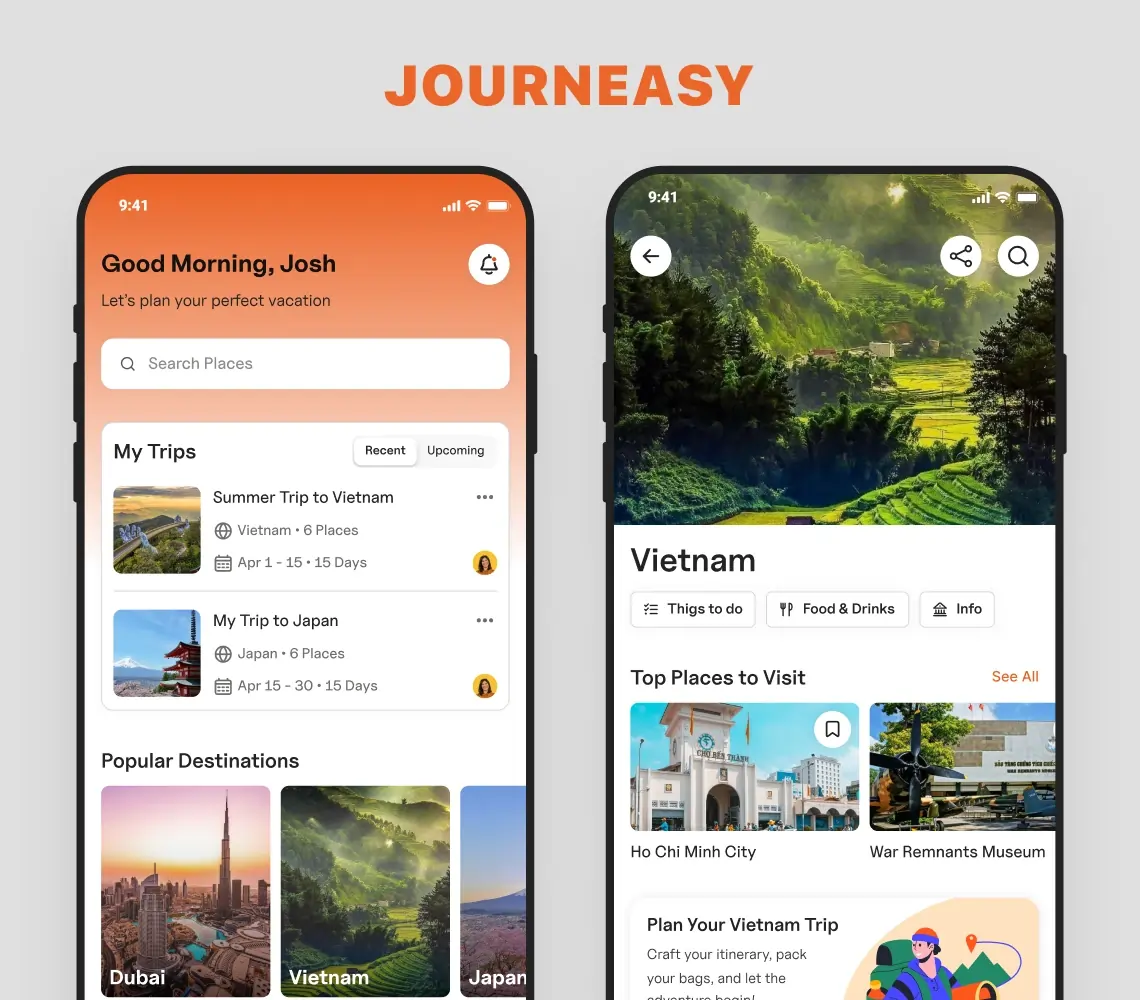
JournEasy: AI Trip Planner

Client: GlobeTravv Ventures, Bengaluru, India
Platforms: iOS, Android, Web
Timeline: 3 Months
The Challenge
Travelers were jumping between multiple apps to build itineraries, coordinate plans with their travel group, and complete bookings. Group planning often happened across chat threads and spreadsheets, making the experience fragmented and difficult to manage in one place.
Our Solution
We built an AI-powered trip planner that generates personalized itineraries based on user preferences, budget, and travel history. Real-time collaborative editing allows multiple travelers to work on the same itinerary simultaneously, with conflict-free syncing across devices.
We also integrated booking flows directly into the platform and implemented GDPR- and CCPA-aligned security from the first sprint to protect sensitive payment and passport data.
Technology Stack
- Flutter
- ReactJS
- Node.js
- PostgreSQL
- AWS
- Firebase
Results
- Delivered in 3 months, ahead of the agreed schedule.
- Launched across iOS, Android, and Web from a unified build.
- Achieved a 5.0 verified Clutch rating from the client.
Explore the AI Trip Planner App Development case study.
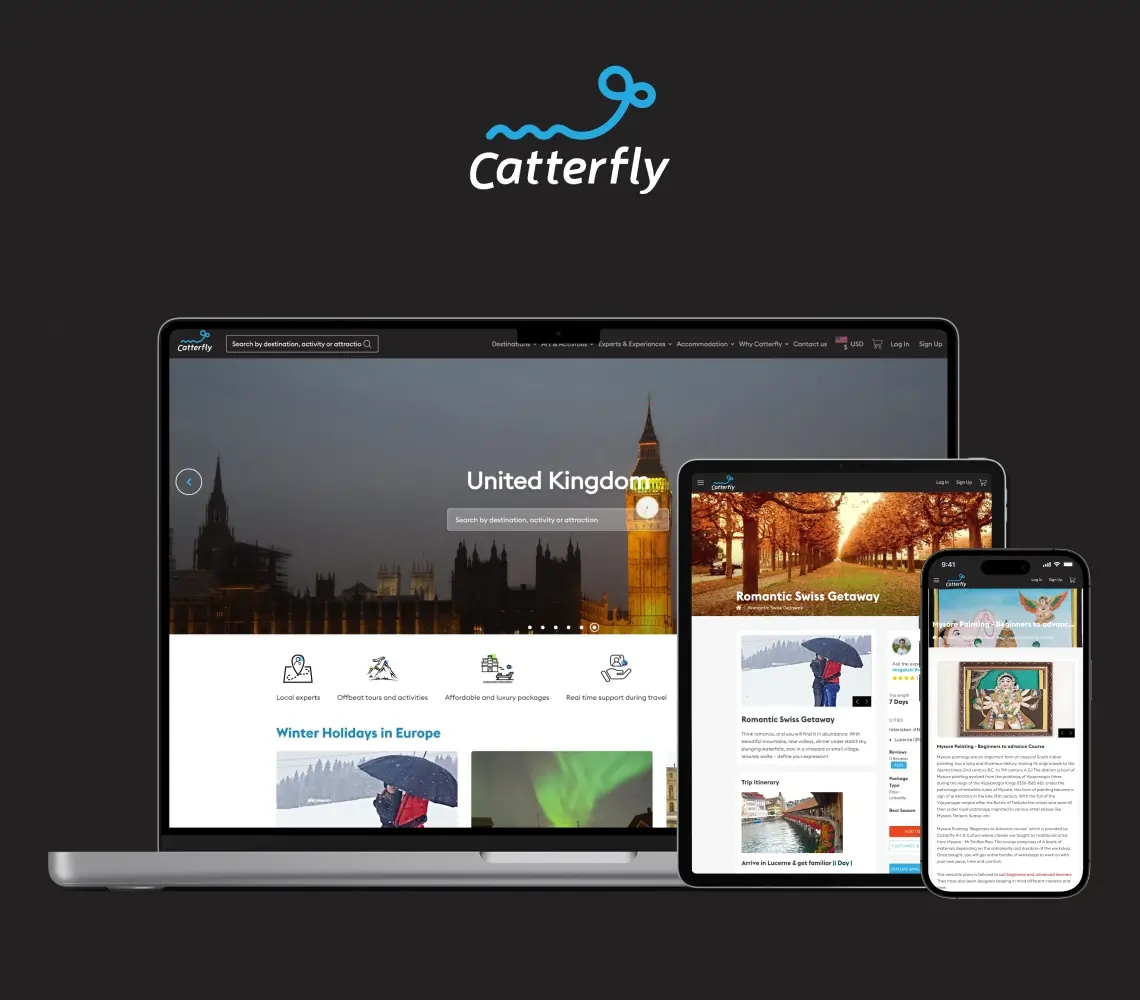
Multi-Category Travel Portal: Alps Tour

Project Type: Online Travel Portal
Booking Categories: Flights, Hotels, Trains, Holiday Packages
Languages: 4
The Challenge
Alps Tour needed to manage flights, hotels, trains, and holiday packages through a single platform. Each category came with different inventory sources, pricing models, and booking workflows, while the platform also needed to support multiple languages.
Our Solution
We built a unified travel portal that brings all four booking categories into one search and checkout experience. The platform also includes multi-language support across both the interface and travel content, creating a consistent experience across markets.
Results
- Launched across 4 booking categories.
- Supported 4 languages across the platform.
- Unified multiple inventory sources and booking flows.
See the online travel portal case study for the complete build, features, and implementation details.
Wrapping Up
Travel app development is about building products that solve real problems for real travelers. The market is massive, the technology is mature, and the demand is only going up.
Whether you are launching a trip planning app, a booking platform, or a full-service travel portal, the steps are clear: research your market, define your features, build an MVP, test it with real users, and iterate.
The biggest mistake most teams make is trying to build everything at once. Start focused. Ship fast. Improve based on data. If you know which part of the traveler journey you are solving first, contact our travel app development team.
FAQs
1. How much does it cost to develop a travel app?
A basic MVP starts around $15,000-$30,000. Mid-range apps with AI features, itinerary builders, and admin panels run $30,000-$50,000. Full-featured platforms with AR, multi-language support, and complex integrations can reach $100,000 or more.
2. How long does it take to build a travel app?
A simple MVP takes 3 to 4 months. A mid-range app with booking, reviews, and admin features takes 5 to 7 months. A complex, full-featured platform can take 8 to 12 months from kickoff to app store launch.
3. What tech stack is best for travel app development?
For cross-platform apps, Flutter and React Native are the top choices. For native performance, use Swift and Kotlin. Backend frameworks like Node.js or Django work well. Travel APIs include Amadeus, Sabre, and Google Maps.
4. How do travel apps make money?
The most common models are commission-based earnings on bookings, subscription tiers, in-app purchases, advertising, and listing fees charged to service providers. Most successful apps combine two or three of these.
5. Should I build a native or cross-platform travel app?
Cross-platform frameworks like Flutter give you iOS and Android from a single codebase, saving time and cost. Native development offers better performance for graphics-heavy features. For most travel apps, cross-platform is the practical choice.
6. What is an MVP for a travel app, and why start with one?
An MVP includes only the core features needed to launch and test your idea. For a travel app that might be search, booking, and payments. Starting there saves budget, reduces risk, and gives you real feedback before you invest further.
7. Can I add AI features to my travel app?
Yes. Generative AI can power itinerary creation, chatbots, personalized recommendations, price predictions, and real-time travel support. We built JournEasy with AI-generated itineraries and real-time group collaboration.
8. How do I choose a travel app development company?
Shortlist teams with proven travel app experience and strong case studies. Confirm they support key integrations such as GDS, payments, and mapping APIs. Start with a discovery call to evaluate their expertise and process.
9. What is tourism app development, and how is it different?
Tourism app development serves operators and destination organizations rather than individual travelers. The build centers on tour packages, guide scheduling, group bookings, and capacity management instead of consumer search and comparison.


 How we Work