

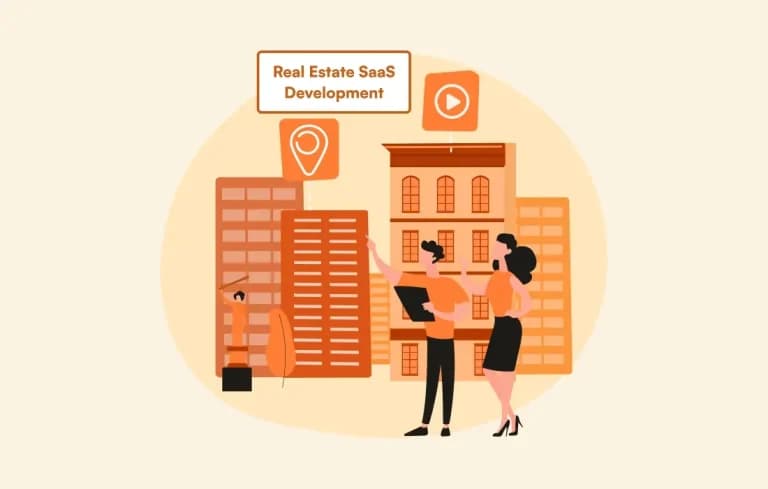
Real Estate SaaS Development: A 2026 Guide for Founders
If you’re building a real estate SaaS product, this guide walks you through the essentials: the core workflows to focus on, how the architecture really works, what features matter most, the mistakes founders often make, and how to build a modern, scalable proptech product without overengineering.

Summarise with AI


If you’ve spent any time in real estate, you already know the truth. Most software in this industry is outdated or built for a completely different decade.
So it is no surprise that SaaS platforms are now becoming the default choice for brokerages, developers, property managers, and proptech startups.
The opportunity is massive. But so are the mistakes founders make while building these products.
This guide breaks down the essentials.
- What Real Estate SaaS truly means
- The process behind scalable platforms
- Plus, the common pitfalls that slow teams down
If you’re planning to build or modernize a real estate SaaS platform, start here.
Table of Contents
What Is Real Estate SaaS (and Why the Industry Is Finally Ready for It)?
Real Estate SaaS is simple at its core.
The thing is, cloud-based software replaces manual work. Plus, there are disconnected tools and outdated legacy systems across the real estate lifecycle.
But what makes it powerful is who it serves:
- Brokerages
- Property managers
- Real estate developers
- Investors
- Proptech startups
- Tenants and owners
Everyone gets access to the same real-time data, automated workflows, and digital processes. That too, without heavy infrastructure or maintenance.
This shift is exactly why proptech SaaS development has exploded over the last few years. Teams finally want tools that match how real estate actually works.
Why the Industry Is Finally Ready (2026 Reality Check)
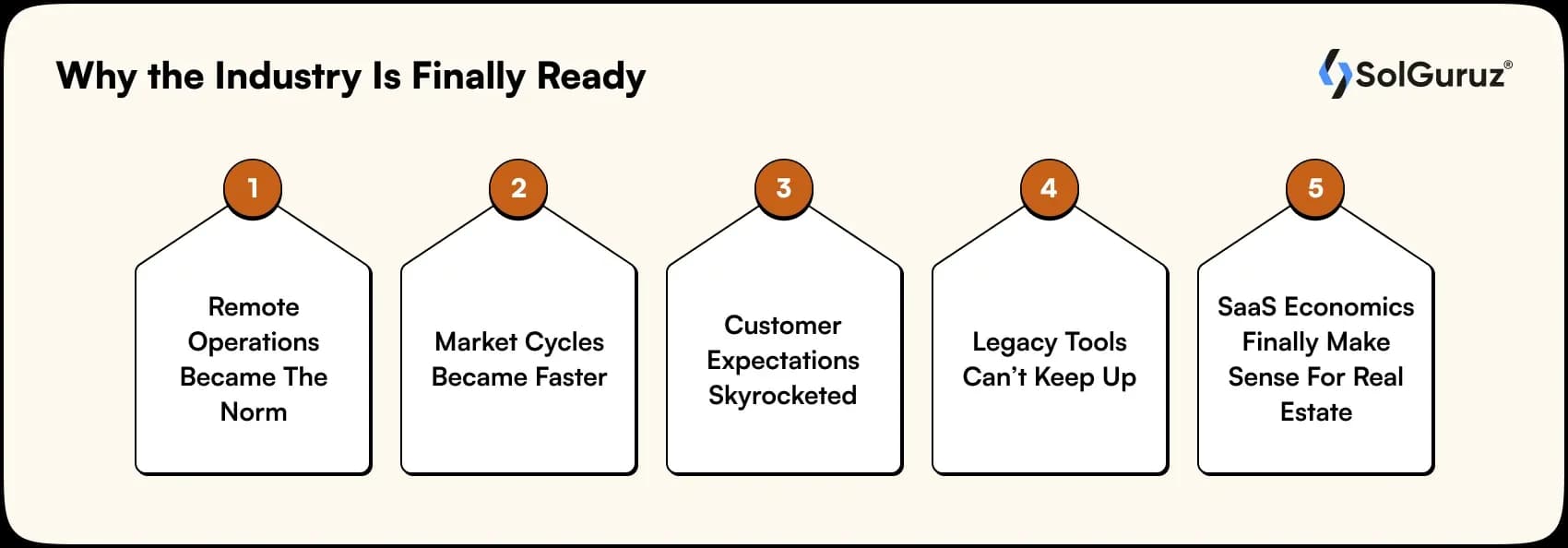
For years, real estate resisted digital transformation. But these shifts changed everything:
1. Remote operations became the norm
Teams now expect cloud-first tools, not desktop software or Excel sheets.
2. Market cycles became faster
Owners, brokers, and investors want dashboards that update instantly. Not at the end of the month.
3. Customer expectations skyrocketed
Tenants want seamless experiences. Buyers expect faster communication. Investors expect transparent reporting.
4. Legacy tools can’t keep up
Most were built over a decade ago… for workflows that barely exist today.
5. SaaS economics finally make sense for real estate
Pay-as-you-grow pricing, multi-tenant architecture, and integration-ready platforms make adoption much easier.
Benefits of Using SaaS for Real Estate
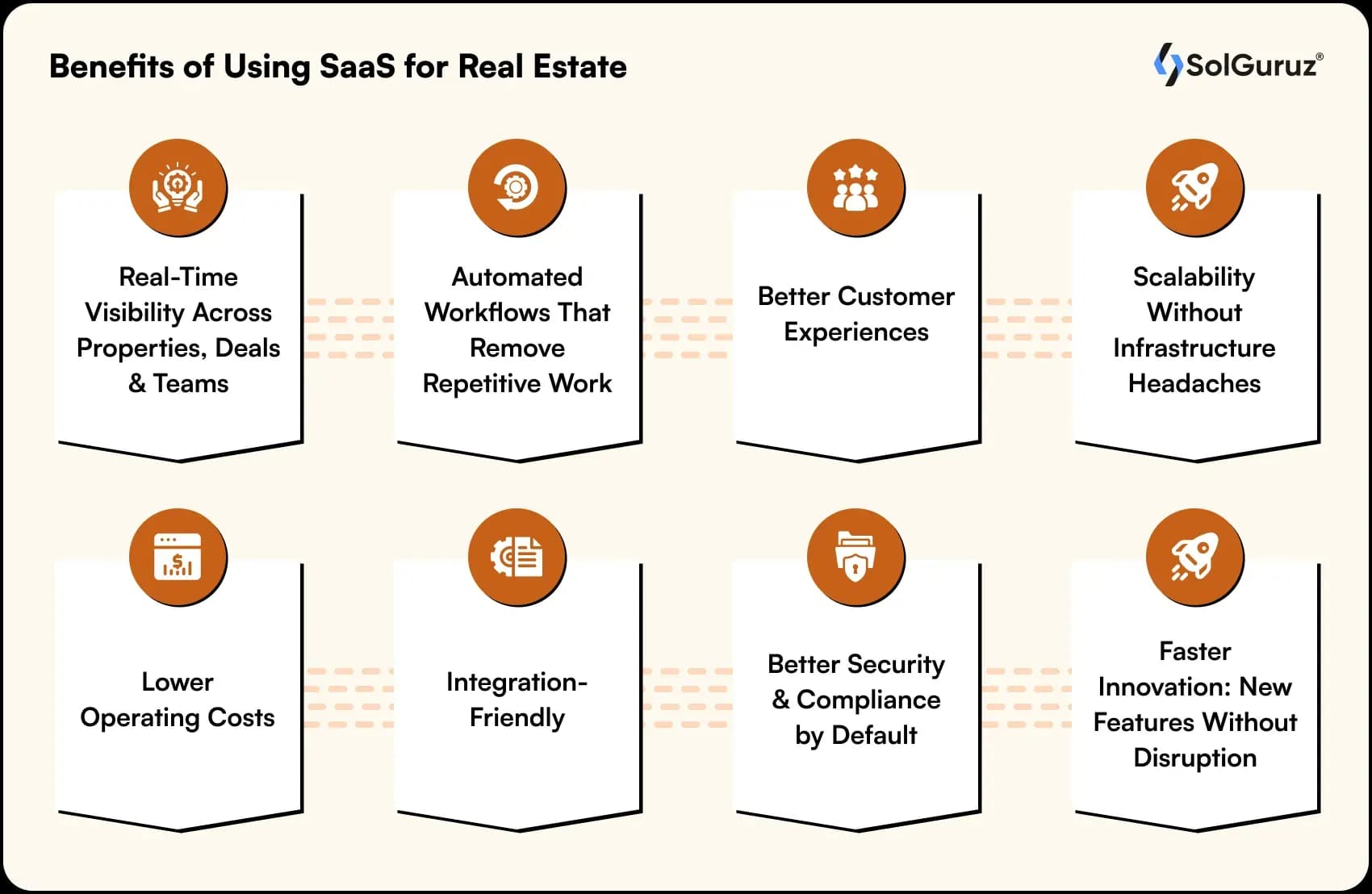
Real estate is one of the few industries where small workflow improvements can create a massive financial impact.
That is why SaaS platforms are becoming the go-to solution because they directly improve these outcomes.
Here’s what they actually deliver:
1. Real-Time Visibility Across Properties, Deals, and Teams
Everyone works on the same live data. Including brokers and asset managers.
No version conflicts. No digging through spreadsheets.
Teams make faster, more confident decisions.
2. Automated Workflows That Remove Repetitive Work
There are so many processes that require repetitive work. Like follow-ups, rent collection, or investor updates.
For all this, SaaS turns manual tasks into automated workflows.
This is where most companies see immediate ROI.
3. Better Customer Experiences
SaaS platforms improve touchpoints at every stage:
- Tenants can pay rent or raise requests online
- Buyers get quicker responses and document access
- Investors receive clean, real-time reporting
- Owners get transparent performance dashboards
Great CX is no longer optional It is a competitive advantage.
4. Scalability Without Infrastructure Headaches
Growth in real estate isn’t slow. A new property, a new team, 200 new tenants.
Traditional software breaks under this. SaaS doesn’t.
It scales instantly as your portfolio or transaction volume grows.
5. Lower Operating Costs (and Predictable Monthly Pricing)
With SaaS:
- No hardware
- No expensive on-premise setups
- No massive annual maintenance contracts
- No need for large internal IT teams
You only pay for what you use. And you avoid the long-term cost burden of outdated systems.
6. Integration-Friendly (MLS, CRM, PMS, Accounting, IoT)
The biggest pain in real estate is fragmented tools.
SaaS platforms solve this by offering APIs and prebuilt integrations:
- MLS/IDX feeds
- CRM pipelines
- accounting + invoicing
- payment gateways
- IoT sensors
With this, everything works together properly.
7. Better Security & Compliance by Default
Modern SaaS platforms ship with:
- data encryption
- role-based access
- audit logs
- tenant/owner permission controls
- SOC/GDPR-grade compliance
This is critical when handling sensitive financial, identity, and lease-related data.
8. Faster Innovation: New Features Without Disruption
Unlike traditional software, users don’t wait 6–12 months for updates.
SaaS platforms ship improvements continuously. Meaning you’re always using the latest, most secure version.
Types of Real Estate SaaS Solutions With Use Cases
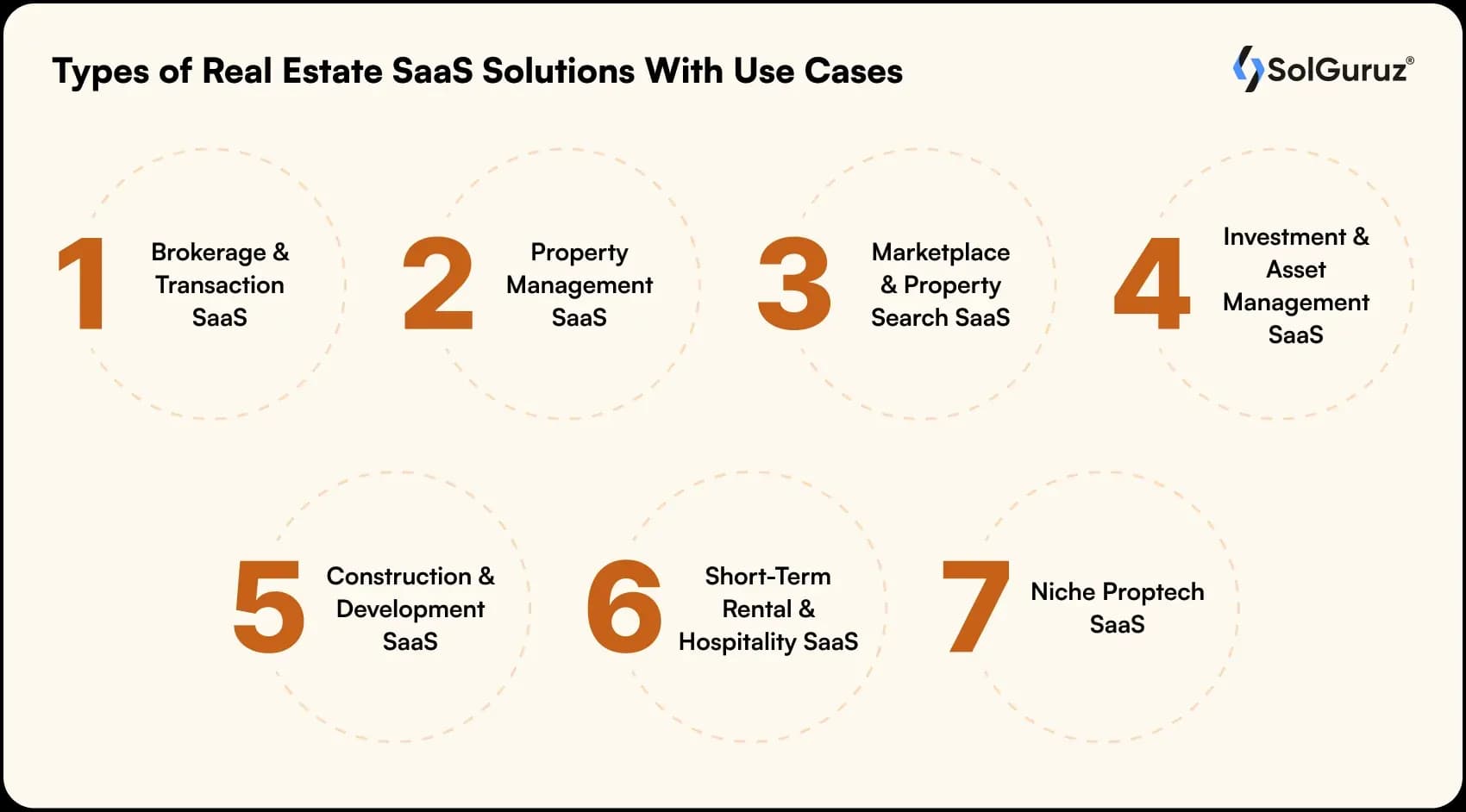
Real estate doesn’t need more software. It needs software that solves real, painful workflows.
Here are the SaaS categories that actually matter. And what top-performing teams use them for.
1. Brokerage & Transaction SaaS
Built for one goal: faster deal cycles.
What it solves:
- Leads slipping through cracks
- Slow follow-ups
- Scattered contracts & docs
Use cases:
- Agents get an auto-organized pipeline (no Excel hacks).
- Buyers receive instant updates, showing schedules and e-signed documents.
- Brokerages reduce “dead leads” because the system handles 80% of chasing.
2. Property Management SaaS
The operating system for rental portfolios.
What it solves:
- Tenant communication chaos
- Manual rent collection
- Maintenance mismanagement
Use cases:
- Tenants raise tickets → auto-assigns to the right vendor.
- Rent reminders + late fees run automatically.
- Owners get visibility into occupancy, revenue, and expenses. Without asking PMs for reports.
3. Marketplace & Property Search SaaS
For platforms that want to be the “go-to” discovery destination.
What it solves:
- Manual listing management
- Poor lead routing
- Search experiences that convert poorly
Use cases:
- A marketplace pulls MLS/IDX data automatically.
- Users save searches and get personalized alerts.
- Leads reach the right agent instantly.
4. Investment & Asset Management SaaS
Built for developers, family offices, and institutional investors.
What it solves:
- Outdated spreadsheets
- Delayed reporting
- Zero real-time performance visibility
Use cases:
- Investors see IRR, cash flow, yield, and risk metrics instantly.
- Developers share construction + sales progress with stakeholders.
- Asset managers track every unit, lease, renewal, and expense in one dashboard.
5. Construction & Development SaaS
For teams responsible for building real estate, not just selling or managing it.
What it solves:
- Schedule slippage
- Cost overruns
- Poor vendor coordination
Use cases:
- Subcontractors update progress from site → stakeholders see real-time impact.
- Budget variances trigger alerts before overruns explode.
- RFIs, drawings, contracts: everything can be version-controlled and centralized.
6. Short-Term Rental & Hospitality SaaS
The backbone of Airbnb-style operations.
What it solves:
- Guest messaging
- Multi-channel booking chaos
- Cleaner/vendor scheduling
Use cases:
- Cleaning jobs auto-create based on bookings.
- Smart locks issue unique guest codes.
- Dynamic pricing adjusts daily to maximize occupancy.
7. Niche Proptech SaaS (High-Growth Segment)
Where most new startups win.
Examples:
- AI leasing assistants
- Digital closing platforms
- Smart-building energy + IoT management
- Co-living management
- Valuation & underwriting tools
Use cases:
- AI bots handle leasing inquiries round the clock.
- IoT sensors detect failures before tenants complain.
- Valuation tools help agents price homes accurately in minutes.
How Real Estate SaaS Is Built Under the Hood
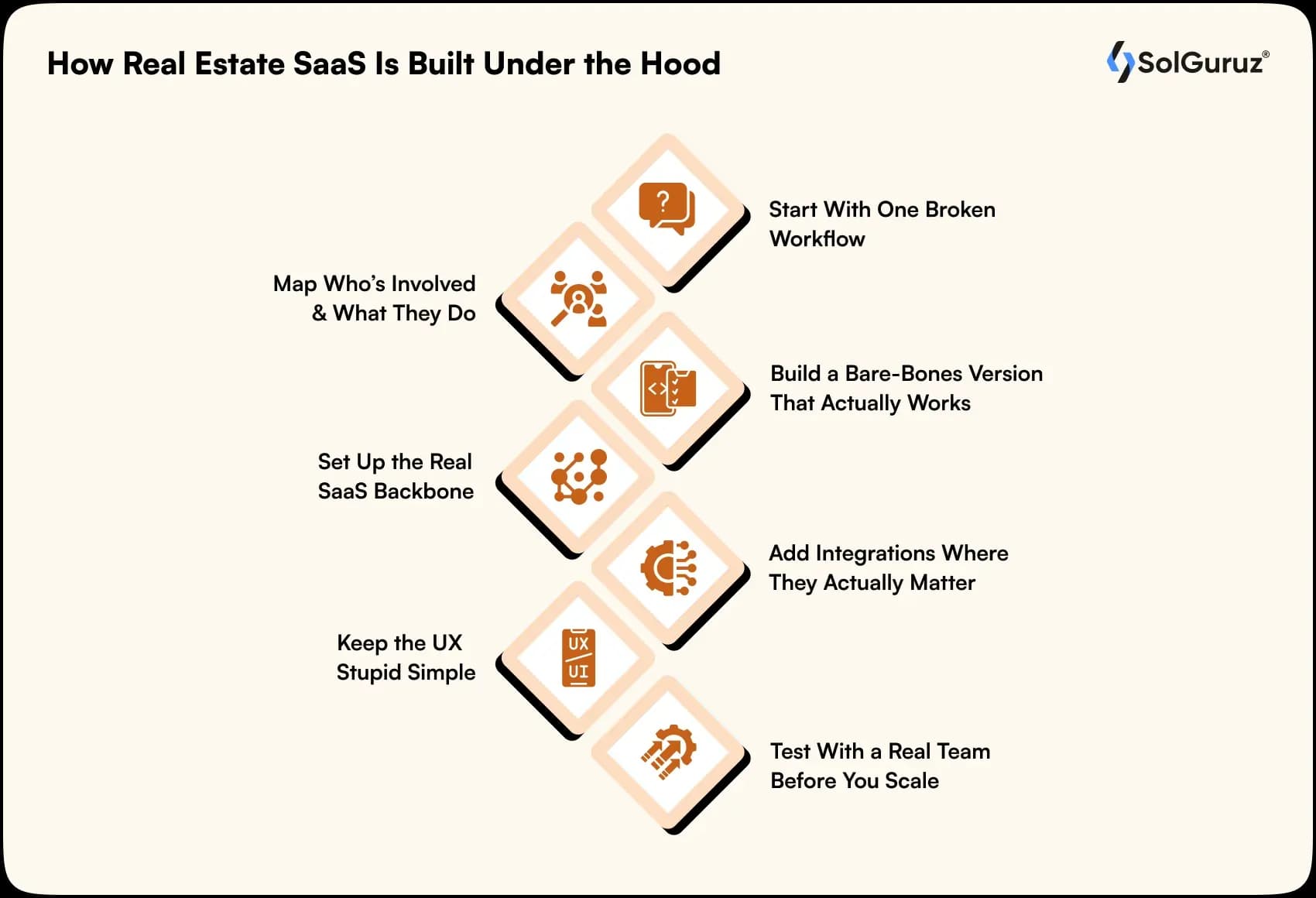
Building a real estate SaaS platform isn’t about adding dashboards, permission levels, and fancy charts.
It’s about taking messy, offline real estate workflows. And turning them into something teams actually want to use every day.
Here’s how teams that build successful real estate SaaS products actually approach it:
1. Start With One Broken Workflow (Not the Whole Industry)
Every real estate SaaS idea begins with someone saying,
“Okay, this part of our process is a joke. Why is this still manual?”
It could be lead follow-ups, maintenance ticketing, investor reporting, or construction tracking.
Pick ONE painful workflow. Solve it properly.
This becomes your product’s core identity. And later, your strongest selling point.
2. Map Who’s Involved and What They Do
Real estate isn’t a single-user system.
You’re building for agents, admins, tenants, owners, vendors, investors… each with their own agenda.
Before writing a single line of code, you map:
- Who needs to see what
- Who approves what
- Where things get stuck right now
If you skip this step, you end up with a product where tenants see owner documents and investors see internal notes. (Yes… that happens.)
3. Build a Bare-Bones Version That Actually Works
Your protech MVP isn’t meant to impress anyone.
It’s meant to prove that the workflow you picked can run smoothly:
- clean screens
- simple lists
- fast search
- no 14-step forms
- basic automation
Think of it as:
“Can this replace the Excel sheet or WhatsApp thread people use today?”
If yes → you’re on track. If no → don’t scale yet.
4. Set Up the Real SaaS Backbone
Once the core workflow works and NOW you deal with the heavy stuff.
The kind of things founders never see but rely on every day:
- multi-tenant setup
- role-based access
- proper data relationships (property → unit → lease → tenant → payment)
- clean event logs
- stable cloud hosting
This part decides whether your product scales or falls apart the moment your 10th client signs up.
5. Add Integrations Where They Actually Matter
Real estate teams will NOT adopt a SaaS product that doesn’t talk to their other tools.
So you plug in what matters for your niche:
- MLS/IDX for brokerages
- payments + accounting for PMs
- e-signing for transactions
- IoT for smart buildings
- analytics for investors
Integrations aren’t “nice to have.” They’re the difference between “this is cool” and “we literally can’t function without this.”
6. Keep the UX Stupid Simple
Most real estate users aren’t tech-heavy.
If your product feels complicated, they’ll abandon it faster than they abandon tenants who pay rent late.
Good UX in real estate means:
- fewer steps
- clear buttons
- no jargon
- everything where people expect it to be
Your job isn’t to impress them with design. Your job is to make their everyday tasks disappear.
7. Test With a Real Team Before You Scale
No proptech product becomes great in isolation.
You ship a working version, give it to one brokerage or one PM company, and watch how they break it.
- Where do they hesitate?
- What do they ignore?
- What still happens outside the system?
These insights are gold. This is where the real product gets shaped. Not in team meetings, not in Jira boards.
Common Mistakes Founders Make When Developing Real Estate SaaS Solutions
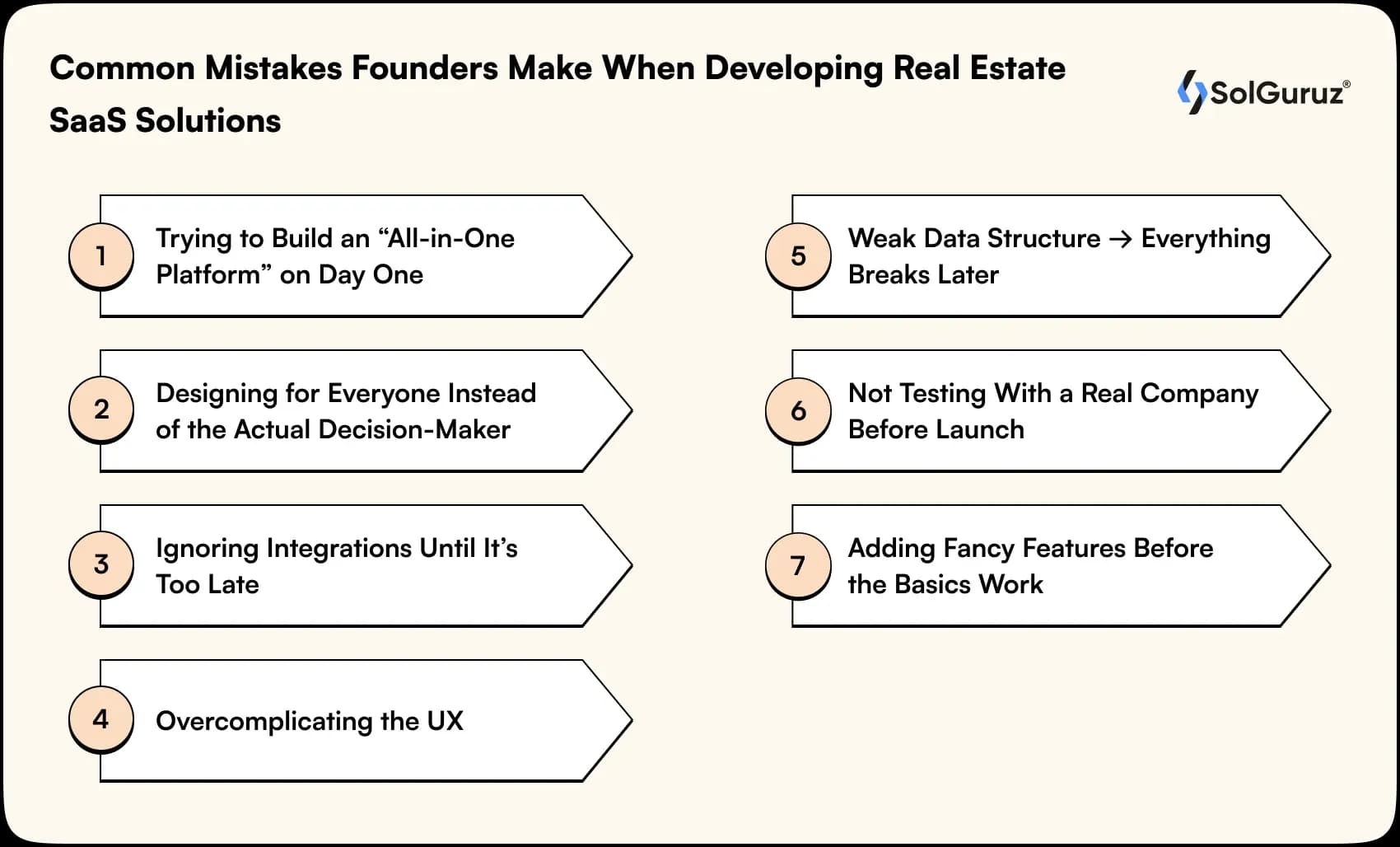
Real estate SaaS has massive potential. Which is exactly why so many teams get it wrong.
Not because they can’t build.
But because they build the wrong things in the wrong order for the wrong people.
Here are the mistakes that sink most proptech products long before launch:
1. Trying to Build an “All-in-One Platform” on Day One
Nothing kills momentum faster than this.
Founders see 20 problems in real estate and try to solve all of them in v1
Congratulations. You just built a product nobody will understand.
The winners always do the opposite: Pick one workflow. Nail it. Expand later.
2. Designing for Everyone Instead of the Actual Decision-Maker
Real estate has many users, but not all users matter equally.
Your platform should revolve around the people who:
- Use it daily
- Benefit instantly
- Hold budget influence
- Care about efficiency
Building a feature because “someone asked for it” is how you end up with a bloated, confusing system.
3. Ignoring Integrations Until It’s Too Late
See, real estate runs on integrations.
Founders who leave this for “phase two” get a rude awakening when clients ask, “Wait… this doesn’t connect to anything?”
Always define required integrations early. They’re not a feature. They’re adoption fuel.
4. Overcomplicating the UX (Real Estate Users Are Not Engineers)
Agents, PM teams, tenants, vendors, owners…
None of them want to go through 14 clicks to create a task or find a document.
Most real estate SaaS failures are not technical failures. They’re usability failures.
If someone needs training to use your product, you’ve already lost.
5. Weak Data Structure → Everything Breaks Later
Real estate data is relational.
If you don’t structure it properly from the start, your filters break, reports lie, permissions get messy, and onboarding becomes painful.
A sloppy data model is a quiet disaster.
It won’t ruin you today. But it will ruin everything when you try to scale.
6. Not Testing With a Real Company Before Launch
Your team loving the product means nothing.
Your investors’ liking the demo means nothing.
The only feedback that matters:
real users, doing real work, on a real deadline.
One small pilot with one brokerage or PM company can save you months of development and thousands of dollars.
7. Adding Fancy Features Before the Basics Work
Founders love AI leasing assistants, predictive maintenance, automated underwriting…
But if:
- users can’t track a lead,
- tenants can’t raise a ticket,
- owners can’t see reports, or
- search takes 5 seconds…
The basics create retention.
The fancy stuff creates marketing.
You need both. But in the right order.
How SolGuruz Can Help With Real Estate SaaS Development
Building real estate SaaS isn’t hard because of the tech – it’s hard because of the industry.
A reliable tech partner helps you navigate complex workflows, compliance challenges, and all those unexpected edge cases that appear only in real estate.
A good tech partner will help you navigate all the weird edge cases.
That’s where the right tech team makes the difference.
We guide you through the process, explain how we work, and help you build a SaaS product that fits real-world operations.
At SolGuruz, we help businesses validate ideas, build products, and grow confidently — and if you’re ready, you can even become a partner in your product journey.
FAQs
1. How long will it realistically take to build something usable?
If we focus on one workflow (the right way to do it), you can get a solid MVP in about 4–8 weeks. But honestly, the speed depends on how clear you are about what actually matters in v1.
2. What features do people usually expect?
From what I’ve seen, people don’t want a “big system.” They want something they don’t have to think about. Fast search, clean UI, simple actions, automation behind the scenes, and integrations with the stuff they already rely on. If the product saves them time, they’ll love it. If it adds steps, they’ll drop it.
3. And what does it cost to build something like this?
Most MVPs land somewhere in the $20K–$80K range. The variation honestly comes from one thing: how ambitious you get. A focused MVP is affordable. A platform trying to replace 10 different tools… not so much.
4. Why do so many real estate SaaS ideas fall apart?
Because people try building a “platform” before they’ve nailed a single workflow. Or they wait too long to test with real users. Or they forget that real estate teams hate complicated software. It’s rarely the idea that kills the product. It’s the execution.
5. Is SaaS secure enough for sensitive property data, leases, payments, etc.?
Short answer: yes. Longer answer: it depends on whether the product is built properly. But in general, SaaS is safer than the Excel files and email threads real estate teams use now.
6. Should I build a custom or just pick an existing solution?
Here’s the honest take: If your workflows are standard, buying is faster and cheaper. If your workflows are unique, or you’re building a proptech product to sell, or you want tech to be your edge. Building custom makes way more sense. Just don’t build custom unless the value is clear.

Written by
Satendra Bhadoria
Satendra Bhadoria is the Co-Founder and Chief Operating Officer at SolGuruz, bringing over a decade of experience in large-scale operations and delivery management within the global BPO and services industry. Before co-founding SolGuruz, he managed large delivery teams supporting clients across the United States, Europe, and Australia. At SolGuruz, Satendra oversees delivery governance, quality frameworks, hiring and staffing models, offshore development center (ODC) setups, and client engagement practices. His day-to-day work revolves around execution discipline, process maturity, delivery reliability, and building team structures that scale effectively for both startups and enterprises. He is also actively engaged in domain-driven delivery initiatives, including real estate technology platforms, property workflow systems, and operations-focused digital solutions areas, where process clarity and dependable execution are critical for long-term growth. He also contributes as a core member of the Uttar Bharatiya Business Network (UBBN), engaging with business leaders and entrepreneurs on operational practices, collaboration models, software solutions, and sustainable growth strategies. This involvement keeps his perspective grounded in real business operations beyond software delivery.


From Insight to Action
Insights define intent. Execution defines results. Understand how we deliver with structure, collaborate through partnerships, and how our guidebooks help leaders make better product decisions.
 How we Work
Building a Real Estate SaaS?
We’ll help you avoid the usual mistakes and ship v1 faster.

Strict NDA

Trusted by Startups & Enterprises Worldwide

Flexible Engagement Models

1 Week Risk-Free Trial