

Real Estate CRM Software Development: A 2026 Guide
This guide explains why real estate businesses are moving toward custom CRM software development. It covers the ideal development approach in 2026, must-have and advanced features, realistic cost ranges, and how a tailored CRM improves lead management, site visits, and conversions.

Summarise with AI


Real estate is not a linear sales business.
Leads don’t convert after one call. Deals don’t move in clean stages. And…. There are a lot of fragmented inquiries.
In such cases, a normal CRM won’t help much.
That’s why property consultancies are now building their own custom CRM software.
This helps them fix some major concerns like lead leakage, missed follow-ups, and more.
In this guide, I will share everything that you should know about real estate CRMs and the best way to develop it.
Table of Contents
Why Are Real Estate Businesses Building Their Own CRM?
Real estate sales don’t follow clean pipelines. A single lead may involve multiple site visits and long gaps.
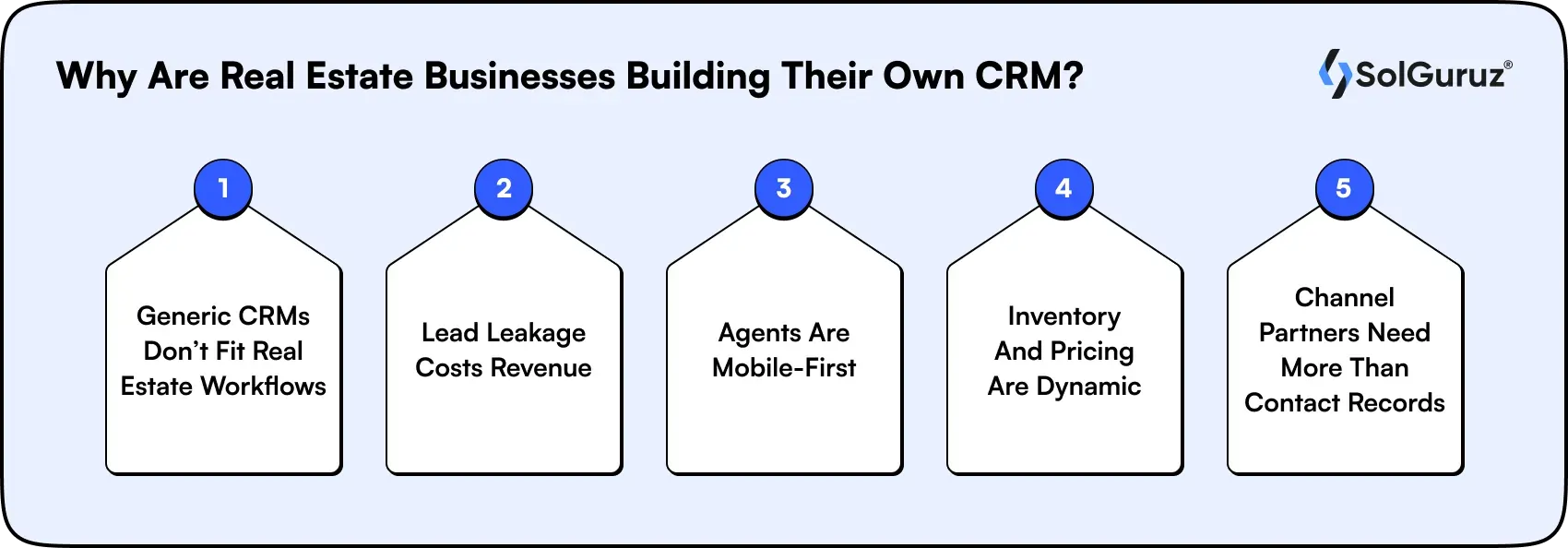
But that’s not all. The following are the major reasons:
1. Generic CRMs Don’t Fit Real Estate Workflows
Most CRMs assume short, linear sales cycles. Real estate deals are long, non-linear, and restart often. Custom CRMs are designed around site visits, booking stages, documentation, and post-booking follow-ups. That’s where real deals actually move.
2. Lead Leakage Costs Revenue
Leads come from multiple sources, like calls. And it is very easy to miss follow-ups without automation and centralized tracking. Custom CRMs capture and route every inquiry with defined response workflows.
3. Agents Are Mobile-First
Real estate agents mainly work on-site. So CRMs need to have mobile accessibility. This helps them take quick updates and instant follow-ups.
Overall, this helps with better adoption and cleaner data.
4. Inventory and Pricing Are Dynamic
In real estate, there is a constant change in property availability, pricing, and discounts. Generic CRMs treat properties like static products. Custom CRMs reflect live inventory and prevent incorrect or outdated sales information.
5. Channel Partners Need More Than Contact Records
For developers and large brokerages, channel partners drive a major share of sales. Custom CRMs support CP onboarding, lead distribution, commission tracking, and performance visibility.
PS. Many businesses rely on a real estate development company for their development needs.
What is the Best Way to Develop a Real Estate CRM Software in 2026
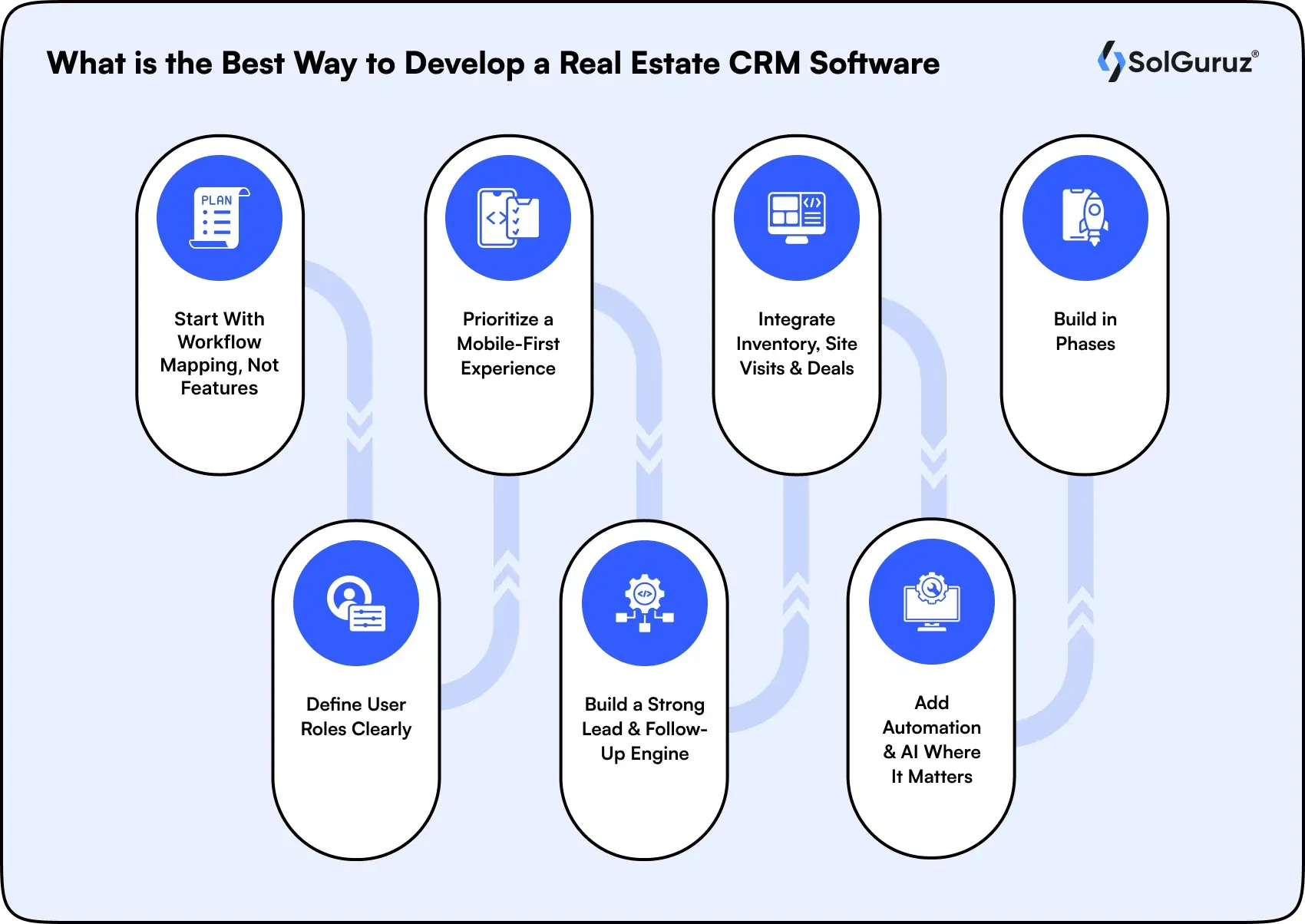
So, you know that real estate needs a different kinda CRM.
But how do you know which direction to go forward with? Or how to even develop it properly?
Well… for that, I am sharing this process that you can use for building your custom real estate CRM.
1. Start With Workflow Mapping, Not Features
Before development begins, map your real sales flow:
- How leads arrive (portals, WhatsApp, calls, CPs)
- How agents follow up and schedule site visits
- How bookings, payments, and documents are handled
- Where deals usually stall or drop
This ensures the CRM is built around real behavior, not assumptions.
2. Define User Roles Clearly
A real estate CRM is used by multiple stakeholders, such as:
- Sales agents
- Sales managers
- Channel partners
- Admin and leadership
Each role needs a different view, permissions, and KPIs. This helps you avoid clutter and improves adoption.
3. Prioritize a Mobile-First Experience
Agents live in the field. Hence, your CRM must work properly on mobile with all the functionalities.
The mobile version can have stuff like quick updates, one-tap follow-ups, and offline-friendly actions.
4. Build a Strong Lead & Follow-Up Engine
Response speed directly impacts conversions. Automate:
- Lead capture from all sources
- Instant assignment and alerts
- Follow-up reminders and workflows
This prevents lead leakage and ensures consistent engagement.
5. Integrate Inventory, Site Visits, and Deals
Your CRM should connect:
- Live property availability
- Site visit scheduling and tracking
- Booking milestones and payment status
This eliminates manual coordination and keeps sales teams aligned.
6. Add Automation and AI Where It Matters
In 2026, automation is expected. And in case of a real estate CRM, you can have these options:
- Lead scoring and prioritization
- Smart follow-up suggestions
- Auto-reminders for stalled deals
7. Build in Phases (MVP → Scale)
Start with a focused MVP covering core sales workflows. Once you see that adoption is on track, you can start expanding. You can add advanced analytics and AI-driven insights.
This reduces risk and speeds up time to value.
When your system matches how your sales team actually works, adoption follows naturally.
Basic + Advanced Features for a Real Estate CRM
A real estate CRM should not try to do everything on day one. The right approach is to cover core sales operations first, then layer in automation and intelligence as the business scales.
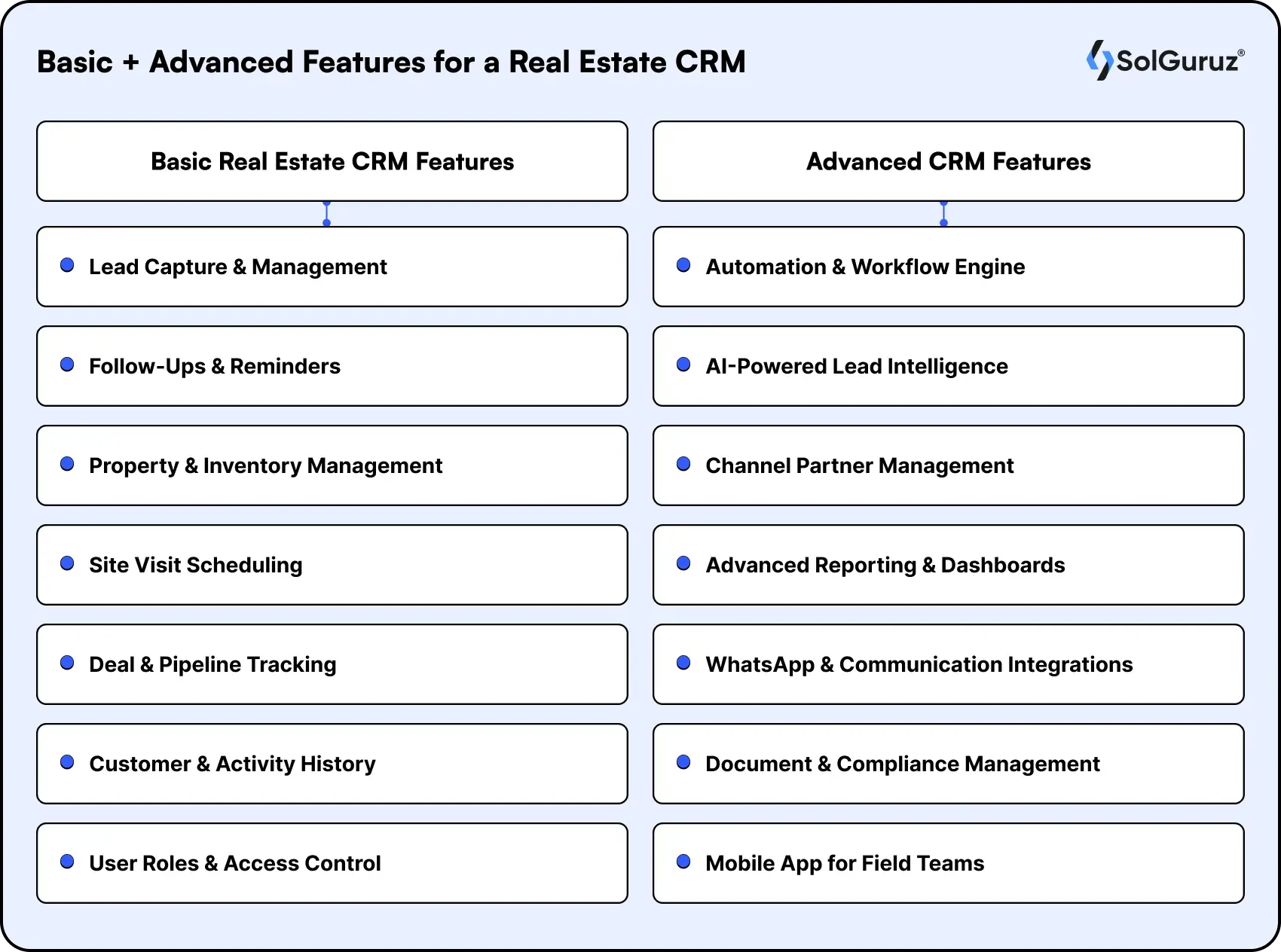
Below is how features should be logically split.
Basic (Must-Have) Real Estate CRM Features
These features form the foundation of daily sales operations.
1) Lead Capture & Management
- Capture leads from portals, website forms, calls, WhatsApp, and referrals
- Auto-assign leads to agents based on rules
- Track lead source and response time
2) Follow-Ups & Reminders
- Task-based follow-up reminders
- Missed follow-up alerts
- Basic email, SMS, and WhatsApp reminders
3) Property & Inventory Management
- Unit-level inventory with availability status
- Pricing, offers, and configuration details
- Project-wise property mapping
4) Site Visit Scheduling
- Site visit booking and agent assignment
- Automated visit reminders
- Visit status tracking (completed, rescheduled, no-show)
5) Deal & Pipeline Tracking
- Custom deal stages aligned with real estate sales
- Booking amount and milestone tracking
- Basic payment status visibility
6) Customer & Activity History
- Centralized customer profiles
- Call logs, messages, site visits, and notes in one timeline
7) User Roles & Access Control
- Agent, manager, admin access levels
- Data visibility based on role
Advanced (Scale-Ready) CRM Features
These features improve efficiency, conversions, and visibility as operations grow.
1. Automation & Workflow Engine
- Automated lead routing
- Drip follow-up campaigns
- SLA-based escalation for missed actions
2. AI-Powered Lead Intelligence
- Lead scoring based on behavior and source
- Conversion probability insights
- Smart follow-up recommendations
3. Channel Partner Management
- CP onboarding and approval workflows
- Lead distribution and tracking
- Commission calculation and settlement reports
4. Advanced Reporting & Dashboards
- Lead-to-site-visit conversion rates
- Agent and CP performance analytics
- Project-wise demand and revenue insights
5. WhatsApp & Communication Integrations
- Centralized WhatsApp inbox
- Automated replies and templates
- Conversation tracking at lead level
6. Document & Compliance Management
- KYC, booking forms, agreements, and approvals
- Secure document storage and version control
7. Mobile App for Field Teams
- Offline data capture
- Quick follow-ups and voice notes
- Location-based site visit updates
What is the Cost to Develop a CRM Software for Real Estate
There is no fixed price for developing a real estate CRM. The cost depends on how closely the system needs to match your sales workflow, the number of users involved, and the level of automation you expect.
That said, real estate CRM development costs generally fall into predictable ranges.
| CRM Type | Estimated Cost |
| Basic Real Estate CRM (Leads, follow-ups, pipeline) | $20,000 – $35,000 |
| Mid-Level CRM (Inventory, site visits, automation) | $40,000 – $70,000 |
| Advanced CRM (CP management, AI, analytics, mobile apps) | $80,000 – $150,000+ |
Note: The cost can vary more if you plan to delegate CRM development to offshore agencies.
For example, if it’s a place like India (where the talent pool is abundant). The cost to develop your CRM can drop by like 60%.
We Can Build a Real Estate CRM for You!
You know our secret sauce?
I’ll tell you. It’s actually quite simple.
We never start with features. We start by understanding your business.
We usually plan CRM around client’s projects, team structure, sales cycle, and growth goals. Then we build it in phases to ensure faster adoption and ROI.
This process works even if you are a broker, developer, or property consultancy.
If you’re considering building a real estate CRM, let’s talk.
A short consultation can help you validate scope, cost, and the right roadmap before you invest.
FAQs
1. How long does it take to develop a real estate CRM?
A basic CRM can take 3–6 weeks. But if you need somewhere around a mid to advanced system with automation, then it can take like 2-4 months.
2. Can a real estate CRM integrate with WhatsApp and property portals?
Yes. A custom CRM can integrate with WhatsApp. It can also be integrated with major property portals, calls, and ad platforms.
3. Is it better to build everything at once or start with an MVP?
I would advise you to start with an MVP first. If you want to build core sales workflows first, then you have to add multiple advanced features. Like AI, CP automation, and analytics, once adoption is strong.
4. Will agents actually use a custom CRM?
Adoption improves significantly when the CRM is mobile-first and designed around how agents work in the field. Simple interfaces, quick actions, and minimal data entry drive usage.
5. Can the CRM scale as our business grows?
Yes. A well-built CRM is designed to scale. Adding more projects, agents, channel partners, and automation without needing a rebuild.
6. Do we own the CRM and the data?
With custom development, you fully own the software, source code, and data. There are no per-user licensing fees or vendor lock-ins.

Written by
Satendra Bhadoria
Satendra Bhadoria is the Co-Founder and Chief Operating Officer at SolGuruz, bringing over a decade of experience in large-scale operations and delivery management within the global BPO and services industry. Before co-founding SolGuruz, he managed large delivery teams supporting clients across the United States, Europe, and Australia. At SolGuruz, Satendra oversees delivery governance, quality frameworks, hiring and staffing models, offshore development center (ODC) setups, and client engagement practices. His day-to-day work revolves around execution discipline, process maturity, delivery reliability, and building team structures that scale effectively for both startups and enterprises. He is also actively engaged in domain-driven delivery initiatives, including real estate technology platforms, property workflow systems, and operations-focused digital solutions areas, where process clarity and dependable execution are critical for long-term growth. He also contributes as a core member of the Uttar Bharatiya Business Network (UBBN), engaging with business leaders and entrepreneurs on operational practices, collaboration models, software solutions, and sustainable growth strategies. This involvement keeps his perspective grounded in real business operations beyond software delivery.


From Insight to Action
Insights define intent. Execution defines results. Understand how we deliver with structure, collaborate through partnerships, and how our guidebooks help leaders make better product decisions.
 How we Work
Missed Leads Cost More Than a CRM
Get experienced developers who have built CRM before.

Strict NDA

Trusted by Startups & Enterprises Worldwide

Flexible Engagement Models

1 Week Risk-Free Trial