

Hotel Management Software Development in 2026: Scale Your Profits
Hotel management software is no longer optional, but it’s essential. With 70% of hotels adopting advanced systems by 2028 and 35% fewer operational errors reported, investing smartly is key. This guide covers AI features, IoT integration, costs, tech stacks, and strategies to turn operations into 5-star efficiency.

Summarise with AI


Your hotel isn’t failing because of guests or staff, but it’s failing because your operations aren’t smart enough. Ready to change that?
Think of running a hotel where booking, guest requests, and every staff task work seamlessly, with no lags, delays, excessive workload, and no frustrated guests. Seems like a dream, doesn’t it? But what if this could become reality in 2026?
The Hotel and Hospitality Management Software Market witnessed substantial growth from USD 7.06 billion in 2024 to USD 7.57 billion in 2025, with an anticipated continued expansion at a CAGR of 6.90%, reaching USD 10.55 billion by 2030.
Still, the hotel entrepreneurs are struggling to enhance their hotel booking operations.
In this blog, we’ll explore exactly how hotel management software is creating transformation, and how adopting the right solution can boost revenue, streamline operations, and elevate the guest experience.
Table of Contents
How Technology is Reshaping Hospitality Operations
We all know how fast industries and businesses are adopting technologies within their workflow to make things and workflow faster. The hotel sector is going through rapid change by deploying advanced software and digital tools.
It was observed that almost 72% hotels aim to prefer advanced management solutions by 2026 to make operations run smoothly and faster.
For example, Marriott International uses integrated property management systems to automate bookings, housekeeping, and guest preferences.
As the demand for smarter systems grows, many hospitality businesses are investing in hotel management software development to build custom solutions tailored to their operations. This shift has resulted in up to 25% better operational efficiency and a 15% boost in guest satisfaction across the industry.
Key ways by which technology is reshaping hospitality:
- Automation in workflow: From check-ins to billing, software reduces the manual work and errors.
- Data-Driven Decisions: Guest behaviour and booking help in making pricing decisions, guest behaviour, and more.
- Enhanced Guest Experience: Personalised recommendations, mobile check-ins, and instant service improve satisfaction and loyalty.
Top Features of Hotel Management Software
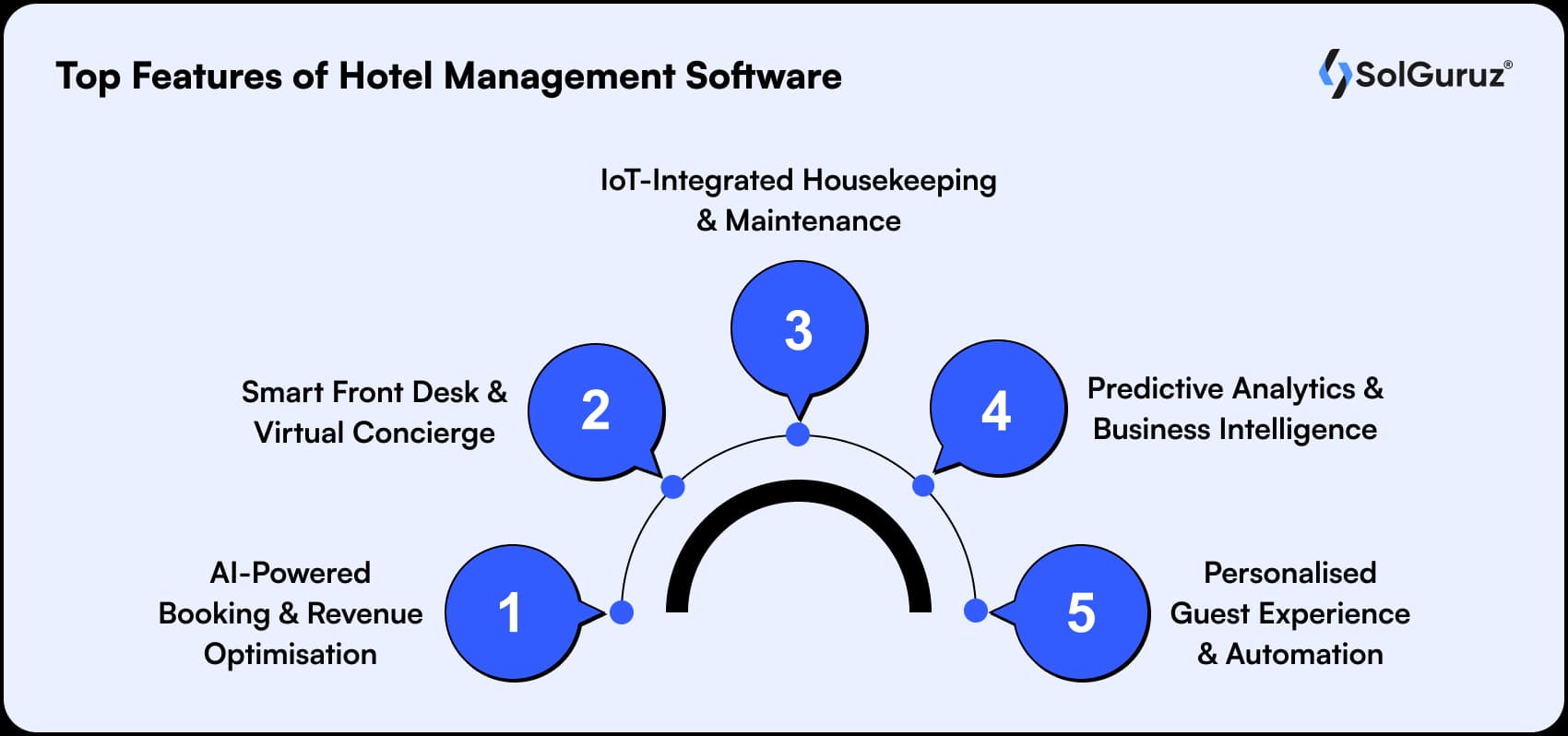
Modern hotel management software must be versatile, automated, and user-friendly.
Key features include:
1. AI-Powered Booking & Revenue Optimisation
Yes, it’s all AI now, which is making the operations faster and efficient. Next gen system automatically predicts the demand, adjusts room prices based on real-time, and optimises occupancy with the use of AI AI-driven algorithm. This results in reducing and increasing the profitability without any manual work.
2. Smart Front Desk & Virtual Concierge
Avoiding basic check-ins, now with advanced software adoption hotel sector, AI, chatbots, voice assistants, and facial recognition help in providing seamless check-in/out, tailored guest recommendations and instant support.
3. IoT-Integrated Housekeeping & Maintenance
For better tracking of the activities and work status of housekeeping, sensors in rooms and equipment report issues right away, track cleaning status, and optimise staff schedules. This ensures rooms are always well organised and reduces maintenance downtime.
4. Predictive Analytics & Business Intelligence
Through the deployment of advanced software management tools, you can forecast trends, high-value guests, and recommend promotions. This helps determine market shifts and assists in making decisions more effectively.
5. Personalised Guest Experience & Automation
Through enabling AI and machine learning, it allows for hyper-personalised room settings to customised packages and loyalty programs, enhancing guest satisfaction and repeat stays.
Key Note: Hotels using automated management systems report a 25–35% reduction in operational errors and an instant increase in guest satisfaction.
Future Trends in Hotel Management Software
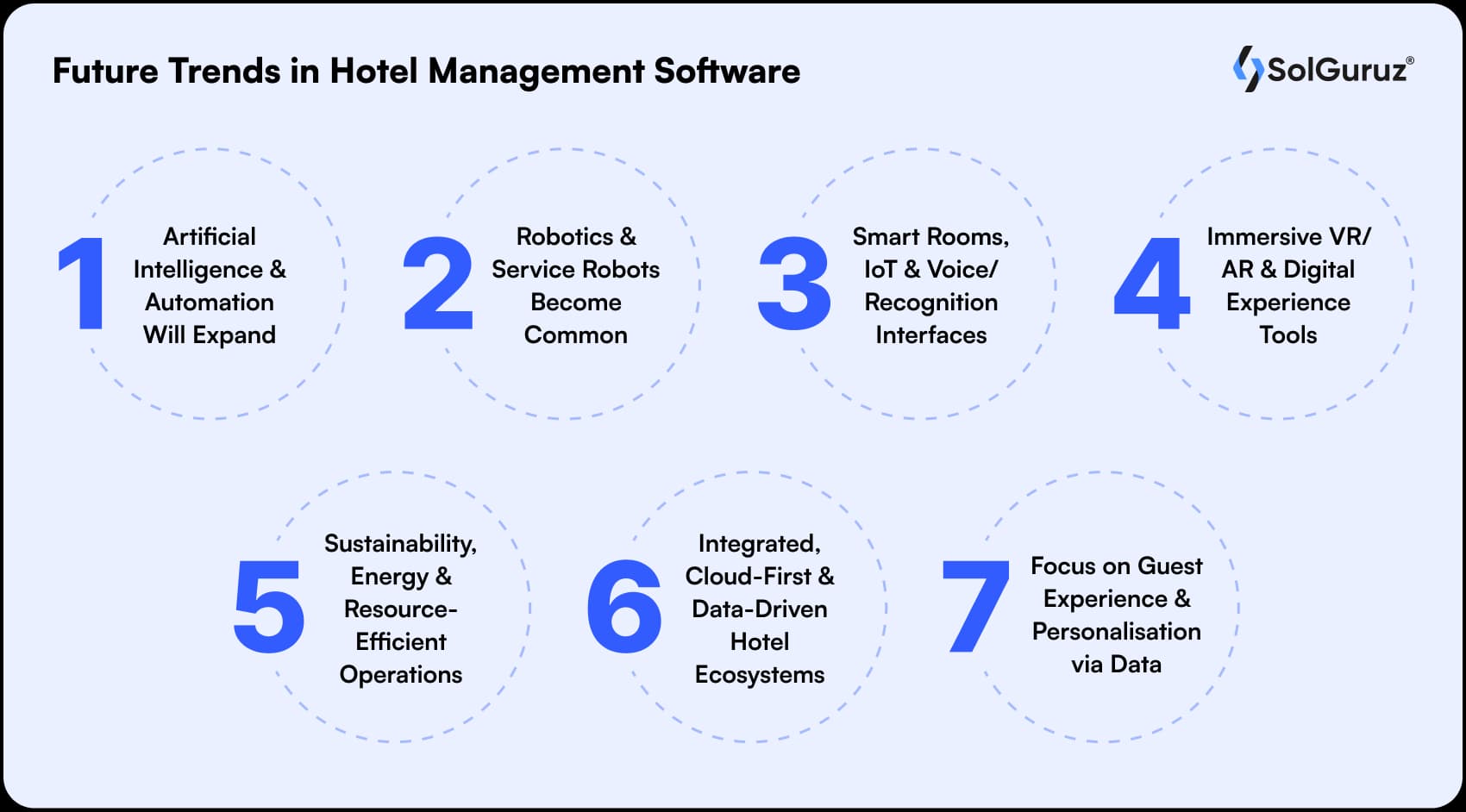
The hospitality industry is changing fast, and it is important to understand the trends that are shaping the overall sector:
1. Artificial Intelligence & Automation Will Expand
Is AI the next big driver of hotel efficiency? Absolutely. Hotels are rapidly adopting automation to streamline workflows and minimize manual effort. From smart chatbots to service robots, AI is already providing instant guest support and faster operations. In 2026 and beyond, AI will redefine how hotels work.
2. Robotics & Service Robots Become Common
Globally, hotels are expanding their application of technologies and deploying robots everywhere within their operations, such as room service delivery, housekeeping and more. It helps in reducing human intervention.
3. Smart Rooms, IoT & Voice/Recognition Interfaces
Every room will now have IoT-integrated sensors, automated environmental controls, and voice assistance for guest requests will be standard, hence providing guests a seamless experience.
4. Immersive VR/AR and Digital Experience Tools
In the hospitality sector use of AR and VR can be on a wider scale to offer virtual tours before booking, for staff training or marketing promotions, and to boost guest confidence.
5. Sustainability, Energy, and Resource-Efficient Operations
With everyone driving sustainability within the business, the hotel industry is also coming up with sustainability practices with the use of technology. For example, smart energy management, resource-efficient operations, and helping hotels to minimise environmental impact and cost.
6. Integrated, Cloud-First & Data-Driven Hotel Ecosystems
Instead of using isolated tools, hotels are expected to depend on unified cloud platforms, as it will help them in working and coming in property management, booking, and CRM all within a single platform. This helps in scalable operations and gives a holistic visibility.
7. Focus on Guest Experience & Personalisation via Data
Personalisation has become a major task for businesses to understand user behaviour and patterns. With the use of data analytics and advanced systems, hotels will focus more on personalised stays, room settings, and offers, based on guest performance and past behaviour, providing a satisfied guest experience.
Technology Stack for Hotel Management System Development
If you are aiming to develop a strong and advanced software hotel system, make sure to be aware of choosing the right technology. It helps to build a scalable and performant hotel management system.
Here are some of the technology stacks to be focused on:
1. Frontend
In the front end, languages such as React, VueJS, and Angular are to be used. These are important tools as they make sure guests can browse, interact with the hotel service. Future trends like web apps and AI personalization will make their experience better.
2. Backend
Your backend should be strong enough to handle loads of users and heavy traffic. Technologies such as Django, Laravel, and NodeJS provide robust and scalable architectures. Moreover, they also support AI modules, internet and smart devices connectivity, and real-time analytics, making the software AI-ready.
3. Database
If you want your database to be strong when the user base grows, make sure to use databases such as PostgreSQL, MongoDB, and MySQL. With current trends, cloud databases, AI-driven data management are utilised to enhance decision-making.
4. Cloud & Hosting
To make sure that your hotel management system works smoothly and faster, it is important for you to adopt cloud platforms like Google Cloud Services, Azure, AWS and more. These platforms ensure that the software works in a flow and is cost-efficient.
5. Mobile
Every user nowadays wants faster booking via mobile apps. Your hotel software management should evolve with mobile devices and work smoothly on both IOS and Android platforms. Hotel software can be more optimised with updated on-demand technologies such as Flutter, Swift, and React Native, which can build secure apps.
6. Other Tools & Integrations
Modern platforms integrate payment gateways, third-party APIs, and CMMS for automated maintenance and real-time operational tracking. It is the rationale why most advanced systems are also getting connected with IoT devices, AI chatbots, and are being integrated into one ecosystem.
Remember: Hotel software is not only used for its features, but by how smoothly it performs, expands, and evolves with new versions. Your tech stack decides whether the system becomes future-proof or outdated in a marketplace.
Pros and Cons of Developing Hotel Management Software
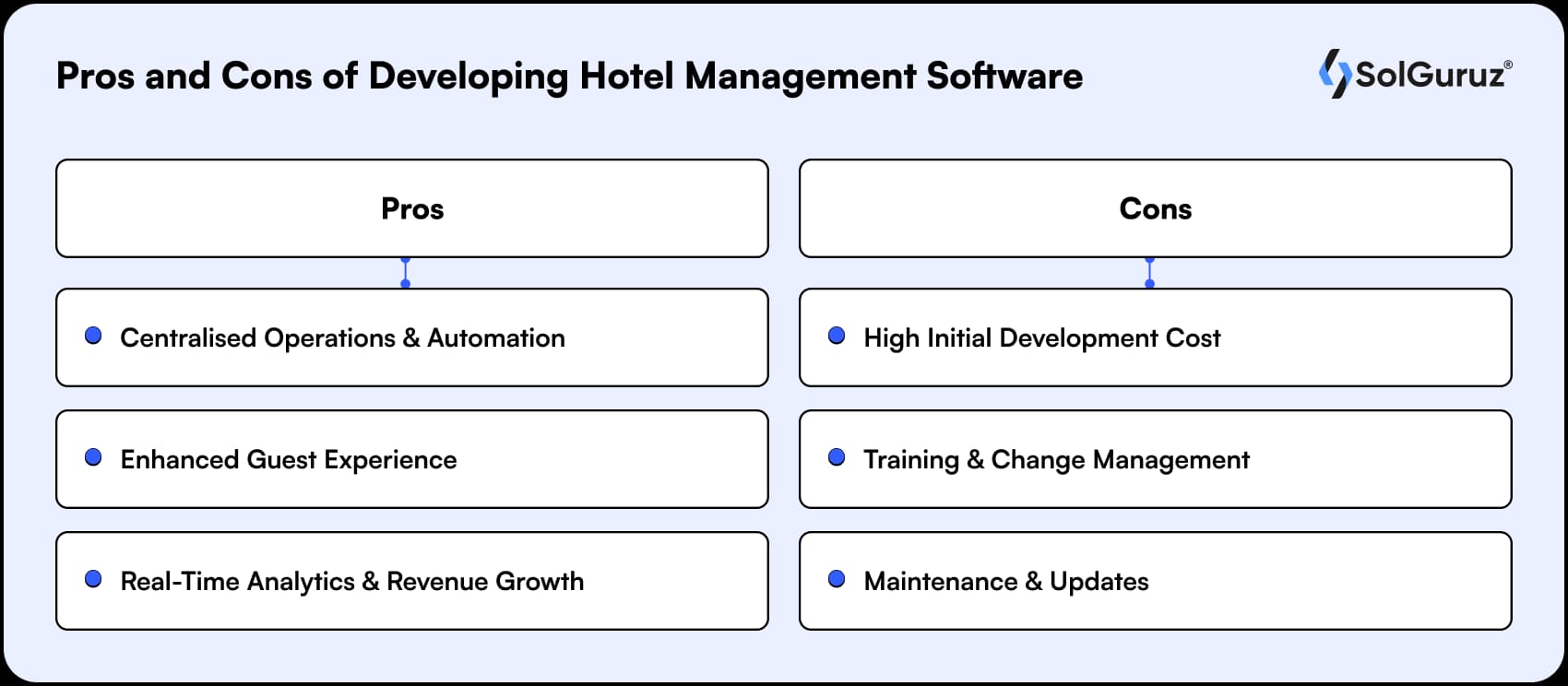
Like any major digital investment, hotel management software brings powerful benefits but also strategic considerations you should be aware of.
Pros of Building Hotel Management Software
Consider the pros of developing hotel management software:
1. Centralised Operations & Automation
With the adoption of hotel management software, you can easily integrate reservations, housekeeping, and guest service all in one unified platform. This reduces the load on the world and human effort.
2. Enhanced Guest Experience
Yes, with full functionality of hotel management software, guest experience can be improved via automated check-ins, digital advanced features and personalized services, which allow for faster responses whenever guests request service.
3. Real-Time Analytics & Revenue Growth
If you want to check real-time analytics and boost your revenue growth, manage pricing and user patterns, all can be done with the help of well-optimized hotel management software.
Cons Affecting the Decision of Building Hotel Management Software
Now, let me discuss some of the cons of building hotel management software:
1. High Initial Development Cost
Hotel software with personalised rich key features will need additional investment in planning, designing, and engineering. This can be a challenging task for the small and sied hoteliers to adopt the software in their workflow.
2. Training & Change Management
Training and development learning is required to be provided to staff and adapted to dogotaised workflows. Resistance to working and adopting technology can lead to delays in operations and higher costs.
3. Maintenance & Updates
Constant software updates, bug fixes, and feature upgrades are essential to keep the system in working condition smoothly and with third-party integrations and compliance changes makes it can become complex, performance and security can decline without long-term maintenance. Without proper long-term maintenance, performance can drop, and security gaps can appear.
This is why reliable hotel management software development isn’t just about building a system; it’s about continuously supporting it so it stays fast, secure, and aligned with how the hospitality industry operates.
Hotel Management Software Development Process
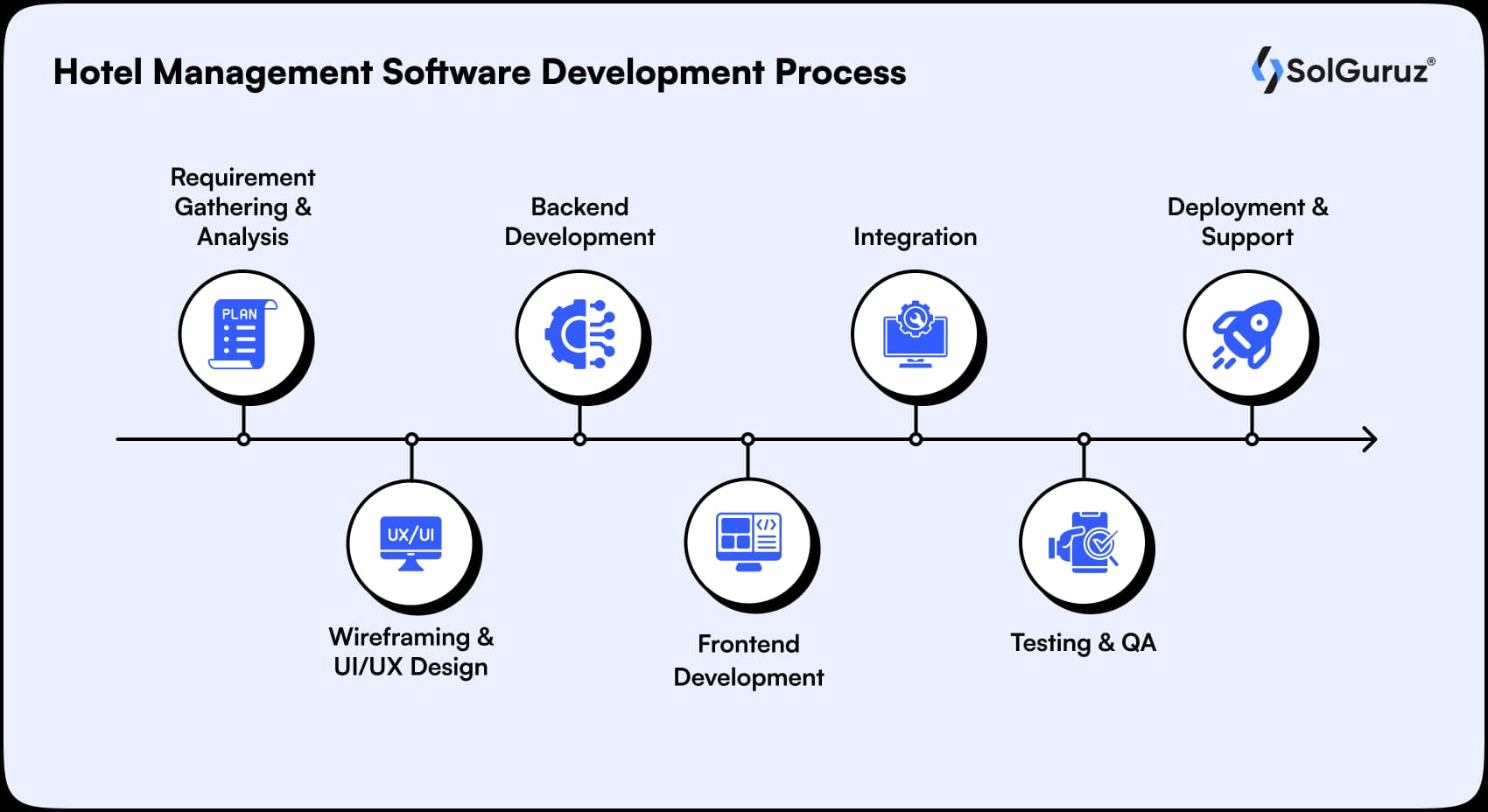
Before building a hotel management software. It is necessary to see what processes you are actually following.
Let’s see the roadmap below:
1. Requirement Gathering & Analysis
This is an important initial step in which you need to understand the actual requirements of the hotel, target audience, and business goals. This also includes guests creating an analysis of guest behaviour, trends, and operational issues to provide a solution that matches the modern hospitality business structure.
2. Wireframing & UI/UX Design
Both mobile and website must have a user-friendly and good interface for both staff and guests. You can also create wireframes, test the interface with prototyping, and test via friends, colleagues, and collect feedback from them for better improvements.
3. Backend Development
In a system, the backend plays a key role, and developers focus on building a scalable, secure, and cloud-enabled architecture that is capable of higher volume of data and integrating with IoT capabilities. A strong backend architecture in a hotel software system ensures smooth functioning within all departments.
4. Frontend Development
This aims for responsive and interactive interfaces. To improve the guest experience, modern development utilises progressive web apps, mobile responsiveness, and dynamic dashboards with rich key features.
5. Integration
Smart devices, POS, and CRM can all be integrated through advanced hotel software. Integration now provides you with APIs for cloud services, IoT devices, and tools, thus creating a unified experience and platform for all operations.
6. Testing & QA
Continuous testing and QA guarantee that the software doesn’t have any bugs. Constant improvements are needed at every phase of software development.
7. Deployment & Support
This is the final stage, in which the system is launched, and continuous support is required. In terms of a modern system, it includes real-time monitoring, maintenance, and keeping the hotel software strong and secure.
Cost of Developing Hotel Management Software Development
The cost to develop hotel management software depends on its scale, features, and platforms.
Based on industry benchmarks and SolGuruz’s services, the estimated costs are:
- Basic Software: $15,000 – $40,000
This basic version involves guest check-in/check-out, basic billing, and other normal functions. - Intermediate Software: $50,000 – $80,000
Includes enhanced reservation systems, housekeeping management, CRM, detailed reporting, and more. - Advanced Software: $120,000+
Focuses on real-time booking, dynamic pricing, AI-driven recommendations, and mobile app integration.
Development team and location
The software development cost can depend on the team’s location and the complexity of the software. Let’s see the difference in cost:
| Country | Average Hourly Rate | Impact on Final Software Cost |
| USA | $90 – $150/hr | Highest labour costs; fastest access to advanced dev ecosystems |
| UK | $70 – $120/hr | Higher operational costs; ideal for premium enterprise builds |
| India | <$25/hr | Most cost-effective; suitable for startups & enterprise outsourcing |
| Germany | $80 – $135/hr | Focus on quality & compliance; suitable for EU-based hotel |
| Canada | $75 – $125/hr | Strong enterprise development, but pricier than offshore |
| Australia | $70 – $120/hr | Competitive for mid-scale builds with a strong engineering culture |
Insight: Development costs vary most due to location-based hourly rates and feature complexity. Startups can easily minimize budgets by outsourcing to cost-efficient regions like India without sacrificing quality.
Final catch
Are you still thinking about how you can enhance your hotel system efficiency with a better conversion rate? 73% of hotels have already automated their whole system, and later adopters are falling behind the competition.
Properties with advanced management software are gaining 55% more direct bookings in contrast with competitors with outdated platforms. Yes, now it’s your time to deploy hotel management software within your workflow to make operations faster.
SolGuruz, with years of experience in building hotel management software, doesn’t just provide you with rich key embedded software, but it puts you ahead in the competitive market. With proven deployment timelines of 90 days and zero-downtime migrations, waiting is the only risk you can’t afford.
We aim to provide transparent commitment and communication towards clients and deliver the product and service on the given deadline.
Your competitors upgraded their hotel software months ago. When will you?
FAQs
1. What is hotel management software, and why do hotels need it in 2026?
Hotel management software automates your hotel bookings, billing, housekeeping and guest service. Hotels are now aiming to deploy to boost efficiency, reduce errors, and improve guest experiences. Automated systems enhance bookings by 41% and operational efficiency by 25%.
2. How much does it cost to develop hotel management software?
The cost of developing a hotel management software depends on the team's location and the complexity level of the software, from basic to advanced. Cost can range $10k for basic software versions and can go up to $100k+ for advanced AI and IoT-enabled solutions.
3. What are the must-have features of hotel management software?
There are various types of must-have features of hotel management software, such as smart front desk, dynamic pricing, and IoT-based housekeeping automation are important. Moreover, mobile check-ins, digital keys can also enhance your operations at the core.
4. How long does it take to develop custom hotel management software?
The development time ranges from 2-12 months, depending on the level of complexity. The basic version could include 2-4 months, and the advanced version will need 6-12 months. Top partners provide production-ready systems in 90 days with minimal disruption and faster ROI.
5. Should I build custom software or buy off-the-shelf solutions?
Off-the-shelf solutions are faster and cheaper at start, but subscription costs are higher. You can build customer software development, but it needs higher investment. Also, it has been observed that customised software often leads to direct bookings by 35% and minimizes the dependency by 25%.

Written by
Jay Nandwana
Jay Nandwana is a Senior Technical Business Consultant at SolGuruz, specializing in product discovery, solution planning, and translating business ideas into structured software execution plans. With 7+ years of experience working with startups, scaleups, and enterprises, Jay helps organizations transform raw concepts into well-defined digital products. He works closely with founders and stakeholders to shape MVPs, validate feature priorities, and evolve early-stage ideas into scalable, production-ready platforms. For growing businesses, he supports expansion initiatives by aligning requirements, integrations, and workflows with long-term system stability and growth. His work focuses on requirement clarity, stakeholder alignment, and reducing development risk before engineering begins - ensuring teams build the right product, not just a working product. Jay frequently writes about product discovery, requirement engineering, and decision frameworks drawn from real client engagements, with a strong focus on booking, travel, and operational workflow platforms. His insights help teams understand how early planning impacts scalability, cost, and long-term product success.


From Insight to Action
Insights define intent. Execution defines results. Understand how we deliver with structure, collaborate through partnerships, and how our guidebooks help leaders make better product decisions.
 How we Work
4x More Bookings in Same Marketing Budget.
Hotels using custom software see 30% better conversion on direct bookings.

Strict NDA

Trusted by Startups & Enterprises Worldwide

Flexible Engagement Models

1 Week Risk-Free Trial