



AI Hallucinations Explained: Causes, Examples, and Solutions
AI hallucinations happen when a model confidently generates information that is incorrect or completely made up. This blog explains why these errors occur, real examples of hallucinations, and how developers can reduce them to build more reliable AI systems.

Summarise with AI
Short on time? Let AI do the work. Get the key points.


No, if this is not to your taste, then
The classic case of Google AI's hallucinating. This became viral last year, around May 2024.
Let's read more in this section of our Gen AI Wiki series.
What are AI Hallucinations?
AI hallucinations are inaccurate or false outcomes produced by AI models.
A number of things, including biases in the data used to train the model, inadequate training data, or inaccurate assumptions made by the model, might result in these errors. For AI systems that are used to make critical judgments, like financial trading or medical diagnosis, hallucinations may be an issue.
In one line, AI hallucinations can be defined as "the negative or false responses the generative AI model gives."
Why Do They Happen?
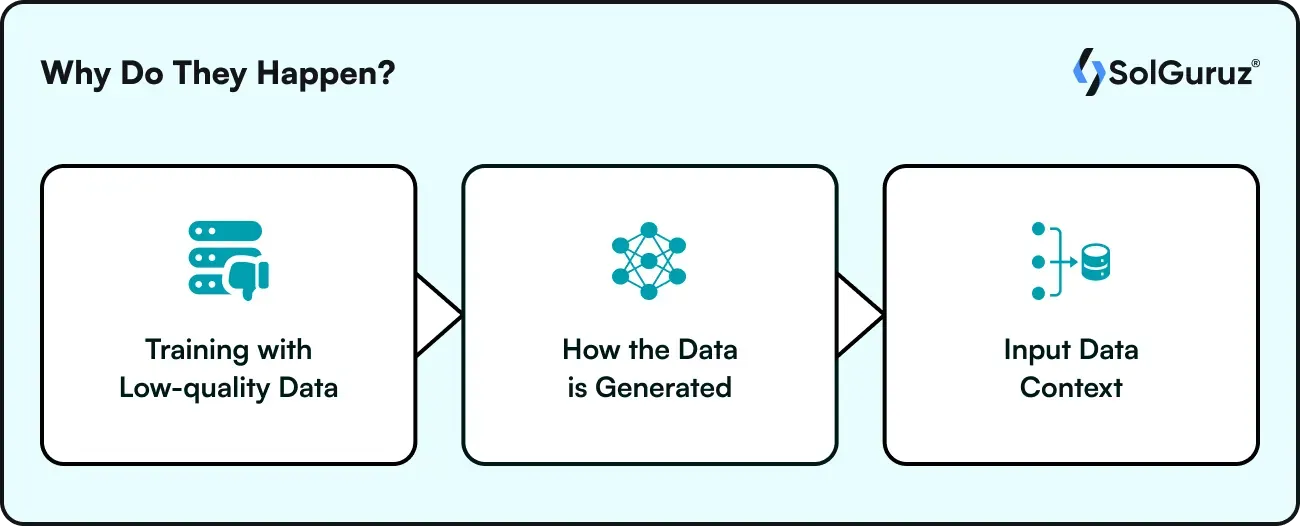
Here are some reasons why AI hallucinations happen -
Training with Low-quality Data
When the data used to train the LLM contains inaccurate, partial, or faulty information, hallucinations may result.
For LLMs to generate output that is accurate and relevant to the user who supplied the input prompt, a substantial amount of training data is necessary.
However, there may be biases, errors, noise, or inconsistencies in this training data; as a result, the LLM generates inaccurate and occasionally utterly nonsensical outputs.
How the Data is Generated
Even with a consistent and dependable data collection that includes high-quality training data, hallucinations may nevertheless arise as a result of the training and generation techniques employed.
For instance, the transformer may execute erroneous decoding or bias created by the model's earlier generations, both of which cause the system to hallucinate its response. Additionally, models may be biased toward certain or generic phrases, which could affect the data they produce or cause them to invent their response.
Input Data Context
Hallucinations may occur if the human user's input request is ambiguous, inconsistent, or contradictory. Users have control over the inputs they give the AI system, but they have no control over the caliber of training data or the techniques employed. They can improve the AI system's output by refining their inputs and giving it the appropriate context.
How Do They Occur?
By identifying patterns in the data, AI models are trained to generate predictions. However, the completeness and quality of the training data frequently determine how accurate these forecasts are.
Incomplete, skewed, or otherwise defective training data can cause the AI model to pick up incorrect patterns, which may result in false predictions or hallucinations.
An AI model trained on a dataset of medical photos, for instance, would be able to recognize cancer cells.
The AI model might, however, mistakenly assume that healthy tissue is malignant if the dataset contains no pictures of healthy tissue.
AI hallucinations can happen for a variety of reasons, including flawed training data. Inadequate grounding could also be a contributing issue.
Real-world knowledge, physical characteristics, or factual information may be difficult for an AI model to comprehend effectively.
Because of this lack of foundation, the model may produce results that appear believable but are, in fact, erroneous, irrelevant, or illogical. This can even go so far as to create links to nonexistent websites.
An example of this would be if an AI model were created to summarize news items and include material not originally included or even made-up content.
Developers working with AI models should be aware of these possible reasons for AI hallucinations.
Types of AI Hallucination
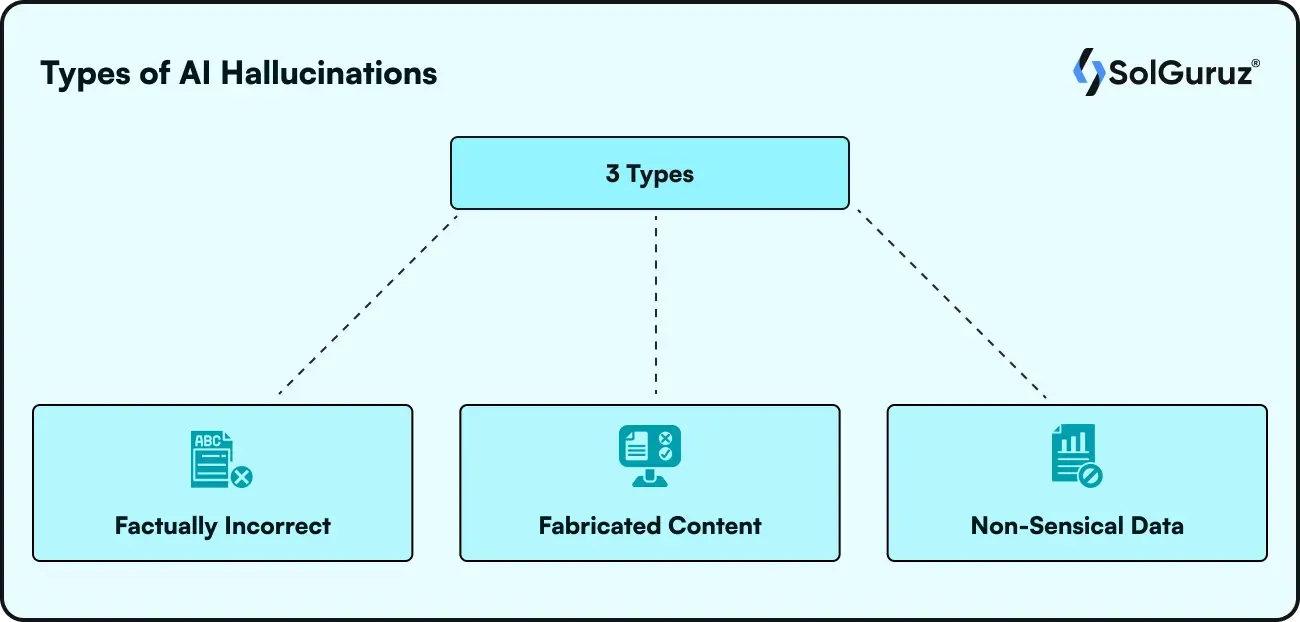
Hallucinations fall into three broad categories:
1. Factually Incorrect
When an AI model produces inaccurate data, such as historical or scientific misrepresentations, this is known as a factual error.
In mathematics, for instance, even well-developed models have struggled to maintain constant accuracy.
While newer models, even with improvements, still struggle with more complex mathematical tasks, especially those that involve rare numbers or circumstances that are not well-represented in their training data, older models frequently make mistakes on simpler math issues.
2. Fabricated Content
Sometimes, when an AI model is unable to provide an accurate response, it will create a completely made-up narrative to justify its inaccurate answer.
(Such a classic human trait. AI is picking up quickly.)
The risk that the model will fabricate content increases with the topic's level of obscurity or unfamiliarity.
For example, if you give AI a topic it hasn't been trained on, it still gives a totally incorrect answer. That's dangerous.
Combining two facts presents another difficulty, particularly for older models, even when the model "knows" both, as the following example shows.
3. Non-Sensical Data
AI-generated output can lack genuine meaning or coherence despite appearing polished and grammatically perfect, especially when the user's cues contain contradicting information.
This occurs because, rather than actually comprehending the text they generate, language models are built to anticipate and organize words based on patterns in their training data.
As a result, the output may sound convincing and read easily, but it will ultimately make little sense because it will not be able to communicate ideas that are meaningful or logical.
Examples of AI Hallucinations
The clearest way to understand the risk is through cases that have already been documented. Each of these was reported by a named source, and each shows a different way the failure reaches real people.
1. An airline was held to a refund policy its chatbot invented
After a bereavement, a passenger asked Air Canada's website chatbot about reduced fares and was told a discount could be claimed within 90 days of the ticket being issued. The page the chatbot itself linked to said the opposite: the policy does not apply once travel is complete. British Columbia's Civil Resolution Tribunal found negligent misrepresentation and ordered compensation, rejecting the argument that the chatbot was somehow responsible for its own answers. Moffatt v. Air Canada, 2024 BCCRT 149, decided 14 February 2024.
2. A court sanctioned lawyers over six fabricated cases
A filing in a US federal case cited six judicial opinions that did not exist, complete with fake quotes and internal citations produced by ChatGPT. When challenged, the lawyers submitted what appeared to be copies of the non-existent decisions rather than withdrawing them. Judge P. Kevin Castel imposed a $5,000 sanction, jointly and severally, on the two lawyers and their firm in June 2023.
3. A launch advert contained a factual error about a telescope
In February 2023, a promotional clip announcing Google's Bard showed it claiming the James Webb Space Telescope had taken the first image of a planet outside our solar system. The first such image came from the European Southern Observatory's Very Large Telescope in 2004. Reuters spotted the error, and Alphabet shares fell roughly 8% the following day, though analysts at the time also pointed to a thinly received AI event and competitive pressure from Microsoft.
4. A search feature recommended glue in pizza sauce
Shortly after AI Overviews reached US search users in May 2024, a query about cheese sliding off pizza returned advice to mix non-toxic glue into the sauce for tackiness. Reporters traced it to a roughly eleven-year-old joke comment on Reddit carrying about eight upvotes. Google acknowledged the example publicly and shipped more than a dozen changes, including limits on treating satire and forum humour as sincere. No harm was reported, and the feature was restricted rather than withdrawn.
5. A transcription model invented words nobody said
A peer-reviewed study of OpenAI's Whisper found that around 1% of transcribed audio segments contained entire phrases absent from the recording, and that 38% of those fabrications carried explicit harms, including an invented medication. An Associated Press investigation then reported that a Whisper-based clinical scribe was in use across more than 30,000 clinicians, while OpenAI itself warns against using the model in high-risk decision-making. The documented fabrications were found in study audio, not in verified patient records, but the deployment scale is the reason the finding mattered.
6. A newspaper printed a reading list of books that do not exist
A 64-page summer supplement distributed with the Chicago Sun-Times carried a recommended reading list on which 10 of 15 titles were invented, attributed to real and well-known authors. The section came from a syndication partner, where a freelancer had used an AI tool without checking the output. The paper's owner published a signed account of what happened and set up an oversight process.
7. A consultancy refunded part of a government contract
Deloitte Australia agreed to repay part of a fee for a report delivered to a federal department after the document was found to contain references and citations that did not exist. Reported in October 2025.
What the pattern shows
None of these systems malfunctioned in the way software normally does. Each produced fluent, well-formed, confident output that happened to be false, and in every case the error passed through a human process that assumed the output was checked. That is the practical risk: not that a model fails loudly, but that it fails in a register people trust.
How to Prevent Them?
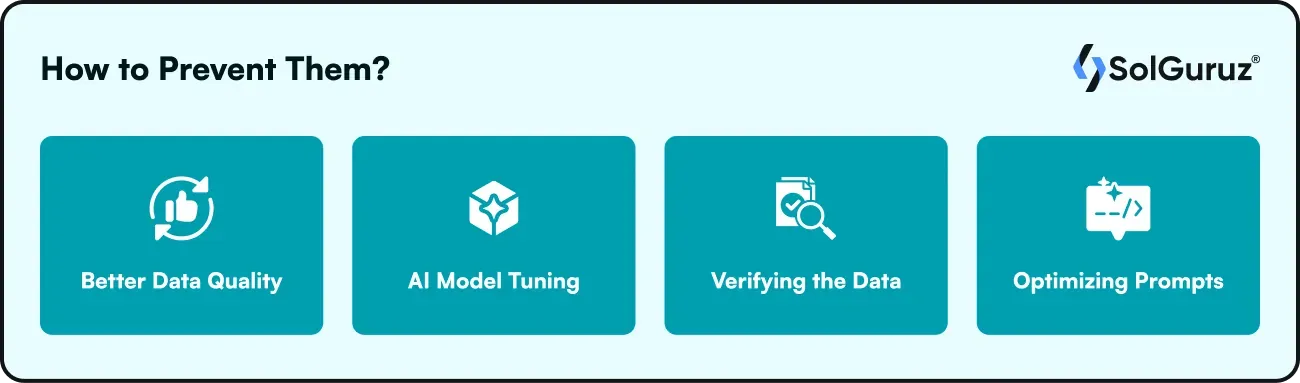
When there are causes for AI to hallucinate, then there are ways it can be prevented. Here are some ways:
Better Data Quality
One of the best strategies for model deployers to reduce AI hallucinations is to use high-quality training data. Deployers can lower the possibility that models will produce inaccurate or deceptive results by making sure that training datasets are representative, diversified, and devoid of major biases.
By finding gaps and filling them with more pertinent data, methods like data augmentation and active learning can help improve the quality of datasets.
AI Model Tuning
AI models must be adjusted and improved to reduce hallucinations and increase overall dependability. These procedures lessen errors, increase the relevance of results, and match a model's behavior to user expectations.
Fine-tuning is particularly useful for tailoring a general-purpose model to particular use cases, making sure it functions well in certain situations without producing inaccurate or irrelevant results.
Verifying the Data
By comparing AI-generated outputs to reliable sources or existing knowledge, human reviewers can identify mistakes, fix inaccuracies, and avert potentially dangerous outcomes.
Human review adds another level of scrutiny to the workflow, especially for applications like law or medicine, where mistakes can impact someone's life.
Optimizing Prompts
Careful prompt design is crucial for reducing AI hallucinations from the perspective of end users. A clear and detailed prompt provides the AI model with a stronger foundation for producing relevant outcomes, whereas a vague one may result in a hallucinated or irrelevant response.
Several prompt engineering techniques can be used to improve output dependability. For instance, dividing difficult tasks into smaller, easier-to-manage processes lessens the cognitive load on the AI and lowers the possibility of mistakes.
Doing all four together, on a system people depend on, is the part that takes engineering rather than prompting. That is the substance of LLM development.
Where Hallucination Is Useful
Hallucination is in general a relative and subjective phenomenon, however, it has some useful applications in some places.
Creative Fields and Art
AI hallucination presents a fresh method of artistic production, giving designers, artists, and other creatives a means of producing unique and visually striking graphics. Art always asks for a fresh and creative perspective, and AI hallucinations help them.
Artists can create bizarre and dreamlike pictures that can inspire new art forms and genres thanks to artificial intelligence's hallucinogenic qualities.
Gaming Industry
Additionally, AI hallucination improves VR and game immersion. Game developers and VR designers can create new worlds that elevate the user experience by using AI models to create virtual settings and induce hallucinations. Additionally, hallucinations can provide game encounters with a sense of surprise, unpredictability, and originality.
Closing in
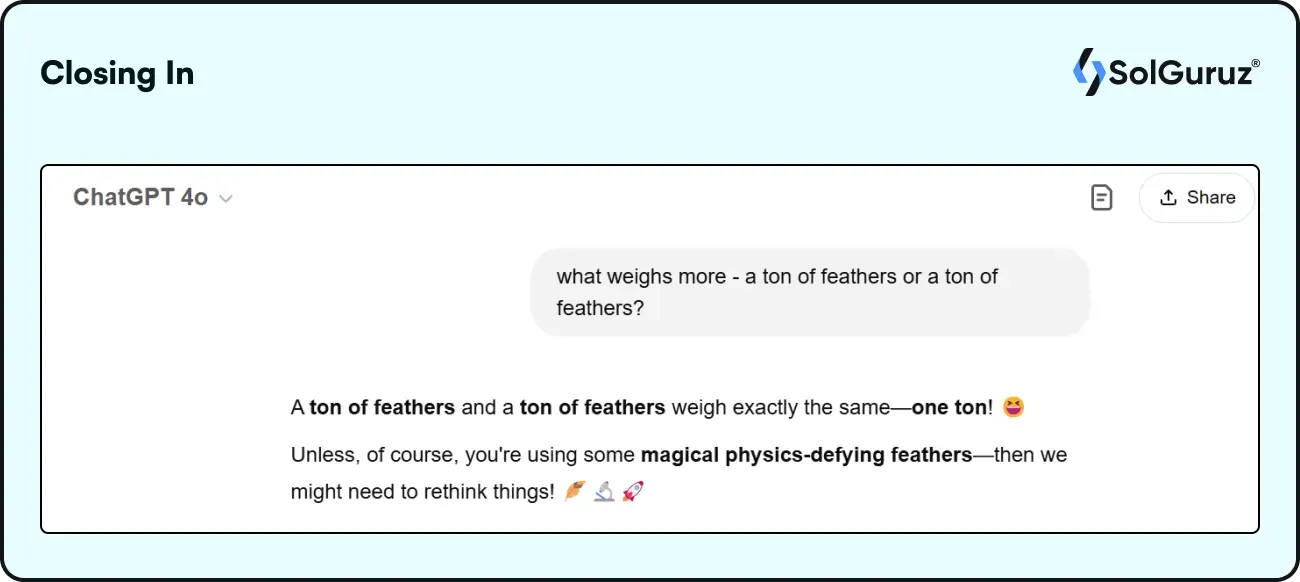
Hallucinations are surely a thing to resolve in AI, but surely GPT 4o is trained for "sarcasm". This is progress. Mimicking is an advanced human action that requires great training.
Well, talking about progress, AI models are surely making progress through better training.
They are being trained to cover up like humans, using sarcasm as a shield to cover inaccurate answers or answers they don't know.
Surely, a positive sign.
FAQs
1. What is an example of an AI hallucination?
An AI hallucination is when a model generates false information with confidence, such as unsafe advice (e.g., incorrect recipes) or made-up sources like fake research papers or websites.
2. Are AI hallucinations dangerous for businesses?
Yes. They can lead to incorrect decisions, misinformation, compliance risks, and loss of customer trust, especially in sensitive industries like healthcare, finance, and legal services.
3. Can prompt engineering reduce AI hallucinations?
Yes. Clear instructions, strong context, step-by-step prompts, and restricting outputs to trusted sources help reduce hallucinations and improve accuracy.
4. What is the difference between AI hallucination and AI bias?
Hallucination is when AI generates false information. Bias is when outputs are skewed or unfair due to training data, affecting fairness and representation.
5. Can Retrieval-Augmented Generation (RAG) help prevent hallucinations?
Yes. RAG reduces hallucinations by grounding AI responses in external data sources like databases or documents instead of relying only on trained knowledge.
Looking for an AI Development Partner?
SolGuruz helps you build reliable, production-ready AI solutions - from LLM apps and AI agents to end-to-end AI product development.

Strict NDA

Trusted by Startups & Enterprises Worldwide

Flexible Engagement Models

1 Week Risk-Free Trial
Next-Gen AI Development Services
As a leading AI development agency, we build intelligent, scalable solutions - from LLM apps to AI agents and automation workflows. Our AI development services help modern businesses upgrade their products, streamline operations, and launch powerful AI-driven experiences faster.


Why SolGuruz Is the #1 AI Development Company?
Most teams can build AI features. We build AI that moves your business forward.
As a trusted AI development agency, we don’t just offer AI software development services. We combine strategy, engineering, and product thinking to deliver solutions that are practical, scalable, and aligned with real business outcomes - not just hype.
Why Global Brands Choose SolGuruz as Their AI Development Company:

Business - First Approach
We always begin by understanding what you're really trying to achieve, like automating any mundane task, improving decision-making processes, or personalizing user experiences. Whatever it is, we will make sure to build an AI solution that strictly meets your business goals and not just any latest technology.
Custom AI Development (No Templates, No Generic Models)
Every business is unique, and so is its workflow, data, and challenges. That's why we don't believe in using templates or ready-made models. Instead, what we do is design your AI solution from scratch, specifically for your needs, so that you get exactly what works for your business.
Fast Delivery With Proven Engineering Processes
We know your time matters. That's why we follow a solid, well-tested delivery process. Our developers follow AI-Assisted Software Development principles to move fast and stay flexible to make changes. Moreover, we always keep you posted at every step of the AI software development process.
Senior AI Engineers & Product Experts
When you work with us, you're teaming up with experienced AI engineers, data scientists, and designers who've delivered real results across industries. And they are not just technically strong but actually know how to turn complex ideas into working products that are clean, efficient, and user-friendly.
Transparent, Reliable, and Easy Collaboration
From day one, we keep clear expectations on timelines, take feedback positively, and share regular check-ins. So that you'll always know how we are progressing and how it's going.
From Our Portfolio
AI Projects We Have Shipped to Production
SolGuruz has shipped 102+ products across 14 industries. See how SolGuruz built production AI applications - LLM-powered clinical documentation, AI travel planning, healthcare staffing intelligence, and AI journaling - using GPT-4, Claude, and custom ML models at real-world scale.

AI Clinical Notes Platform That Turns 2-Hour Documentation Into One Click
NoteCliniq transforms clinical conversations into HIPAA-compliant SOAP notes in seconds, eliminating 2+ hours of manual documentation daily for busy clinicians.
Key Outcomes

AI-Powered Trip Planner App Solution
Explore how SolGuruz created an AI-powered trip planner app. It is an exclusive AI vacation planner that helps with finding hotels, cabs, places, and complete itineraries.
Key Outcomes
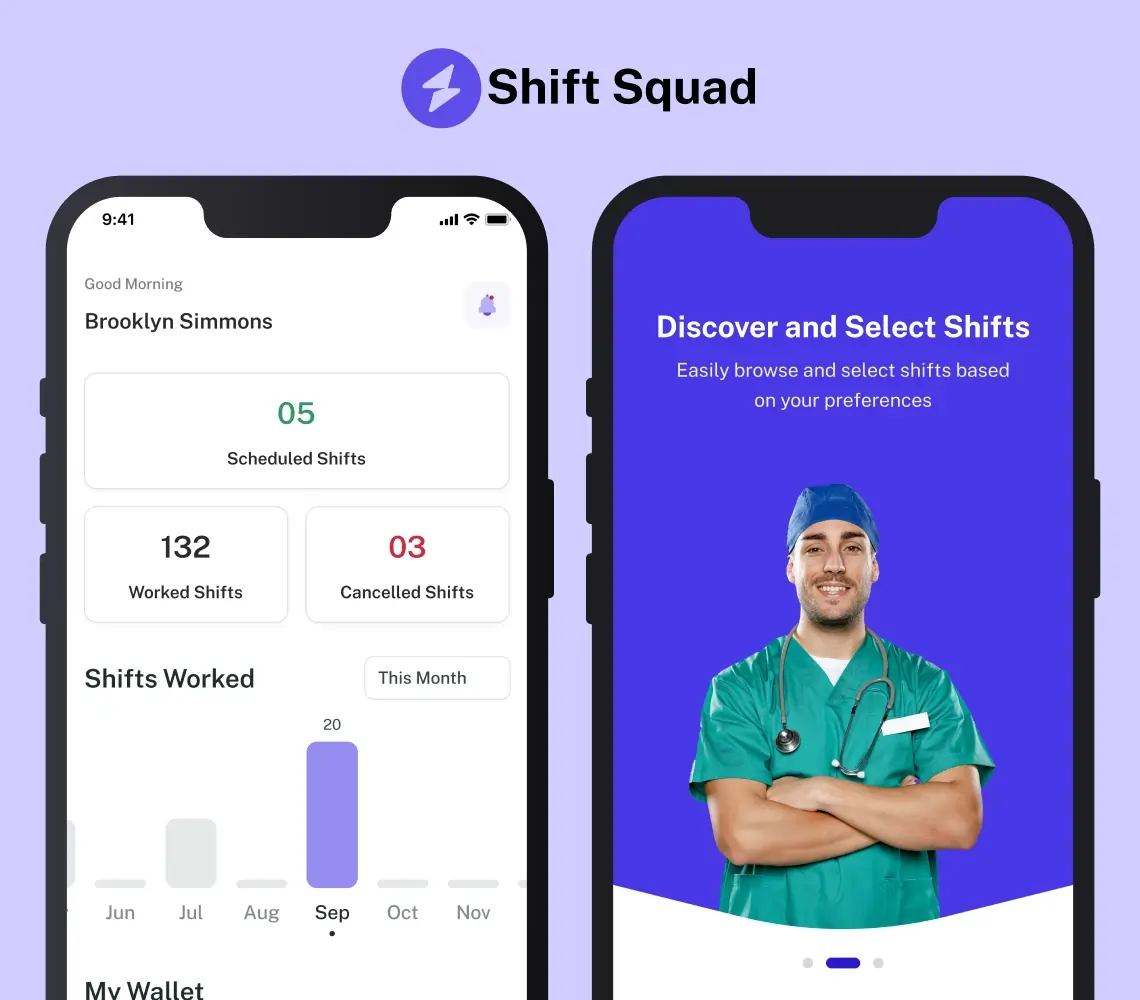
AI-Powered Healthcare Staffing App Solution
Explore our AI-powered healthcare staffing app case study. See how SolGuruz’s expertise transforms nurse staffing challenges into seamless solutions.
Key Outcomes

AI Journaling App Development Solution
Discover with us how we built Dream Story, an AI-powered journaling application that helps manage daily notes by capturing your thoughts and emotions. A one-stop solution for those who love noting down daily summaries!
Key Outcomes
Whether you’re modernizing a legacy system or launching a new AI-powered product, our AI engineers and product team help you design, develop, and deploy solutions that deliver real business value.

