

Outsource Web Development in 2026: Benefits, Risks, Models, and What to Watch Out For
Outsourcing web development can save you 30-70% on costs and get your product live faster. But it only works when you pick the right model, the right partner, and set up the right guardrails. Here’s everything you need to know before you start.

Summarise with AI


Let me be direct with you.
Most businesses that outsource web development don’t fail because outsourcing is broken. They fail because they outsource to the wrong team, with the wrong expectations, and no process in place.
I’ve seen it from both sides. We’ve worked with founders who tried outsourcing, got burned, came to SolGuruz, and finally got a product they were proud of. The difference wasn’t the concept of outsourcing – it was how it was set up.
So in this guide, I’m going to give you the real picture: the benefits of outsourcing web development, the actual risks (not the sanitized version), the engagement models available in 2026, and how to know whether it’s the right call for your business right now.
No fluff. Just what you actually need to decide.
Table of Contents
What Does It Mean to Outsource Web Development?
When you outsource web development, you hand off some or all of your web development work to an external team – a dedicated development company, an offshore agency, or individual contractors hired on demand.
The external team handles what you need: building your website from scratch, maintaining an existing one, adding new features, designing the front-end, writing APIs on the back-end, or all of the above.
They’re not your employees. You don’t pay their benefits, rent their desk space, or manage their HR. You agree on scope, timeline, and output. They deliver.
Companies outsource to partners in India, Eastern Europe, Latin America, and Southeast Asia – regions known for strong engineering talent at a fraction of Western salaries. At SolGuruz, for instance, we’ve built web products for clients in the US, UK, and Australia using our India-based development teams, helping them launch faster and at significantly lower cost.
Industry Snapshot
- IT outsourcing market revenue is projected to hit $591.2B in 2025 and $812.7B by 2029 (Statista)
- Nearshoring to Latin America can cut development costs by 30-70% vs US rates
- 72% of US homebuyers now use smartphones to find properties – a signal of how critical web products have become across sectors
- Businesses spending over $700 billion annually on outsourcing cite cost savings and speed as primary drivers
In-House vs. Outsourced Web Development: An Honest Comparison
Before we get into pros and cons, here’s the side-by-side view most decision-makers actually need:
| Factor | In-House Team | Outsourced Web Dev |
| Cost | High salaries, benefits, infra | Lower – pay for what you need |
| Hiring speed | Slow – weeks to months | Fast – team ready in days |
| Talent pool | Limited to the local market | Global specialists at your disposal |
| Scalability | Hard – hiring/firing cycles | Easy – scale up or down anytime |
| IP control | High – everything in-house | Manageable with NDA + SoW |
| Time to launch | Slower – ramp-up time needed | Faster – proven workflows in place |
| Communication | Instant – same office, same zone | Structured – async + daily standups |
| Best for | Long-term core product team | Specific projects or fast scale-ups |
There’s no universal winner here. Both models work in different situations. But if you’re a startup or a growth-stage company that needs to move fast, outsourcing almost always wins on cost, speed, and access to specialists.
Pros and Cons of Outsourcing Web Development – At a Glance
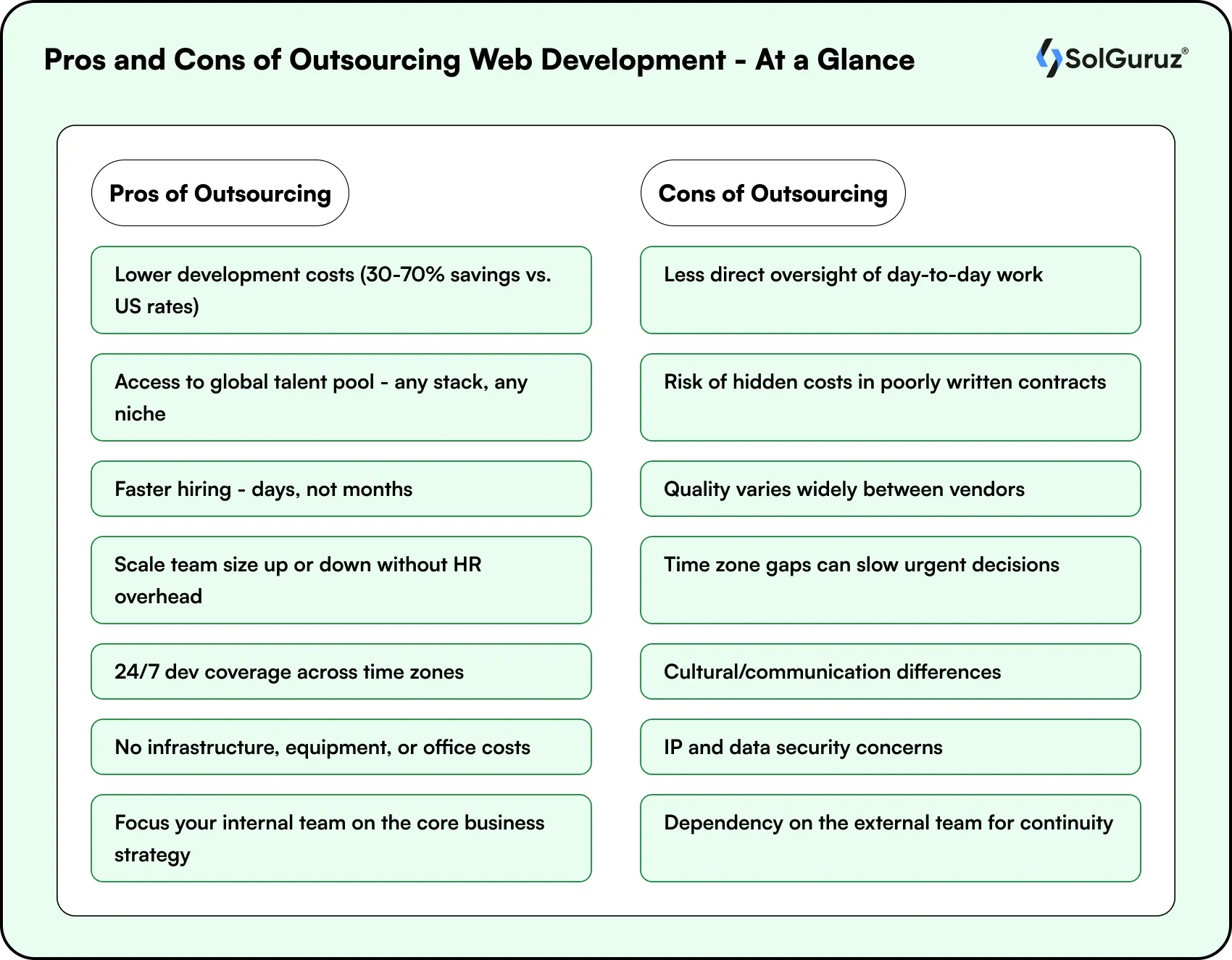
| Pros of Outsourcing | Cons of Outsourcing |
| Lower development costs (30-70% savings vs. US rates) | Less direct oversight of day-to-day work |
| Access to global talent pool – any stack, any niche | Risk of hidden costs in poorly written contracts |
| Faster hiring – days, not months | Quality varies widely between vendors |
| Scale team size up or down without HR overhead | Time zone gaps can slow urgent decisions |
| 24/7 dev coverage across time zones | Cultural/communication differences |
| No infrastructure, equipment, or office costs | IP and data security concerns |
| Focus your internal team on the core business strategy | Dependency on the external team for continuity |
Let’s break these down properly. The summary table above is just the starting point.
The Real Benefits of Outsourcing Web Development
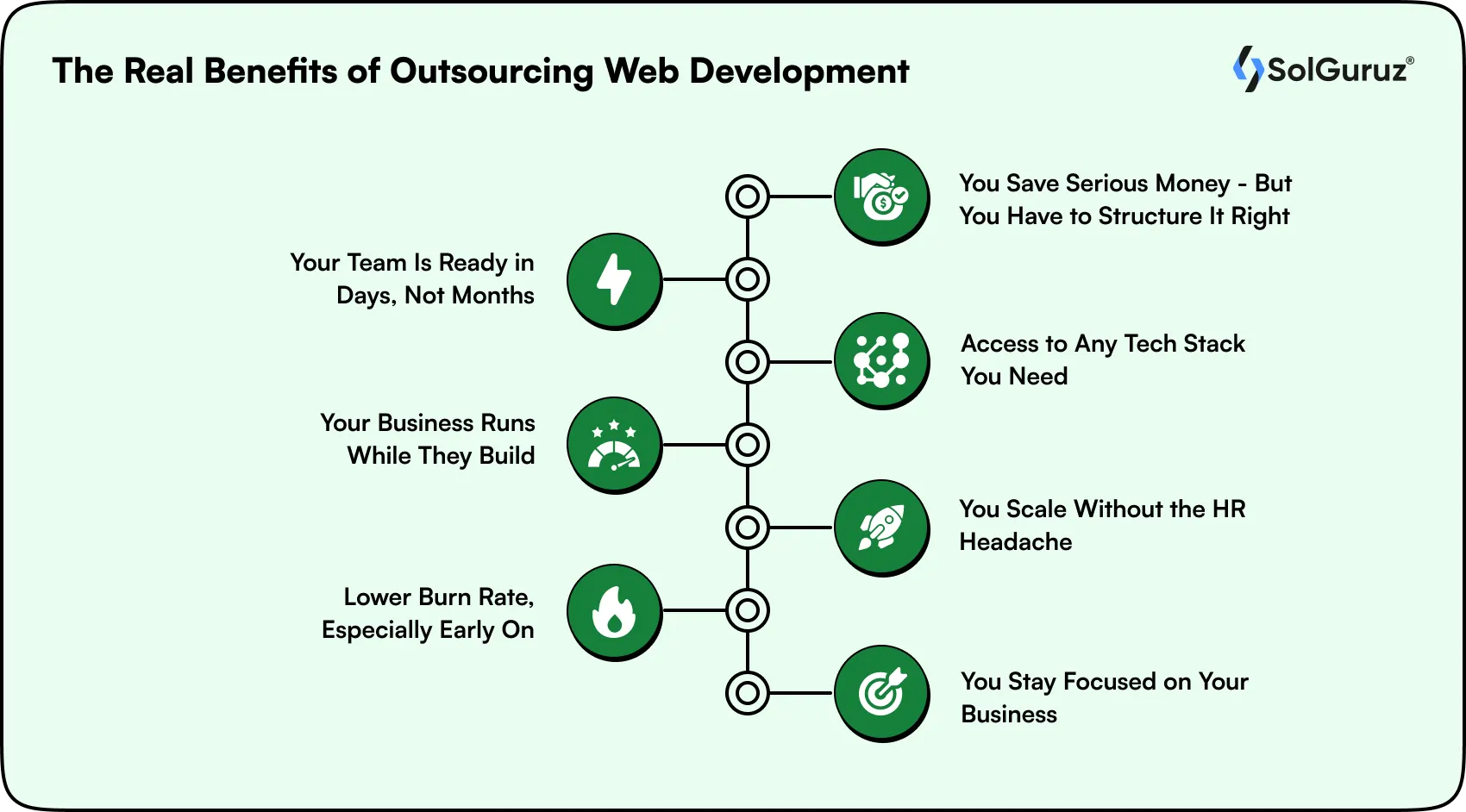
1. You Save Serious Money – But You Have to Structure It Right
A senior full-stack developer in the US costs $120,000-$160,000 per year in salary alone, not counting benefits, onboarding, and equipment. The same skill level in India or Eastern Europe? Roughly $25,000-$55,000 per year.
That’s not a small difference – it’s the kind of saving that can fund an entire marketing budget or a second product line.
But the savings only materialize if you choose a team with clear deliverables and milestone-based payment. Vague scope + hourly billing = budget overruns. We’ll get to that.
2. Your Team Is Ready in Days, Not Months
Hiring a developer in-house takes 6-12 weeks minimum. By the time you post, screen, interview, negotiate, and onboard, your competitor has already shipped.
When you outsource to an established development company, you get a ready team. The developers already know each other, they have tooling set up, and they’ve done this before. At SolGuruz, most new projects have developers assigned within 48-72 hours of a signed agreement.
3. Access to Any Tech Stack You Need
Need a React.js front-end with a Node.js back-end? A Next.js app for better SEO? A Python-based AI API? You’re not limited to whoever you can find and afford locally.
Outsourcing gives you access to specialists in React.js, Next.js, Node.js, Angular, Vue, and whatever else your product needs – without having to train anyone or wait for the right hire to appear.
4. Your Business Runs While They Build
If your outsourced team is in India (IST) and you’re in New York (EST), there’s a 9.5-hour difference. That’s not a problem – that’s a feature.
Your team finishes for the day. Your development partner picks up right where you left off. When you log in the next morning, there’s new work to review. It’s continuous delivery without you burning out.
5. You Scale Without the HR Headache
Need three developers for a three-month sprint? Then one for maintenance after? With an outsourced team, you adjust the contract. No layoffs, notice periods, no morale hit.
This kind of flexibility is something no in-house team can match – and it matters enormously at the growth stages where your development needs change every quarter.
6. Lower Burn Rate, Especially Early On
If you’re a startup, every dollar of runway is precious. An in-house dev team means salaries from day one, whether your product makes money or not. Outsourcing converts that fixed cost to variable – you spend when you build.
7. You Stay Focused on Your Business
Web development without experience is a black hole for founder time. You end up in the weeds on technical decisions you’re not equipped to make, debating frameworks, reviewing pull requests, and losing sight of your actual market.
When you hire dedicated web developers through an outsourced model, a good partner handles the technical complexity and keeps you in the loop without pulling you into the engine room.
The Real Risks of Outsourcing Web Development (And How to Beat Them)
Here’s where most outsourcing blog posts go soft on you. They list the risks and move on. I’m not going to do that – I’m going to tell you how to actually handle each one.
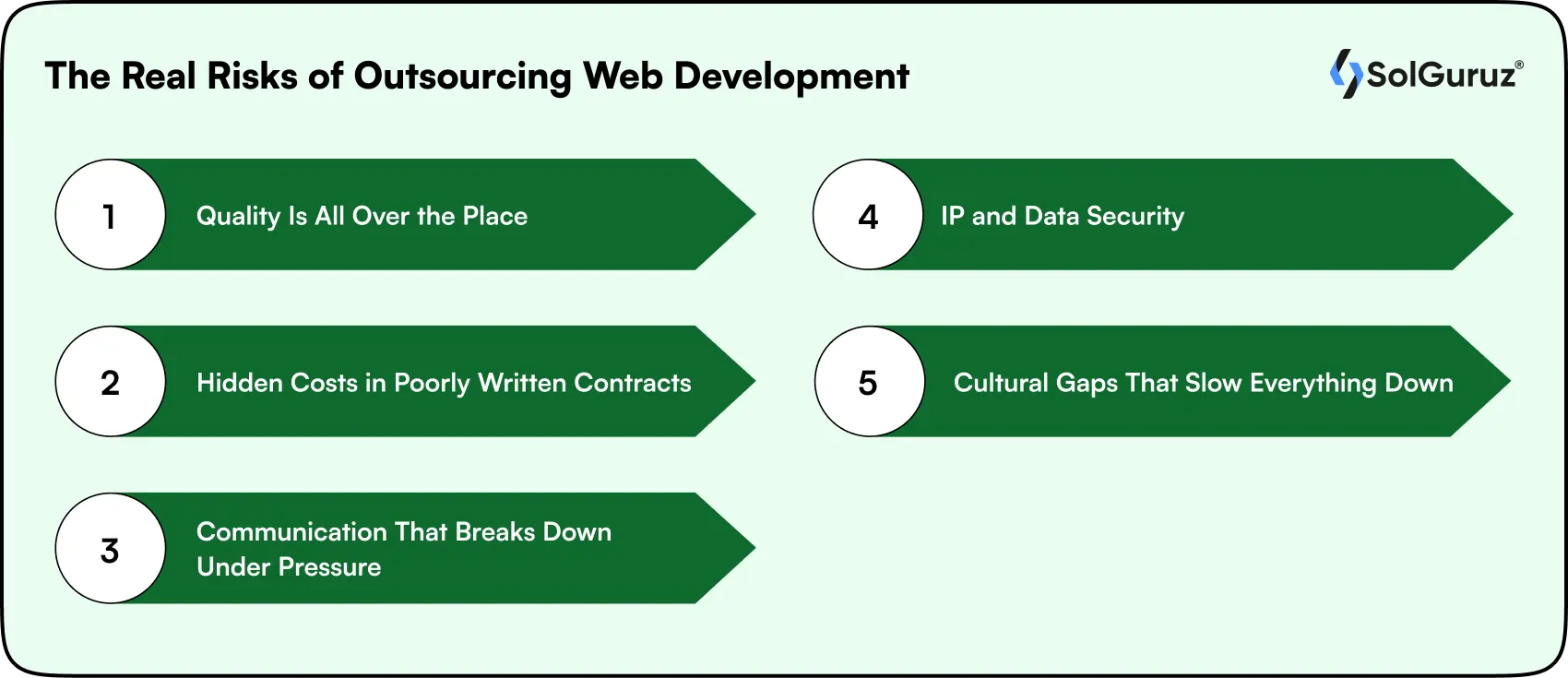
Risk 1: Quality Is All Over the Place
The outsourcing market ranges from world-class engineers to developers who copy-paste code from Stack Overflow and call it done. The difference isn’t always obvious from a proposal or a portfolio.
How to handle it: Ask for a paid discovery sprint before committing to full development. Request references from past clients in a similar industry. And look for a partner that shows you working demos, not just screenshots.
Risk 2: Hidden Costs in Poorly Written Contracts
A fixed-price contract sounds safe until you realize ‘scope changes’ cover almost everything. A good outsourcing partner will document everything in a Statement of Work – features, timelines, payment milestones, third-party tools, cloud costs, and what ‘change request’ means specifically.
How to handle it: Read every line of the SoW before signing. If they won’t define the scope clearly, that’s your answer right there.
Risk 3: Communication That Breaks Down Under Pressure
Things get messy when requirements change, a bug appears before launch, or a client needs a quick fix at 3 pm on a Friday. If you don’t have a clear communication protocol, things fall through the cracks.
How to handle it: Set up daily async standups (Slack or Loom), a weekly video review call, and weekly written progress reports. At SolGuruz, we share morning and evening scrum updates, so nothing ever waits more than a few hours.
Risk 4: IP and Data Security
You’re sharing your business logic, your codebase, maybe your customer data, with an external team you haven’t met in person. That’s a real risk.
How to handle it: Sign a strict NDA and a Non-Compete agreement before sharing anything. Ensure code ownership is in the contract. Ask your partner what security protocols they follow and where data is stored.
Risk 5: Cultural Gaps That Slow Everything Down
Work styles, communication norms, and expectations vary by culture. A developer who nods in a meeting might mean ‘I heard you’ rather than ‘I agree’ – and you might not discover the gap until a milestone is missed.
How to handle it: Invest in onboarding your outsourced team the same way you’d onboard an internal hire. Share your product vision, your business goals, and your definition of done. Over-communicate early. It saves ten hours of rework later.
The 3 Outsourcing Models – Which One Fits Your Situation?
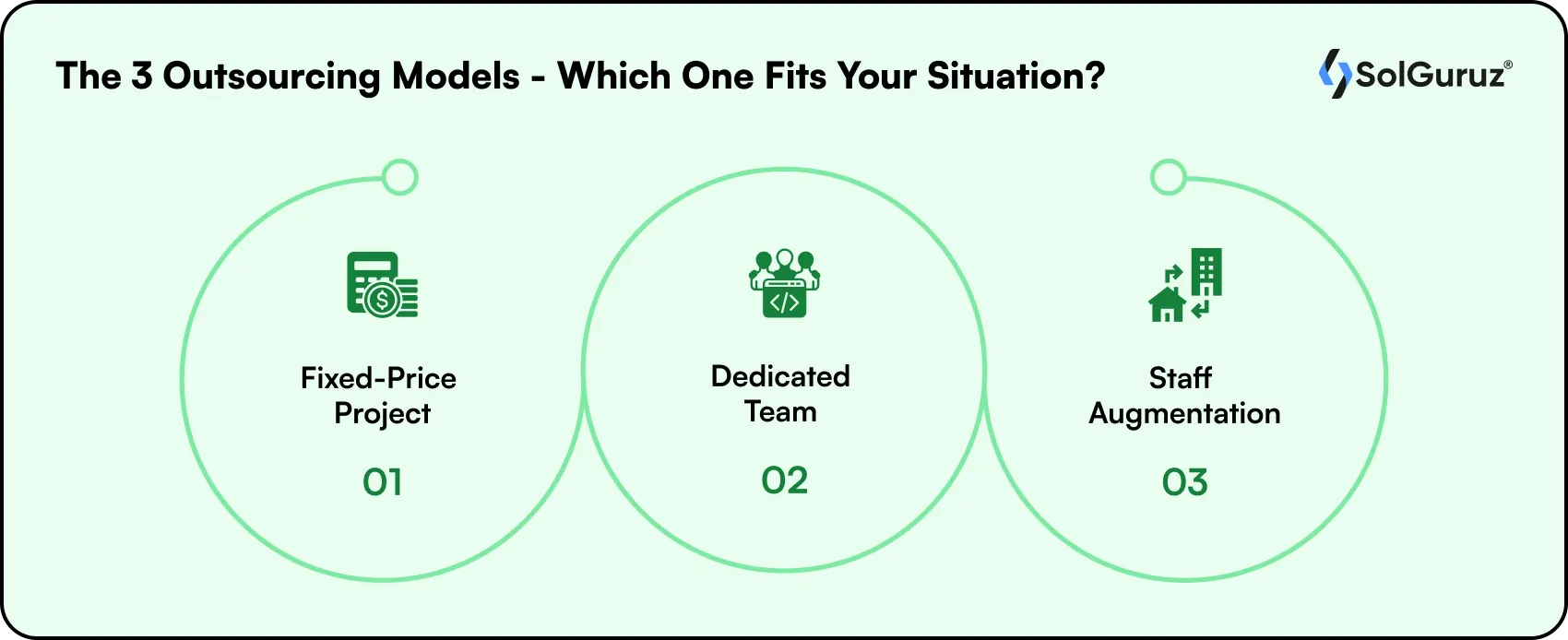
Not all outsourcing is the same. These are the three main engagement models, and each suits a different stage and type of project:
| Model | What It Is | Best For | Pros | Cons |
| Fixed-Price Project | Defined scope + timeline | Short one-off projects | Predictable cost | Rigid if scope changes |
| Dedicated Team | Your offshore dev team | Long-term or evolving products | Full focus + alignment | Higher monthly cost |
| Staff Augmentation | Add devs to your team | Skill gaps + deadline crunches | Max control + flexibility | You manage them directly |
For most startups and scale-up businesses, the dedicated development team model strikes the best balance. You get committed developers who understand your product deeply, while retaining flexibility to adjust scope and resourcing as your needs evolve.
When Does It Actually Make Sense to Outsource Web Development?
Outsourcing works well in these situations:
- You need to ship something fast and don’t have developers in-house
- You need a tech stack that your team doesn’t cover
- You’re a startup and need to preserve runway
- Your product has a defined scope (MVP, feature sprint, redesign)
- You need to scale development for a high-growth period without permanent hires
- Your core competency is business, not software engineering
It may not be the right fit when:
- Your product requires constant real-time collaboration that async tools can’t support
- Your industry is highly regulated with strict data residency requirements
- You’ve had multiple failed outsourcing experiences without understanding why
How to Choose the Right Web Development Outsourcing Partner
This is where the decision actually gets made. Here’s what to look for, in order of importance:
1. Portfolio of real products, not just landing pages. Ask if you can speak with past clients.
2. Clear process – how do they handle scope changes, delays, and communication? If they can’t describe it, they don’t have one.
3. Tech stack match – do their developers specialize in what you need?
4. Legal protection – NDA, SoW, IP ownership clause, and Non-Compete all in the contract.
5. Cultural fit – are they responsive, transparent, and willing to push back when something doesn’t make sense?
6. Trial engagement – any serious partner will let you start with a short paid sprint before committing to a full engagement.
How SolGuruz Handles Web Development Outsourcing Differently
We’ve been on the receiving end of rescue projects from clients burned by bad outsourcing partners. So we built our process specifically to address what goes wrong most often.
1. Transparency From Day One
Before development starts, we sign a detailed Statement of Work that lists every feature agreed upon, every milestone, every payment cycle, third-party tool requirements, cloud costs, and exactly what a change request means. No surprises later.
2. Daily Communication That Actually Works
We share day-wise weekly timesheets so clients know the exact hours spent by each team member on each task. We take morning and evening scrum calls, schedule a weekly demo with your team, and send a written progress report to all stakeholders. You’re never in the dark.
3. Quality That Doesn’t Slip
We write user stories against your requirements, build detailed wireframes and clickable prototypes, so you see the product before a line of code is written, write test cases, and log every defect in a project management tool with a resolution timeline.
4. Legal Protection as Standard
Strict NDA and Non-Compete agreements are signed as part of every engagement. Code ownership stays with you. Your business logic and client data are protected.
If you’re evaluating partners and want to see how we’ve handled similar projects, check out our offshore development case studies.
What Does It Cost to Outsource Web Development?
Costs vary enormously depending on location, project complexity, and engagement model. Here’s a realistic breakdown:
Cost Ranges (2026 Estimates)
- Offshore (India, Southeast Asia): $20-45/hour
- Eastern Europe (Poland, Ukraine): $45-80/hour
- Latin America (nearshore to US): $50-90/hour
- US-based outsourcing: $100-180/hour
Project benchmarks:
- Basic business website (5-10 pages): $5,000 – $15,000
- Mid-tier web app with custom features: $20,000 – $60,000
- Complex platform (SaaS, marketplace): $60,000 – $200,000+
Note: A dedicated team model is billed monthly (typically $8,000-$25,000/month for a 2-4 person team) and delivers better value for ongoing products.
The lowest cost is rarely the best value. A $20/hour developer who produces code that needs to be rewritten costs more in the end than a $40/hour developer who ships clean, documented work.
Before You Sign Anything – Your Outsourcing Checklist
- Define your project scope in writing before approaching any vendor
- List the tech stack you need or ask for recommendations with reasoning
- Request a portfolio of projects similar to yours
- Ask to speak with two past clients directly
- Confirm the contract includes: NDA, SoW, IP clause, and milestone payment terms.
- Set up a 1-2 week paid trial sprint before a full commitment
- Agree on communication tools, update frequency, and who your point of contact is
- Define what ‘done’ means for each feature before it goes into development
Wrap Up
Outsourcing web development isn’t a shortcut. It’s a decision that, when made carefully, puts a skilled team behind your product without the overhead of building one from scratch.
The benefits are real: cost savings of 30-70%, faster time to market, access to any tech stack globally, and the flexibility to scale without the HR cycle. The risks are just as real – but every single one is manageable with the right partner and the right contract.
The companies that struggle with outsourcing usually skip the process. They find someone cheap, skip the SoW, and hope communication works out. It doesn’t.
The ones that succeed treat their outsourced team like a true extension of their business – with onboarding, clear goals, structured communication, and mutual accountability.
If you’re ready to start, or if you’ve been burned before and want to try again with a partner that has the guardrails in place, let’s talk. We offer a 1-week free trial on new engagements, and our NDA is signed before the first conversation.
FAQs
1. What exactly is web development outsourcing?
Web development outsourcing means hiring an external development company or team to build, maintain, or improve your website or web application, instead of using internal employees. The external team operates independently but delivers work as per your requirements, scope, and timeline.
2. What are the biggest risks of outsourcing web development?
The main risks are quality inconsistency, hidden costs from poorly scoped contracts, communication breakdowns across time zones, IP and data security concerns, and over-dependence on a vendor. All of these are manageable with the right partner, a detailed contract, and structured communication protocols.
3. How much can I save by outsourcing web development?
Depending on the region you outsource to, you can save 30-70% on development costs compared to hiring in the US or UK. India-based teams typically cost $20-45/hour vs $100-180/hour for US-based developers. The savings are real, but only if you pick a partner who delivers quality output.
4. What are the three main outsourcing engagement models?
The three main models are: Fixed-Price Project (defined scope and timeline, best for short one-off builds), Dedicated Development Team (your own offshore team, best for long-term products), and Staff Augmentation (adding individual developers to your existing team for specific skill gaps or deadline crunches).
5. How do I know if a web development partner is trustworthy?
Ask for references from past clients in your industry and speak to them directly. Review their portfolio for live products, not just mockups. Ask for a trial sprint before signing a long-term contract. Verify that their contract includes an NDA, SoW, IP ownership clause, and defined milestone payments.
6. Does SolGuruz offer a trial before a full engagement?
Yes. We offer a 1-week free trial on all new development engagements so you can see how we work before committing. All conversations are covered under a strict NDA.

Written by
Satendra Bhadoria
Satendra Bhadoria is the Co-Founder and Chief Operating Officer at SolGuruz, bringing over a decade of experience in large-scale operations and delivery management within the global BPO and services industry. Before co-founding SolGuruz, he managed large delivery teams supporting clients across the United States, Europe, and Australia. At SolGuruz, Satendra oversees delivery governance, quality frameworks, hiring and staffing models, offshore development center (ODC) setups, and client engagement practices. His day-to-day work revolves around execution discipline, process maturity, delivery reliability, and building team structures that scale effectively for both startups and enterprises. He is also actively engaged in domain-driven delivery initiatives, including real estate technology platforms, property workflow systems, and operations-focused digital solutions areas, where process clarity and dependable execution are critical for long-term growth. He also contributes as a core member of the Uttar Bharatiya Business Network (UBBN), engaging with business leaders and entrepreneurs on operational practices, collaboration models, software solutions, and sustainable growth strategies. This involvement keeps his perspective grounded in real business operations beyond software delivery.


From Insight to Action
Insights define intent. Execution defines results. Understand how we deliver with structure, collaborate through partnerships, and how our guidebooks help leaders make better product decisions.
 How we Work
Ready to Outsource Your Web Development?
Get a dedicated web team that delivers on time. NDA-protected. 1-week free trial.

Strict NDA

Trusted by Startups & Enterprises Worldwide

Flexible Engagement Models

1 Week Risk-Free Trial