

MVP Development Cost in 2026: Complete Breakdown by Industry [With Calculator]
Discover what MVP development actually costs in 2026 across different industries. This guide breaks down pricing factors, hidden expenses, and real-world examples. Use our calculator to estimate your project budget and make informed decisions about your product launch.

Summarise with AI


How Much Should You Budget for Your MVP in 2026?
Well, I agree you have an idea. You know you need to test it before going all in.
But the numbers you see online range from $10,000 to $500,000, and no one explains why.
So, what is the truth?
MVP development costs vary wildly based on what you are building, who builds it, and how you approach the project.
This guide walks you through the actual numbers. You will see what drives costs up or down, what different industries typically spend, and how to plan your budget without guessing.
Table of Contents
What Exactly is an MVP and Why Does It Matter?
An MVP (Minimum Viable Product) is the simplest version of your product that solves a real problem for your users. It is not about building everything you can imagine. It is about building just enough to test your core idea with real people.
Think of it like opening a food truck before building a restaurant. You test the menu, learn what customers want, and adjust before making a massive investment.
Hmm, yes; the same logic applies to software. Launch with core features, get feedback, then expand based on what users actually need.
Let Me Break Down the MVP Development Costs in 2026
Let’s start with the basics. MVP development costs typically fall into these ranges:
Simple MVP: $15,000 – $40,000 Basic apps with standard features like user login, profiles, and simple interactions. Here, you may think of task managers, basic booking systems, or simple marketplaces.
Medium Complexity MVP: $40,000 – $100,000 Apps with real-time features, payment processing, or third-party integrations. Examples include delivery apps, social platforms, or subscription services.
Complex MVP: $100,000 – $250,000+ Products with advanced features like AI, complex databases, multi-user roles, or heavy backend processing. This includes fintech platforms, healthcare systems, or enterprise tools.
These numbers change based on who builds your product and where they are located.
What Actually Affects Your MVP Development Cost?
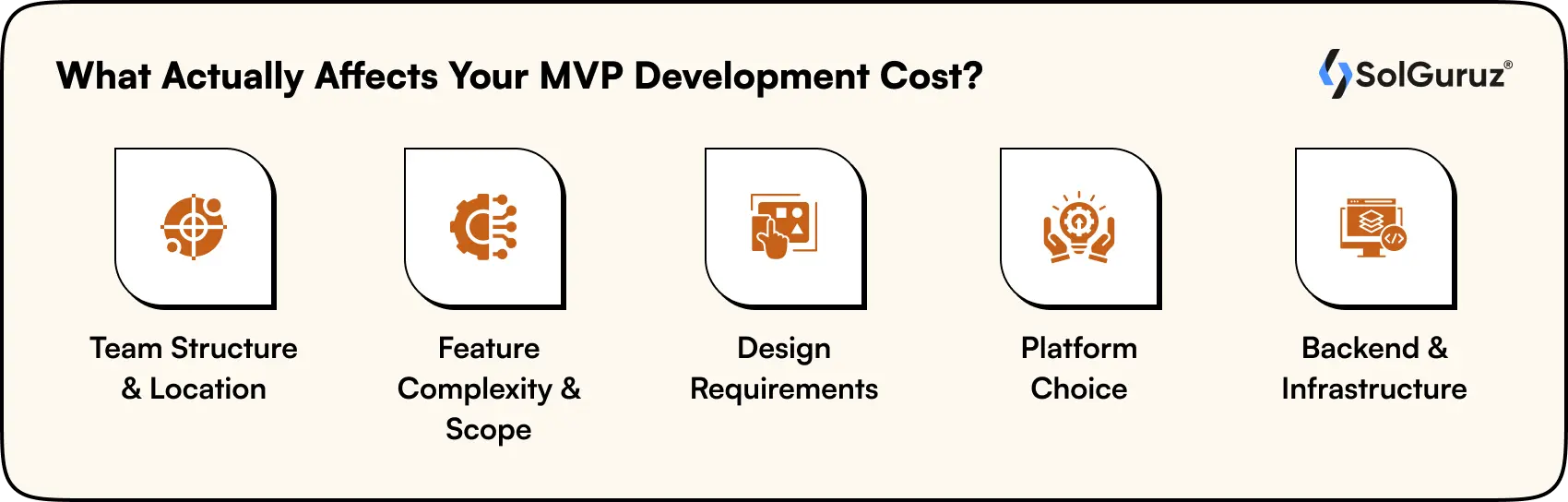
Team Structure and Location
Your biggest cost variable is the choice of who builds your MVP.
- Freelance Developers: $20 – $150 per hour. Lower upfront costs, but you manage everything. Quality varies significantly. Good for very simple projects or tight budgets.
- In-House Team: $80 – $200+ per hour. Full control and alignment with your business. High overhead costs, including salaries, benefits, equipment, and office space. Makes sense for long-term products.
- Outsourcing Companies: $30 – $150 per hour. Balanced approach with dedicated teams and project management. Costs vary by location. Eastern Europe and Asia typically charge less than North America or Western Europe.
Feature Complexity and Scope
Every feature adds time and cost. Here’s what different features typically require:
- User authentication and profiles: 40-80 hours
- Payment integration: 60-100 hours
- Real-time chat or notifications: 80-120 hours
- Admin dashboard: 100-150 hours
- Third-party API integrations: 40-100 hours per integration Search and filters: 60-100 hours
The more features you add, the more interactions between them need testing. This compounds development time.
Design Requirements
A basic interface with standard components costs less than custom designs with animations and unique interactions.
- Template-based design: $2,000 – $8,000
- Custom UI/UX design: $8,000 – $25,000
- Advanced animations and interactions: $15,000 – $40,000+
Platform Choice
Building for a single platform costs less than building for multiple platforms.
- Single platform (iOS or Android): Standard cost
- Both iOS and Android (native): 1.8x – 2x cost
- Cross-platform (React Native, Flutter): 1.3x – 1.5x cost
- Web application: Similar to single mobile platform
- Web + Mobile: 1.5x – 2x cost
Backend and Infrastructure
Your app needs a backend to store data and handle logic.
- Simple backend with basic API: $5,000 – $15,000
- Moderate backend with user management: $15,000 – $35,000
- Complex backend with real-time processing: $35,000 – $80,000+
MVP Development Cost Breakdown by Industry
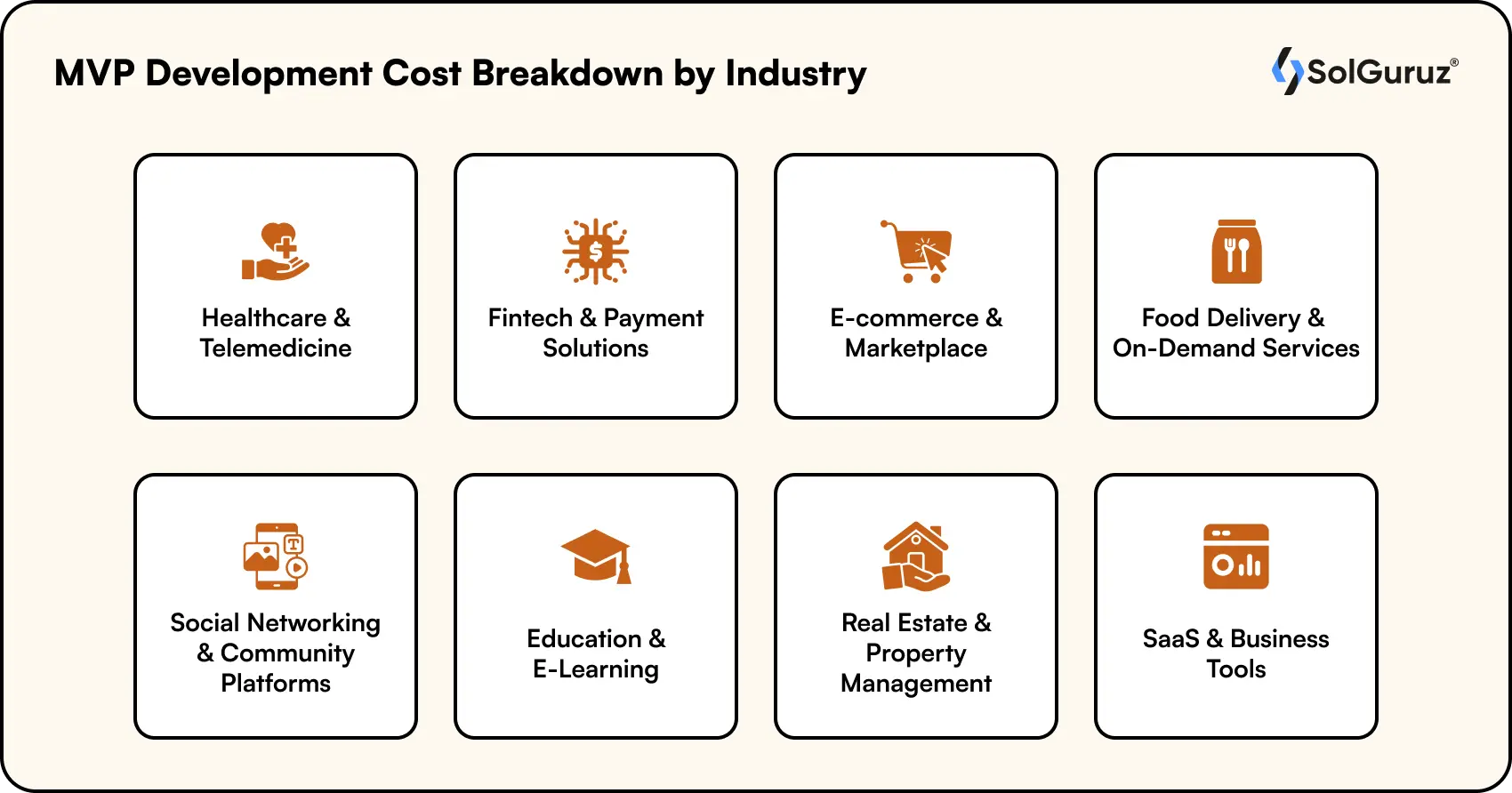
Different industries have different baseline requirements. Here’s what typical MVPs cost in major sectors.
Healthcare and Telemedicine
Typical Cost Range: $80,000 – $200,000
Healthcare apps are subject to strict regulations and must maintain strong security. HIPAA compliance, patient data protection, and secure communication add complexity.
Common features include appointment scheduling, video consultations, prescription management, and patient records. These require careful handling of sensitive information.
Fintech and Payment Solutions
Typical Cost Range: $100,000 – $250,000
Financial apps require robust security, regulatory compliance, and reliable payment processing. Data encryption, fraud detection, and transaction management increase development time.
Whether you are building a payment app, lending platform, or investment tool, expect higher costs due to security and compliance requirements.
E-commerce and Marketplace
Typical Cost Range: $40,000 – $120,000
Marketplace MVPs need product listings, search, shopping carts, payment processing, and order management. Two-sided marketplaces (buyer and seller interfaces) cost more than simple online stores.
The complexity grows with features like ratings, reviews, seller dashboards, and inventory management.
Food Delivery and On-Demand Services
Typical Cost Range: $50,000 – $150,000
These apps connect customers, service providers, and, in some cases, delivery drivers. Real-time tracking, order management, payment processing, and push notifications are standard requirements.
You typically need separate interfaces for customers, service providers, and admin panels.
Social Networking and Community Platforms
Typical Cost Range: $60,000 – $150,000
Social apps require user profiles, content posting, feeds, likes, comments, and often real-time messaging. Notification systems and content moderation add complexity.
The backend needs to handle growing user interactions and data efficiently.
Education and E-Learning
Typical Cost Range: $45,000 – $130,000
E-learning platforms need content delivery, progress tracking, assessments, and sometimes live classes. Video streaming and interactive content increase costs.
Features like certificates, gamification, and discussion forums add development time.
Real Estate and Property Management
Typical Cost Range: $50,000 – $140,000
Real estate apps typically include property listings, search filters, image galleries, contact forms, and sometimes virtual tours. CRM integration and lead management features are common.
Advanced features like mortgage calculators or AR property viewing push costs higher.
SaaS and Business Tools
Typical Cost Range: $70,000 – $180,000
Business software often needs multiple user roles, dashboards, reporting, data export, and API integrations. The complexity varies widely based on the specific problem you are solving.
Enterprise features like SSO, advanced permissions, and audit logs increase development time.
Hidden MVP Costs That Catch Businesses Off Guard
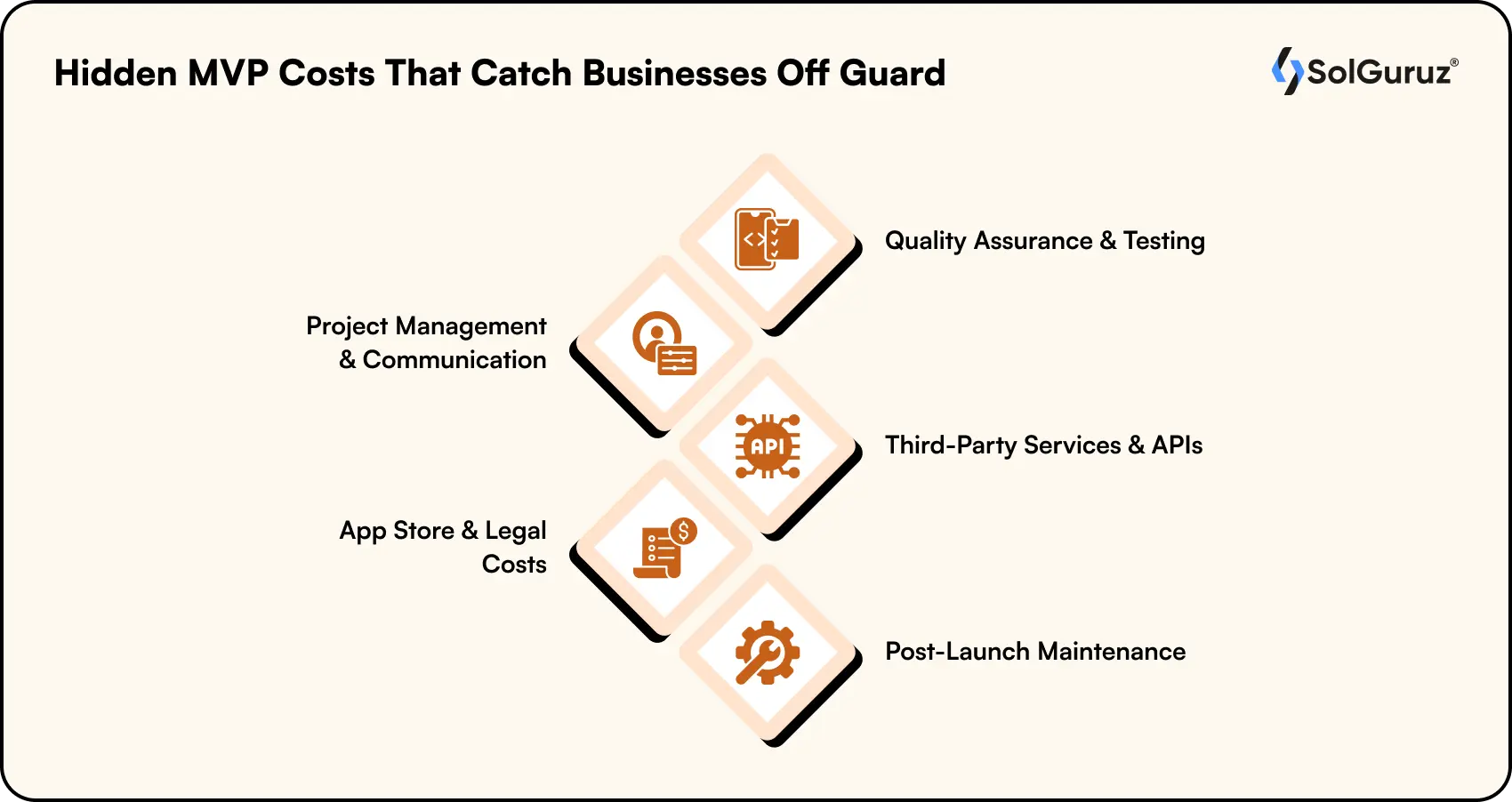
Beyond development, several costs add up during and after your MVP launch.
Quality Assurance and Testing
Testing typically adds 20-30% to your development cost. This covers functional, usability, performance, and security testing.
Skipping this creates defects that erode user trust and incur higher costs to fix later.
Project Management and Communication
Someone needs to coordinate developers, designers, and stakeholders. This typically adds 10-15% to your total cost.
Good project management keeps everyone aligned and prevents costly miscommunication.
Third-Party Services and APIs
Many MVPs rely on external services for payments, messaging, analytics, or cloud hosting.
- Payment processing: 2.9% + $0.30 per transaction (Stripe)
- Cloud hosting: $50 – $500+ monthly (AWS, Google Cloud)
- SMS notifications: $0.0075 per message (Twilio)
- Push notifications: $0 – $200+ monthly
- Analytics: $0 – $200+ monthly
These seem small, but they add up quickly as you scale.
App Store and Legal Costs
- iOS App Store: $99 per year, Google Play Store: $25 one-time,
- Legal review and terms of service: $1,000 – $5,000,
- Privacy policy and compliance: $500 – $3,000
Post-Launch Maintenance
Your MVP will need updates, bug fixes, and hosting after launch. Plan to allocate 15-20% of the initial development cost annually to maintenance.
This covers server costs, security updates, OS compatibility updates, and minor improvements.
How to Reduce Your MVP Development Cost Without Sacrificing Quality
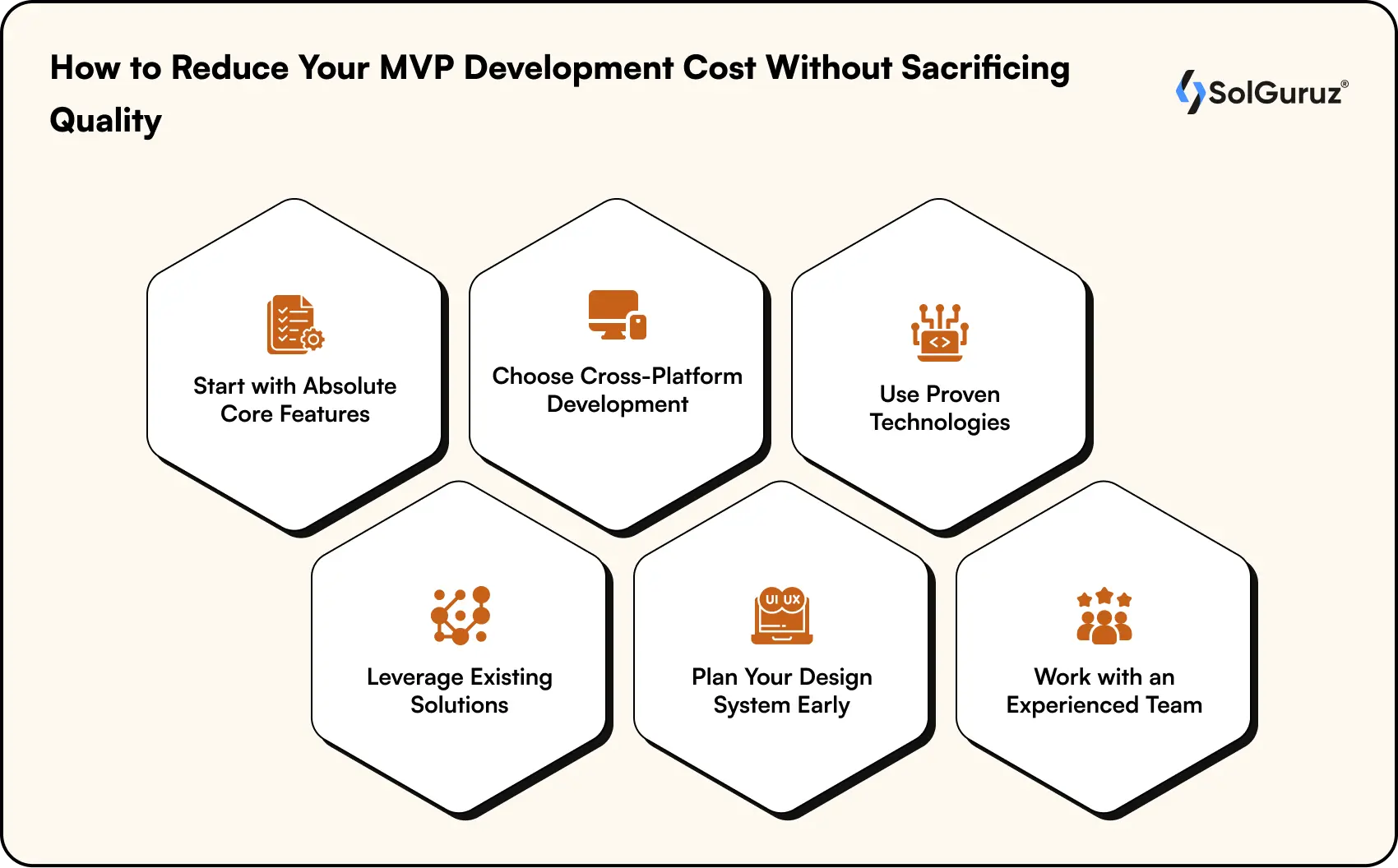
Here are the top six ways to reduce your MVP costs. You can also connect with our experts to learn more by booking a free consultation on our calendar.
1. Start with Absolute Core Features
List everything you think your product needs. Now cut it in half. Then cut it again.
Your MVP should solve one core problem extremely well. Every additional feature multiplies complexity and cost.
2. Choose Cross-Platform Development
Building with Flutter or React Native lets you launch on iOS and Android simultaneously at a lower cost than native development.
You sacrifice some performance optimization, but for most MVPs, the cost savings outweigh the tradeoffs.
3. Use Proven Technologies
Avoid bleeding-edge frameworks or experimental technologies. Stick with established tools that your development team knows well.
This reduces debugging time and makes it easier to find developers if needed.
4. Leverage Existing Solutions
Use pre-built components and services instead of building everything from scratch.
Authentication? Use Firebase or Auth0. Payments? Integrate Stripe. Analytics? Add Google Analytics or Mixpanel.
Each integration you use is functionality you don’t have to build and maintain.
5. Plan Your Design System Early
A consistent design system with reusable components speeds up development. Your team builds each element once and reuses it throughout the app.
This also makes future updates faster and cheaper.
6. Work with an Experienced Team
Experienced developers build faster and make fewer costly mistakes. A mid-level team charging $80/hour that completes 400 hours costs less than a junior team charging $40/hour that completes 900 hours.
Look for teams with relevant industry experience who can guide you toward smart technical decisions.
MVP Development Timeline and How It Affects Cost
Typical MVP Timeline Breakdown
- Discovery and Planning: 1-2 weeks. Understanding requirements, defining features, and planning architecture.
- Design: 2-4 weeks, creating wireframes, mockups, and final designs for all screens.
- Development: 8-16 weeks Building frontend, backend, integrations, and core functionality.
- Testing and Quality Assurance: 2-4 weeks. Finding bugs, testing on different devices, and improving performance.
- Deployment and Launch: 1 week Setting up servers, submitting to app stores, and going live.
- Total Timeline: 3-6 months for most MVPs
Rushing development usually means cutting corners on testing or forcing developers to work inefficiently. This leads to more bugs and higher costs over time.
Questions to Ask Before Starting Your MVP
Before you contact development teams, answer these questions:
- What single problem does your MVP solve? If you can’t explain it in one sentence, you need more clarity.
- Who is your target user? Different audiences need different features and design approaches.
- What’s your success metric? How will you know if your MVP works? Downloads? Active users? Transactions?
- What’s your timeline? When do you need to launch? Why that date?
- What’s your budget range? Honest budget conversations help teams suggest realistic approaches.
- Do you need iOS, Android, or web? Where do your users spend time?
What are the Red Flags When Choosing a Development Partner
Watch out for these warning signs:
- Extremely low quotes without seeing your requirements. Good development takes time. Suspiciously low quotes often mean cut corners or a misunderstood scope.
- No questions about your business or users. Developers should want to understand your goals, not just build features.
- Promises of exact timelines before scoping. No one can provide precise timelines without a deep understanding of the requirements.
- No process for handling changes. Requirements change during development. Ask how they handle scope adjustments.
- Reluctance to share previous work. Reputable teams are happy to share case studies and client references.
What to Do After Your MVP Launches
Launching your MVP is just the beginning. Here’s what happens next:
1. Collect User Feedback
Set up ways to hear from users. In-app feedback, surveys, user interviews, and support tickets all provide insights.
Don’t just collect feedback – categorize it by frequency and impact.
2. Monitor Key Metrics
Track what matters for your business. Active users, retention rate, feature usage, and conversion rates indicate whether your MVP is working.
Tools like Mixpanel, Amplitude, or Google Analytics help you understand user behavior.
3. Plan Your Next Phase
Based on feedback and metrics, decide what to build next. Some features will be critical. Others seemed important but users don’t care about them.
Budget for iterative improvements. Most successful products evolve significantly after their initial launch.
4. Maintain and Update
Regular updates show users you care about the product. Fix bugs quickly, improve performance, and add small enhancements based on feedback.
Plan monthly or quarterly update cycles depending on your resources.
Framework: MVP Development Cost Calculator
Well, you can use this simple framework to estimate your MVP cost:
- Step 1: Count Your Core Features. List the features critical to your MVP’s functionality.
- Step 2: Estimate Hours Per Feature Simple feature: 40-80 hours Moderate feature: 80-150 hours Complex feature: 150-300 hours
- Step 3: Add Design Time Basic design: 80-150 hours Custom design: 150-300 hours
- Step 4: Add Testing and QA, Add 25% of total development hours
- Step 5: Add Project Management. Add 15% of total development hours
- Step 6: Calculate Total Hours. Sum everything above
- Step 7: Multiply by Hourly Rate Freelancer: $20-$150/hour Outsourcing: $30-$150/hour In-house: $80-$200/hour
- Step 8: Add Third-Party Costs Monthly services × 6 months for initial budget
Example Calculation:
5 moderate features × 100 hours = 500 hours Custom design = 200 hours Testing (25%) = 175 hours Project management (15%) = 130 hours Total: 1,005 hours
At $75/hour (outsourcing rate): $75,375 Third-party services ($300/month × 6): $1,800 Total MVP Cost: ~$77,000
Selecting the Best MVP Development Company
MVP development is an investment in learning what your users actually need. The cost should align with your business stage, market validation needs, and growth plans.
Spending $150,000 on an MVP before talking to any customers is risky. But spending $15,000 on something that doesn’t align with your vision also wastes time and money.
Find the middle ground. Build enough to test your core hypothesis. Use real user feedback to guide your next steps. Adjust based on what you learn.
The best MVP is one that launches, teaches you something valuable, and sets you up for sustainable growth. Well, if you are still confused or have doubts, SolGuruz is right here to help you develop your MVP in a few weeks.
FAQs
1. How long does it take to build an MVP in 2026?
Most MVPs take 3-6 months from start to launch. Simple apps with basic features might take 2-3 months to complete. Complex apps with advanced functionality can take 6-9 months to develop. Timeline depends on feature scope, team size, and how quickly you make decisions during development.
2. Should I build a native app or use cross-platform development?
Cross-platform development (Flutter, React Native) costs 30-50% less than building native apps for both iOS and Android. Performance differences are minimal for most MVPs. Choose native development only if you need platform-specific features or maximum performance optimization.
3. What's the difference between MVP and full product development?
An MVP includes only core features needed to solve your main problem and test your idea with real users. Full product development adds all the features, optimizations, and polish you envision. MVPs typically cost 40-60% less than complete products and launch much faster.
4. Can I add features after launching my MVP?
Yes, and you should. The whole point of an MVP is to learn what users actually need. After launch, collect feedback, monitor usage data, and prioritize new features based on real user behavior. Most successful products look very different from their initial MVP.
5. How much should I budget for maintenance after launch?
Plan to allocate 15-20% of your initial development cost annually for maintenance. This covers hosting, security updates, bug fixes, and minor improvements. If you plan to actively add features, budget more for ongoing development.
From Insight to Action
Insights define intent. Execution defines results. Understand how we deliver with structure, collaborate through partnerships, and how our guidebooks help leaders make better product decisions.
 How we Work
Build MVP Without Breaking the Bank
We help you launch faster while keeping your budget under control.

Strict NDA

Trusted by Startups & Enterprises Worldwide

Flexible Engagement Models

1 Week Risk-Free Trial
Give us a call now!

+1 (724) 577-7737