

Mobile App Maintenance Services: What’s Included, What It Costs, and How to Choose Right
Mobile app maintenance services cover bug fixes, OS updates, security patches, performance tuning, and feature releases. This guide explains what’s included, what it actually costs, and exactly what to look for when choosing a mobile application maintenance and support partner.

Summarise with AI


Key Takeway
- Mobile app maintenance services keep apps secure, stable, and compatible with new iOS and Android updates after launch. They typically include bug fixes, security patches, performance monitoring, and feature updates.
- Mobile app maintenance costs usually range from $500 to $10,000+ per month, depending on the app’s complexity, platform, integrations, and support requirements.
- Choosing the right maintenance partner is critical for long-term app performance. Look for teams with platform expertise, proactive monitoring, clear SLAs, and experience maintaining apps similar to yours.
Mobile app maintenance services are ongoing activities that keep your app secure, stable, compatible with new OS updates, and performing well after launch. These services typically include bug fixes, security patches, performance monitoring, feature updates, and app store compliance support.
Many businesses assume that once an app is launched, the work is mostly done. In reality, mobile apps operate in a constantly changing environment where operating systems evolve, devices change, security threats emerge, and user expectations grow.
Without regular maintenance, apps can quickly face crashes, compatibility issues, performance problems, and declining app store ratings.
In this guide, you’ll learn what mobile app maintenance services include, how much they typically cost, and how to choose the right maintenance partner for long-term reliability.
Table of Contents
What Are Mobile App Maintenance Services?
Mobile app maintenance services are ongoing technical activities that keep your app stable, secure, up to date, and competitive after it goes live.
Think of it this way: your app is a product in a moving environment. OS versions change. Devices get new specs. Users expect new features. Security threats evolve. If you’re not actively maintaining the app, it’s slowly degrading even when you’re not touching it.
Mobile application maintenance and support typically includes:
- Bug fixes and crash resolution
- OS compatibility updates (iOS and Android releases)
- Security patches and vulnerability fixes
- Performance monitoring and optimization
- Third-party API and library updates
- Feature enhancements and UI improvements
- Database maintenance and server-side support
- App store compliance updates
Why Teams Underestimate Mobile App Maintenance
Many businesses assume that once a mobile app is launched, most of the work is complete. In reality, mobile apps require continuous maintenance to remain stable, secure, and compatible with evolving technology.
Operating systems change frequently. Companies like Apple and Google release major updates every year, and these updates can affect existing app functionality. Changes in permissions, background tasks, push notifications, and UI behavior often require developers to update the app to maintain proper performance. For example, updates like iOS 17 and Android 14 introduced changes that required many apps to update their code.
User expectations also play a major role. Even small issues such as crashes, slow loading times, or outdated interfaces can quickly impact app store ratings and user retention.
The apps that remain competitive are rarely the ones that were simply built well. They are the ones that receive consistent updates, monitoring, and improvements over time.
What’s Included in Mobile App Maintenance Services
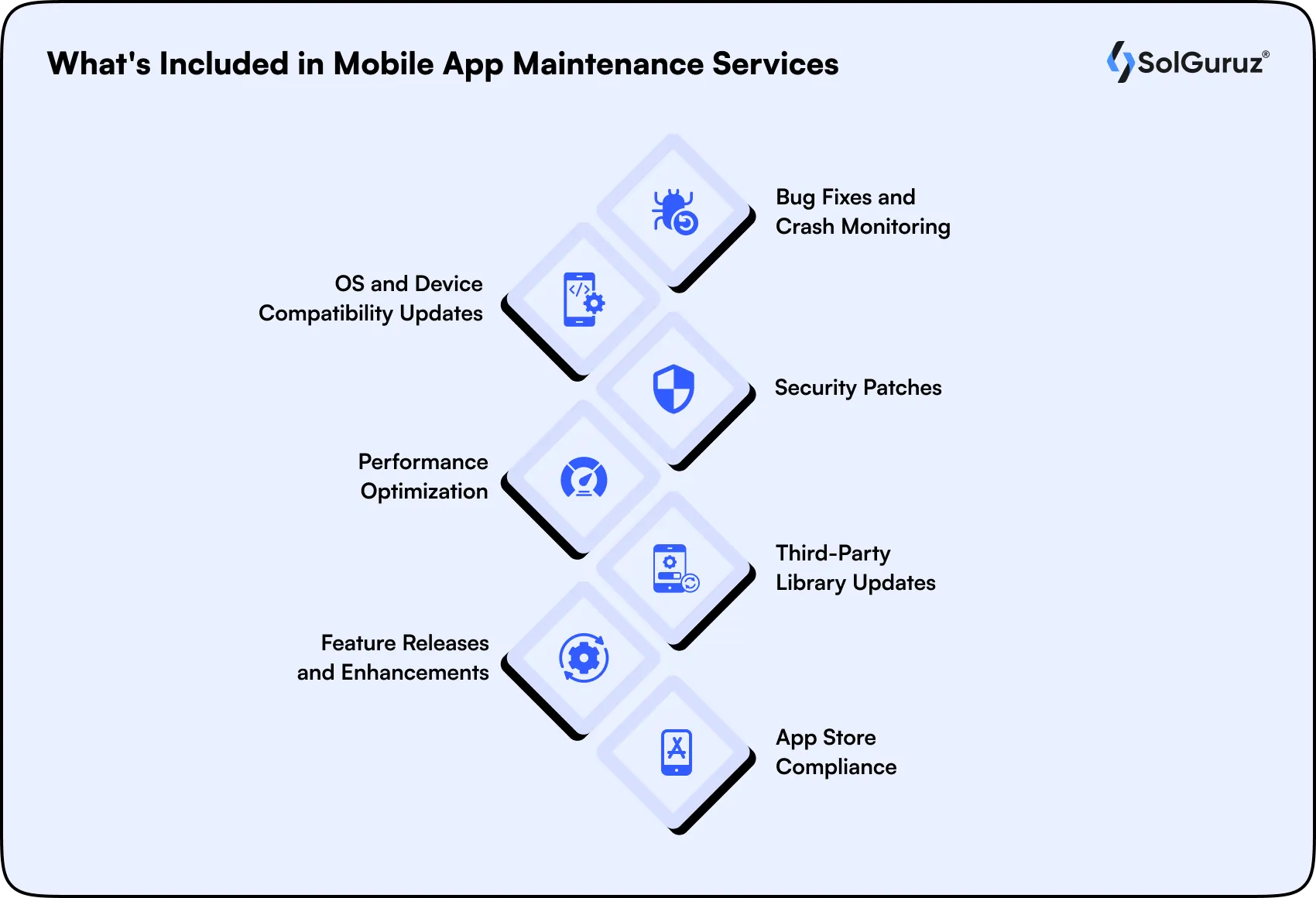
Not all maintenance contracts are the same. Here’s a breakdown of what you should expect from a proper mobile application maintenance and support plan.
1. Bug Fixes and Crash Monitoring
Bug fixes and crash monitoring are core components of mobile app maintenance services. Maintenance teams track crash reports using tools such as Firebase Crashlytics or Sentry to identify issues before they significantly impact users.
Effective maintenance also includes defined response SLAs. Critical crashes should be investigated and fixed quickly, often within hours, while less severe issues can be addressed within standard support timelines.
2. OS and Device Compatibility Updates
Every time Apple or Google releases a new OS version, your app needs to be tested and, often, updated. This is non-negotiable. Apps that skip this start generating 1-star reviews within weeks of a major OS release.
Good maintenance services include pre-release testing on beta OS versions, so you’re not scrambling on launch day.
3. Security Patches
Security is the area where most teams move slowest – and it’s the area that costs the most when ignored. Mobile apps are entry points into your user data. Vulnerabilities in dependencies, API calls, and authentication logic get exploited.
A proper maintenance plan includes regular dependency audits, security scans, and compliance checks – especially relevant if your app handles health, finance, or personal data.
4. Performance Optimization
Apps slow down over time. Databases grow. APIs become inefficient as data scales. Memory leaks accumulate. Regular performance audits catch these before users feel them.
This includes load time optimization, image compression, caching improvements, and database query tuning.
5. Third-Party Library Updates
Most apps rely on 10 to 30+ third-party libraries and SDKs. When those updates are made, your app needs to update too. Ignored library updates are a common source of security vulnerabilities and unexpected crashes.
6. Feature Releases and Enhancements
Maintenance isn’t just about keeping things working – it’s also about keeping the app competitive. A good maintenance partner helps you plan and ship small feature updates on a regular cadence, based on user feedback and market trends.
7. App Store Compliance
Apple and Google regularly update their guidelines. Apps that fall out of compliance get flagged, removed from search results, or delisted. Maintenance services include staying on top of policy changes and making the necessary adjustments before deadlines.
Mobile App Maintenance Cost: What Should You Budget?
This is one of the most common questions businesses ask when planning mobile app development services or post-launch support. The honest answer is that maintenance costs depend on your app’s complexity, the level of support required, and how frequently updates are needed.
That said, here are realistic ranges:
| App Complexity | Estimated Monthly Cost | Typical Includes |
| Simple (single platform, basic features) | $500 – $1,500/month | Bug fixes, OS updates, basic support |
| Mid-level (cross-platform, integrations) | $1,500 – $4,000/month | Performance monitoring, security, and feature updates |
| Complex (enterprise, high traffic, regulated) | $4,000 – $10,000+/month | Dedicated support, SLAs, compliance, proactive monitoring |
Maintaining your app regularly is usually cheaper than fixing issues after they appear. When bugs reach production, teams often need emergency development time, urgent releases, and reputation management — all of which increase costs far beyond routine maintenance.
How to Choose a Mobile App Maintenance Partner: 8 Factors to Check
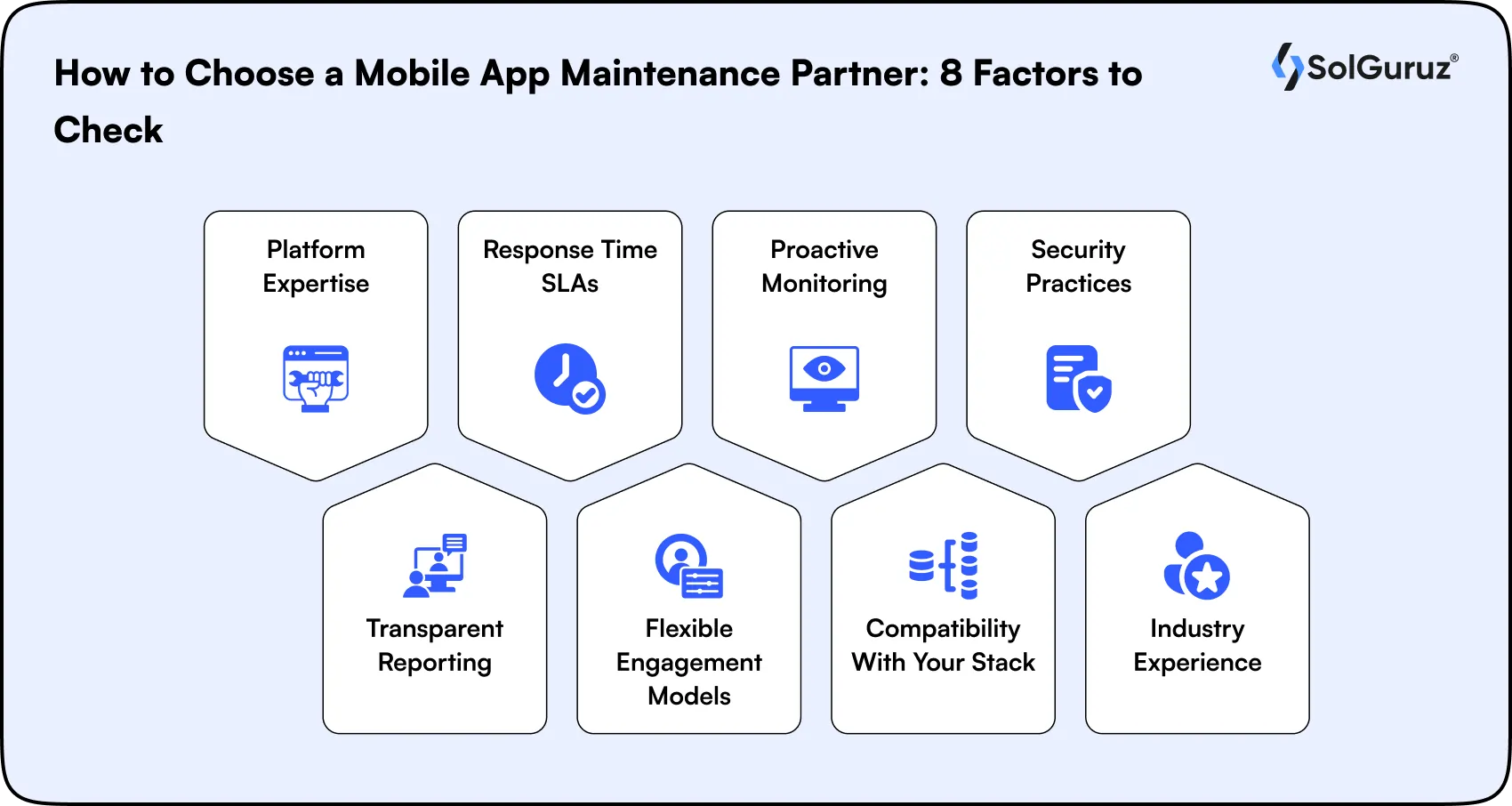
This is where most teams make mistakes. They either go with the cheapest option or stick with their original dev team out of convenience – without checking if they’re actually equipped for long-term maintenance.
Here’s what actually matters:
1. Platform Expertise
Does the team have proven experience on your platform? iOS and Android maintenance require different skill sets. If your app is built in Flutter or React Native, your partner needs to know those frameworks in depth – not just at a surface level.
2. Response Time SLAs
What happens when something breaks at 2 AM on a Friday? A good maintenance partner has defined SLAs – typically tiered by severity. Critical bugs get a 4-hour response. Non-critical issues get 24-48 hours. Make sure these are in writing.
3. Proactive Monitoring
Are they waiting for you to report bugs, or are they watching your crash logs, API response times, and error rates in real time? Proactive monitoring means issues get caught before users notice them.
4. Security Practices
Ask specifically about their security review cadence. How often do they audit dependencies? Do they run OWASP-based security checks? If your app touches health data, payments, or personal records, this is non-negotiable.
5. Transparent Reporting
You should be getting regular reports – what was fixed, what was monitored, what’s coming up. A good maintenance partner keeps you informed without you having to chase them.
6. Flexible Engagement Models
Some teams need a full maintenance retainer. Others just need on-call support for specific issues. Find a partner who can match your model – fixed monthly, hourly, or project-based – without forcing you into an oversized contract.
7. Compatibility With Your Stack
If your app was built in Swift, your maintenance team should be fluent in Swift. If you’re using specific backend services (Firebase, AWS, custom APIs), the team needs to understand your architecture before they start touching it.
8. Industry Experience
Maintenance teams with experience in your industry understand specific compliance requirements, user behavior patterns, and technical standards. For example, apps in healthcare, fintech, or logistics often require specialized knowledge that teams with broader custom software development experience can better support.
Key Note: Choosing a maintenance partner is not just about fixing bugs; it’s about ensuring your app stays stable, secure, and compatible as technology evolves. A team with the right expertise and processes can prevent issues early and keep your app performing reliably for users.
How to Know If Your App Needs Maintenance Right Now
Not sure if your current app situation is urgent? Here are signs that maintenance can’t wait:
- Your app hasn’t been updated in 6+ months
- You’ve received user complaints about crashes or slow load times
- A new iOS or Android version dropped, and you haven’t tested for compatibility
- You’re using libraries with known CVEs (security vulnerabilities)
- Your app store rating has dropped in the last 90 days
- Your team doesn’t have a defined process for handling bug reports
- You rely on a third-party service that has changed its API
Any one of these is a signal. More than one means you’re already behind.
How SolGuruz Handles Mobile App Maintenance and Support
We’ve maintained apps across iOS, Android, Flutter, and cross-platform frameworks for clients in healthcare, logistics, fintech, and SaaS.
Here’s how our mobile application maintenance and support process works:
Kickoff audit: We start by reviewing your codebase, dependencies, crash logs, and performance baselines. This gives us a clear picture of what needs attention and what can wait.
Defined SLAs: We agree on response time tiers upfront. Critical issues, non-critical bugs, and enhancement requests each have a clear turnaround commitment.
Proactive monitoring: We set up monitoring tools from day one, so we’re catching issues before your users report them.
Monthly reporting: You get a clear summary of what was done, what’s in queue, and what’s coming up – every month, without chasing us for it.
Flexible models: We offer retainer-based and on-demand support depending on what your team actually needs.
We work with startups who just launched their first app and enterprise teams that need hands-on support for complex, regulated systems. Either way, the goal is the same: your app stays stable, secure, and competitive.
Conclusion
Mobile app maintenance services aren’t optional – they’re part of shipping a product that lasts.
The apps that stay relevant don’t just get built well. They get maintained consistently. OS updates, security patches, performance tuning, feature releases – all of it adds up to the difference between an app users trust and one they delete.
If you’re looking for a mobile application maintenance and support partner who brings structure, transparency, and real technical depth, we’re ready to talk.
FAQs
1. How much do mobile app maintenance services cost per month?
Costs range from $500/month for simple apps to $10,000+/month for complex enterprise applications. The variables are platform (iOS/Android/cross-platform), frequency of updates, and the level of support included. Most mid-level apps budget $1,500 to $4,000 per month for comprehensive maintenance.
2. What's the difference between mobile app maintenance and support vs. development?
Development is about building features from scratch. Maintenance is about keeping what's already live stable, secure, and up-to-date. Support is the reactive side - handling user-reported issues, crashes, and service requests. Most mature apps need all three, often from the same partner.
3. How often should a mobile app be updated?
At minimum, your app should be reviewed and updated with each major iOS or Android release - typically once or twice a year. In practice, most stable apps ship smaller updates every 4 to 8 weeks to address bugs, performance issues, and minor feature changes.
4. Can I get mobile app maintenance services for an app I didn't build with SolGuruz?
Yes. We regularly take on maintenance for apps built by other teams. We start with a codebase audit to understand your architecture, dependencies, and current state before we begin any work.
5. What platforms do you support for mobile application maintenance?
We support iOS (Swift, Objective-C), Android (Kotlin, Java), and cross-platform frameworks including Flutter and React Native. We also handle backend maintenance for apps running on Firebase, AWS, and custom server infrastructure.

Written by
Paresh Mayani
Paresh Mayani is the Co-Founder and CEO of SolGuruz, a global custom software development and product engineering company. With over 17+ years of experience in software development, architecture decisions, and technology consulting, he has worked across the full lifecycle of digital products, from early validation to large-scale production systems. He started his career as an Android developer and spent nearly a decade building real-world mobile applications before moving into product strategy, technical consulting, and delivery leadership roles. Paresh works directly with founders, scaleups, and enterprise teams where technology choices influence product viability, scalability, and long-term operational success. He partners closely with founders and cross-functional teams to take early ideas and turn them into scalable digital products. His work revolves around AI integration, agent-driven workflow automation, guiding product discovery, MVP validation, system design, and domain-specific software platforms across industries such as healthcare, fitness, and fintech. Instead of solely focusing on building features, Paresh helps organizations adopt technology in a way that fits business workflows, teams, and growth stages. Beyond delivery, Paresh is also an active tech community contributor and speaker, contributing to global developer ecosystems through Stack Overflow, technical talks, mentorship, and developer community (Google Developers Group Ahmedabad and FlutterFlow Developers Group Ahmedabad) initiatives. He holds more than 120,000 reputation points on Stack Overflow and is one of the top 10 contributors worldwide for the Android tag. His writing explores AI adoption, product engineering strategy, architecture planning, and practical lessons learned from real-world product execution.





From Insight to Action
Insights define intent. Execution defines results. Understand how we deliver with structure, collaborate through partnerships, and how our guidebooks help leaders make better product decisions.
 How we Work
Is Your App Getting the Maintenance It Deserves?
We handle updates, bug fixes, security patches, and performance tuning - so your team doesn't have to.

Strict NDA

Trusted by Startups & Enterprises Worldwide

Flexible Engagement Models

1 Week Risk-Free Trial