

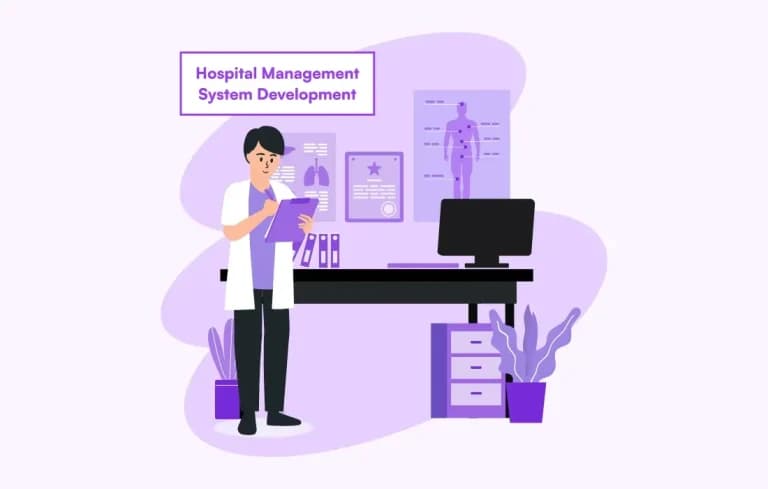
Hospital Management System Development: Complete Guide for Modern Healthcare
Hospital management system development is streamlining workflows, boosting patient throughput, and reducing admin tasks by up to 45%. From AI-powered insights to appointment management, modern HMS improves care and efficiency. This guide unlocks key features, development steps, costs, and tips to choose the right partner.

Summarise with AI


In modern hospitals, clinical decisions happen in seconds, but administrative systems often lag. Slow patient records, manual billing, and disconnected platforms drain time and efficiency.
Studies show healthcare organizations lose 20–35% of operational efficiency due to outdated systems and repetitive administrative work. The issue isn’t clinical expertise, but it’s the lack of a unified digital infrastructure.
This is where Hospital Management System (HMS) software becomes essential:
- Centralizes hospital data and workflows
- Improves operational efficiency
- Enhances patient care coordination
In this guide, we explain what an HMS does, its essential features, development approach, cost considerations, and how to choose the right HMS development partner for long-term success.
Table of Contents
What Is Hospital Management System Development?
The development of hospital management information systems shows the digital roots of modern healthcare facilities. This advanced technology platform integrates every aspect of hospital operations into a single unified system.
Instead of rolling around multiple tools, spreadsheets, and manual processes, hospitals use one system to manage all:
- Patient records
- Appointments
- Billing and insurance
- Pharmacy and lab workflows
- Inventory and staff operations
Modernized HMS solutions combine healthcare software development services with industry expertise to develop platforms that address specific operational challenges.
Why Hospitals and Clinics Need a Hospital Management System Today
Healthcare demand is rising, but operational efficiency isn’t.
Hospitals without a centralized system face:
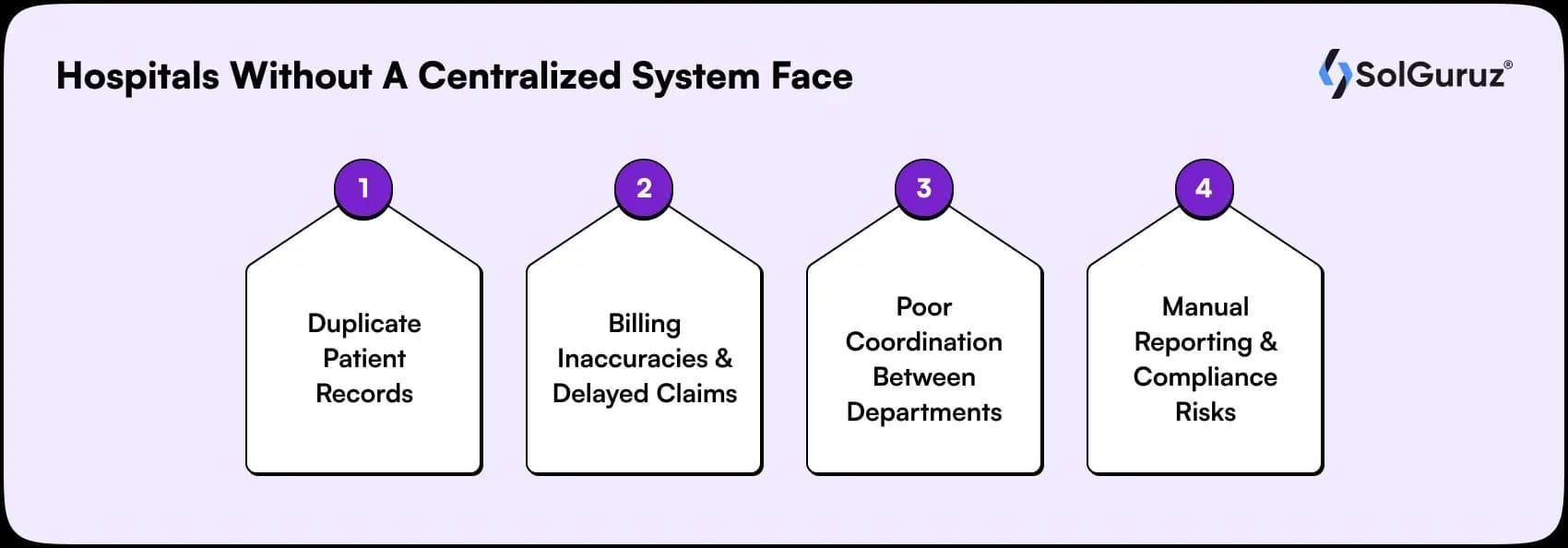
- Duplicate patient records
- Billing inaccuracies and delayed claims
- Poor coordination between departments
- Manual reporting and compliance risks
The Solution:
A well-developed hospital management system software acts as the digital backbone of a healthcare organization.
Real Impact:
- 30–40% reduction in administrative workload
- Faster patient turnaround
- Better clinical decision-making
- Improved revenue cycle management
According to market research, the global hospital management solutions market was valued at USD 6.43 billion in 2024 and is projected to grow from USD 7.56 billion in 2025 to reach USD 27.86 billion by 2033.
The demand for enhancing current hospital management software has risen with the advancement of technology and a high level of competition.
How to Develop a Hospital Management System: Step-by-Step Guide
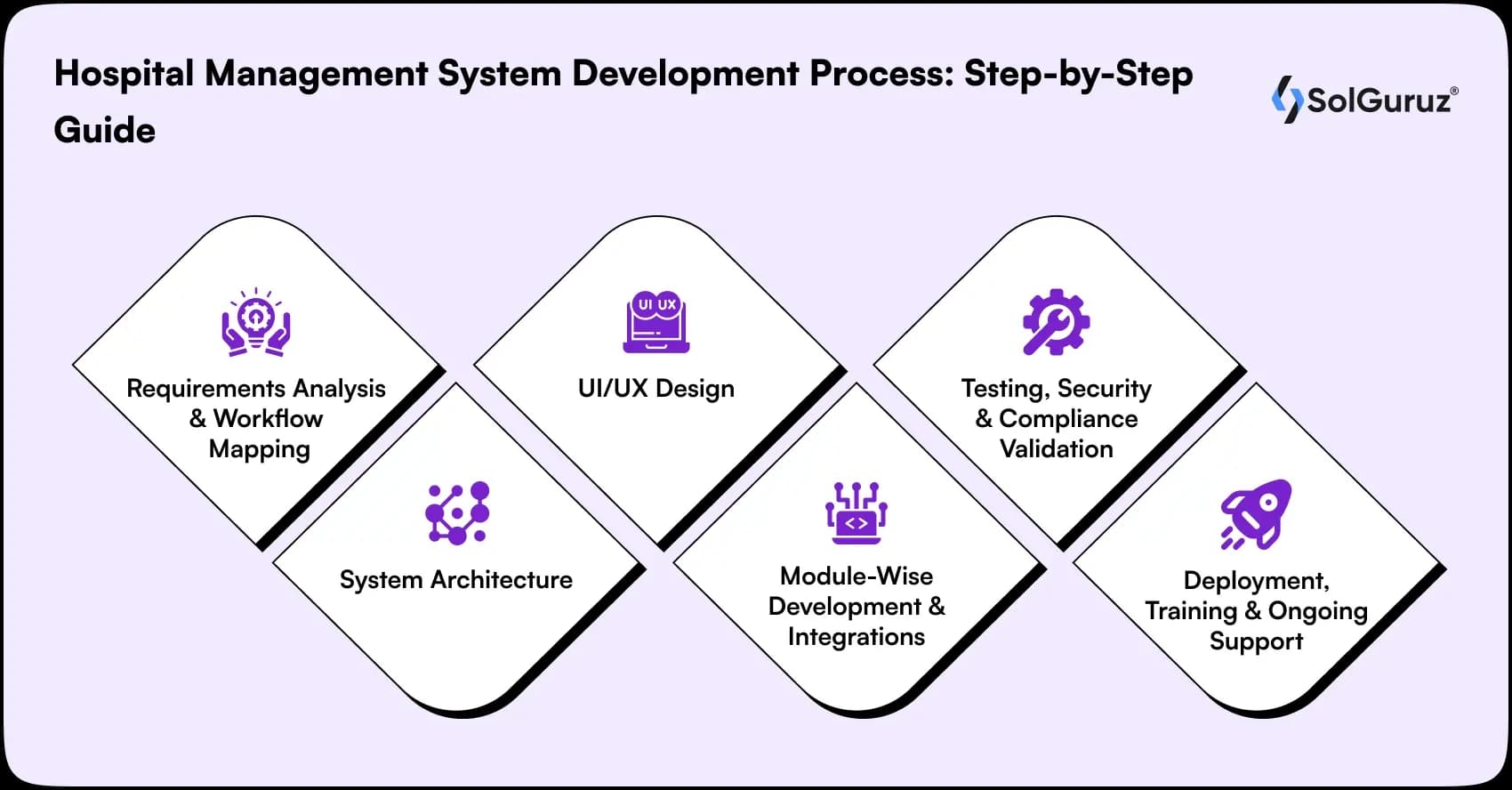
A successful hospital management system starts with a clear process and the right technical partner. When working with an experienced MVP development company, the focus stays on solving real hospital challenges, not just building software.
Here’s how the hospital management system development process works:
1. Requirements Analysis and Workflow Mapping
- Identify the working process of hospitals and clinics.
- It specifically involves departmental workflows, regulatory requirements, and patients’ journeys.
This step ensures the software aligns with real clinical and administrative processes rather than forcing hospitals to adapt to rigid technology.
2. System Architecture
Time to develop architecture now.
- Decisions are taken focusing on data security, on-premises deployment, and modular design
- Stronger architecture design enables hospitals to add new modules like telehealth or AI analytics, without the need to rebuild the whole system
3. UI/UX Design
- Create intuitive dashboards for doctors, patients, nurses, and administrators.
- Ensure minimal training is needed, and clicks are reduced, allowing quick access to patient data by minimizing clicks.
4. Module-Wise Development and Integrations
- Core modules like patient management, billing, pharmacy, and labs are built first.
- The system is being combined with third-party tools, for example, lab equipment, insurance platforms, and integrated into existing EMR systems.
5. Testing, Security, and Compliance Validation
- Before the final deployment of software, the system goes through testing to check performance, data security, big fixes.
- Validation of compliance with healthcare regulations -> Helps in avoiding legal or operational risks.
6. Deployment, Training, and Ongoing Support
- Smooth system launch with minimal disruption
- Quick staff onboarding and guidance
Hospital Management System Software Features (Must-Have in 2026)
These are the key features of hospital management system development that need to be integrated:
| Feature | Key Capabilities |
| Patient Management | Appointment scheduling and reminders, Patient history tracking, Medical records access |
| AI-Enhanced Clinical Decision Support | Patient data is analyzed to deliver real-time care suggestions and risk alerts.
Modern AI development services enable hospitals to implement predictive algorithms. |
| Predictive Analytics & Resource Optimization | Forecasting of admissions, staffing needs, bed occupancy, and supply demands to improve operations and patient care flow |
| AI-Powered Billing & Insurance Automation | With this feature, it becomes easy to automate the process of billing, intelligent claims processing, and fraud detection, reducing errors |
| AI Virtual Assistants & Chatbots | Through this feature, it offers 24/7 patient support, automated appointment bookings without the need for additional staff. |
Given the intense competition in the hospital industry, adopting the above-highlighted Hospital management system development features will enable you to unlock new efficiency gains in your workflow.
Hospital Management Software Usage: Hospitals vs Clinics
While hospitals and clinics share the same software/systems, efficient patient care, the way the hospital management system is used differs based on scale, complexity, and operational needs.
Key Difference in Usage: Hospitals vs Clinics
Most of the hospital and clinics’ workflow is now done on digital systems to manage patient care; their operational demands are quite different:
| Aspect | Clinics | Hospitals |
| System Complexity | Lightweight and streamlined for daily operations | Highly complex with multiple departments and workflows |
| Patient Volume | Low to moderate patient load | High patient volume across departments |
| Modules Required | Patient management, appointments, billing, and basic reporting | Full EMR, billing, pharmacy, lab, inventory, analytics |
| Cost & Implementation Time | Lower cost and faster implementation | Higher investment with phased rollout |
Key Note: Clinics focus on speed and simplicity, while hospitals require scalable, multi-department systems. Studies show tailored implementations can improve operational efficiency by 15–20% without increasing system complexity or cost.
Pros and Cons of Hospital Management System Software
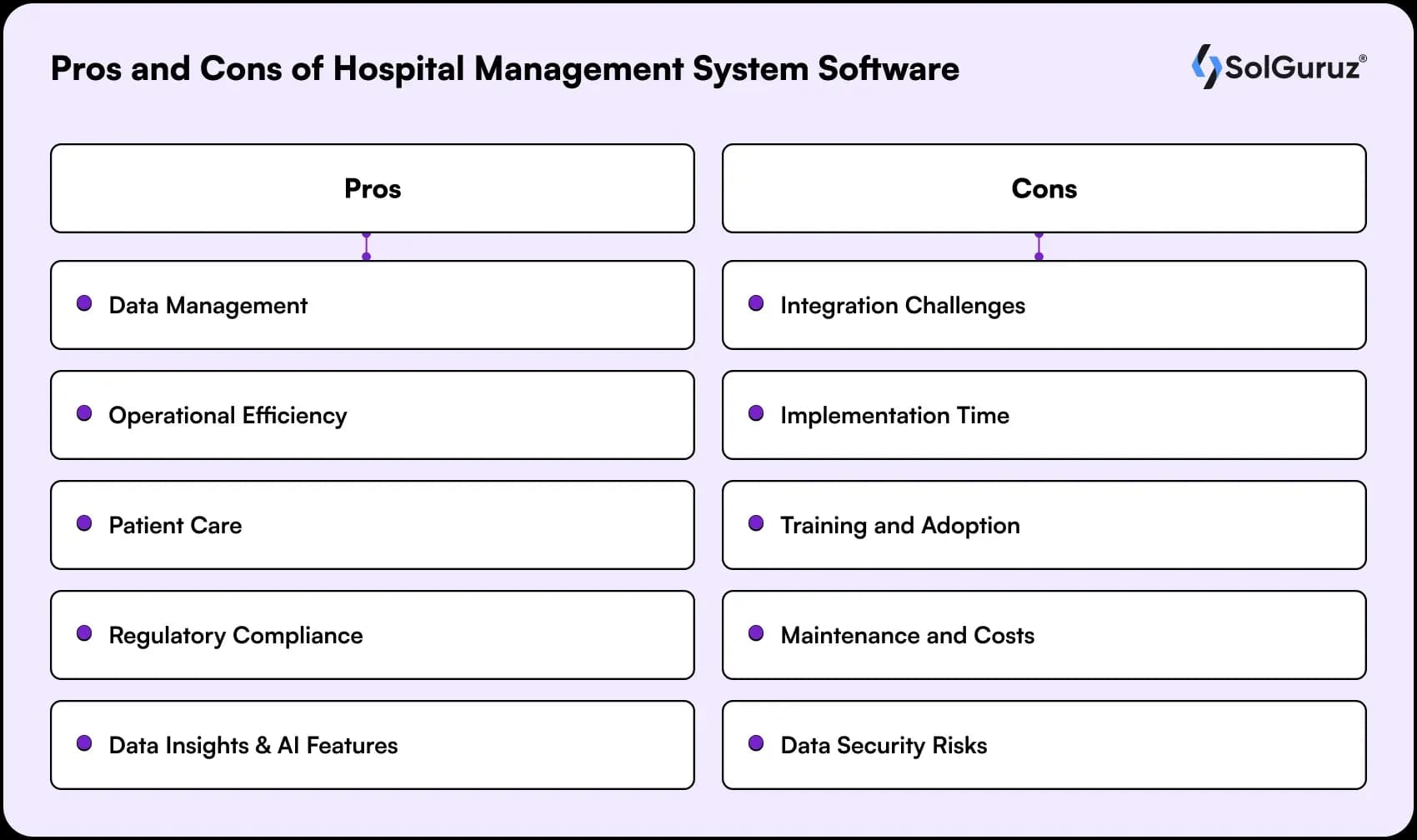
Hospital management system software has benefits, but it also has some drawbacks to consider. Knowing these helps healthcare organizations make informed decisions.
Pros of Hospital Management System Software
Let’s discuss the pros:
1. Data Management:
- Critically focuses on patient records, billing, and inventory.
- Through data management, it is easy to remove duplicate values and bugs.
2. Operational Efficiency:
- This critical allows for automating scheduling, billing, and reporting.
- Reduces administrative workload at the core.
- Frees up staff to focus on making them engaged with patient care.
3. Patient Care:
- With the help of hospital management software, it delivers you fast access to medical history and prescriptions.
- Improvise clinical decision-making.
4. Regulatory Compliance:
- Supports HIPAA, HL7, and local regulations.
- Automates reports of the compliance errors.
5. Data Insights & AI Features:
- Shows advanced analytics and AI-powered modules.
- It is also useful in diagnostics, predictive inventory, and fraud detection.
Cons of Hospital Management System Software
Let’s discuss the cons:
1. Integration Challenges:
- Integration can be difficult to connect HMS with legacy systems, or multiple departments could be complex.
- It needs proper systematic planning to avoid any type of errors.
2. Implementation Time:
- Full deployment, mainly for multi-department hospitals, can take a longer time.
3. Training and Adoption:
- Staff need proper training to use the system effectively.
- Some staff might not find it comfortable to work with the software, which can slow down benefits.
4. Maintenance and Costs:
- Large investment needed for customized or enterprise-grade systems.
- Regular Updates and technical support are needed.
5. Data Security Risks:
- Saving sensitive patient data creates a major risk of cybersecurity threats.
- It needs high-end, robust security practices and continuous-level monitoring.
How Much Does Hospital Management System Development Cost?
Below is the estimated cost of a hospital management system software:
| System Complexity | Estimated Cost | Features / Use Case |
| Basic / MVP | $10,000 – $45,000 | This system includes features such as registration of patients, appointment scheduling, and basic billing. |
| Mid-Scale | $50,000 – $80,000 | It offers EHR, patient/staff portals, lab and pharmacy integration, and reporting. |
| Enterprise / Advanced | $90,000 – $120,000+ | Complete integration across departments, BI dashboards, AI features, telehealth, and IoT devices. |
Disclaimer: Costs are flexible, so make sure to collaborate with a reliable development partner for the correct cost structure.
How to Choose the Right Hospital Management System Development Company
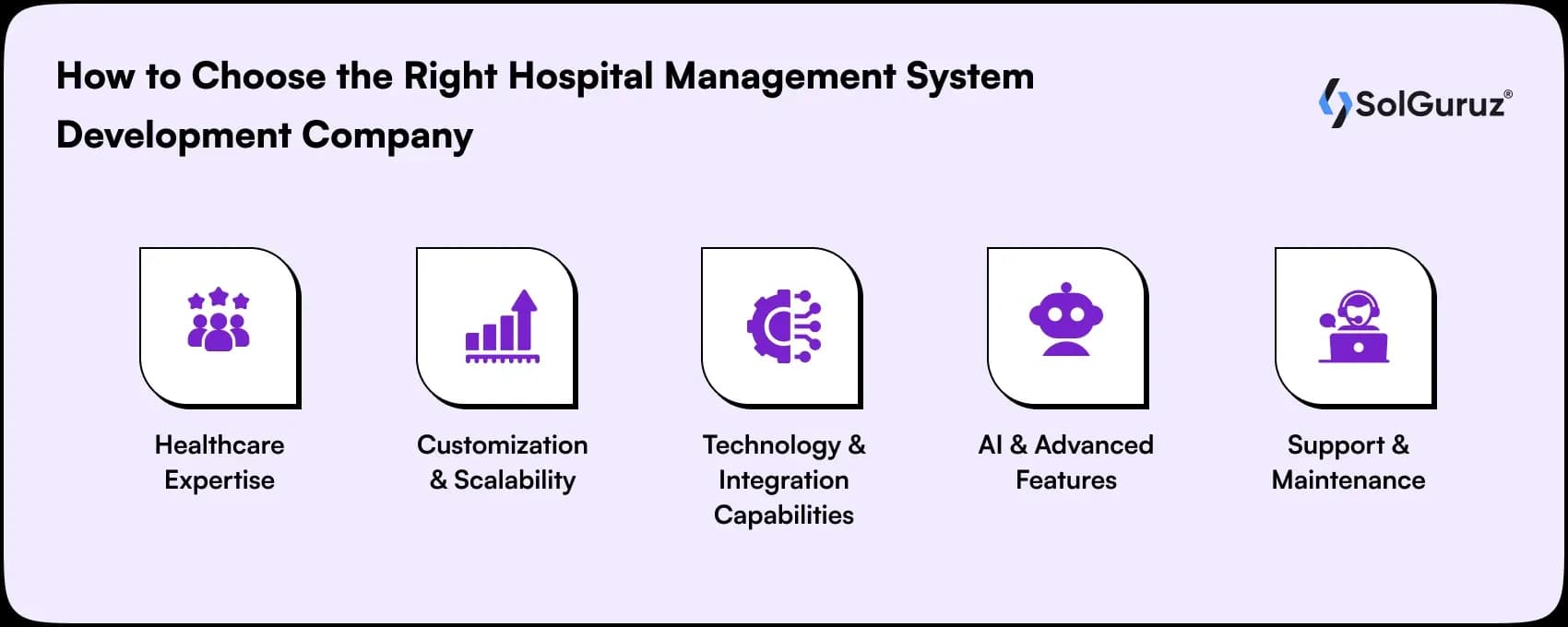
Struggling to find a reliable development company for your hospital management software?.
Here’s what to consider:
1. Healthcare Expertise
- Get in touch with the companies that have proven experience in the healthcare domain.
- Check if they have a proper understanding of hospital workflows and regulatory compliance.
2. Customization & Scalability
Make sure that they can do customization within the system as per your hospital’s requirements, departmental workflows, and based on important growth plans.
3. Technology & Integration Capabilities
- Need to look out for whether the developers have the knowledge to integrate HMS with existing systems.
- If the team is skilled in working with web/app development, and cross-platform app development allows for seamless access across different platforms.
4. AI & Advanced Features
With the change of trend in the hospital industry, when choosing a development company, check that they can include advanced AI features within the software that have the capability to predict analysis, AI power, e-modules, and create dashboards as well.
5. Support & Maintenance
Post launch to be done smoothly and without any errors. The reliable partner should provide regular updates, training, and quick troubleshooting to prevent operational downtime.
Become a partner with Solguruz.
Now, to get AI-powered hospital management solutions, connect with SolGuruz to build smarter. Together, we deliver scalability, efficiency, and high-end patient care.
- Access expert hospital management system development services
- Aim to work with reporting and automation
- Customized solutions for clinics and hospitals
- End-to-end support following a systematic process
Check out How We Work to see our approach and process.
Ready to Transform: Healthcare Through Technology
Hospital management system software changes manual workflows into efficient, patient-focused operations. Research has proven that hospitals using advanced HMS can reduce administrative workload by up to 35%. The right system boosts healthcare teams to deliver faster, safer care.
Modern HMS solutions go beyond appointments and billing:
- AI-enabled system improves data-driven decision-making
- Predictive analytics optimize staffing and patient flow
- Integrated reporting improves inventory and resource management
With the SolGuruz team, you get a partner who delivers scalable, compliant HMS software with 4x faster adoption and measurable workflow improvements.
Transform healthcare operations and stay ahead with technology designed to make care better for everyone.
FAQs
1. What is a hospital management system development?
A platform that makes it convenient for hospitals to manage their workflows, handle administrative tasks, and make everything integrated with automation, which ultimately improves efficiency.
2. Do you think that hospital management software improves data security?
Definitely, modern HMS platforms use encryption, access controls, and compliance protocols to safeguard sensitive patient information at any cost.
3. Can hospital management systems integrate with other healthcare systems?
Yes. Most HMS solutions support interoperability, allowing seamless integration with existing electronic systems and third‑party tools such as pharmacy systems and insurance platforms.
4. Does hospital management system development support telehealth and remote services?
Yes, modern HMS efficiently works with telemedicine seamlessly via integration. It allows doctors to access detailed patient records during scheduled remote appointments and to document telemedicine visits.
5. How does a hospital management system help reduce operational costs?
HMS automates the process across the entire department, eliminating bugs and errors, streamlining workflows.
From Insight to Action
Insights define intent. Execution defines results. Understand how we deliver with structure, collaborate through partnerships, and how our guidebooks help leaders make better product decisions.
 How we Work
Build a Future-Ready HMS
Reduce admin workload by 35% with an AI-powered hospital management system.

Strict NDA

Trusted by Startups & Enterprises Worldwide

Flexible Engagement Models

1 Week Risk-Free Trial
Give us a call now!

+1 (724) 577-7737