

What is the Cost of Developing an Education App? Full Breakdown (MVP to Full Scale)
The cost of developing an education app depends on your features, complexity, tech stack, and how focused your MVP is. This guide breaks down real cost ranges, timelines, must-have features, and hidden budget drivers. Build a high-impact EdTech app without overspending or underbuilding.

Summarise with AI


The demand for digital learning has exploded. Students expect flexible learning.
Teachers want smarter tools. Parents look for structured guidance.
And EdTech founders everywhere are trying to build the next big learning platform.
But before anything else, one question always slows the conversation-
“How much does it actually cost to develop an education app?”
If you’ve tried asking different edtech app development companies, you’ve probably heard the same vague reply:
“It depends on the features.”
It is true. But not helpful.
EdTech apps vary wildly in complexity. And you will find out this and everything else, like cost breakdown, timeline, and tips to reduce the cost in this comprehensive cost guide.
By the end, you’ll know how to build a powerful EdTech app without burning money or compromising on impact.
Let’s start.
Table of Contents
So, What Is the Cost to Develop an Education App?
The first thing almost every founder, educator, or EdTech entrepreneur asks is:
“How much does it cost to build an education app?”
We completely understand the concern. And here is the real answer:
Education app development cost depends on one core factor – its feature complexity.
An expert education app development company can help in detail with sketching out the cost and developing an engaging app. To give you a head start, refer to the table.
The table below shows the cost breakdown with the app complexity level.
Cost Estimate Based on App Complexity
The cost of an education app varies widely depending on how complex the product is and the depth of features you choose.
Here’s a simple breakdown of what you can expect at each stage from MVP to a fully scalable, AI-powered platform.
| Stage | Development Timeline | Estimated Cost (USD) | Key Features |
| MVP / Basic Learning App | 2–4 months | $10K–$30K | Login, course list, quizzes, video lessons, basic tracking |
| Mid-level EdTech App | 4–8 months | $40K–$90K | Live classes, assignments, gamification, payments, and teacher panel |
| Fully Featured / AI-Powered LMS | 8–12+ months | $90K–$250K+ | AI recommendations, virtual classrooms, analytics, multi-role LMS |
We explain why complexity impacts cost later in the Factors Influencing the Cost of an Education App section.
MVP Cost Breakdown – What You Get in a Basic EdTech App
Here’s what an entry-level MVP usually includes-
| MVP Features Included |
|
|
|
|
|
|
|
|
|
| Estimated Cost | Timeline |
| $10,000 – $30,000 | 6 – 8 weeks |
For a detailed breakdown of an enterprise-grade EdTech platform, you can get a custom cost blueprint from our team.
Cost Breakdown by Components
If you are impressed with our UI/UX or want to integrate some AI features into your educational app, then
Here is a component-wise estimate based on what you add
| Component | Estimated Range (USD) | Notes |
| UI/UX Design | $5K–$25K | More animations = higher cost (kids’ learning apps cost more) |
| Frontend (Mobile App) | $10K–$50K+ | Depends on features, screens, roles & platforms |
| Backend & Integrations | $20K–$60K+ | Video hosting, LMS modules, SCORM, live classes |
| AI/ML Features | $10K–$40K | Personalized learning, chatbots, adaptive difficulty |
| Testing & QA | $5K–$15K | Includes cross-device tests, security audits |
| Deployment & Launch | $1K–$10K | App Store, Play Store, server setup |
| Annual Maintenance | 10–20% of the initial cost | Updates, content scaling, hosting, hypercare |
As an edtech founder, you are searching for a comprehensive table with features and a cost breakdown table. Here is one to give a clear idea
Feature vs. Cost Breakdown Table
To help you make smarter decisions, this table outlines the typical costs associated with each feature group. Whether you’re building a simple MVP or a full-scale AI-driven platform, these ranges give you a realistic budget expectation.
| Feature Group | MVP/Basics | Advanced/AI/AR | Typical Cost (USD) |
| User Auth & Registration | Yes | Yes | $2,000–$5,000 |
| Content Delivery | Yes | AR/VR, ML | $3,000–$12,000 |
| Quizzes, Progress | Yes | AI, adaptive content | $3,500–$15,000 |
| LMS / Admin Panel | Basic | Custom analytics | $4,000–$15,000 |
| Video/Live Class | Simple upload | AI proctoring | $4,000–$18,000 |
| Gamification | Basic badges | Leaderboards/AI | $2,500–$10,000 |
| Push Notifications | Yes | Automated triggers | $800–$2,500 |
| Payment Gateway | Yes | Multi-currency | $1,800–$5,000 |
| CMS Integration | Basic | AI-driven | $5,000–$20,000 |
| Compliance/Security | GDPR | Advanced encryption | $1,500–$5,000 |
The table comprehensively covers the features in every stage of the development process, with the cost included.
Note – The cost mentioned in the table is approximate and will vary depending on your customization.
Key Factors Influencing the Education App Development Cost
The cost of building an education app depends on the decisions you make early on. Features, tech stack, platform choice, AI modules, backend systems, and even your development team’s location all influence your budget.
Here’s how each factor impacts the overall cost.
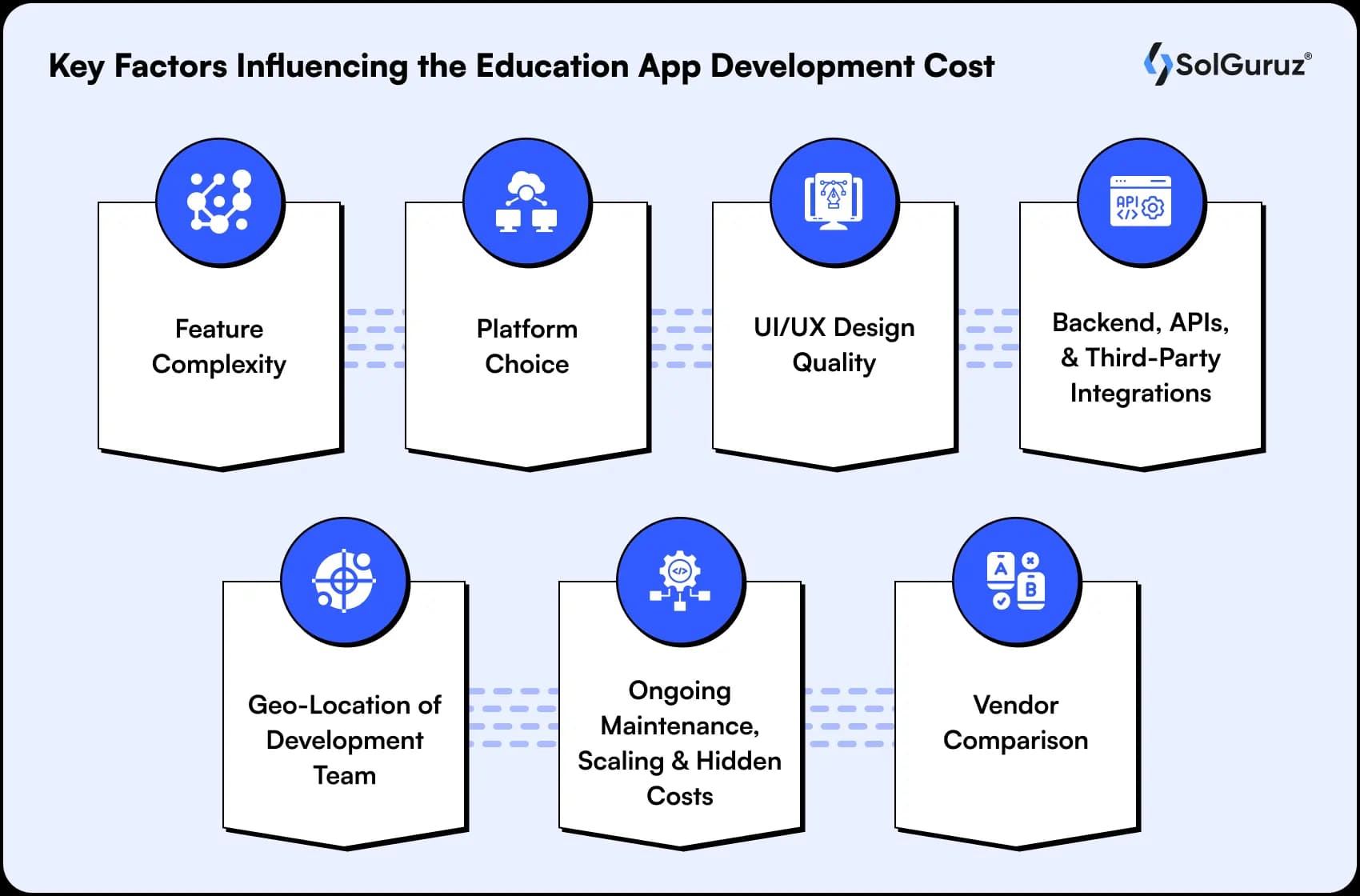
What Drives the Budget to Make an Education App
Building an EdTech platform is not a fixed-price project.
Your final cost depends on several key variables such as features, app complexity, AI integrations, video infrastructure, and long-term scalability.
Here we have given a breakdown of what impacts your budget and why.
1. Feature Complexity (Most Important Cost Driver)
A simple learning app with videos and quizzes is affordable. But add live teaching, whiteboards, gamification, and AI tutors, and you move into a higher cost bracket.
Feature Complexity Cost Impact
| App Type | Description | Cost Impact |
| Basic MVP | Content, quizzes, and basic progress | Low |
| Mid-Level | Live classes, dashboards, assignments | Medium |
| Full-Scale + AI | AI tutor, adaptive learning, analytics | High |
Now you must be thinking, “How are edtech apps like Duolingo so successful?”
Educational apps like Coursera or Duolingo succeed because they deliver-
- Personalized learning
- Great content delivery
- Strong analytics
- Habit-forming design
These require deeper engineering and a scalable foundation, and advanced, complex features.
2. Platform Choice
Building separately for Android and iOS doubles your cost and time.
Cross-platform frameworks like Flutter let you build once and deploy everywhere.
Platform Cost Impact
| Platform | Cost Level | Notes |
| Android or iOS Only | Low | Fastest to build |
| Both (Native Build) | High | Two separate codebases |
| Cross-Platform (Flutter/React Native) | Medium | One codebase, faster delivery |
For EdTech apps, cross-platform app development is ideal because learning happens across devices.
So choose a solution that makes your edtech app available on all platforms.
3. UI/UX Design Quality
Whether it is about kids’ learning apps, needing colorful UI, characters, and micro-animations.
Or if you consider professional LMS apps needing dashboards, analytics, and structured interfaces. Designing plays a crucial role in educational applications.
Design Cost Impact Spectrum
| Design Type | Cost Impact | Description |
| Basic UI | Low | Simple screens |
| Custom UI | Medium | Branded elements |
| Premium + Animations | High | Interactive, gamified, advanced visuals |
4. Backend, APIs, and Third-Party Integrations
The backend is the engine of your education app.
Costs rise when you add live classes, whiteboards, real-time chat, video CDN, or AI scoring.
Integrations Cost Impact Table
| Integration Type | Examples | Cost Impact |
| Basic | Login, analytics, payments | Low |
| Advanced | Live class SDKs, whiteboard, LMS plugins | Medium |
| AI-Driven | Personalization, ML models | High |
AI-based learning personalization requires data pipelines and custom models, leading to higher costs.
5. Geo-Location of Development Team
Location dramatically impacts price. Educational apps are a hit everywhere in the world. When we talk about development cost, it is different in different regions of the world.
Hourly Rate Comparison
| Region | Avg Hourly Rate | Cost Impact |
| US / Canada | $120–$180/hr | Very high |
| UK / EU | $80–$130/hr | High |
| India | <$25/hr | Most cost-efficient |
It is evident from the table that hiring mobile app developers in India can reduce the overall app cost by 2–3x.
6. Ongoing Maintenance, Scaling & Hidden Costs
Education apps are content-heavy and require continuous updates. A small glitch and you lose per-day users. So, take into account the ongoing maintenance and scaling costs.
Another place where transparency matters is the hidden cost. So here is a table for
Hidden Cost Components
| Cost Type | Range (USD/year) | Purpose |
| Maintenance & Hypercare | $5,000–$15,000 | Bug fixes, updates |
| Cloud Hosting | $2,000–$8,000 | Video storage & CDN |
| API & SDK Renewals | $500–$2,000 | Live classes, maps, analytics |
| Security & Compliance | $1,000–$3,000 | COPPA, GDPR audits |
| Marketing & ASO | Varies | User growth |
| Scaling Infrastructure | Variable | More users = higher server load |
7. Vendor Comparison
Choosing the right education app development solution can significantly impact your overall cost.
Here we have compiled a simple comparison table to help you evaluate the three most common vendor types – freelancers, agencies, and in-house teams.
Vendor Comparison Table
| Vendor Type | Pros | Cons | Typical Rate (USD/hr) | Notes |
| Freelance Developers | Cost-effective, quick to start | Hard to manage at scale. | $15–$50/hr | Suitable for small tasks. |
| Development Agency | Full team with designers, backend, QA | Higher cost than freelancers | $25–$100/hr | Best for MVPs, scaling apps, and long-term partnerships |
| In-House Team | Complete control | Slow hiring, high salaries | $50–$120/hr | Ideal only for large companies. |
How to Vet & Select the Right Vendor (Critical Questions to Ask)
Before signing a contract, ask these non-negotiable, outcome-focused questions to ensure your vendor is the right fit.
- Do you have experience in EdTech app development? Can you show a similar work portfolio?
- Which tech stack will work the best for my app and why?
- How do you estimate costs?
- What is your development process?
- Do you offer post-launch support and maintenance?
- Do you offer a small paid pilot or discovery workshop before full engagement?
The selection of the partner depends on the answers you get. Anyone answering extensively and transparently to such questions is your pick.
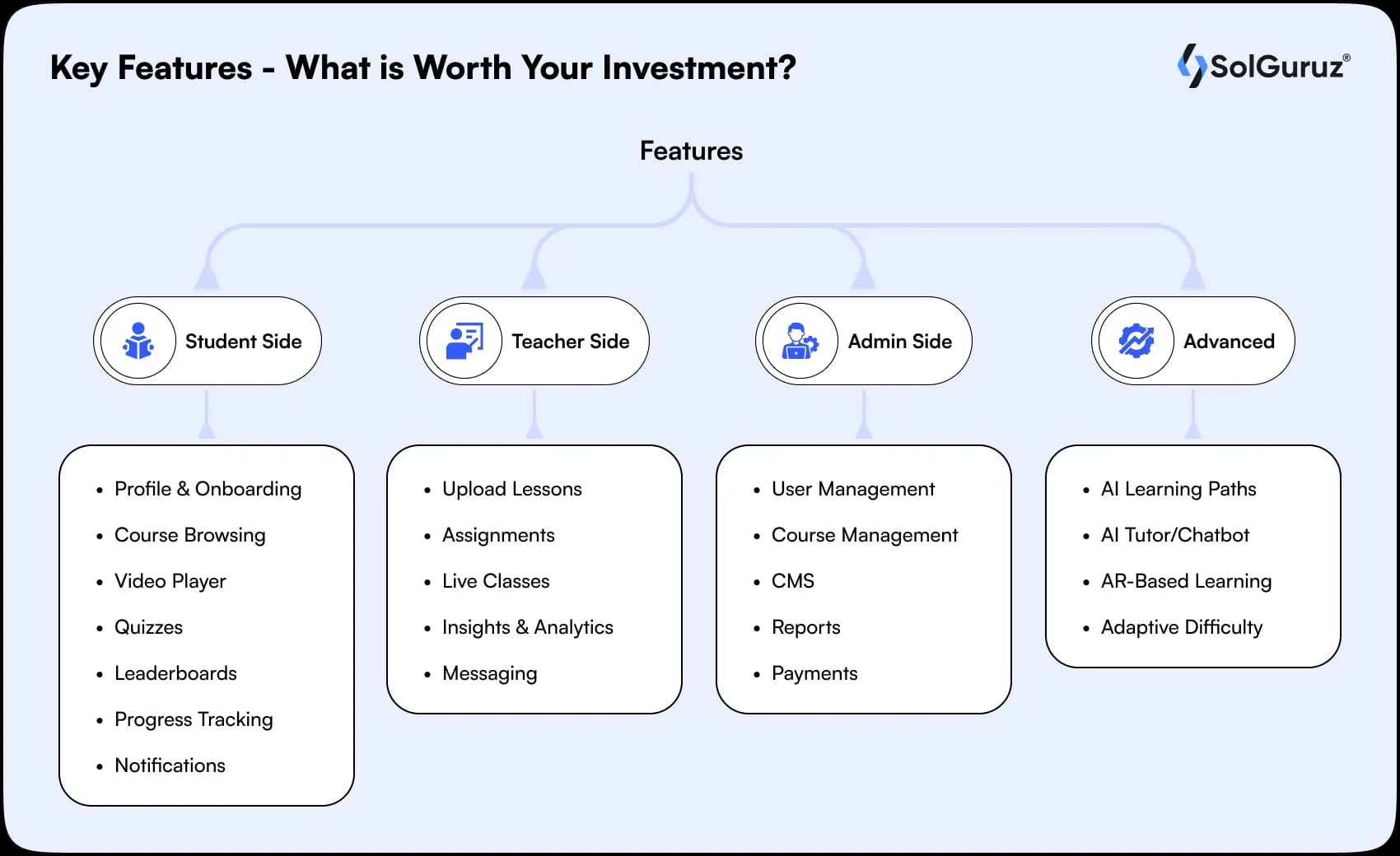
Key Features – What Is Worth Your Investment?
Each feature below is carefully crafted to enhance learning, streamline teaching, and simplify management. These are the capabilities that truly elevate your app and make your investment worthwhile.
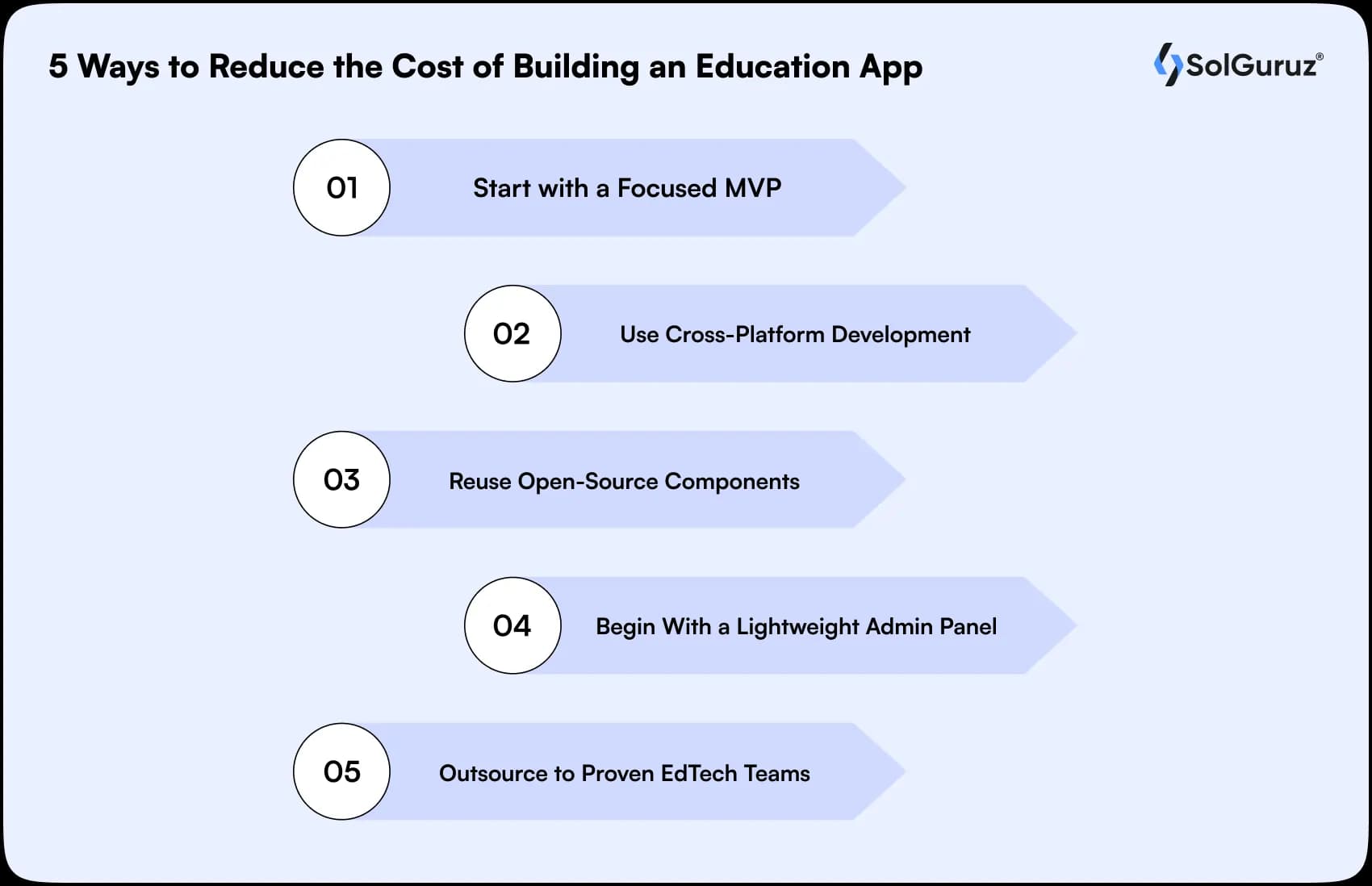
5 Ways to Reduce the Cost of Building an Education App
Most EdTech founders overspend because they build too much, too early. These five proven strategies will help you cut development costs, accelerate launch time, and invest only where it truly matters.
1. Start with a Focused MVP
The biggest mistake anyone makes is building a full Coursera clone on day 1.
Do not copy big apps frame by frame. They had multiple updates and millions of investment to get the app you see today.
Begin with the features that deliver real learning outcomes – like video lessons, quizzes, and basic progress tracking.
A focused MVP helps you validate your idea early, gathering real student/teacher feedback.
Once adoption grows, scale with more advanced modules like AI tutors, gamification, or analytics.
2. Use Cross-Platform Development
We have already covered this in the “Key factors influencing the cost.”
Using Flutter or React Native allows you to build once and deploy everywhere, reducing development time by 40–50%.
For most EdTech startups, cross-platform is the smartest and most cost-efficient choice.
3. Reuse Open-Source Components
Building from scratch, when you live in an era of “open-source components,” is a mistake.
Open-source libraries offer ready-made components for calendars, video players, quiz modules, chat interfaces, and UI layouts.
Using these reduces development time significantly while keeping quality intact.
Just make sure licensing and compliance are checked – especially for education apps used by children and teens.
4. Begin With a Lightweight Admin Panel
A full custom admin dashboard can be expensive to build early on.
Instead, start with no-code/low-code tools like Firebase Console, Retool, or SuperAdmin for internal management. A no-code or vibe coding development company can help you save time and build quickly.
Once your app scales, you can invest in a custom CMS or full admin panel tailored to your workflows.
5. Outsource to Proven EdTech Teams
Hiring an in-house team is costly and slow, especially if you’re launching your first product.
Working with an experienced EdTech development company like SolGuruz gives you access to specialists in mobile, backend, AI, video, and UI/UX – without inflated operational costs.
You get faster delivery, better quality, and a scalable architecture built right from the start.
This approach helps you launch sooner, stay within budget, and avoid expensive mistakes.
Build an Education App That Actually Makes an Impact
When you’re investing serious budget into an EdTech product, you expect real growth.
You don’t want just a development vendor – you need a strategic partner who understands learning science, education workflows, and student engagement.
That’s exactly where SolGuruz delivers unmatched value.
- Transparent Pricing – Clear estimations. We don’t believe in hidden costs. We have agile sprints and weekly demos, so you always know where your budget is going.
- Smart Feature Prioritization (No Overbuilding) – We guide you towards building only what improves learning outcomes and user adoption rates. No unnecessary modules. No unwanted money spent.
- Proven Expertise in EdTech Development – From learning apps to full LMS platforms, we have built extensive edtech solutions. Our dedicated development team has built educational apps used across institutes, coaching centers, and digital academies.
- Speed Without Compromising Quality – We specialize in fast yet stable MVP delivery using modern frameworks, reusable components, and best-in-class engineering practices.
- AI-Ready Architecture from Day One – Adaptive learning paths, AI tutors, predictive analytics, automated assessments, we help you design for the future, not just the launch.
If you are ready to build an edtech app that students love, teachers prefer, and perform well, let us build together!
FAQs
1. Which additional factors influence the cost of an education app?
Additional factors that affect education app development cost may be AI or personalization features, video streaming or live class SDKs. Also, you can include backend architecture and third-party integrations.
2. How long does it take to develop an education app?
Education apps typically take 2–12 months to develop: MVP: 2–4 months, mid-level EdTech app: 4–8 months, full-scale LMS or AI-driven platform: 8–12+ months. Timeline depends on complexity, team size, and scope.
3. What features should an education app include?
Must-have features for an education app should be: user login and profiles, course list and structured modules, video lessons, quizzes and assessments, and teacher or admin dashboards. Advanced apps may include AI tutors, gamification, live classes, analytics, and adaptive learning paths.
4. Do I need AI features in my education app?
Not necessarily. But using AI can significantly improve learning outcomes. AI helps personalize lessons, automate assessments, predict student performance, and enhance engagement.
5. Why should I hire SolGuruz to build my education app?
SolGuruz specializes in building scalable, modern EdTech platforms with fast MVP delivery, transparent pricing, strong UI/UX, and AI-ready architecture. We cover everything - mobile, web, backend, cloud, LMS modules, and integrations, so do not look for multiple vendors; we are a one-stop solution.
From Insight to Action
Insights define intent. Execution defines results. Understand how we deliver with structure, collaborate through partnerships, and how our guidebooks help leaders make better product decisions.
 How we Work
Build EdTech App Without Burning Your Budget
Get a clear estimate, feature roadmap, and tech stack plan - tailored to your idea.

Strict NDA

Trusted by Startups & Enterprises Worldwide

Flexible Engagement Models

1 Week Risk-Free Trial
Give us a call now!

+1 (724) 577-7737