


How to Build a Language Learning App Like Duolingo?
Planning to build an app like Duolingo? This guide breaks down everything from features and AI integration to design, cost, and monetization. Learn how to create a scalable, engaging, and data-driven language learning platform that keeps users hooked and helps your EdTech idea stand out.

Summarise with AI


Learning a new language is hard.
But Duolingo was able to make it easy.
All you will have to invest is a few minutes a day. And from that, users earn XP and keep streaks alive.
And somehow end up competing with friends to practice Spanish verbs at 11 PM.
It’s a marvel of smart product design + gamification + machine learning.
If you want to build a language learning app like Duolingo, then this guide is best for you.
Table of Contents
How Does Duolingo Work?
Duolingo is a marvel in itself.
Why? Because it is a masterclass in how to make learning feel like a game.
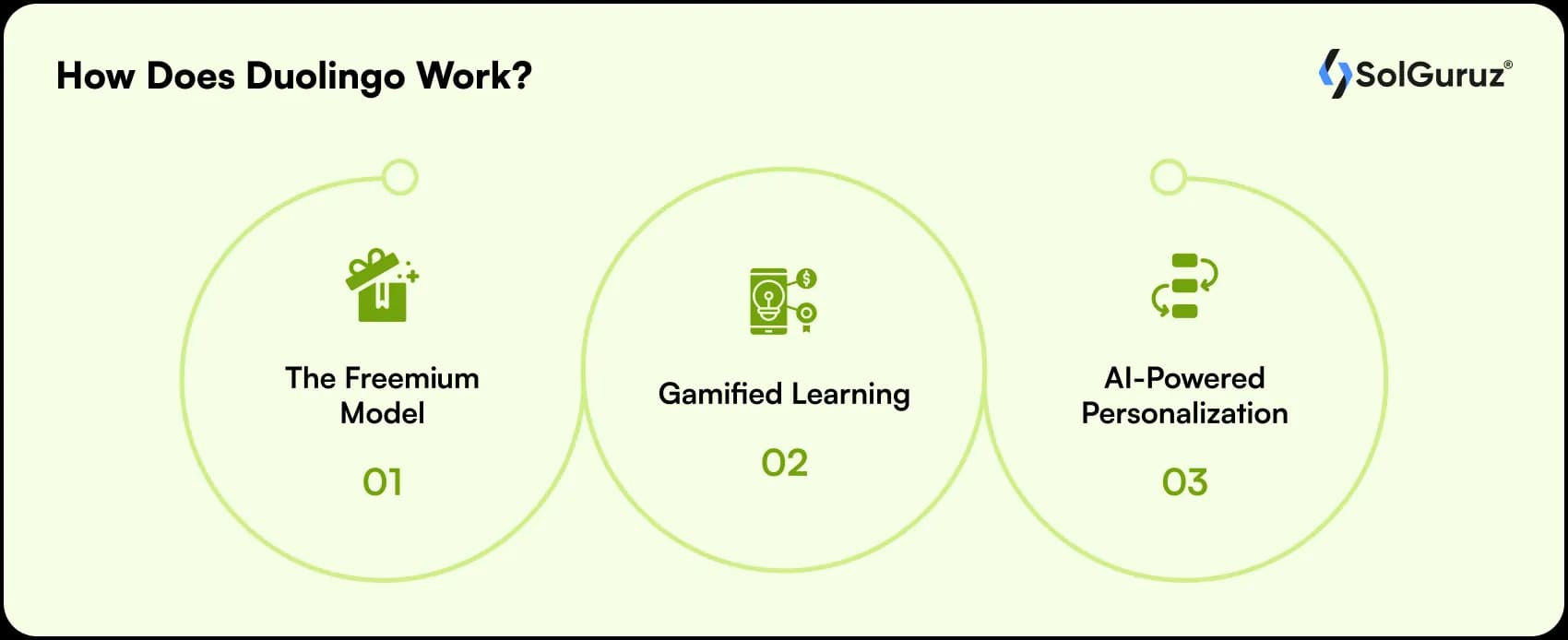
And, Duolingo’s success comes from three things:
- A freemium business model that scales like crazy.
- A gamified learning system that keeps users hooked.
- And an AI engine that quietly personalizes every single lesson.
Let’s break it down 👇
1. The Freemium Model
Duolingo lets anyone start learning for free. That’s its biggest growth lever.
Its revenue comes from:
- Duolingo’s premium ad-free subscription.
- In-app ads are shown to free users.
- In-app purchases like “streak freezes” or XP boosters.
- And a growing B2B offering, helping schools and organizations track learners.
This model keeps acquisition frictionless while monetizing power users at scale
The same principle is behind most top-tier SaaS and consumer apps.
2. Gamified Learning
Every screen in Duolingo is designed like a mini dopamine trigger:
- You earn XP points for each lesson.
- You maintain daily streaks (or risk losing them 😅).
- You unlock levels, badges, and leaderboards.
- And you get push notifications that guilt-trip you back into learning.
This turns something traditionally “boring” into a habit loop.
It’s the game-first psychology that keeps users returning daily without external motivation.
3. AI-Powered Personalization
Here’s what most people don’t see.
The thing is, Duolingo heavily uses AI and machine learning to adapt to each learner’s pace and mistakes.
- Its AI adjusts difficulty based on user performance.
- Speech recognition models evaluate pronunciation.
- Chatbots simulate conversations for practice.
- And data analytics continually refine lesson sequencing.
In short, Duolingo built a system that makes the product smarter with every user.
That’s exactly what you should aim for when building an app like Duolingo.
What Features Should be There in an App like Duolingo?
Most founders make the same mistake when building a language app. They copy Duolingo’s interface, not its system.
The real magic isn’t the green owl or the streak counter. It’s how every feature feeds into a single goal.
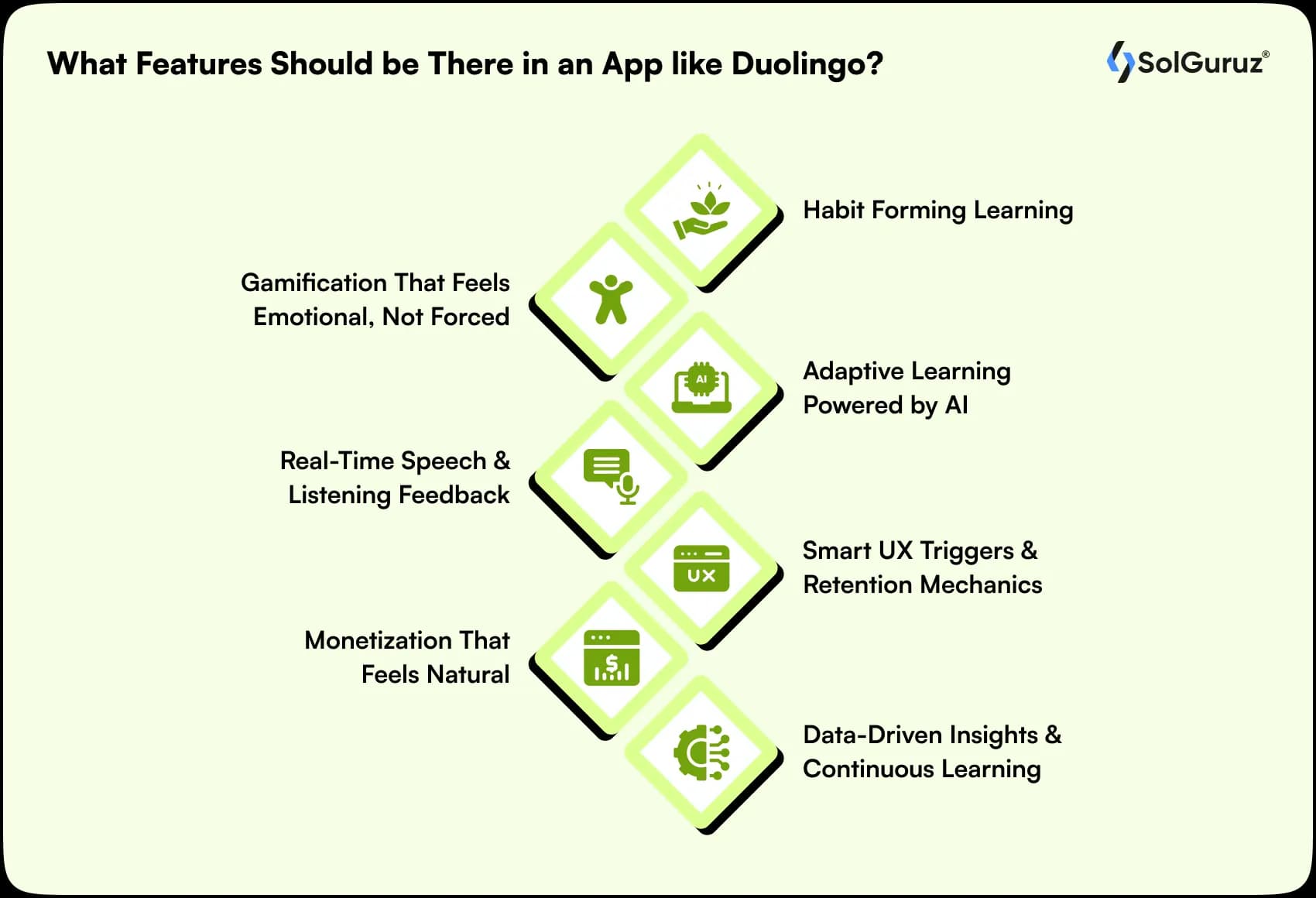
Here are what features you must have.
1. Habit Forming Learning
Duolingo lessons aren’t random flashcards. They are very small learning loops that seem quite achievable.
Each lesson:
- Teaches one skill or concept,
- Gives instant feedback, and
- Rewards completion.
So, when you design your app, make learning seem doable.
2. Gamification That Feels Emotional, Not Forced
Duolingo doesn’t just give you points. It gives you pressure.
Lose a streak? You’ll feel it.
That’s emotional gamification. It is best for building a solid retention system.
Your version should include:
- Streaks that reset (loss aversion works)
- XP or skill points that unlock new challenges
- Leaderboards & leagues to bring social competition
- Badges or milestones that reward consistent effort
But here’s the key: gamification shouldn’t overshadow learning. It should amplify the satisfaction of progress.
3. Adaptive Learning Powered by AI
This is the heart of any modern language app.
Duolingo’s AI keeps track of how well a user performs. Based on that, it tweaks the lesson difficulty.
When you integrate AI, think beyond personalization buzzwords. Build systems that:
- Identify weak areas automatically (e.g., grammar mistakes, pronunciation gaps)
- Adjust difficulty dynamically
- Offer smart repetition for concepts a user struggles with
- Suggest next lessons based on learning behavior
4. Real-Time Speech & Listening Feedback
Language is sound, not text.
You can use AI-driven speech recognition and voice analysis.
It will help you evaluate pronunciation, tone, and rhythm.
With the help of this, you can give instant feedback like: “You pronounced rendezvous perfectly this time.”
It feels human. And this is what makes learning conversational.
5. Smart UX Triggers & Retention Mechanics
Duolingo’s UX isn’t just bright colors and cute animations. It’s psychology wrapped in design.
Borrow what works:
- Visual progress bars → dopamine hits on completion
- “Don’t break your streak” push notifications → habit triggers
- Time-based rewards → bring users back at specific intervals
- Session timers & quick lessons → reduce friction to start learning
The goal? Make your user think, “I’ll just do one quick lesson.”
6. Monetization That Feels Natural
Duolingo’s freemium model works because it doesn’t interrupt learning. It enhances it.
The app monetizes through:
- Ad-supported free users
- Subscriptions (Super Duolingo)
- In-app purchases like streak freezes
- Institutional access (Duolingo for Schools)
Your takeaway: let users experience value before paying.
If you want to push them to upgrade, then it should be for convenience.
7. Data-Driven Insights & Continuous Learning
Behind Duolingo’s friendly UX is a massive data engine.
Every tap, mistake, or quit point gets tracked to refine the app.
So build analytics early (even in your MVP).
You need to track engagement and retention cohorts.
This is what separates a hobby project from a scalable EdTech product.
Also, check out these e-learning app trends before you finalize the features.
How to Build a Language Learning App Like Duolingo?
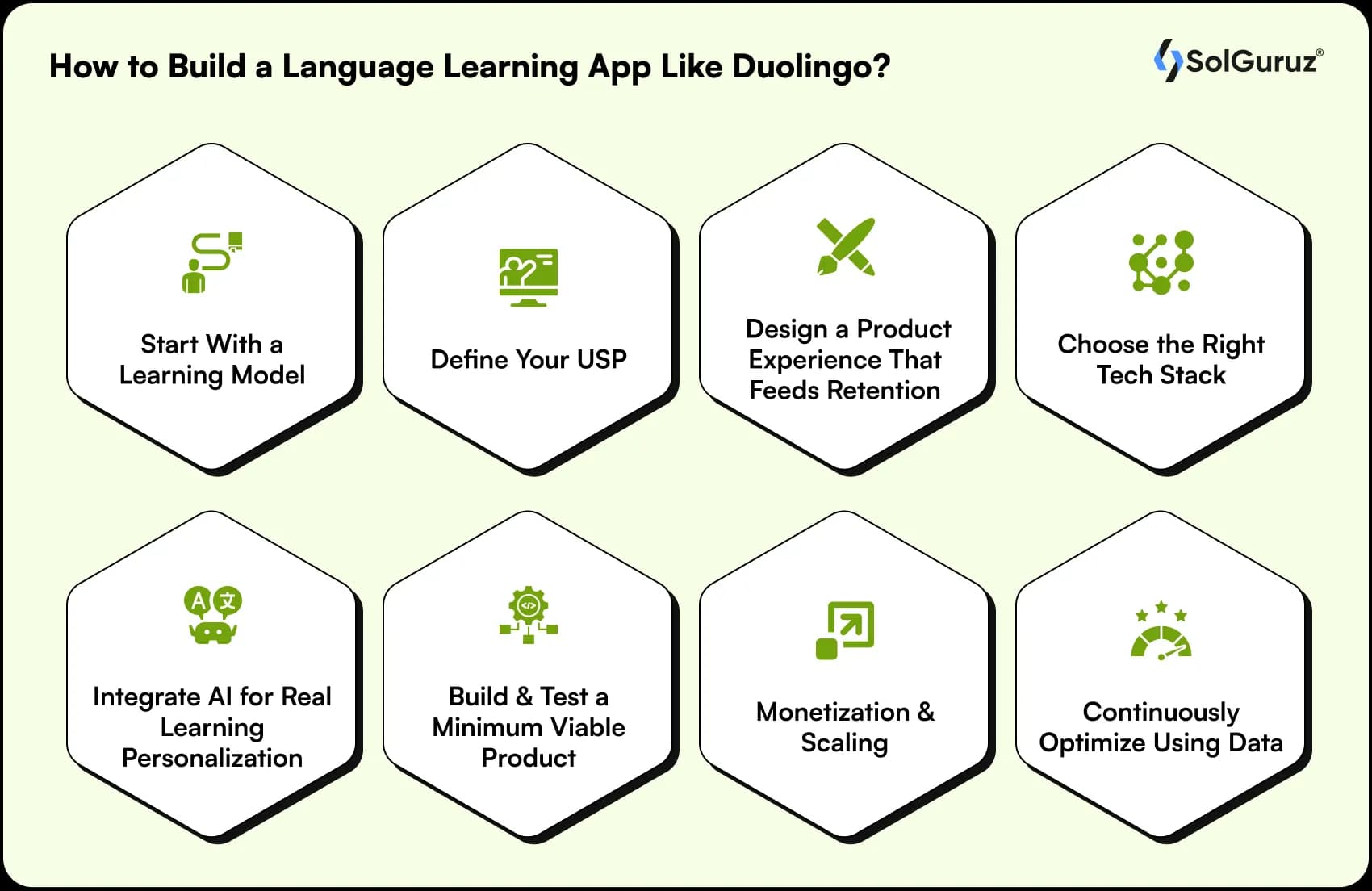
Many startups fail to clone Duolingo. Why? It is tough to build the right product system.
And here is how you can approach it even if you are new.
Step 1: Start With a Learning Model
First of all, you need to decide how your app will teach.
Will it focus on vocabulary? Conversational skills? Or Listening comprehension?
When it comes to Duolingo, the learning path is built on spaced repetition + gamified micro-learning.
You don’t have to copy that. But you do need a defined teaching framework that your AI can optimize later.
Without this, all you have is an expensive quiz app.
Step 2: Define Your USP (Why Another Duolingo?)
Duolingo dominates the general market. To stand out, you need a niche or innovation angle.
Examples:
- Focus on regional or minority languages
- Conversational AI tutors instead of static lessons
- Voice-first learning for hands-free practice
- Gamified peer challenges or community-driven progress
Define what your version does better before you start designing anything.
Step 3: Design a Product Experience That Feeds Retention
Every successful learning app has a habit loop: Trigger → Action → Reward → Progress.
Build around that:
- Trigger: “You’re about to lose your streak.”
- Action: User opens the app and takes a quick lesson.
- Reward: XP + instant positive feedback.
- Progress: Visible streak or achievement bar.
Your UI, notification logic, and lesson design should all feed this system.
Retention isn’t a metric. It’s a design principle.
Step 4: Choose the Right Tech Stack
You don’t have to over-engineer. Build lean.
Here is the tech stack I recommend to build such an app:
- Frontend: Flutter or React Native (for cross-platform apps like Duolingo)
- Backend: Node.js, Django, or Laravel
- Database: PostgreSQL or Firebase
- AI Layer: Python + GPT/Whisper APIs for natural language and speech
- Hosting: AWS / Google Cloud
- Analytics: Firebase Analytics, Mixpanel, or Amplitude
Your goal: fast MVP → measurable results → scalable backend.
Step 5: Integrate AI for Real Learning Personalization
AI is what separates a gamified app from a learning assistant.
Here’s where you can use it:
- Learning Engine: Tracks user performance and adjusts difficulty.
- Speech Recognition: Checks pronunciation accuracy.
- AI Chatbots: Sets up conversational practice in real time.
- Personalized Lesson Generation: Use GPT-based models to auto-create contextual exercises.
If done right, your users will feel like the app “knows” them. That’s retention gold.
Step 6: Build & Test a Minimum Viable Product
Launch small. One language. One audience. One killer feature.
Maybe just “AI-powered pronunciation feedback for Spanish learners.”
Focus on:
- Usability testing (is it fun and intuitive?)
- Learning outcomes (are users improving?)
- Retention metrics (do they come back daily?)
Note: MVP with 1 strong feature beats a low-quality clone with 15.
Step 7: Monetization & Scaling
Once you are sure about the traction, start monetizing slowly.
As you grow, scale through community-driven engagement.
You can try out leagues, friend challenges, and progress sharing.
Step 8: Continuously Optimize Using Data
Track everything:
- Lesson completion rates
- Drop-off points
- Average learning streaks
- Session duration
- Conversion to premium
This is how Duolingo built a billion-dollar app. By letting data shape the product, not opinions.
How Much Does It Cost to Develop a Duolingo-like App?
Let’s get one thing straight. A good language learning app isn’t cheap.
Especially if you want to match up with Duolingo.
But the good news is: you don’t have to spend like Duolingo. You just have to spend smartly.
| App Type | Approx. Cost (USD) | Timeline |
| Basic MVP (Single Language) | $10,000 – $30,000 | 3–4 months |
| Mid-Level App (Gamification + AI Feedback) | $40,000 – $70,000 | 5–7 months |
| Full-Scale App (Multi-language + AI + Subscriptions) | $80,000 – $110,000+ | 8–12 months |
Let’s Build an App Like Duolingo
Duolingo is special.
And that’s what makes it tough to recreate such an amazing app.
But it can be done with the right team.
At SolGuruz, we’ve helped startups and EdTech companies build AI-powered apps.
So, if you really want to build a language learning app, then let’s get in touch.
FAQs
1. How long does it realistically take to build a Duolingo-like app?
A solid MVP usually takes around 1-3 months to build.
A full product with adaptive learning, chatbots, and multi-language support? Expect 3–6 months if you’re building it properly.
2. Do I need my own AI model, or can I plug into existing ones?
You can build most of the AI experience using models like GPT for chat. And Whisper for pronunciation feedback.
Once you have real user data, then train your own models.
That’s how you go from “cool app” to “category leader” without burning six figures upfront.
3. What actually makes Duolingo addictive? And can I replicate that?
It’s not luck.
It’s the loop. A mix of short lessons, streak pressure, and emotional rewards.
You can absolutely recreate that loop in your own app, but you need to design from psychology outward, not features inward.
Start by making learning feel like progress, not effort.
4. How does Duolingo make money, and how should I think about monetization?
Duolingo plays the long game: build habit → build brand → monetize gently.
They earn through:
- Paid subscription (Super Duolingo)
- Ads for free users
- Microtransactions (streak freezes, XP boosts)
If you’re just starting out, go freemium-first. Let users experience value before they ever see a paywall.
5. Should I go cross-platform right away or start with one OS?
Go cross-platform from day one. That’s exactly why Flutter exists.
Language learning apps rely on habit loops; you can’t afford to lose half your user base because they’re on Android while you built for iOS.
6. Why partner with a team like SolGuruz instead of hiring freelancers?
Because building an AI-driven education product isn’t about writing code. It is about building continuity.
You need a team that understands product psychology, AI integration, and long-term scalability.
That’s the gap SolGuruz fills. We don’t just “build an app,” we build the learning engine behind it.
From Insight to Action
Insights define intent. Execution defines results. Understand how we deliver with structure, collaborate through partnerships, and how our guidebooks help leaders make better product decisions.
 How we Work
Build an App Like Duolingo
We’ll help you plan features and build a gamified UX that drives daily engagement.

Strict NDA

Trusted by Startups & Enterprises Worldwide

Flexible Engagement Models

1 Week Risk-Free Trial
Give us a call now!

+1 (724) 577-7737