

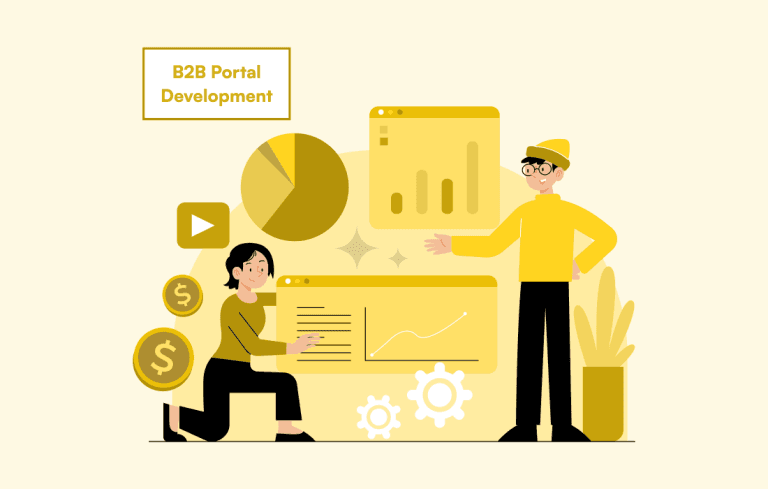
B2B Portal Development: Building the Digital Backbone of Modern Businesses
B2B portal development is reshaping how businesses buy, sell, and collaborate digitally. With over 73% of B2B buyers preferring self-service portals, companies using B2B platforms reduce operational costs by up to 30%. This blog covers what B2B portal development entails, including key features, benefits, costs, pros, and cons, as well as how to build a scalable portal in 2026.

Summarise with AI


I’ve worked closely with B2B teams that still are dependent on spreadsheets, emails, and legacy CRMs to manage orders and partner relationships.
This makes the decision-making slower.
-> It increases manual errors.
-> It limits real-time visibility, directly impacting revenue and customer trust.
According to Forrester, it forecasts that by 2026, 20% of B2B sellers will negotiate quotes via AI agents on portals, as 61% of buyers use private genAI for purchases. B2B buyers prioritize analyst reports and social proof on digital platforms, with genAI integration pressuring leaders to enhance portal capabilities
In this blog, I’ll explain what B2B portal development is, its importance in 2026, key features, costs, pros and cons, and best practices to help you build a scalable, future-ready B2B portal.
Table of Contents
What Is B2B Portal Development?
B2B portal development means creating secure digital platforms where businesses connect with suppliers, partners, and customers. These systems handle complex workflows, process transactions, and manage permissions across multiple user levels.
A well-designed B2B portal acts as a centre hub where:
- Suppliers upload invoices and track purchase orders
- Distributors manage inventory and place bulk orders
- Partners access marketing materials and performance data
- Customers can see their history and generate reports
The fast growth of digital commerce B2B web portal development has become a strategic investment. The global B2B e-commerce market reached $16.9 trillion in 2024, with portal-based transactions accounting for 48% of this growth.
Why B2B Portal Development Matters in 2026 and Beyond
B2B buying behavior has changed on a wider scale:
- 72% of B2B sales interactions are now digital-focused
- 68% of buyers want self-service portals over speaking to sales executives
- Companies adopting digital portals see up to 55% faster order processing
Without a B2B portal, it becomes a challenging task for businesses to handle manual errors and poor partner experiences, leading to the loss of customers and clients. Getting into a partnership with a Custom software development company helps companies to build scalable and future-ready B2B portals.
What Is The B2B Portal Development Process: Explained Step-by-Step
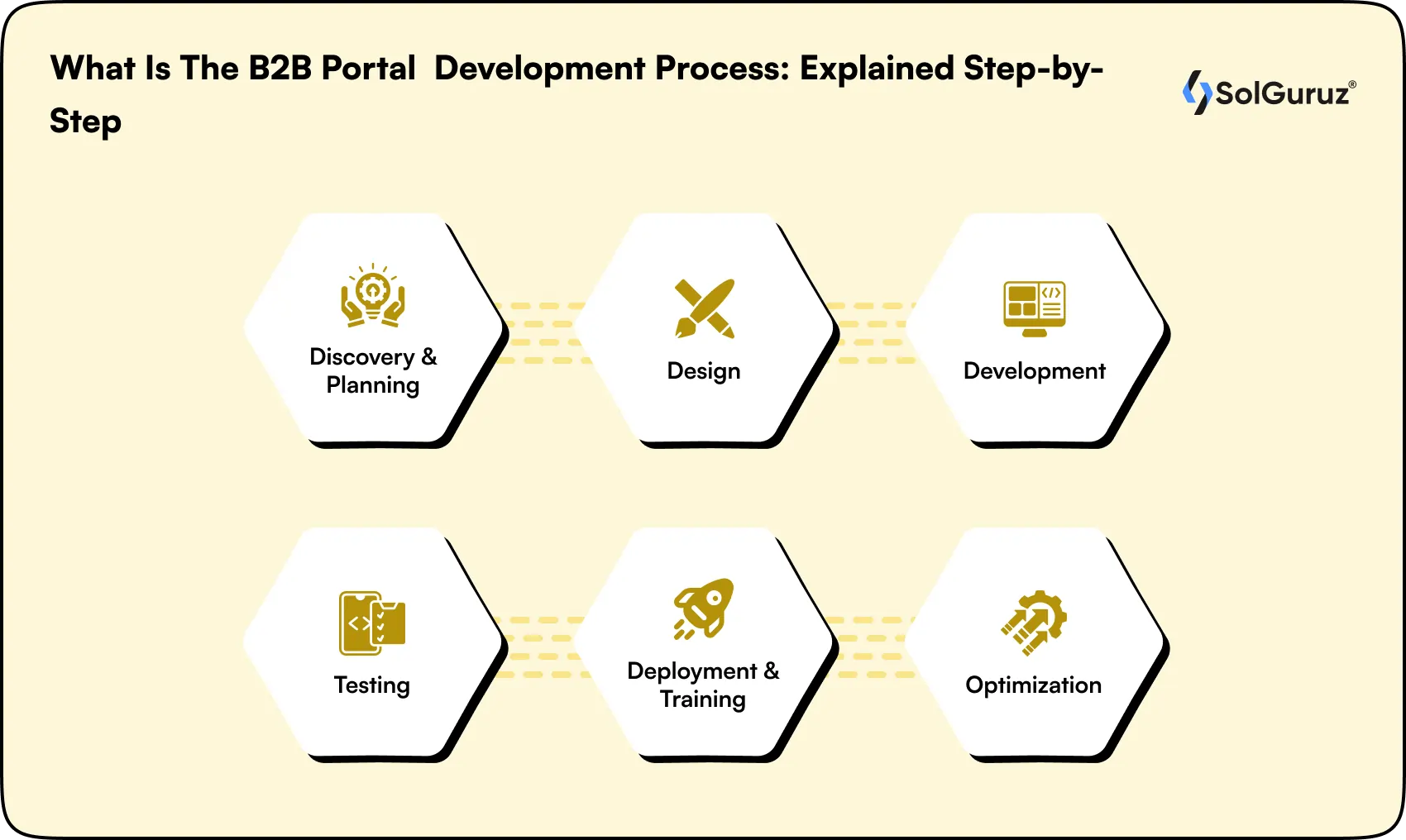
Let me now discuss the process you can follow for B2B portal development:
1. Discovery & Planning
- Identify stakeholder needs, document workflows, and create technical specifications.
- With detailed planning and following the correct roadmap of investment, it reduces development costs by 25%
2. Design
- Build wireframes, create UI, and plan user journeys.
- Navigate users through a simple and clean UI.
3. Development
- Create front-end and back-end -> Results in robust performance
- Get integrated with third-party systems and add personalized features.
4 . Testing
Continuous testing helps in improving performance, so conduct functional testing and security audits.
5. Deployment & Training
After testing, launch the portal and get users familiar with the portal’s UI
6. Optimization
Focus on continuous improvement, adding new features, and maintaining security updates
What Are The Key Features of a B2B Portal
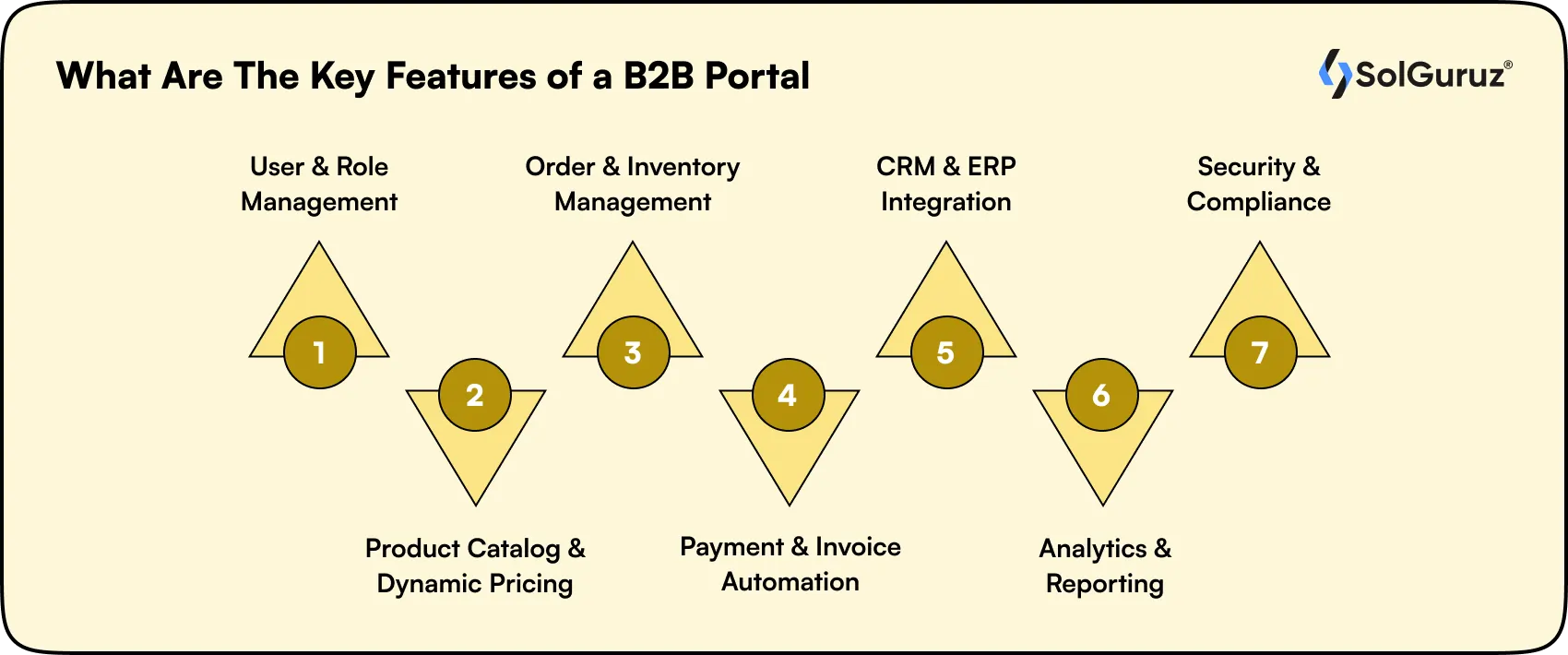
The B2B portal provides you with several features:
1. User & Role Management
Portal works across different roles and people, such as distributors and buyers. Stakeholders, admins who further get role-based access with customized dashboards.
2. Product Catalog & Dynamic Pricing
Yes, the B2B portal shows product catalogs, pricing variances and heavy discounts.
3. Order & Inventory Management
Through the portal, it is more convenient to manage orders and inventory consistently.
4. Payment & Invoice Automation
- The billing process gets automated
- Generates invoices in real time and manages customer-specific credit limits
5. CRM & ERP Integration
Make sure data flows continuously between your B2B portal and various systems, including” with “Ensure data flows continuously between your B2B portal and systems such as SAP, Salesforce, and others.
6. Analytics & Reporting
Monitor sales trends, monitor order frequency, understand customer behavior, and evaluate overall portal performance.
7. Security & Compliance
B2B portal also ensures data encryption, access control, audit logs, and compliance with industry standards.
What Are The Types of B2B Portals
Below are the most common types of B2B portals designed to meet specific business needs.
| Type of B2B Portal | Who It’s For | Purpose & Key Functions |
| Customer B2B Portal | Business buyers & clients | It is for business buyers and clients. This portal enables you to place bulk orders, check custom pricing, and track shipments. |
| Vendor / Supplier Portal | Suppliers & manufacturers | Focuses on managing inventory levels, submitting invoices, and updating delivery schedules. |
| Partner / Distributor Portal | Resellers & channel partners | This portal helps in accessing contract pricing, sales tools, and marketing assets, specifically developed for partners. |
| Wholesale B2B Portal | Wholesalers & bulk buyers | This portal is for bulk buyers. It also allows for large-volume orders, customized pricing, and a minimum order quantity. |
| B2B eCommerce Portal | B2B sellers & corporate buyers | Online product catalogs, negotiated pricing, and digital payments |
| Enterprise Self-Service Portal | Large enterprises & stakeholders | Centralized access for orders, approvals, documents, and analytics |
Insights: Portals are useful when developed for a specific group of users rather than for everyone. When the features match the needs of customers, suppliers, or partners who actually use the system, adoption improves, and manual work can be avoided.
What Are The Pros and Cons of B2B Portal Development
It is necessary to acknowledge advantages and potential challenges to make decisions effectively.
Pros
A robust, structured B2B portal provides measurable business value and benefits.
- Ultimately minimizes the operational costs by 25–30%
- Faster order processing and approvals
- Improved partner satisfaction and retention
- A few manual errors and disputes
- Scalable for business growth
Cons
No matter how beneficial B2B portals are and businesses should also consider the challenges involved in implementation and adoption.
- Higher upfront development cost
- Needs change management and training
- Ongoing maintenance and upgrades are required at the core
What Is The Technology Stack For Creating B2B Portals?
For creating complex business workflows, let’s check out some of the tech needed to build a B2B portal:
| Technology Layer | Tools / Technologies | Description & Use Case |
| Frontend | React, Next.js, Angular | Such technologies are used to build faster and responsive interfaces |
| Backend | Node.js, Java, .NET | This focuses on handling business logic, integrations, APIs, and large transactions. |
| Database | PostgreSQL, MySQL, MongoDB | The portal properly stores your customer data, orders, and transaction records in a well-secured manner. This ensures your B2B portal runs without any lag. |
| Cloud Infrastructure | AWS, Azure, Google Cloud | It ensures scalability, high availability, data backup, and global performance |
| Security & Authentication | OAuth, SSO, JWT, MFA | Security and authentication help in protecting critical information with secured login and access control. |
What Is The B2B Portal Development Cost and Factors Affecting It?
Most businesses find B2B portal development expensive. The cost of a B2B portal is determined by factors such as complexity, integrations, and technology stack. Getting detailed insights into such factors helps you make the right decisions when selecting B2B web portal development services that align with your goals and budget.
Estimated Cost Breakdown
Let me now highlight the cost involved in building the B2B portal:
| Portal Type | Estimated Cost | Description |
| Basic B2B Portal | $10,000 – $40,000 | It includes basic features like Order management, basic inventory, and simple user roles. |
| Mid-Level Portal with Integrations | $50,000 – $80,000 | It mostly involves ERP/CRM integration, analytics, and payment automation. |
| Enterprise-Grade B2B Portal | $90,000 – $120,000+ | An advanced feature pack portal with advanced security, scalability, and multiple role access. |
What Are The Key factors Affecting Cost
Below are factors that affect cost and decision-making when developing a B2B portal:
1) Complexity & Features
Need a portal that includes advanced features such as role-based access, analytics, and payment automation? The cost for such features will be higher. This makes it important to hire web developers with proven B2B experience.
2) Integrations
It is quite a complex process to integrate ERP, CRM, and payment gateways also leads to development time and cost.
3) Customization
B2B portal clients want customization of most of the features, workflows, which further leads to a higher budget.
4) Scalability & Security
Enterprise-grade portals with stronger security, cloud deployment, and higher scalability demand higher investment.
Quick Reference:
- Startups or small businesses: Basic Portal
- Growing businesses with existing systems: Mid-Level Portal
- Large enterprises or global operations: Enterprise Portal
Investing in a correct B2B portal ensures efficiency, better partner collaboration, and long-term ROI.
What Are The Best Practices for B2B Portal Development
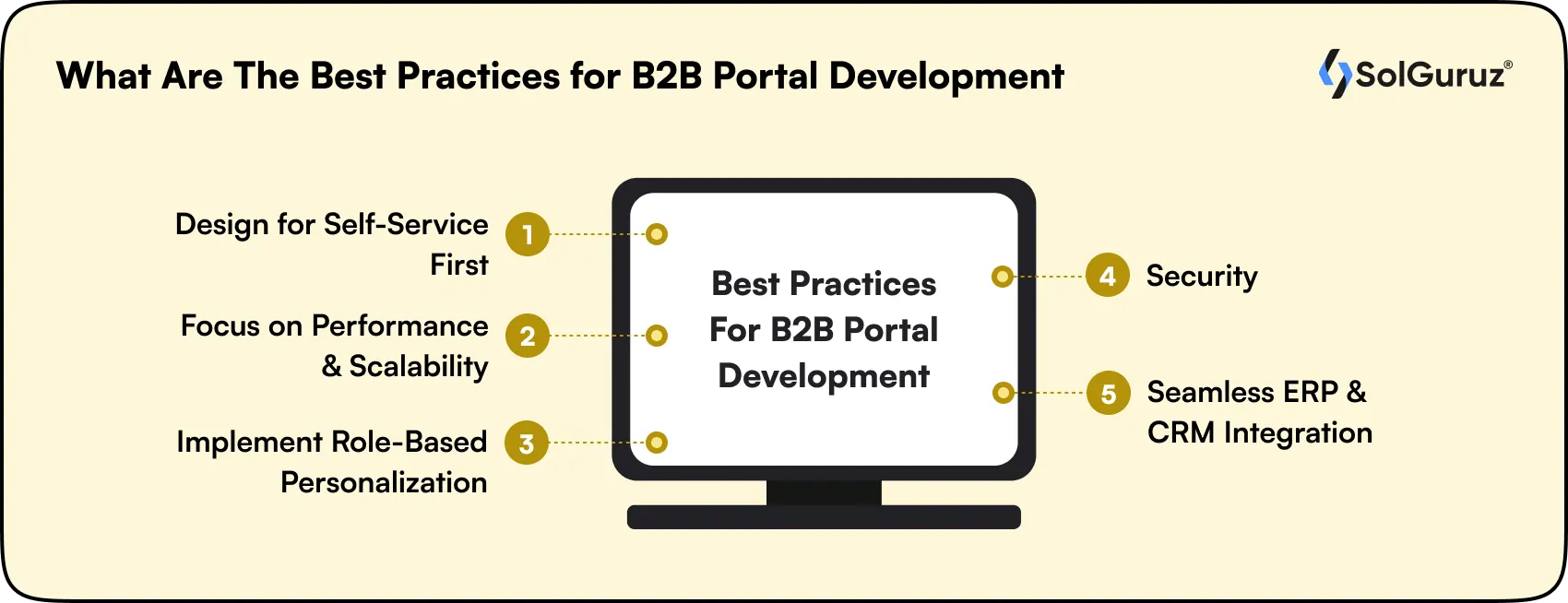
Before choosing a portal for your business, make sure to adopt these practices discussed below:
1. Design for Self-Service First
- Users should use the portal independently -> No use of manual support
- They should be able to track orders, deliveries, making their workflow easier
2. Focus on Performance and Scalability
Create a portal that can easily handle loads of traffic, heavy data volumes, and users. A skilled Web development company ensures the portal is built with a scalable architecture from the start.
3. Implement Role-Based Personalization
Yes, customized dashboards, variance in pricing, and permissions based on user roles.
4. Security
- Security plays a crucial role in B2B portals, as protecting crucial information is necessary.
- Focus on implementing stronger authentication, access controls, and ensuring data security properly.
5. Seamless ERP and CRM Integration
- To be connected smoothly with ERP and CRM systems.
- Ultimately, it leads to less manual work and ensures real-time data flow.
How You Can Hire the Right B2B Portal Development Partner
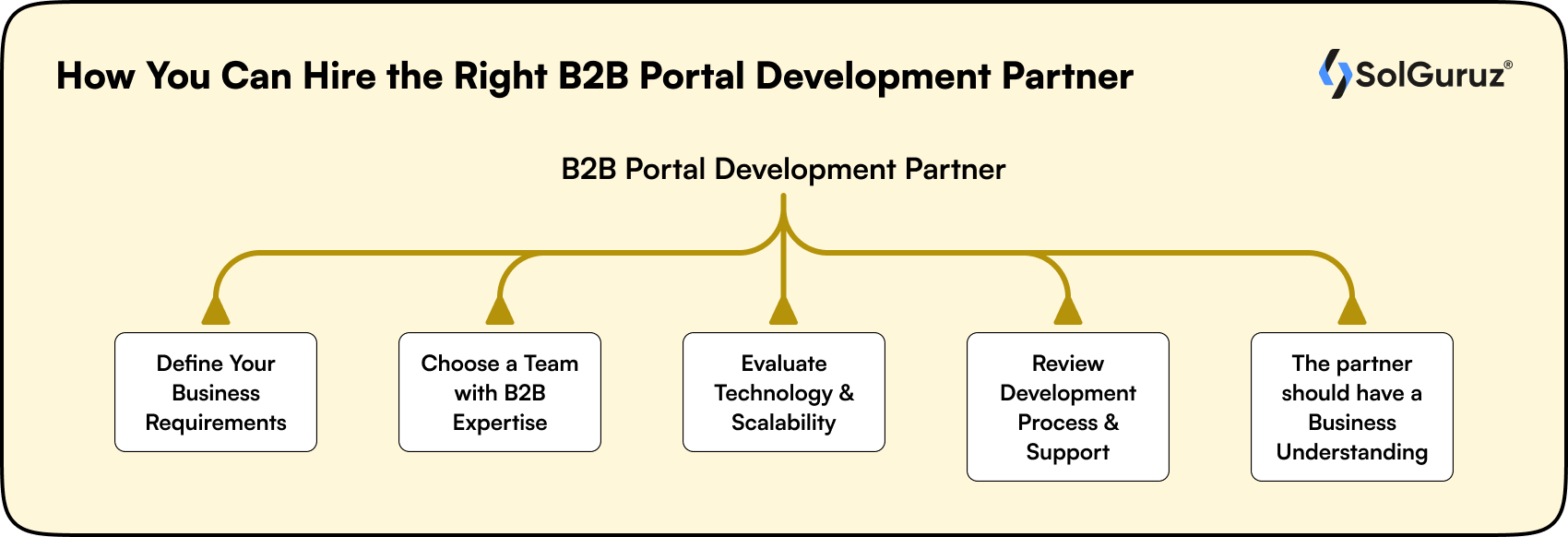
Hiring a B2B portal development partner requires detailed planning and research. Here are the points you can consider when hiring:
1. Define Your Business Requirements
You should clearly outline your business specifications and workflows that can be automated, the types of users, and the goal.
2. Choose a Team with B2B Expertise
Choose those developers who specialize in B2B portal development.
- Should have handled complex pricing, approvals,
- ERP/CRM integration
- Must know security compliance
3. Evaluate Technology and Scalability
A strong partner will design a future-ready architecture that supports growth and high transaction volumes.
4. Review Development Process and Support
- It is important to check how the team handles the workflow and errors, testing, and post-launch support.
- Regular upgrades result in long-term success.
5. The partner should have a Business Understanding
- Hire a partner who can deliver measurable ROI and lower the cost.
- The reliable B2B portal development partner should have a proper understanding of your business domain.
Conclusion: Build a Future-Ready B2B Portal
B2B transactions are becoming more complex, not simpler. Organizations using centralized digital portals achieve up to 2× higher customer retention and encounter fewer problems than those that still rely on manual processes.
A well-architected B2B portal becomes a long-term growth enabler, not just an operational tool.
Why choose SolGuruz?
- Custom B2B portal development
- Ongoing integration with ERP, CRM, and payment systems
- Constant support and feature enhancements
We help businesses transform complexity into clarity and build B2B portals that expand with trust.
FAQs
1. What is B2B portal development, and how does it work?
B2B portal development is the process of creating a digital platform that facilitates more effective business-to-business collaboration. User roles determine access. While buyers place orders, monitor deliveries, and evaluate past transactions, suppliers handle inventory and purchase orders.
2. How much does B2B portal development cost in 2026?
A B2B portal has no cost limit. While business portals with several connectors and security levels can cost more than $120,000, basic portals typically start at around $10,000. Features, level of customization, and system complexity are the primary determinants of total cost.
3. What are the key features of a B2B portal?
Features like customized pricing, role-based access, and order management tools are common. Additional features, such as billing, payment processing, and connectivity with internal tools, are also included in most business portals.
4. How long does it take to develop a B2B portal?
The development process takes 6 to 12 weeks. The timeline might change further, depending on the features you need and how advanced a portal you want for your business.
5. How do I choose the right B2B portal development company?
Start by looking for companies with real experience in B2B projects. Try to explore their work history, expertise in the specific domain, and approach to scalability.

Written by
Lokesh Dudhat
Lokesh Dudhat is the Co-Founder and CTO of SolGuruz, with 15+ years of hands-on experience in full-stack and product engineering. He spent over a decade building native applications across iPhone, iPad, Apple Watch, and Apple TV ecosystems before expanding into backend systems, Angular, Node.js, Python, AI software and solutions, and cloud architecture. As CTO, Lokesh defines and enforces engineering standards, architecture practices, and DevOps maturity across all delivery teams. He is actively involved in system design reviews, scalability planning, code quality frameworks, and platform architecture decisions for complex products. He works closely with product teams and enterprise clients to design resilient, maintainable, and performance-driven systems. His writing focuses on software architecture, headless CMS systems, backend engineering, scalability patterns, and engineering best practices.


From Insight to Action
Insights define intent. Execution defines results. Understand how we deliver with structure, collaborate through partnerships, and how our guidebooks help leaders make better product decisions.
 How we Work
Build a B2B Portal That Grows With Your Business
Our partners scale from 1,000 to 100,000+ users without re-platforming- let’s architect growth together.

Strict NDA

Trusted by Startups & Enterprises Worldwide

Flexible Engagement Models

1 Week Risk-Free Trial