




AI SaaS Development: The Ultimate Guide to Building Intelligent Cloud Solutions in 2026
The AI SaaS market is set to reach $775.44 billion by 2031. This guide covers proven strategies, development steps, costs, and tech stacks to help businesses build scalable, intelligent SaaS platforms in 2026 and beyond.

Summarise with AI


Traditional SaaS is gone! Do you know?
Here’s what changed while you weren’t aware:
Earlier, traditional platforms were falling behind while still working with manual updates. AI-powered SaaS solutions made this easy. They learn, adapt, and optimize themselves in real-time.
Here’s the reality: The global AI SaaS market is up to $72.55 billion in 2024. By 2031? $775.44 billion. That’s the growth I am talking about.
Still waiting for the right time?
The businesses dominating your industry tomorrow are building their AI SaaS products today. The only question is: Are you leading this shift or watching from the sidelines? Let’s dive in.
Table of Contents
AI SaaS Development: Understanding the Transformation
What if your software could evolve, adapt, learn, and improve if someone used it?
Now, this is what AI SaaS can do.
What is AI SaaS: AI SaaS (Artificial Intelligence Software as a Service) specifically integrates advanced AI technologies, such as machine learning and NLP cloud-based SaaS models.
But..
Instead of performing like static tools:
-> AI-powered SaaS analyzes data in real time
-> Understand user interactions for better analysis
In simple terms:
- SaaS delivers software
- AI SaaS delivers intelligence
Why AI SaaS Is Getting Popular?
The AI SaaS development is getting popular and for good reason.
AI and SaaS development allow businesses to manage larger data efficiently while changing raw information into meaningful insights.
- Big enterprises are handing millions of users’ data, which is a hectic process. AI SaaS solutions simplify it and change that data into core insights, allowing faster decision-making.
- AI SaaS lets down the operational costs by automating repetitive tasks and removing human errors at the core.
- Further, companies that adapt AI into their SaaS products could focus more on innovation faster. It is the reason why modern product teams rapidly follow a structured SaaS App Development Guide to develop an AI-first SaaS platform.
Building Your AI SaaS Product: The Strategic Development Roadmap
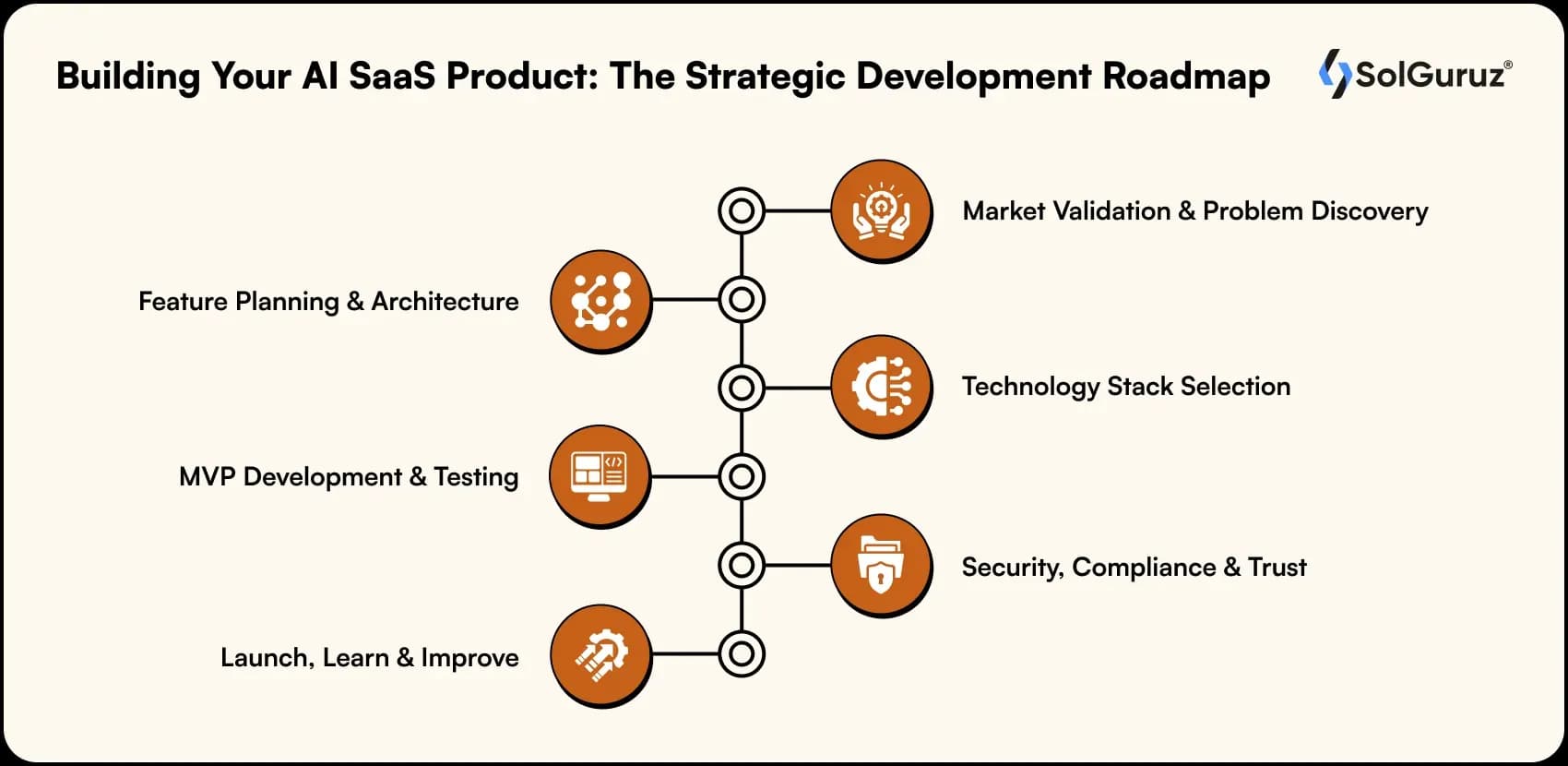
In order to create a successful AI SaaS platform needs more methodical planning and execution across several phases. Picking up the correct SaaS development platform, AI assists in reducing risks.
Phase 1: Market Validation & Problem Discovery
Outcome: Validate real demand and reduce market risk
- Important to reflect the core problem via understanding user pain points.
- Helps in building a blueprint of the overall process ahead.
Phase 2: Feature Planning & Architecture
Outcome: Define a clear product scope and scalable system design
- Focus on adapting must-have features in a SAAS product.
- Design and create a scalable SAAS architecture that supports secure data management and user access control.
Phase 3: Technology Stack Selection
Outcome: Select a future-ready tech stack aligned with scale and AI needs
Choose:
- Front-end frameworks such as React.js/ Vue.js
- Databases like SQL/ PostgreSQL
- Stronger back-end system
Phase 4: MVP Development & Testing
Outcome: Launch a functional MVP within 90–120 days
- Test user MVP and ensure how the user will interact with the product, track performance, and collect feedback.
- You can also focus on using guide improvements instead of assumptions.
Phase 5: Security, Compliance & Trust
Outcome: Establish enterprise-grade security and user trust
When building an AI SaaS product, make sure the data is:
- Secured with encryption,
- Regular audits
- Role-based access.
Phase 6: Launch, Learn & Improve
Outcome: Improve product performance using real-world data
- Updates the features constantly
- Get embedded with AI models by the use of real-world data
Remember: A successful AI SaaS product is achieved by properly following up steps and processes, testing the problem first, launching with an MVP, and constantly focusing on improvements. That’s why going with a structured MVP Development Company helps teams balance innovation with feasibility from the start.
Core Features of AI SaaS Platforms
Below are the key features that define a successful AI SaaS product.
| Feature | Description |
| Intelligent Data Processing | Properly understands the large volumes of structured and unstructured data in real time |
| Machine Learning Personalization | Works best with dashboards, workflows, and recommendations based on user behavior |
| Predictive Analytics | This feature does forecasting of trends, risks, and allows for proactive decision making |
| Automation & Smart Workflows | Through this:
Automates repetitive tasks. Decision-heavy processes to remove manual effort |
| API & Integration Support | More convenient to integrate with third-party tools like CRMs and ERPs. |
| Scalable AI Infrastructure | Cloud-native architecture:
Make sure that it automatically expands AI workloads as the user base grows. |
Key Benefits and Limitations of AI-Powered SaaS Development
AI-powered SaaS solutions also come with both benefits and challenges. Let’s go down beneath:
Benefits of AI SaaS Development
Here are the core benefits of AI-based SaaS development:
1. Smarter User Experiences
With the help of AI, it allows SaaS based products to customize dashboards, suggestions, and workflows for every user without any need for manual work.
2. Automation
Human error is reduced via AI. How?
AI transforms the workflow into automated and also eliminates the operational cost.
3. Faster Decision-Making
AI-driven analytics offers insights instantly
Allows for faster decisions in seconds instead of hours
4. Continuous Product Improvement
Machine learning models improve accuracy and performance over time, no redesign required.
Limitations of AI SaaS Development
Here are the limitations of AI SaaS development:
1. High Initial Development Cost
Large investment needed due to robust data infrastructure and model training
2. Data Dependency and Quality Issues
- Difficult for AI Saas development to work smoothly.
- Insufficient or bad Information can result in low performance or inaccurate output.
3. Complexity in Maintenance
- AI models and software often need regular monitoring and continuous updates.
- This can critically enhance long-term maintenance efforts.
4. Explainability and Trust Concerns
- Sometimes, AI decisions can not be undertaken.
- If a detailed answer is not available, users might not trust AI recommendations or predictions.
AI SaaS Development Tech Stack
Now, knowing the right tech stack is necessary for faster decision-making and a smooth development process:
| Layer | Technologies (Examples) | Purpose |
| Frontend | React.js, Vue.js, TypeScript | Create fast, responsive user interfaces |
| Backend | Node.js, Python (FastAPI/Django) | Handle business logic and APIs |
| Database | PostgreSQL, MySQL, MongoDB | Store structured and unstructured data |
| AI / ML | TensorFlow, PyTorch, OpenAI APIs | Power predictions, personalization, automation |
| Cloud & DevOps | AWS, Google Cloud, Docker, Kubernetes | Scalability, deployment, infrastructure |
AI SaaS Development Cost in 2026
AI SaaS development costs in 2026, completely dependent on product complexity, level of AI integration, and requirements. Choose only those SaaS development companies that can offer you the best cost bundle as per your budget and requirements.
| Product Stage | Cost Range | What’s Included |
| MVP with Basic AI Features | $10,000-$45000 | Core SaaS features, limited AI models, basic analytics, and cloud deployment |
| Mid-Scale AI SaaS Product | $50,000 – $90,000 | This involves scalability, stronger security, and performance optimization. |
| Enterprise-Grade AI SaaS Platform | $100,000+ $150,000 | Customized AI models, large-scale data processing, and compliance |
Disclaimer: Costs vary based on AI complexity, data volume, and compliance needs.
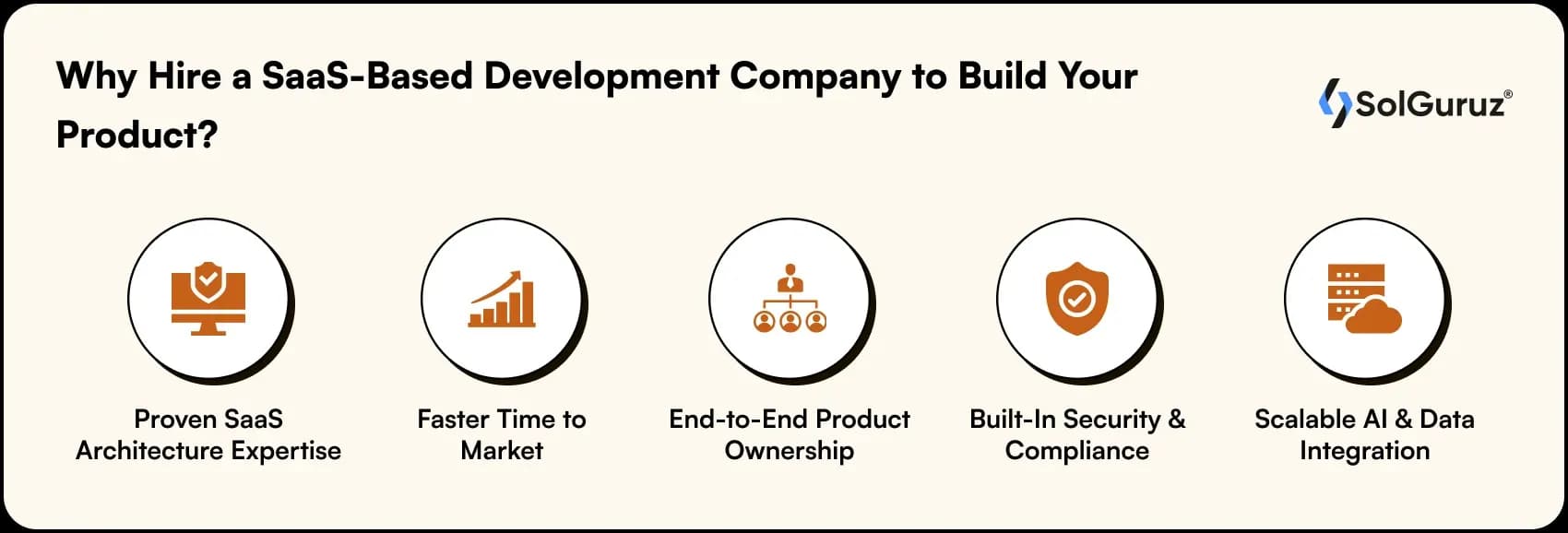
Why Hire a SaaS-Based Development Company to Build Your Product?
Want to hire a professional SaaS based development company?
Hiring a specialized SaaS Application Development Company ultimately improves your ability to build a reliable, market-ready product.
1. Proven SaaS Architecture Expertise
- Properly understand multi-tenant architectures,
- Cloud-native design and auto-scaling infrastructure.
2. Faster Time to Market
- Professional Saas based teams critically follow industry-specific frameworks and resume components.
- It, however, reduces development cycles and assists in launching faster, validating ideas.
3. End-to-End Product Ownership
- Handle everything from MVP and UI/UX to backend, AI, and deployment
- Reduce coordination issues amongst vendors
4. Built-In Security and Compliance
- Important to keep a higher standard for data protection and compliance.
- A specialized company builds security and regulatory requirements directly into the product architecture from the initial start.
5. Scalable AI and Data Integration
- Focuses on integrating AI and machine learning models
- Manages data pipelines efficiently
- Ensure AI performance improves over time
Final Thought: Building the Future with AI SaaS
AI is no longer an experimental layer in SaaS; it is the foundation of modern software. Companies that go with intelligence at early stages deliver more value, moving faster, and getting ahead of traditional competitors.
Building successful AI SaaS products needs AI-first thinking, scalable cloud architecture, and continuous learning systems.
Here is the solution for your AI Saas Product development:
SolGuruz helps companies design and build AI-powered SaaS platforms that are highly secure, scalable, and ready to evolve as user preferences change.
With SolGuruz as your SaaS development partner, you’re not just building a product; you’re building a platform designed to lead, adapt, and grow in the AI-first era.
FAQs
1. What is AI SaaS development?
AI Saas development is the process of integrating with cloud-based software delivery models to smart artificial capabilities. Such type of platforms use machine learning and advanced AI technologies to provide adaptive solutions accessible through subscription models.
2. How much will it cost to develop an AI SaaS product?
The cost of developing such an app relies on factors like platform scope, capabilities, and more. The product's basic features, cost will be around $10,000, and can go up to $90,000 with advanced integrated features.
3. What are the advantages of AI-powered SaaS?
Benefits you can expect from AI-powered SaaS, such as better decision-making, scalability, and keeping users growing without any lag.
4. How long does AI SaaS development take to build?
The development timeline can range from 4-12 months, and depends on AI model requirements, product scope, team size, and other needs. A simple MVP could be deployed in 4-6 months, whereas advanced enterprise platforms would need 6-18 months for release.
5. What technologies are used in AI SaaS development?
The technologies used in AI SaaS development depend on React or Vue for the frontend, Python or NodeJS for the backend, and cloud platforms such as Google Cloud or AWS. The type of technology choice depends on project requirements and team expertise.

Paresh Mayani is the Co-Founder and CEO of SolGuruz, a global custom software development and product engineering company. With over 17+ years of experience in software development, architecture decisions, and technology consulting, he has worked across the full lifecycle of digital products, from early validation to large-scale production systems. He started his career as an Android developer and spent nearly a decade building real-world mobile applications before moving into product strategy, technical consulting, and delivery leadership roles. Paresh works directly with founders, scaleups, and enterprise teams where technology choices influence product viability, scalability, and long-term operational success. He partners closely with founders and cross-functional teams to take early ideas and turn them into scalable digital products. His work revolves around AI integration, agent-driven workflow automation, guiding product discovery, MVP validation, system design, and domain-specific software platforms across industries such as healthcare, fitness, and fintech. Instead of solely focusing on building features, Paresh helps organizations adopt technology in a way that fits business workflows, teams, and growth stages. Beyond delivery, Paresh is also an active tech community contributor and speaker, contributing to global developer ecosystems through Stack Overflow, technical talks, mentorship, and developer community (Google Developers Group Ahmedabad and FlutterFlow Developers Group Ahmedabad) initiatives. He holds more than 120,000 reputation points on Stack Overflow and is one of the top 10 contributors worldwide for the Android tag. His writing explores AI adoption, product engineering strategy, architecture planning, and practical lessons learned from real-world product execution.





From Insight to Action
Insights define intent. Execution defines results. Understand how we deliver with structure, collaborate through partnerships, and how our guidebooks help leaders make better product decisions.
 How we Work
From Idea to Intelligent SaaS
Build secure, scalable AI SaaS products with proven architecture, compliance, and real-world AI integration.

Strict NDA

Trusted by Startups & Enterprises Worldwide

Flexible Engagement Models

1 Week Risk-Free Trial
Real-World Examples of Our Expertise
Explore how real-world challenges were turned into opportunities with our success stories and case studies, showcasing impactful solutions and measurable results.
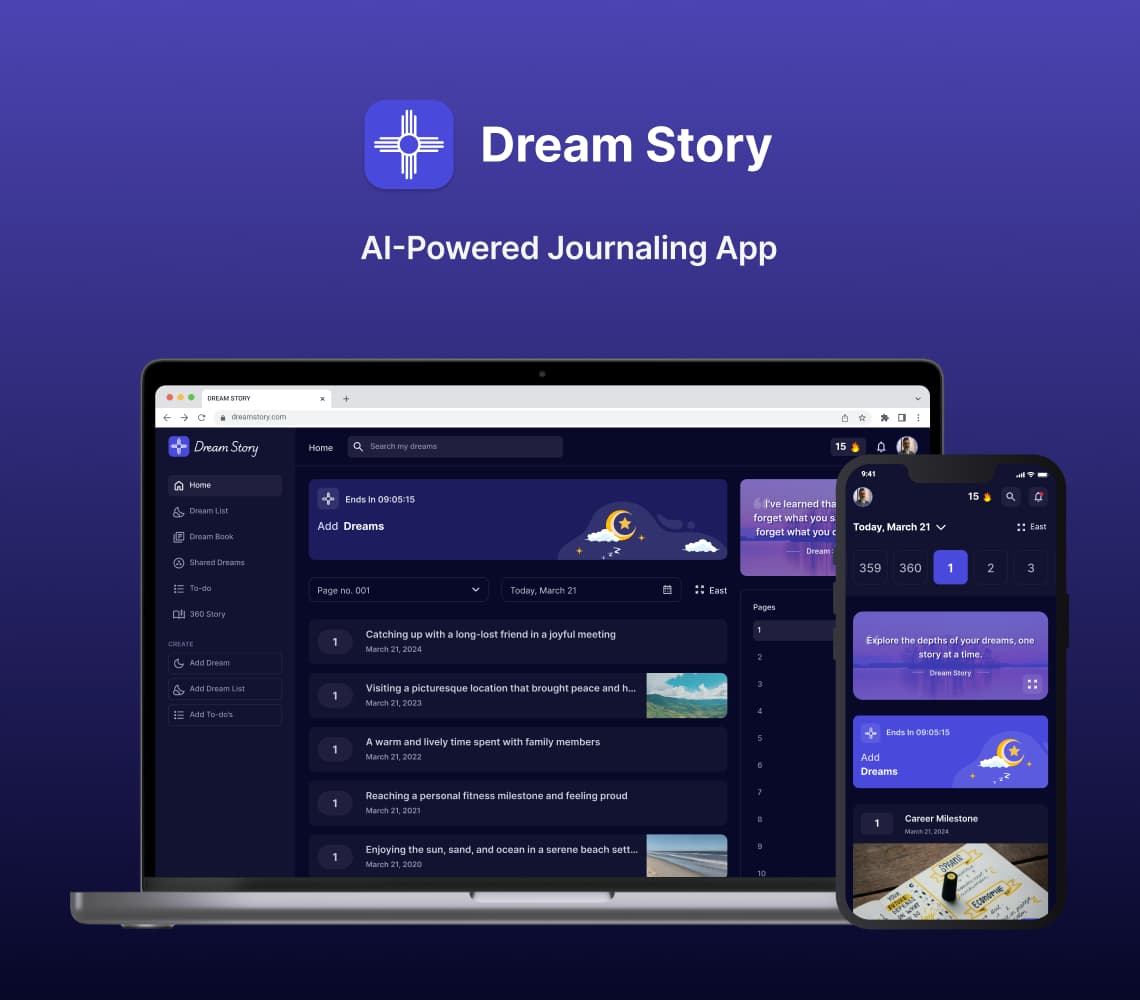
AI Journaling App Development Solution
Discover with us how we built Dream Story, an AI-powered journaling application that helps manage daily notes by capturing your thoughts and emotions. A one-stop solution for those who love noting down daily summaries!
Generative AI
Prompt Engineering
AI Integration
Mobile App
Flutter
Android
iOS
Web App
Desktop
Website
UI/UX
Backend
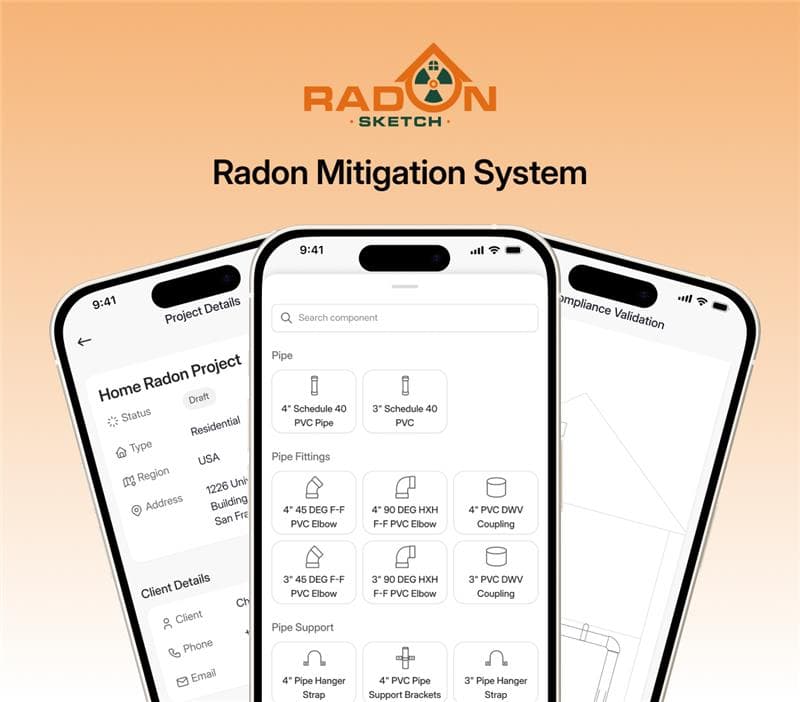
Radon Mitigation System for Mitigators And Enterprise
SolGuruz designed and developed RadonSketch, a smart radon mitigation system solution for mitigators and enterprises. It modernizes outdated workflows with automation, guided compliance, and a powerful visual builder - built end-to-end by our expert team.
Real Estate
UI/UX
MVP Development
Mobile App
Flutter
Android
iOS
Backend
Launch & Maintenance
Digital Transformation
Digital Marketing