
Top 25 Use Cases of Generative AI in the Travel Industry
This guide explores 25 practical use cases of Generative AI in the travel industry, from itinerary planning and dynamic pricing to fraud detection and automated refunds. You’ll learn where AI creates the most business value, how leading travel companies are using it, and which use case to build first.


Summarise with AI
Short on time? Let AI do the work. Get the key points.


Key takeaways
- AI is the front door to travel research now: Traffic from AI sources to US travel sites grew 194% year over year in May 2026, per Adobe Analytics.
- Adoption is mainstream, not early: 74% of US travelers plan trips with AI, and 85% say it saves them time.
- Booking assistance is the most widely adopted AI use case: It leads real-world deployments, followed by destination recommendations and content generation.
- Trust is growing, but transparency still matters. Travelers rely on AI for planning but continue to verify recommendations before completing a booking.
Travel research now starts inside an AI chat as often as a search box, and that shift is reaching every corner of travel, tourism and hospitality. That traffic behaves differently from everything else arriving at your site. AI-referred visitors stay 70% longer and bounce 41% less, yet they still convert 28% below traffic from other sources.
That gap is the whole story. Travelers are happy to let AI plan the trip. They are not yet willing to let it take the payment. So they leave the chat, check somewhere else, and book on whichever site earns their trust in that moment.
The opportunity is not replacing the booking flow. It is being the source the AI cites, and the site the traveler lands on when they step out of the chat. This guide from SolGuruz covers 25 use cases of generative AI in the travel industry. Each one has a plain answer, a real company doing it, and a note on what it takes to build.
What Is Generative AI in Travel?
Generative AI is doing more than improving trip planning. It is changing how businesses across the travel, tourism and hospitality industry attract customers, provide support, optimize operations, and use their data. From increasing bookings to improving customer experiences and streamlining operations, businesses are increasingly investing in AI development services to build intelligent, scalable travel platforms. Here are five ways generative AI is making an impact.
Businesses building these capabilities usually need the booking, pricing, and guest data wired into the model itself, not just an API bolted on. That architecture work is what travel app development services covers end to end.
Generative AI vs Predictive AI in Travel
Founders often use Generative AI and Predictive AI interchangeably, but they solve different problems. Generative AI creates personalized travel experiences, while Predictive AI analyzes historical data to forecast future outcomes. Most modern travel platforms combine both, and generative AI development services cover the layer that turns your booking data into traveler-facing output.
| Generative AI | Predictive AI | |
| What it does | Creates new output: text, plans, replies | Forecasts a number or outcome |
| Travel example | Writes a 5-day itinerary from a prompt | Forecasts next month’s demand on a route |
| When you need it | Traveler-facing planning, support, content | Pricing, inventory, staffing decisions |
Dynamic pricing is predictive. The assistant explaining that price to a traveler is generative. Ship them together and the traveler gets a reason, not just a number
What Generative AI Actually Changes for a Travel Business

Generative AI is doing more than improving trip planning. It is changing how businesses across the travel, tourism and hospitality industry attract customers, provide support, optimize operations, and use their data. From increasing bookings to improving customer experiences and streamlining operations, businesses are increasingly investing in AI development services to build intelligent, scalable travel platforms. Here are five ways generative AI is making an impact.
1. AI Is Becoming a New Travel Discovery Channel
More travelers now use AI assistants to research destinations, compare hotels, and plan trips before visiting a travel website. Businesses that make their content easy for AI to understand are more likely to appear in these recommendations and attract qualified visitors.
2. AI Reduces Customer Support Costs
AI can instantly answer common travel questions, handle booking updates, process cancellations, and assist with itinerary changes. This allows support teams to focus on complex issues while improving response times and lowering operational costs.
3. AI Helps Travel Businesses Respond Faster
Travel demand changes constantly. Generative AI helps businesses update pricing, recommend personalized offers, and adjust inventory based on real-time demand instead of relying on manual decisions or scheduled updates.
4. AI Scales Travel Content Creation
Creating destination guides, hotel descriptions, promotional campaigns, and multilingual content takes significant time. Generative AI enables travel companies to produce high-quality content faster without constantly expanding their content teams.
5. AI Turns Travel Data Into Actionable Insights
Travel businesses collect large amounts of customer reviews, booking history, support conversations, and search data. Generative AI analyzes this information to uncover customer preferences, identify trends, and help businesses make better decisions about products, marketing, and customer experience.
One clarification before the list. These are capabilities you add to a travel product, not products in themselves. If you are still deciding what to build rather than what to add, the travel app ideas guide covers concepts and business models instead.
25 Use Cases of Generative AI in the Travel Industry
Below are the 25 ways travel platforms, airlines, hotels, and OTAs are putting generative AI to work today. Each one starts with a one-line answer, then the detail.
1. AI Travel Agents and Conversational Assistants
An AI travel agent plans and books a trip through conversation instead of search filters, holding preferences across the whole session. What separates it from a chatbot is memory and initiative. It keeps context, so a traveler who named a $2,000 budget in the first message is not asked again in the tenth. It also acts unprompted, flagging a price drop on a route that traveler viewed last week.
Trip.com is the clearest proof this works. After launching TripGenie, the company reported its order conversion rate doubled. Users also spend around 20 minutes longer in the app on days they use it, across close to a million inquiries.
For an OTA that moves two numbers at once. Session length rises because travelers stop bouncing between filter screens. Support volume falls because the assistant answers what would otherwise arrive as a ticket. Keep this separate from your support assistant when you plan the build. This one helps a traveler decide.
The support assistant, covered further down, handles what happens after they pay. They pull different data and need different guardrails. Building either as a real agent rather than a scripted bot means memory, tool access and controlled actions, which is what AI agent development covers.
2. Personalized Itinerary Planning
AI itinerary planning builds a day-by-day trip from a traveler’s budget, interests and dates, then reworks it when conditions change.
Generative AI makes this happen at scale. It pulls together preferences, local data, flight schedules, weather, and even crowd levels to build itineraries that feel handcrafted. And it adapts in real time. If rain hits your beach day, the AI reroutes you to an indoor market or museum nearby.
KAYAK launched an AI tool where travelers type natural language queries like ‘morning flights under $500, nonstop’ and get tailored results instantly.
That is the kind of experience users now expect. If you want to build this kind of engine yourself, here is how to build an AI-powered trip planner app from architecture to cost.
3. Dynamic Pricing Powered by AI
AI dynamic pricing sets rates hour by hour based on demand, competitor prices, local events, and weather conditions. Large short-term rental marketplaces already do this, adjusting nightly rates as market conditions change. Instead of relying on fixed pricing or manual updates, AI continuously analyzes real-time data to recommend the best price for every booking. For travelers, this means fairer prices based on current demand. For travel businesses, it helps maximize occupancy, improve revenue, and respond to market changes faster.
The build effort is moderate. A working pricing engine on your own booking data takes roughly 8 to 12 weeks. Most of that is data preparation, not the model. Our travel app development guide breaks down what each build tier includes and what it takes
4. AI Chatbots for Post-Booking Support
An AI support agent resolves changes, cancellations and rebookings in natural language, at any hour, without a queue. These are not the clunky chatbots of five years ago. Modern AI bots understand context, remember previous conversations, and can handle complex requests like rebooking a canceled flight or modifying a hotel reservation. United Airlines uses predictive AI to anticipate flight disruptions and proactively notify passengers with alternatives.
For travel companies, this means fewer support agents handling routine queries and more time for your team to focus on high-value customer interactions.
5. Smart Travel Recommendations
AI recommendations turn search and browsing signals into destination, stay and activity suggestions matched to that traveler. Every time a user searches, browses, or books something on your platform, they leave behind preference signals. Generative AI picks up on those patterns and turns them into smart recommendations.
If someone keeps searching for mountain stays, the AI starts recommending hill stations, trekking experiences, and cozy lodges. If they browse beach resorts, it pivots accordingly. This goes beyond basic filtering. AI can surface hidden gems, suggest off-season destinations, and even recommend experiences based on what similar travelers enjoyed.
6. Real-Time Language Translation
Real-time AI translation converts menus, signs and conversations on the spot, including slang and local context. AI-powered translation tools now work in real time, whether you are reading a menu in Tokyo, asking for directions in Paris, or negotiating at a market in Marrakech. These tools have moved far beyond word-for-word translation. They understand context, slang, and cultural nuance.
For travel app developers, adding multilingual AI support is a strong differentiator. It opens your platform to a global audience without the cost of hiring a translator for every language.
7. Automated Itinerary Updates and Notifications
Automated itinerary updates rebuild the rest of a traveler’s day when a flight slips or plans break.
Travel plans rarely go exactly as scheduled. Flights get delayed, check-in times change, and reservations are updated at the last minute. An AI-powered travel app automatically adjusts the itinerary when these disruptions happen, helping travelers stay on track without manually reworking their plans.
For example, if a flight is delayed by three hours, the app can notify the hotel, recommend things to do near the airport, and update the rest of the day’s schedule. If check-in is pushed back, it may suggest a nearby café or workspace until the room is ready. These proactive updates create a smoother travel experience and reduce the stress of unexpected changes.
To support these features, the app needs a real-time architecture that can process live flight, hotel, and booking updates.
8. Fraud Detection and Secure Transactions
AI fraud detection flags unusual payment patterns, location mismatches and suspicious booking behaviour before money moves.
Advanced systems scan payments in real time, and some add behavioural biometrics like typing rhythm, swipe gestures and facial recognition to verify identity. Travel platforms processing card payments at volume usually run this as a dedicated layer rather than a rule set inside the booking flow, which is what an AI fraud detection system covers. For travel companies, that means fewer chargebacks, safer transactions and more trust from your users.
9. Automated Travel Expense Management
AI expense management reads receipts and invoices, categorises spend and builds the report without manual entry. Snap a photo of a receipt, and AI automatically categorizes it as a meal, a cab ride, or a hotel bill. It pulls data from invoices, payment records, and email confirmations to build a clean expense report without manual entry.
10. Personalized In-Flight Experiences
AI in-flight personalization matches seats, meals and entertainment to a passenger’s history before they board. AI tracks seating preferences, dietary needs, and entertainment choices. It then uses that data to auto-select seats, recommend meals, and suggest movies or podcasts tailored to each traveler.
Beyond comfort, AI also provides real-time updates on connecting flights and destination weather, so passengers can plan their next steps before they even land.
11. Route Optimization
AI-powered route optimization identifies the best path by analyzing live traffic, weather conditions, road restrictions, and traveler preferences, then recalculates the route as conditions change. Prefer scenic drives? It factors that in. Need the fastest route to the airport? It prioritizes speed. Want to avoid toll roads? It adjusts accordingly. If traffic congestion or road closures occur mid-journey, the AI reroutes instantly. Businesses investing in this can deliver smarter navigation experiences that improve travel efficiency, increase user satisfaction, and keep users engaged for longer within their travel apps.
12. Virtual Tours and Destination Previews
AI virtual tours build an interactive destination preview shaped around what that traveler cares about. These are not generic slideshows. AI tailors the preview based on your interests. Foodie? You get highlights of the best local eateries. History lover? Museums and heritage walks take center stage. TripAdvisor has started rolling out AI-powered voice-guided tours in select destinations, and the trend is picking up fast.
13. Predictive Analytics for Travel Trends
Predictive analytics forecasts demand for destinations and travel dates using search behavior, booking history, social media signals, and macroeconomic data. Instead of generating content, it identifies patterns to predict future demand, helping travel businesses make proactive decisions. Companies investing in machine learning development can build forecasting models that improve pricing, inventory planning, and operational efficiency. Hotels can adjust staffing based on expected occupancy, airlines can optimize route planning, and online travel agencies (OTAs) can ensure the right inventory is available when demand peaks.
14. Sustainable Tourism Recommendations
Sustainability AI scores options on emissions and certifications so travelers can pick lower-impact trips. AI evaluates carbon emissions data, eco-certifications, and local sustainability programs to recommend low-impact options. Think eco-friendly resorts, low-emission transport, and wildlife-friendly tours. For travel brands, adding a sustainability layer to your recommendations is not just good ethics. It is increasingly what customers demand.
15. AI-Powered Content Generation for Travel Marketing
AI content generation produces destination guides, hotel descriptions and campaign copy at volume, with human editing on top. AI can generate hotel descriptions, write SEO-friendly destination content, create personalized email campaigns, and even draft ad copy that adapts to different audience segments. According to Amadeus, 47% of travel tech leaders already use generative AI for content creation. That number is only going up. The key is using AI to handle the volume while your team adds the brand voice and editorial judgment on top. Travel brands now create AI-generated travel visuals to instantly deliver personalized, high-quality imagery while cutting production costs.
16. AI Voice and Image Search for Travel
Travelers now search by speaking a full sentence or uploading a photo, and AI returns matching destinations, accommodations, and routes. Someone can say, “Somewhere warm in March with direct flights under $900,” and instantly receive personalized recommendations without navigating multiple filters. Image search works the same way. Upload a photo of a beach, landmark, or hotel, and the system identifies the location and suggests travel options with real-time pricing. As part of modern AI app development, these multimodal search experiences reduce friction, improve discovery, and eliminate one of the biggest drop-off points in the mobile booking funnel: the traditional multi-step filter screen.
17. In-Stay AI Concierge for Hotels
An in-stay AI concierge handles guest requests, local recommendations, and service orders
Guests ask for late checkout, extra towels, a dinner booking or directions through one thread instead of calling the front desk. The system routes each request to housekeeping, the restaurant, or maintenance automatically. Hotels use it to hold service quality overnight and at peak checkout without adding headcount. The concierge is only as good as what sits behind it. A request about a broken air conditioner has to become a tracked work order, not a message someone reads later.
The concierge is only as good as what sits behind it. A request about a broken air conditioner has to become a tracked work order, not a message someone reads later, which means the hotel management software handling bookings, billing and maintenance has to be in place before the concierge layer is worth building.
Our hotel maintenance CMMS software case study shows how that side was built for a multi-property hotel group.
18. Review Summarization and Sentiment Analysis
AI reads thousands of reviews and returns a short, honest summary plus the themes driving satisfaction and complaints.
Instead of a star rating, a traveler sees “quiet rooms, slow check-in, best breakfast nearby”. Operators get the same data pointed inward, with complaints grouped by theme and tracked over time. It turns review volume from noise into a product signal.
19. Disruption Recovery and Automatic Rebooking
Unlike itinerary updates, which adjust a traveler’s schedule, this use case handles the booking itself. AI automatically checks alternative flights, updates hotel and transport reservations, applies fare rules, and rebooks the traveler with minimal manual effort. For airlines and OTAs, this reduces support workload, speeds up disruption recovery, and delivers a much better customer experience.
20. Loyalty Personalization and Offer Generation
AI writes and targets loyalty offers per member based on their travel pattern rather than one blanket promotion.
A member who flies the same route monthly needs a different offer from someone taking one long holiday a year. The model picks the reward, the timing and the wording. Redemption moves because the offer arrives while the traveler is actually planning.
21. Baggage and Fleet Logistics Tracking
AI reads unstructured operational logs to track luggage, vehicles and ground equipment in real time.
Baggage systems, handler scans and fleet telematics all produce messy text logs that nobody reads. AI parses them into a live position for every bag and vehicle. Airlines use it to cut mishandling claims. Ground handlers use it to spot a bottleneck before the flight is delayed.
22. Corporate Travel Policy Automation
AI checks every business trip against company travel policy and budget before approval, then flags only the exceptions.
Instead of a manual approval chain, the system reads the request, compares it to policy, suggests compliant alternatives, and routes genuine exceptions to a human. Finance gets spend visibility in real time rather than at month-end. It is one of the clearest returns in this whole list.
23. Visa and Entry Requirement Guidance
AI answers what documents a specific traveler needs for a specific trip, based on passport, route, purpose, and stay length.
Entry rules change often and vary by nationality, transit point, and reason for travel. The traveler asks one question instead of reading five government pages. Booking platforms use it to cut denied boarding and the support tickets that follow.
24. Overtourism and Crowd Management
AI forecasts visitor volume by site and hour, then steers travelers toward quieter times and less crowded alternatives.
Destination authorities use it to protect sites and spread demand. Travel apps use it to improve the trip, because nobody wants a two-hour queue. The same forecast drives staffing, ticket release and pricing at the attraction end.
25. Automated Refunds and Passenger Rights Claims
AI works out whether a delay or cancellation qualifies for compensation, then files and tracks the claim.
Most travelers never claim what they are owed because the rules are dense and the process is slow. AI reads the disruption record, applies the relevant regulation and submits. Airlines are building the same capability inward, to settle valid claims faster and reject invalid ones with an audit trail.
Now that you’ve seen the top 25 use cases of Generative AI in the travel industry, the next step is understanding which ones fit your product, your customers, and your business goals
Which Use Case Should You Build First?
Travel, tourism and hospitality businesses all face the same trap here. With so many Generative AI use cases available, it’s easy to try building everything at once. Start with the part of the customer journey that creates the most support requests, delays, or lost bookings. Once that delivers results, expand to other AI features.
| If you are | Start with | Why it should come first |
| OTA or booking platform | Post-booking support | Reduce support tickets and operating costs. |
| Hotel or hotel group | AI concierge | Improve guest service without increasing staff. |
| Airline or rail operator | Disruption management | Help travelers during delays and cancellations. |
| Tour or activity operator | AI itinerary generation | Increase engagement and booking conversions. |
| Corporate travel manager | Travel policy automation | Save time and improve compliance. |
Ask yourself one question: Which part of your travel experience creates the most customer complaints or drop-offs? Start there, measure the impact, and then expand your AI capabilities over time.
Where Generative AI in Travel Goes Next
Generative AI is no longer a new trend in travel. More companies are already using it. The next big change is how much AI can do on its own and where it fits into the travel experience.
1. AI Will Help Complete Bookings
Right now, AI is great at helping travelers research destinations, compare options, and build itineraries. But most people still complete the booking themselves.
This is changing quickly. As AI becomes better at handling bookings, travel businesses will need systems that AI agents can easily access and understand. In the future, companies that are not AI-friendly could lose bookings to competitors.
2. Travelers Want to Know Why AI Made a Recommendation
People do not blindly trust AI recommendations, especially when spending money. They want to see why a hotel, flight, or activity was suggested.
The best travel apps will explain their recommendations, show real-time prices and availability, and link to trusted sources. This transparency helps travelers feel more confident before they book.
3. AI Will Handle Planning Before Payments
Most travelers are comfortable letting AI recommend destinations, hotels, and activities. However, they are much more cautious about sharing payment information or identity documents.
For that reason, AI will likely manage trip planning and customer support first, while travelers continue to complete payments and identity verification themselves.
4. Human Support Will Still Matter
AI can answer questions and solve many common travel problems, but people still prefer talking to a real person when something goes seriously wrong.
The best travel apps will use AI to collect the details, understand the problem, and then quickly connect the traveler with a human support agent who already has the full context.
5. Better Data Will Matter More Than Better AI
As AI technology improves, the biggest challenge is no longer the model itself. The real challenge is having accurate, secure, and well-organized travel data.
Travel companies with clean booking records, updated customer information, and reliable data will be able to build smarter AI experiences and deliver better recommendations.
How SolGuruz Builds AI Into Travel Products
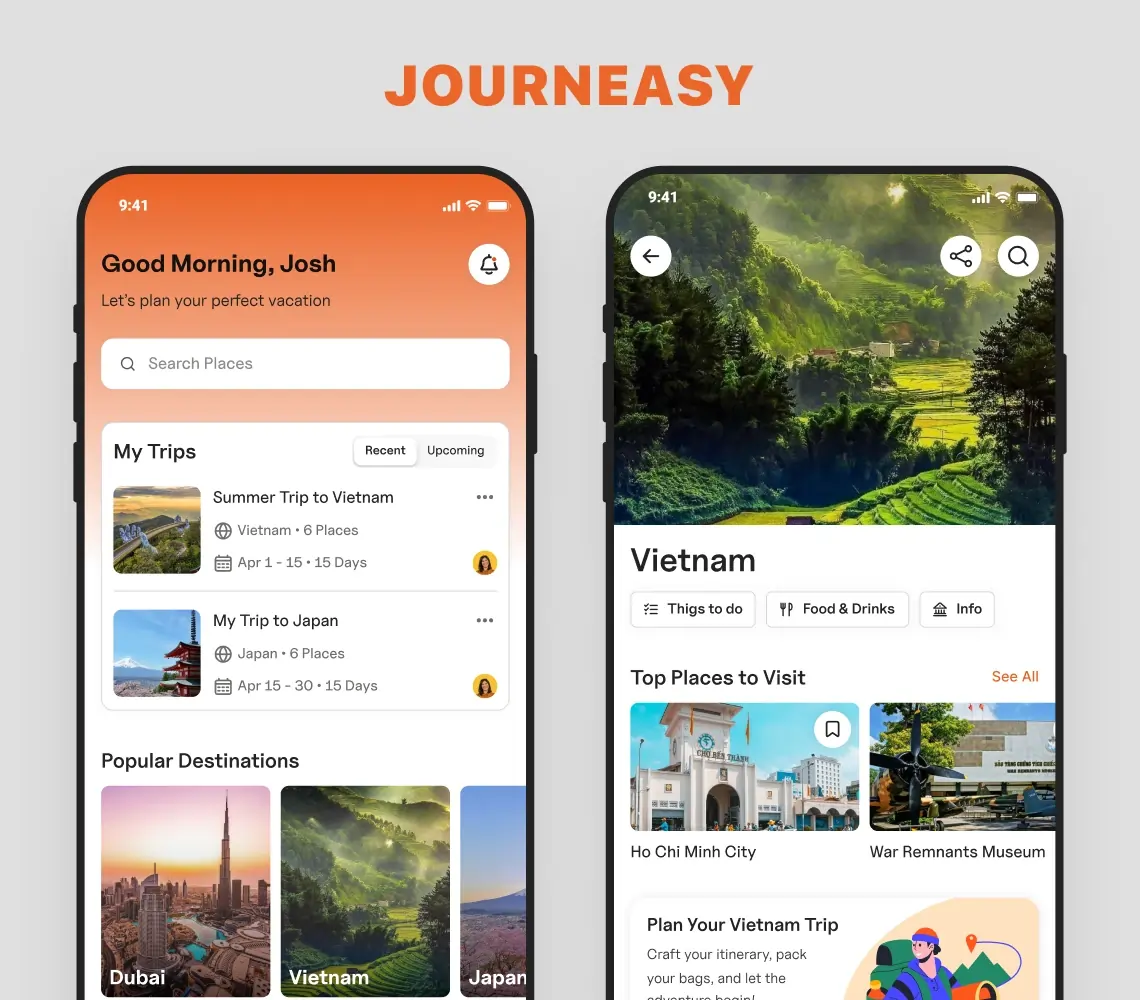
We’ve built several of the AI use cases covered in this guide. One example is JournEasy, an AI-powered trip planner we developed for GlobeTravv Ventures.
JournEasy, an AI-powered trip planner

Problem: The challenge was to help travelers create personalized itineraries, collaborate on trips, and complete bookings without switching between multiple apps.
Solution: We built an AI engine that generates personalized itineraries based on travel preferences and budget, added real-time collaborative trip editing, integrated booking workflows, and implemented GDPR- and CCPA-compliant security across iOS, Android, and the web.
Outcome: The platform was delivered in 3 months, launched across multiple platforms, and received a 5.0 Clutch rating for both delivery and client satisfaction. It gave travelers a faster, more connected planning experience while simplifying trip management.
Whether you are building an AI trip planner, a hotel platform or a travel marketplace, our travel app development work follows the same rule. Solve one high-impact business problem first, then scale AI capabilities from there.
Read the full JournEasy AI trip planner case study to explore the architecture and implementation in detail.
Conclusion
Generative AI is no longer a future trend in the travel, tourism and hospitality industry. It is becoming a competitive advantage, from personalized trip planning and intelligent customer support to dynamic pricing and hotel operations.
The key isn’t building every AI feature at once. The most successful travel companies start with one high-impact use case, measure the results, and expand their AI capabilities over time. Whether that’s reducing support tickets, improving booking conversions, or creating smarter itineraries, the first AI investment should solve a real business problem.
At SolGuruz, we help travel startups, OTAs, hotels, airlines, and tour operators identify the right AI opportunity, design the right architecture, and build scalable AI-powered travel products. If you’re ready to bring Generative AI into your travel business, contact us to discuss your idea and build the AI solution that delivers the biggest business impact first.
FAQs
1. What are the top use cases of generative AI in the travel industry?
The highest-impact ones are itinerary planning, conversational booking assistants, dynamic pricing, post-booking support, disruption recovery, review summarisation and fraud detection. Each improves either the traveler experience or an operating cost line.
2. How is generative AI used in the travel industry?
It creates output rather than retrieving it. That means writing itineraries, answering booking questions, drafting property descriptions and generating recommendations. Airlines, hotels and OTAs use it across planning, pricing, support and marketing.
3. What is the difference between generative AI and predictive AI in travel
Generative AI creates new output such as itineraries and replies. Predictive AI forecasts a number such as demand or price. Dynamic pricing is predictive. The assistant explaining that price is generative.
4. What are the benefits of generative AI for travel businesses?
Lower support cost per booking, faster pricing response, more content without more headcount, and readable insight from your own review and booking data. AI-referred visitors also spend 70% longer on travel sites.
5. Is generative AI actually being used in travel today, or is it still in pilots?
Yes. Generative AI is already being used across the travel industry. Travel companies use it for itinerary planning, booking assistance, customer support, dynamic pricing, personalized recommendations, and hotel concierge services. Many of these features are now part of everyday travel experiences rather than experimental pilots.
6. Do travelers trust AI enough to book through it?
Not yet. Around 74% of US travelers use AI to plan, but nearly 9 in 10 verify the suggestions elsewhere before paying. AI currently wins research and loses the final booking step.
7. Will AI replace travel agents and human support teams?
No. When a trip breaks, travelers still prefer a person, with phone support at 37% against 7% for AI assistants. AI handles routine volume so agents handle the cases that need judgment.
8. What are the risks of using generative AI in travel?
Wrong answers presented confidently, exposure of payment and passport data, and compliance gaps under GDPR or CCPA. All three are design problems. Scope what the model can access before you build.
9. What data do you need before adding generative AI to a travel product?
Clean booking history, guest records, reviews and support tickets. 33% of travel technology leaders name poor data as the main adoption blocker. Model choice matters far less than whether your own data is readable.
10. Which generative AI use case should a travel business build first?
Pick the moment costing the most in support tickets or drop-offs. For most OTAs that is post-booking support. For hotels it is guest requests at peak hours. For corporate travel it is policy approval.
11. Why do generative AI projects fail at travel companies?
Rarely the model. Usually unresolved data security, weak data quality, no in-house owner, or a prototype that never got integrated with the booking engine and support desk. Integration is where most projects stall.


 How we Work