

Offshore Development Center in India 2026: Your Complete Guide to Global Tech Talent
The offshore development center (ODC) model is revolutionizing software development, with the global market expected to hit $42 billion by 2027. An ODC in India reduces costs by 50–60% while providing access to 5.4 million + skilled developers. This guide covers the offshore development center checklist, benefits, ROI, and setup roadmap, whether you’re exploring what an ODC is or planning a dedicated center in India.

Summarise with AI


I recall an experience with a mid-sized fintech startup that reached a breaking point. Their in-house development team struggled to keep up, and the business was at risk.
That’s when I recommended exploring an ODC Offshore Development Center. The results spoke for themselves:
- Operational costs reduced by 35%
- Development timelines boosted almost 3×
- Access to specialized global talent improved project quality
- Team efficiency and collaboration increased
Hence, in 2026, companies without a strategic offshore development plan risk falling behind. Today, I’ll share information on how an Offshore development center can transform your operations, enhance productivity, and scale market reach.
Table of Contents
What is an Offshore Development Center?
Most teams I speak with just don’t start by saying, We want an offshore development center.
They start with missed deadlines, rising costs, or the inability to hire fast enough.
An Offshore Development Center (ODC) is what they usually arrive at next.
In simple terms, it’s a dedicated engineering team based in another country, often India, that works only on your product. Not as a vendor. Not as an additional resource. But as a team that follows your tools, your sprint cycles, and your way of working, day in and day out.
In practical terms, an ODC is:
- A fully dedicated team working only on your product
- Aligned with your engineering standards and processes
- Managed with full visibility and control
This structure allows organizations to scale engineering capacity without repeatedly restarting recruitment or onboarding cycles. For businesses seeking a custom software development company, establishing an ODC ensures access to dedicated developers, expedited delivery, and complete control over the development process.
Is an Offshore Development Center Right for Your Business?
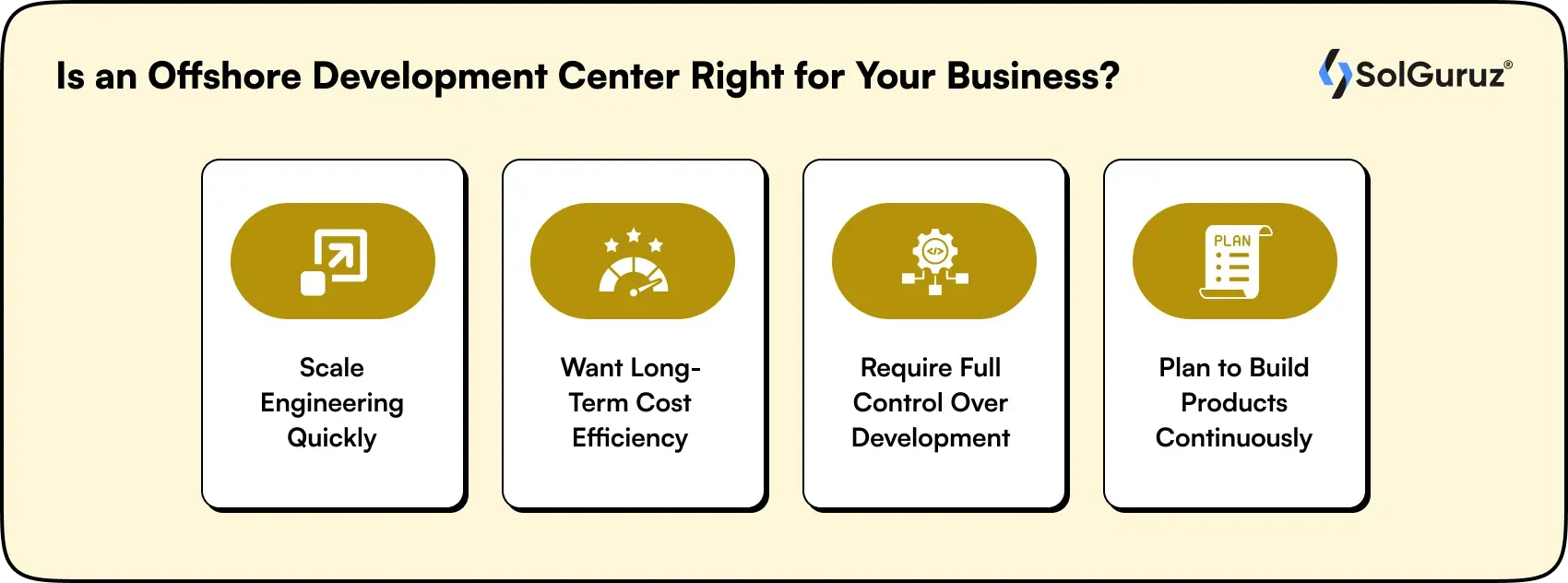
An ODC is a strong fit for businesses that need long-term scalability, control, and predictable delivery.
1) Scale Engineering Quickly:
An ODC allows you to add skilled developers without long hiring cycles. Teams can expand or down based on project demand without affecting the delivery.
2) Want Long-Term Cost Efficiency:
With an offshore development center, you reduce hiring, infrastructure, and operational costs. This creates sustained savings compared to short-term outsourcing models.
3) Require Full Control Over Development:
ODC teams follow your tools, workflows, sprint cycles, and quality standards. You retain full visibility and control over priorities, timelines, and outcomes.
4) Plan to Build Products Continuously:
An ODC works best for ongoing product development rather than one-off projects. Dedicated teams build domain knowledge over time, improving speed and quality.
ODC vs. Traditional Outsourcing
Many people confuse ODCs with outsourcing. Here’s why the distinction matters:
| Aspect | Offshore Development Center (ODC) | Traditional Outsourcing |
| Team Structure | Fully dedicated team integrated with your processes | Shared team handling multiple client projects |
| Management Control | High – you set priorities, monitor daily progress | Low – vendor manages tasks and timelines |
| Cost Approach | Higher setup, but long-term savings and efficiency | Pay-per-project/hour – cheaper short-term, may incur rework costs |
| Scalability | Easily scale team size based on project demands | Limited – bound by vendor availability |
Quick takeaway: ODCs prioritize ownership and stability, while outsourcing focuses on short-term delivery.
Why Companies Are Choosing ODC in 2026
In the last few years, I’ve seen startups and enterprises rolling toward ODC models. Here’s why:
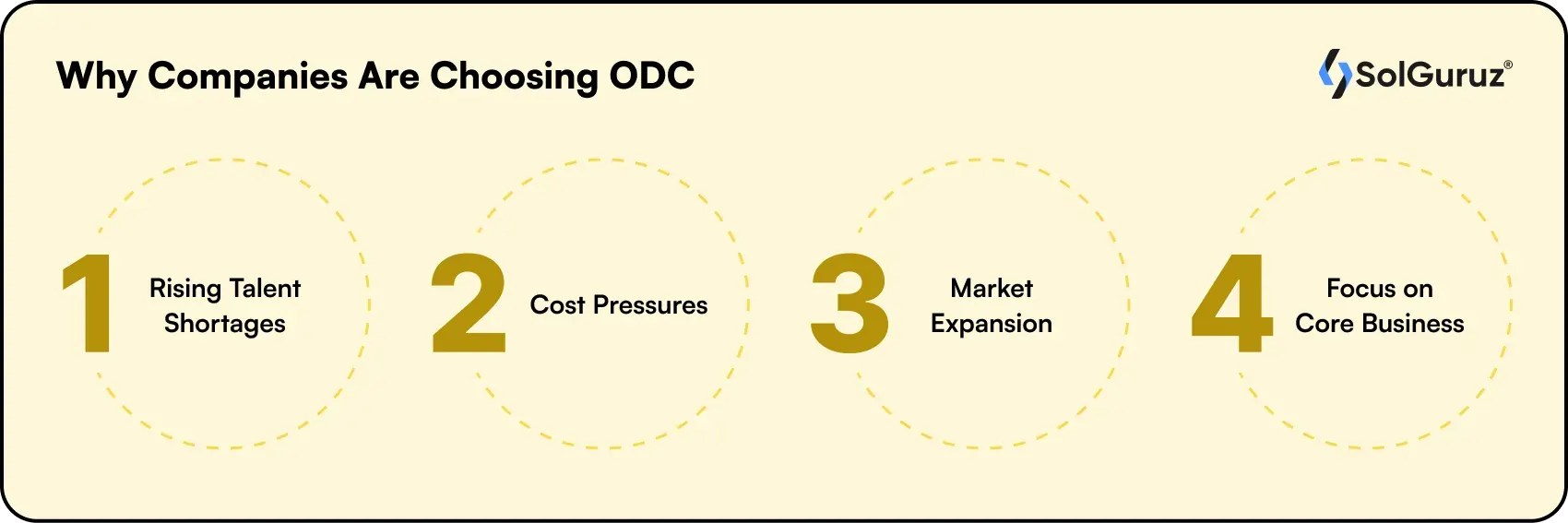
1. Rising Talent Shortages:
The IT job market is competitive, and finding specialized developers locally is challenging.
2. Cost Pressures:
A development center in India can save $50,000+ annually per full-time developer compared to US or EU salaries.
3. Market Expansion:
ODCs allow businesses to operate across time zones, speeding up project cycles and enhancing their Software Development Services globally.
4. Focus on Core Business:
ODCs let your leadership team focus on growth instead of getting busy with technical details. Your executives can spend time on strategy, sales, and market expansion.
What are the Offshore Development Center Benefits
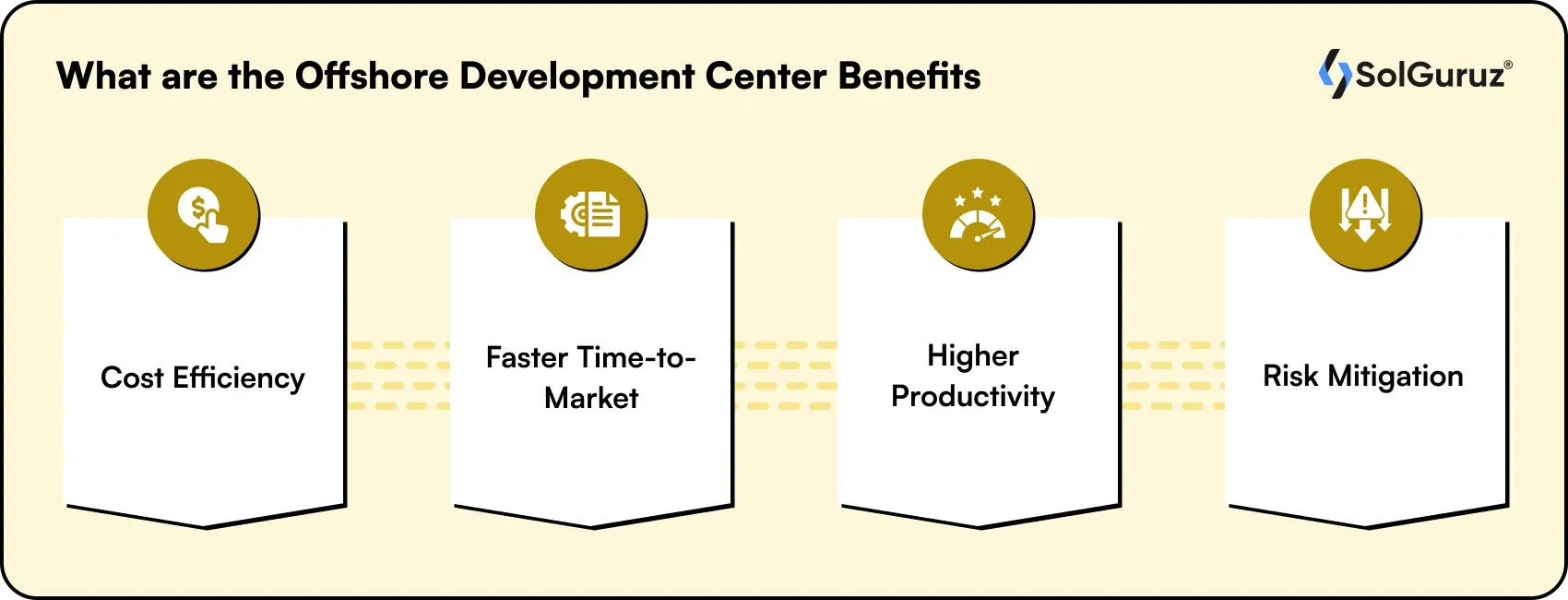
From my hands-on projects, I’ve consistently seen how a well-structured ODC Offshore Development Center delivers measurable value:
1) Cost Efficiency:
The operations and development costs can be reduced by 25-35% without affecting the quality of work.
2) Faster Time-to-Market:
The product release of faster as the offshore team works 24/7 due to different time zones.
3) Higher Productivity:
Yes, productivity is in pace as dedicated teams are under supervision, which reflects strong ownership and better output quality.
4) Risk Mitigation:
Geographic diversification minimizes dependency on local talent markets and operational disruptions.
What Are The Limitations of the Offshore Development Center
While ODCs offer strong advantages, they are not without challenges:
1. Initial Setup Effort:
Proper infrastructure, processes, investment in tools, and networks make it a time-consuming task at the starting point.
2. Communication Gaps:
Decision-making is slow due to the communication gap, which also affects the overall workflow.
3. Management Responsibility:
Unlike outsourcing, ODCs require active involvement in planning, reviews, and performance tracking.
4. Security & Compliance Risks:
It is important to ensure that data protection and regulatory compliance are properly considered, which is a time-consuming process.
Core Features of an Offshore Development Center
An ODC isn’t just a remote team; it’s a complete additional team setup of your company. Essential features include:
1) Dedicated Teams:
Developers work exclusively on your projects.
2) Cultural & Process Alignment:
Teams critically follow your workflow, internal systems, agile methodology, and code standards.
3) Infrastructure Management:
Ensure your offshore team has a complete well well-equipped workspace, reliable high-speed internet, and the latest development tools to deliver seamless results.
4) Ongoing Support & Maintenance:
With the offshore team, the team continuously tracks the systems, fixes bugs, rolls out updates, and ensures everything is smooth and error-free.
5) Flexible Engagement Models:
Your offshore team stays constant on your systems day-to-day, fixing issues as they arise and rolling out updates, so your operations run without interruptions
Why India for Offshore Development Centers?
India remains the top choice for ODCs because of:
| Reason | Why India Is Ideal for Offshore Development Centers |
| Large Talent Pool | Produces over 4 million IT graduates every year, offering access to diverse and specialized tech skills. |
| Cost-Effectiveness | Developer salaries are significantly lower than in Western countries, enabling major cost savings |
| English Proficiency | Strong English communication skills ensure smooth collaboration with global teams. |
| Time Zone Advantage | A 9.5–10.5 hour time difference supports near 24/7 development and faster delivery cycles |
Keynote: India offers you scale, skill, and cost efficiency for building long-term offshore development centers. For companies in 2026, India is not just a cost-saving option; it’s a strategic growth partner.
How to Set Up a Successful ODC: Explain Step by Step Process
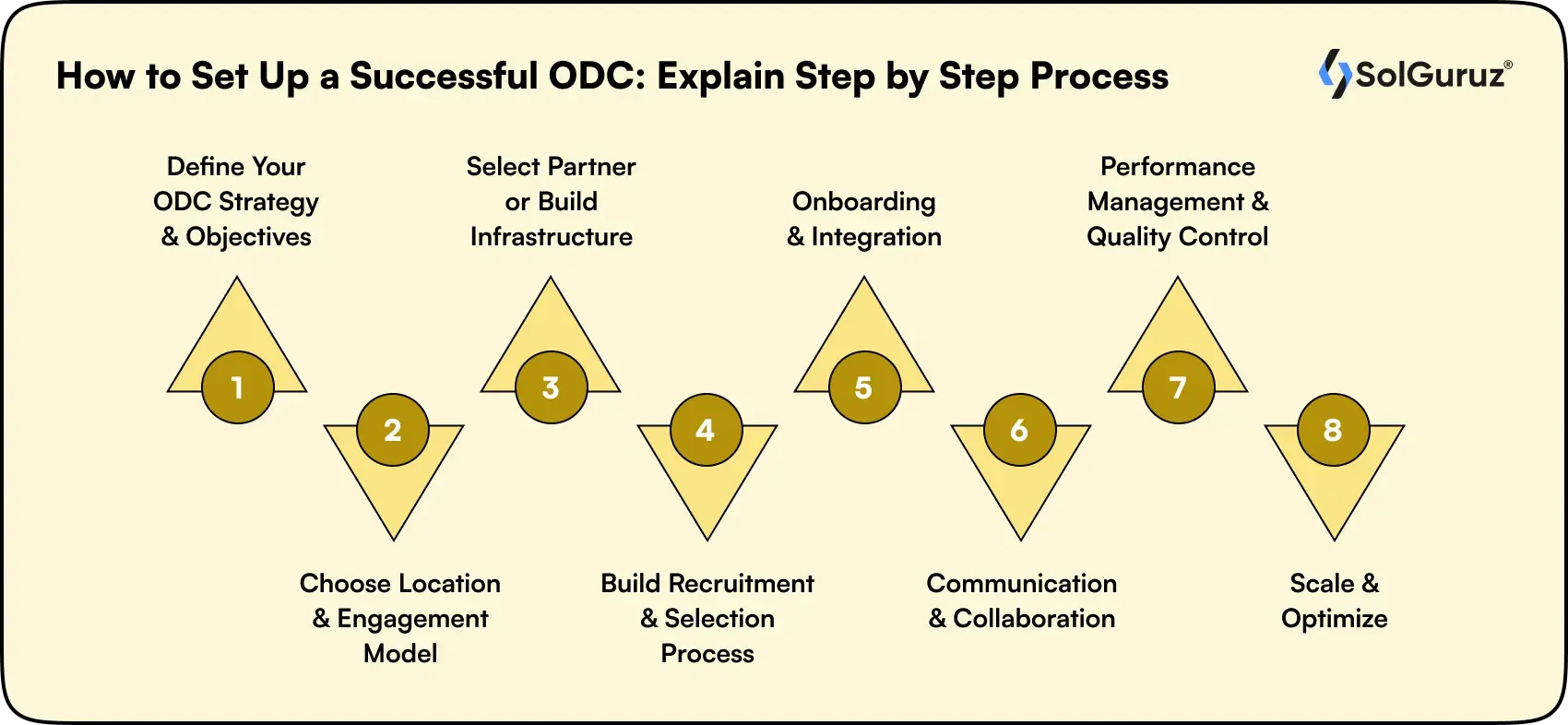
Let me walk you through the exact eight-step framework I use to build offshore development centers that actually deliver results.
1. Define Your ODC Strategy and Objectives:
Clarify your goals: cost reduction, faster development, or talent access. Decide which functions go offshore, team size, and success metrics like cost per developer or deployment frequency.
2. Choose Location and Engagement Model:
Pick a location based on cost, talent pool, and time zone needs. India for scale, Eastern Europe for fintech/AI, Latin America for US overlap. Select between ODC provider, Employer of Record, or your own entity.
3. Select Partner or Build Infrastructure:
Shortlist 4–5 providers and evaluate them based on experience, talent quality, and client references.
4. Build Recruitment & Selection Process:
Start with clear role expectations. Screen candidates for relevant skills and experience, validate them through a practical technical round, and follow up with a meaningful discussion to assess ownership and team fit. It is the phase in which companies aim to hire dedicated developers for their offshore development center.
5. Onboarding & Integration:
New team members need to be introduced to the new product, system, and tools from the start. Understanding of workflow team dynamics should be examined before taking any role from experienced colleagues.
6. Communication & Collaboration:
Most common tools, such as Zoom, GitHub, and Slack, can be used for communication and collaboration. These tools help keep everyone on the same page.
7. Performance Management & Quality Control:
Focus on outcomes such as predictable sprints, stable code, and smoother releases supported by regular check-ins to keep quality and expectations aligned.
8. Scale & Optimize:
Gradually expand the team, promote top offshore developers, and continuously improve processes. Track cost savings, productivity, and satisfaction; treat your ODC as a long-term strategic asset.
Bottom Line: You should treat your offshore team as equal partners, invest in onboarding and communication, and keep consistent quality standards for better ROI.
Top 7 Indian Cities for Offshore Development Center in 2026
When planning your Offshore Development Center in India, make sure to choose a suitable location for positive outcomes.
Here are the top options:
| City | Why It’s Great for ODC | Cost Category |
| Ahmedabad | A fast-growing IT and startup hub with strong engineering talent, lower operating costs than Tier-1 cities, and increasing adoption of offshore delivery models. | Less Expensive |
| Bengaluru | India’s top tech hub with the deepest pool of developers, AI/ML, cloud, and startup ecosystem, ideal for innovation‑driven ODCs. | Expensive |
| Hyderabad | Rapidly growing IT center with strong global capability centers, and lower competition than Bengaluru. | Expensive |
| Pune | A balanced tech hub with strong teams in enterprise software and SaaS, offering reliable engineering talent. | Expensive |
| Chennai | A strong IT hub with experienced teams in enterprise software, DevOps, and offshore projects. | Medium |
| Noida / Greater Noida | Part of NCR with strong IT/fintech growth, excellent connectivity, and access to diverse talent from the Delhi region | Medium |
| Kochi | Emerging tier‑2 tech hub with low office and salary costs, growing presence of global IT firms | Less Expensive |
Remember: Selecting the right city allows you to manage talent quality, cost efficiency, and scalability. The decision to choose a location directly impacts productivity, team retention, and long-term growth.
When to Consider Switching Your Tech Partner
Before selecting the offshore development center strategy, it is necessary to understand why and when companies focus on switching their tech partner. Many teams delay this decision due to the impact of disruption, but the right partner collaboration is critical for seamless execution and long-term growth.
If you notice any of these signs, it may be time to rethink your current tech partnership:
1. Poor Delivery Speed or Quality:
The project missed deadlines, the challenges increased, and unstable releases, which directly impacted your productivity and timelines.
2. Communication Breakdowns:
When the workflow or internal system is inconsistent, it develops confusion, and decision-making is slow, which, however, reduces trust among team members.
3. Innovation & Scalability:
If your partner only follows instructions without suggesting improvements, your product growth and ability to scale will eventually suffer.
4. Budget Overruns:
Major reasons for budget overruns, such as inefficient processes, repeated rework, and unexpected costs, could lead to additional expenses.
5. Team Misalignment:
The chances of team misalignment are higher due to cultural variations, expectations, or inconsistent workflows, resulting in delays of project outcomes.
Get to know why businesses prefer SolGuruz as a reliable tech partner.
Final Thought
An ODC Offshore Development Center is no longer just about saving costs. In 2026, it’s about building a reliable, scalable engineering extension that supports your product and growth goals over the long term. When planned and managed well, an ODC delivers consistency, ownership, and measurable ROI.
- Align your ODC strategy with real business objectives, not just short-term savings.
- Choose the right Indian city based on talent availability, cost balance, and scalability.
- Success to be determined by delivery quality, team stability, and predictable outcomes.
At SolGuruz, we help companies set up offshore development centers that feel like part of their core team and are focused on execution, accountability, and sustainable growth.
FAQs
1. What is an Offshore Development Center (ODC)?
An ODC is a remote team of expert developers, located in different parts of the country, who work only on your projects and follow your processes, tools, and timelines.
2. How is an ODC different from outsourcing?
Yes, they are different as ODC works only for your business, gets along seamlessly with your team, and helps keep knowledge and quality consistent over time.
3. Why should businesses set up an ODC in India?
India has a large hub of skilled developers, lower costs by 50–60%, strong English skills, and the ability to support round-the-clock development, making it good for expanding your engineering team.
4. What are the main benefits of an ODC?
There are various advantages, such as making the product launches fast, boosting team productivity, mitigating risks, and building long-term collaboration as a seamless extension of your in-house team.
5. How long does it take to set up a successful ODC?
The timeline is around 6–12 weeks to set up an ODC, including processes such as hiring, onboarding, process setup, and initial integration with your team.
From Insight to Action
Insights define intent. Execution defines results. Understand how we deliver with structure, collaborate through partnerships, and how our guidebooks help leaders make better product decisions.
 How we Work
Build a Dedicated Offshore Team in India
Launch your ODC in few weeks with proven engineers and transparent pricing.

Strict NDA

Trusted by Startups & Enterprises Worldwide

Flexible Engagement Models

1 Week Risk-Free Trial
Give us a call now!

+1 (724) 577-7737