

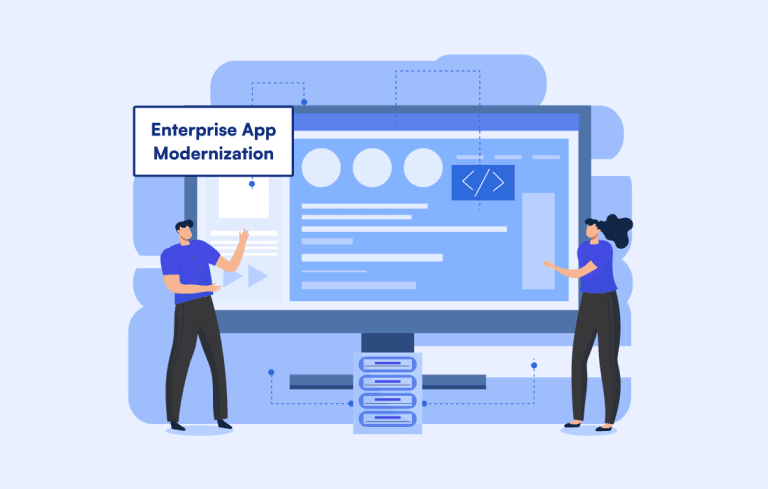
Enterprise Application Modernization: Step-by-Step Strategy & Framework
This blog guides you through enterprise application modernization from legacy assessment to deployment. It covers strategies, costs, and risks to modernize without business disruption. Helping enterprises build scalable, high-performance systems that support long-term business growth.

Summarise with AI


Key Takeaway
- Enterprise application modernization is essential in 2026, with nearly 88% of enterprises still impacted by legacy systems that slow performance, increase costs, and limit scalability.
- A phased modernization roadmap reduces risk and improves ROI, enabling smoother migration, better system stability, and faster business outcomes.
- Success depends on the right strategy, metrics, and partners, using performance data and technical debt analysis to build future-ready, cloud- and AI-enabled enterprise applications.
Why does fixing one small issue in your enterprise application feel like a high-risk operation?
The development team says every small change takes weeks because the codebase is “fragile.”
Hmmm, does this sound familiar?
Today, almost 88% of enterprises are still impacted by legacy systems, draining resources and slowing innovation.
You’re looking at a legacy enterprise application that worked great in 2010 but can’t keep up with today’s demands. The question isn’t whether to modernize; it’s how to do it without disrupting your entire operation.
This guide from SolGuruz shows you exactly how to approach enterprise application modernization, from initial assessment through final deployment.
Table of Contents
What is Enterprise Application Modernization?
Enterprise application modernization is the process of updating legacy software systems to modern architectures, platforms, and technologies.
This is more than just simple updates; it’s more about rethinking how applications are built, deployed, and maintained for today’s business needs.
Application modernization for enterprise environments solves critical problems:
- Outdated technology stacks that limit functionality
- Poor performance under current user loads
- Security vulnerabilities from unsupported platforms
- Higher maintenance costs are expensive for companies
- Challenging to integrate with modern tools and services
The goal of enterprise and legacy application modernization services is to transform systems that slow your business into flexible, scalable platforms that support innovation and long-term growth.
Why Enterprise Application Modernization Matters in 2026
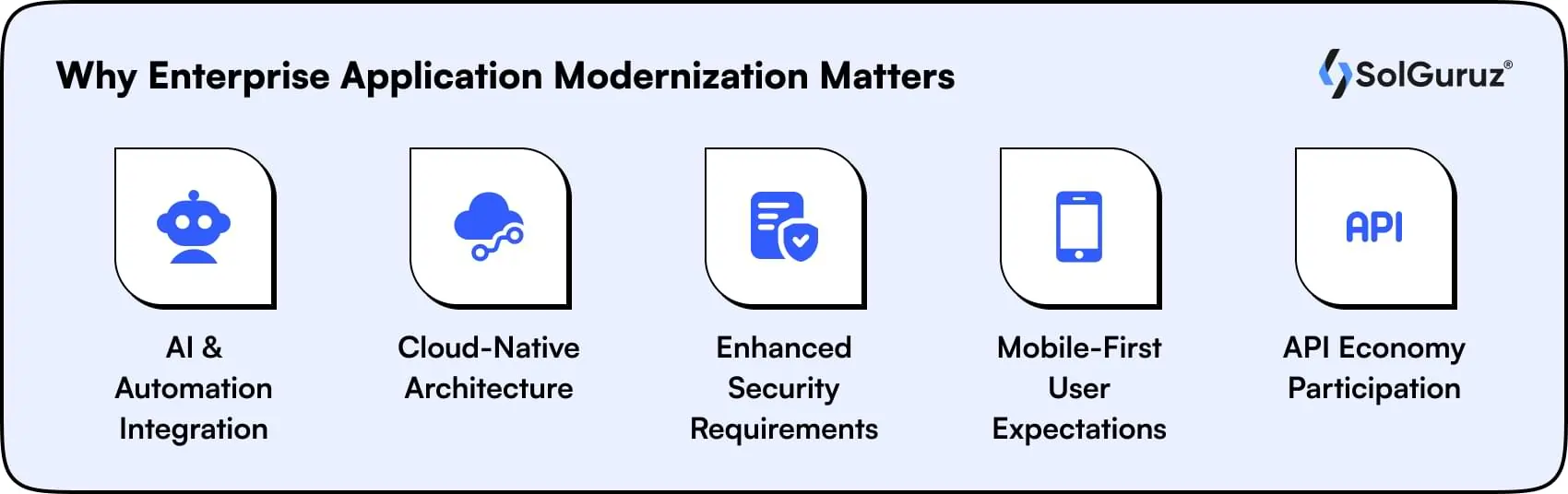
The business sector changed at its core. Enterprise application modernization trends 2026 reflect new realities:
-
AI and Automation Integration
Now, with the change of time, modern applications need to connect with AI tools, machine learning models, and automation platforms. Legacy systems weren’t built for these integrations.
-
Cloud-Native Architecture
On-premises infrastructure finds it difficult to match the scalability and cost efficiency of the cloud. Businesses shifting to hybrid or complete cloud environments need applications designed for such platforms.
-
Enhanced Security Requirements
Cybersecurity threats are changing and occur in different ways. Traditional applications with outdated security models create compliance risks and release sensitive data.
-
Mobile-First User Expectations
Users expect seamless experiences within devices. Legacy desktop applications don’t meet modern usability standards.
-
API Economy Participation
Modern businesses connect through APIs. Legacy systems often lack API capabilities or use outdated integration methods.
These trends make enterprise application modernization necessary for competitive survival, not just technical improvement.
What Makes Enterprise App Modernization Different
Enterprise applications are specifically run on business operations. They manage sensitive data, integrate with multiple systems, and support hundreds or thousands of users. This results in several challenges mentioned below:
-
Business continuity matters more than speed
You can’t afford downtime during the transition. Operations must continue while you rebuild.
-
Data integrity is non-negotiable
Years of business data live in these systems. Migration errors can create compliance issues and damage customer relationships.
-
Multiple stakeholders complicate the decision
IT, operations, finance, and end users all have different priorities. Getting alignment takes time.
-
Technical debt compounds over time
Quick fixes from years ago have created dependencies that make changes risky.
The right enterprise application modernization strategy addresses these realities instead of ignoring them.
Enterprise App Modernization Roadmap: 8 Essential Steps
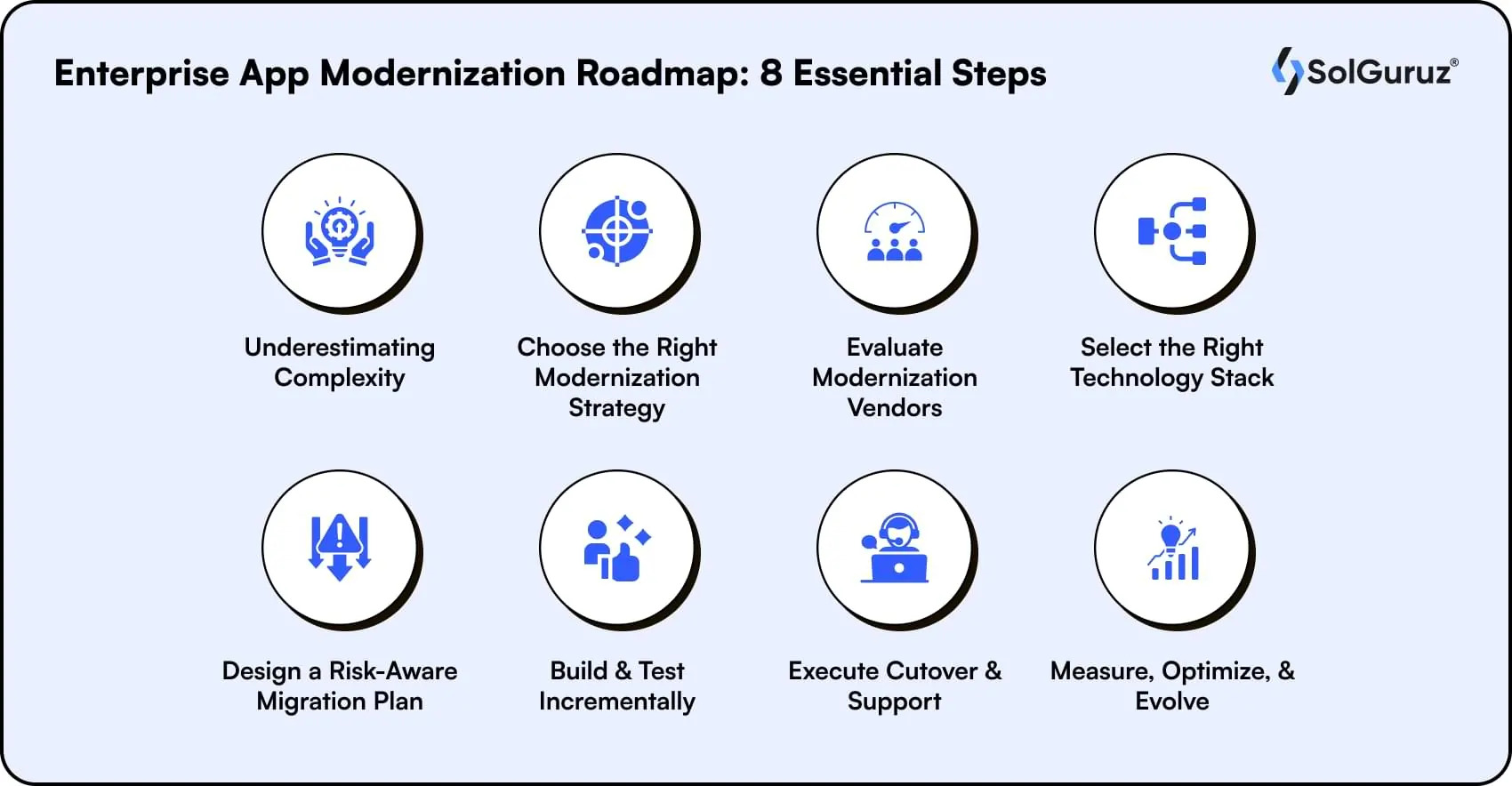
Modernizing enterprise applications doesn’t have to be complicated. A clear roadmap helps you reduce risks, boost performance, and prepare your systems for the future. Follow these 8 simple steps to plan and execute modernization with confidence.
Step 1: Conduct a Full System Assessment
Properly know your current architecture before modernizing. Focus on:
- Application layers, databases, and data flows
- Third-party integrations and APIs
- Custom vs vendor solutions
- Infrastructure and hosting
Focus first on business-critical features that directly impact users and operations. Track key metrics such as response time, support tickets, development cycle time, and technical debt to build a clear modernization business case.
Step 2: Choose the Right Modernization Strategy
Choose a strategy depending on the business needs and technical specifications:
- Rehosting (Lift & Shift): Move to new infrastructure without code changes.
- Replatforming: Minimal updates for modern platforms.
- Refactoring: Improve code without changing functionality.
- Rebuilding: Rewrite apps from scratch for major improvements.
- Replacing: Adopt new commercial solutions.
Many projects combine strategies for maximum efficiency.
Step 3: Evaluate Modernization Vendors
Important key factors to consider while selecting a vendor:
- Industry experience (e.g., healthcare, finance)
- Technical expertise: legacy systems, cloud, APIs
- Methodology: phased approach, risk mitigation, post-launch support
- Flexibility & references: hybrid services, staff augmentation, client reviews
Step 4: Select the Right Technology Stack
Yes, it is necessary to focus on deploying the right tech stack.
- Backend: .NET, Java/Spring, NodeJS, Python
- Frontend: React, Angular, VueJS
- Database: PostgreSQL, MySQL, MongoDB, SQL Server
- Infrastructure: Cloud (AWS, Azure, Google Cloud), containerization, serverless
Focus on cloud-native, scalable, and secure solutions for future-proofing.
Step 5: Design a Risk-Aware Migration Plan
- Parallel Operation: Run old and new systems simultaneously
- Phased Migration: Move modules gradually
- Big Bang Cutover: Full switch at once
Include a data migration strategy: extract, transform, validate, and load data carefully.
Step 6: Build & Test Incrementally
Start with one workflow to validate the architecture. Implement:
- Automated unit, integration, and performance tests
- Continuous user feedback loops
- Quality metrics monitoring: defect rates, coverage, and completion
Step 7: Execute Cutover & Support
A well-planned cutover ensures business continuity while minimizing risk and downtime.
- Pre-cutover checklist: test features, verify data, train support teams.
- Cutover: freeze legacy system, migrate data, switch users.
- Post-cutover: monitor performance, provide rapid support, and address issues.
Step 8: Measure, Optimize, & Evolve
Continuous measurement ensures your modernized application focuses on delivering long-term value.
- Track metrics: performance, development speed, support tickets, and user satisfaction.
- Continuously gather feedback, optimize features, address technical debt, and evolve apps.
- Modernization is ongoing, not one-time.
Key Note: Modernizing enterprise applications reduces technical debt, improves performance, and enables scalability for cloud, AI, and mobile-first business operations, especially when you hire mobile app developers to extend functionality across modern devices.
Common Modernization Mistakes to Avoid
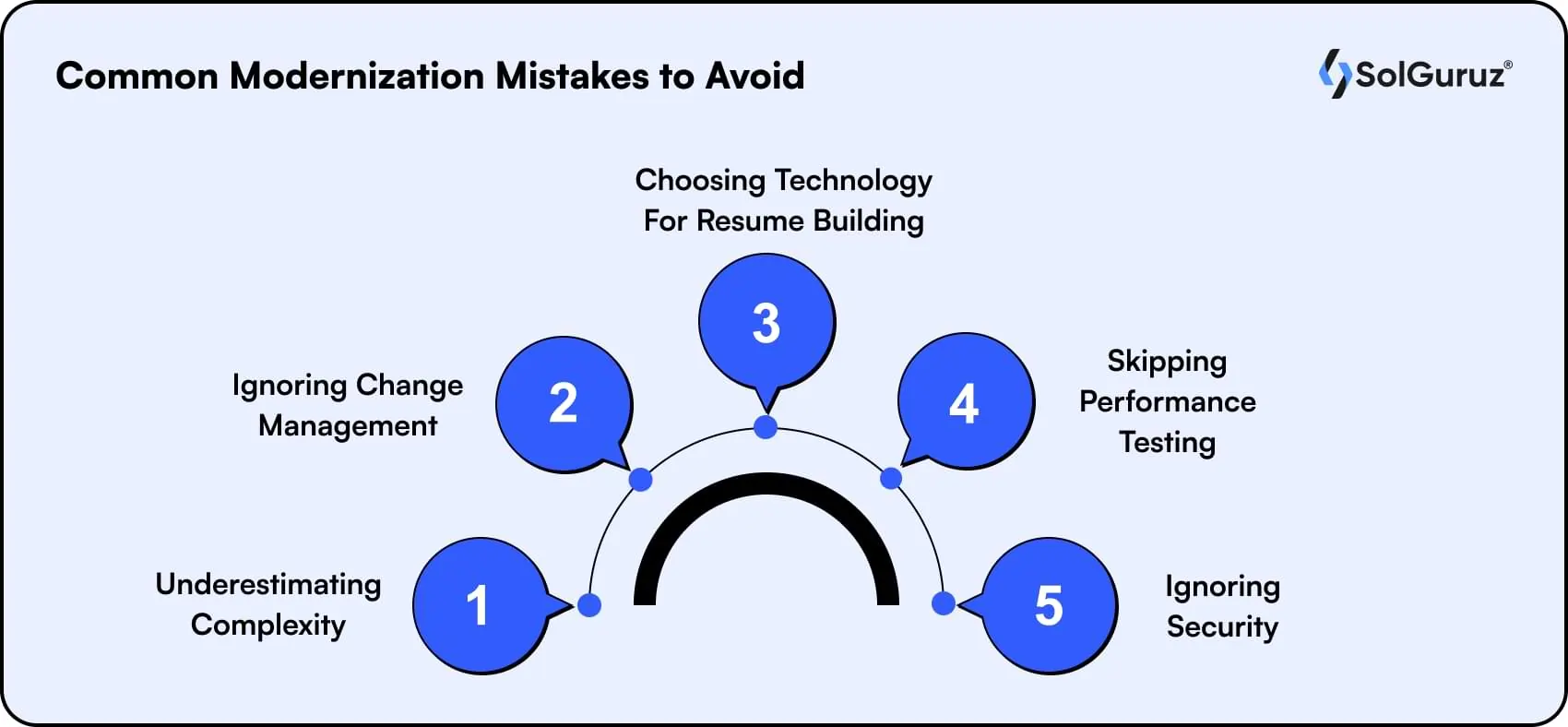
Here are some of the most common mistakes to avoid when planning your enterprise app modernization.
1. Underestimating Complexity
Legacy systems contain years of business logic and edge cases. Teams that rush through assessment face surprises during development.
2. Ignoring Change Management
Technology changes are easier than helping people adapt to new ways of working. Plan training, communication, and support.
3. Choosing Technology for Resume Building
Developers want experience with the latest frameworks. Pick proven technology that matches your business needs and team capabilities.
4. Skipping Performance Testing
Applications that work fine in development can collapse under production load. Test with realistic data volumes and user counts.
5. Ignoring Security
Modern applications face different threats than legacy systems. Build security into architecture from the start.
How Long Does Enterprise Application Modernization Take?
Timeline depends on application complexity and chosen strategy:
1. Small applications (under 10,000 lines of code): 3-6 months.
2. Medium applications (10,000-100,000 lines): 6-12 months
3. Large applications (100,000+ lines): 12-24 months, Complex enterprise systems: 2-3 years in phases
Phased approaches take longer overall but reduce risk and allow course correction.
Enterprise application modernization projects succeed when timelines align with realistic complexity assessments.
What Does Enterprise Application Modernization Cost?
Well, the budget of enterprise app modernization truly depends on several factors:
1. Application Size and Complexity:
More features, integrations, and users increase development time and cost.
2. Chosen Strategy
Rehosting costs less than rebuilding. Refactoring falls somewhere in between.
3. Team Composition
Internal teams have lower hourly costs but may lack specialized expertise. External partners bring experience but charge more.
4. Infrastructure Changes
Cloud migration adds setup costs but may reduce long-term operational expenses.
5. Data Migration Scope
Large, complex datasets require more transformation and validation work.
Most enterprise modernization projects range from $100,000 to several million dollars, depending on these variables.
When evaluating enterprise application modernization consulting proposals, compare total value delivered, not just hourly rates.
How to Build Your Modernization Roadmap?
Modernising your enterprise applications is a significant financial commitment that affects every aspect of your company. The proper strategy strikes a balance between business continuity and technological advancements.
- Start by doing a detailed evaluation of your existing system.
- Choose a modernisation plan that fits your objectives and limitations. If you need knowledge at an extensive level, choose your vendors with thorough research.
- Select technology that boosts sustained expansion. To reduce disturbance, plan migration properly.
- Modernization needs to be done incrementally, backed by continuous user feedback, with a correctly planned cutover and ongoing performance optimization.
Done well, modernization transforms a liability into a competitive advantage. Your team can build features faster. Your users get better experiences. Your business operates more efficiently.
The question is whether you’re ready to commit to the process and see it through, and for the same, we at SolGuruz are always ready to help, guide, and build.
FAQs
1. How do I know If My Enterprise App Needs Modernization?
Try to check frequent outages, slow performance, high maintenance costs, security risks, or difficulty finding developers. If the system causes more problems than it solves, modernization is needed.
2. Should We Modernize Everything At Once Or In Phases?
It’s safer to modernize in steps, starting with the most important or problem areas. Only rebuild everything if the system is beyond repair or urgent changes are needed.
3. Build Internally Or Hire Modernization Services?
Internal teams know your business; external partners bring expertise. Hybrid approaches work well partner on complex parts and handle routine features in-house.
4. What Are The Key modernization trends for 2026?
AI/ML integration, cloud-native systems, API-first design, microservices, enhanced security, and low-code/no-code platforms.
5. What Happens To Our Data During Modernization?
Data is extracted, transformed, validated, and loaded into new systems. Parallel runs and backups ensure accuracy and safety.
6. How To Prevent The App From Becoming Legacy Again?
Use supported technologies, automate tests, review technical debt, and continuously update developer skills.
From Insight to Action
Insights define intent. Execution defines results. Understand how we deliver with structure, collaborate through partnerships, and how our guidebooks help leaders make better product decisions.
 How we Work
Ready to Modernize Your Enterprise Apps?
We help businesses transform legacy systems into modern platforms.

Strict NDA

Trusted by Startups & Enterprises Worldwide

Flexible Engagement Models

1 Week Risk-Free Trial
Give us a call now!

+1 (724) 577-7737