

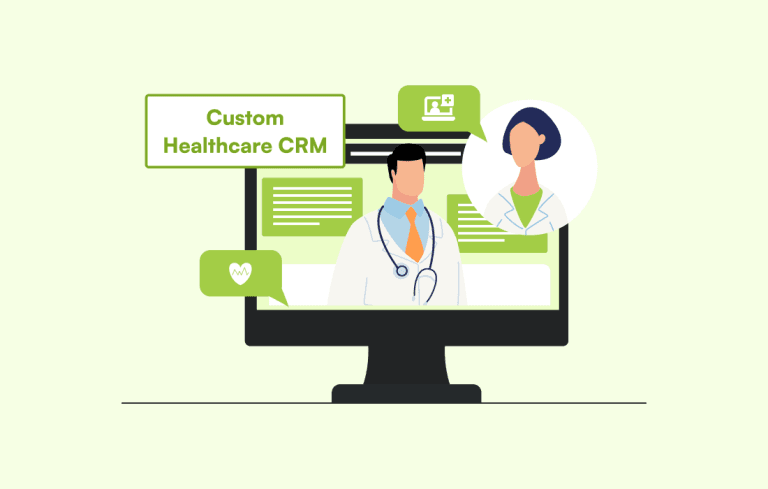
Custom Healthcare CRM Development: Features, Cost & Compliance Checklist [2026 Guide]
This blog explains Custom Healthcare CRM Development in 2026, covering key features, cost breakdown ($10K–$120K+), and compliance requirements like HIPAA and GDPR. Learn how AI-powered healthcare CRM software improves patient engagement, automates workflows, and integrates with EHR/EMR systems. It also includes a practical compliance checklist to help you build a secure, scalable, patient-centric CRM.

Summarise with AI


Key takeaways
- Custom healthcare CRM development improves patient engagement by 20–30% by enabling unified patient records, multichannel communication, and personalized care journeys, making patient-centric healthcare CRM a necessity in 2026 rather than an option.
- Healthcare organizations adopting AI-driven CRM software reduce administrative workload by up to 40% through automation of scheduling, follow-ups, reporting, and care coordination, directly lowering operational costs and staff burnout.
- Investing in the right healthcare CRM cost tier ($10K–$120K+) helps prevent costly rework and scalability challenges. A compliance-ready CRM built by a specialized Healthcare Software Development Company, with HIPAA, GDPR, HL7, and FHIR standards at its core, scales faster and delivers stronger long-term ROI.
With AI shifting towards every sector, it has become a challenging task for businesses to cater to the needs of users. In the healthcare industry, patients’ demands are changing rapidly.
Healthcare providers utilize customized CRM systems, and more than 70% of patients now want personalized, digital-first communication.
Because custom healthcare CRMs are created around their unique workflows, regulatory restrictions, and the need for individualized patient engagement, the majority of healthcare providers pick them.
This blog delivers critical information about CRM features, development costs, processes, and a compliance checklist to help you make a data-driven decision.
Table of Contents
Why Healthcare Needs a Specialized CRM in 2026
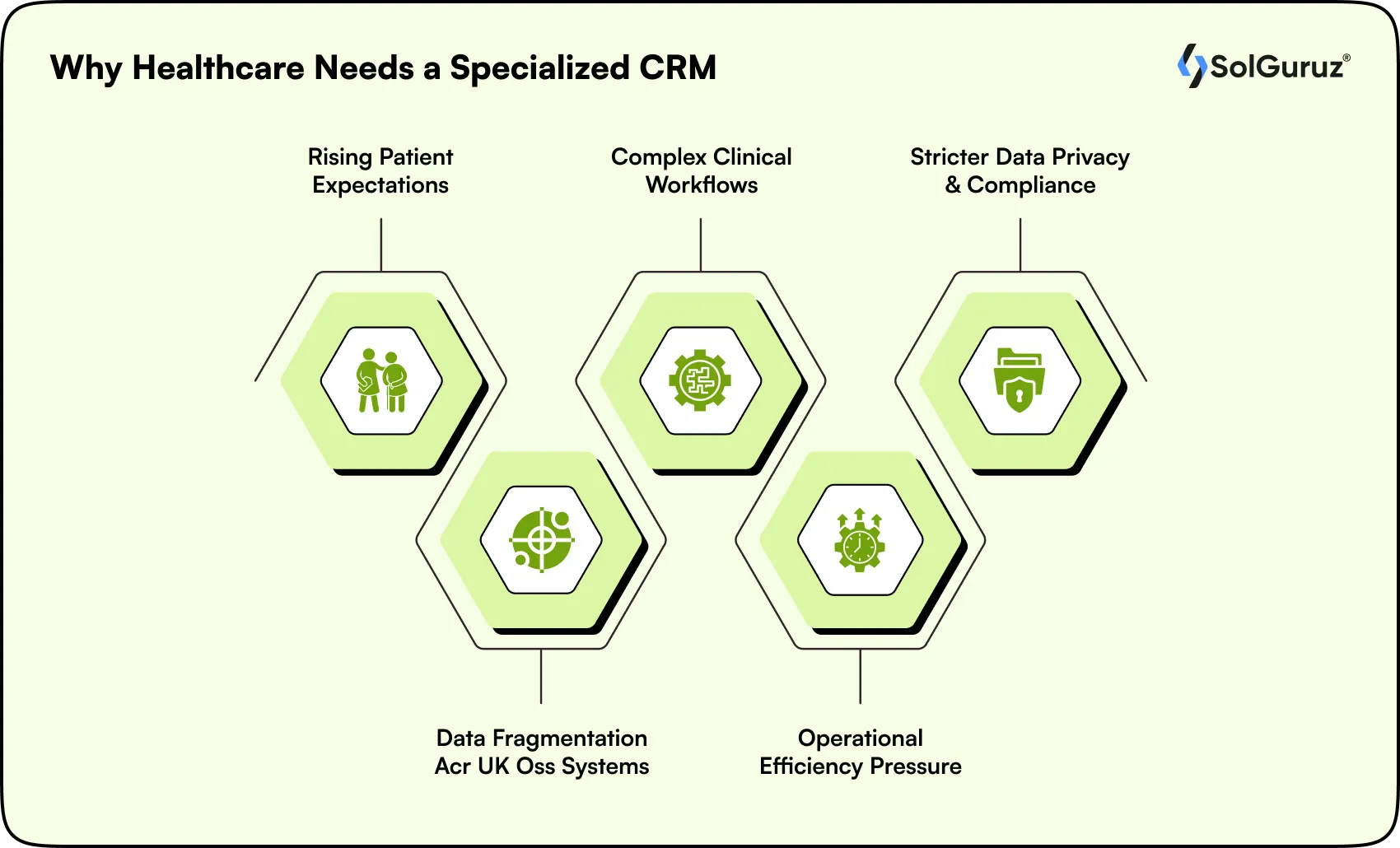
Healthcare needs a specialized, AI-enabled CRM in 2026 as patient journeys become increasingly digital, data-driven, and tightly regulated. Traditional CRM platforms are not designed to support clinical workflows, protect sensitive health information, or meet compliance requirements throughout the care lifecycle.
To operate efficiently, providers need an intelligent CRM built on a unified platform that connects patient data, care coordination, and operational workflows. This growing complexity is why healthcare organizations are increasingly turning to custom software development to build secure, compliant CRM solutions tailored to real-world clinical environments.
Key reasons driving the shift:
Below are the key reasons to focus on:
-
Rising Patient Expectations
Patients increasingly anticipate real-time, personalized communication through a variety of channels, much like they do in banking and retail.
-
Complex Clinical Workflows
It is quite challenging for basic CRMs to handle complex tasks and protect sensitive credentials involved in healthcare.
-
Stricter Data Privacy & Compliance
Yes. Strict regulations such as HIPAA and GDPR need built-in security, access controls, and audit trails, not just add-ons.
-
Data Fragmentation Across UK OSS Systems
EHRs, labs, billing, and engagement tools need to work simultaneously as a specialized CRM acts as the connected layer.
-
Operational Efficiency Pressure
With AI becoming a significant aspect of healthcare operations, automation is vital to minimize administrative workload, boost staff efficiency, and regulate operational expenses.
What Are The Key Features of a Modern Healthcare CRM
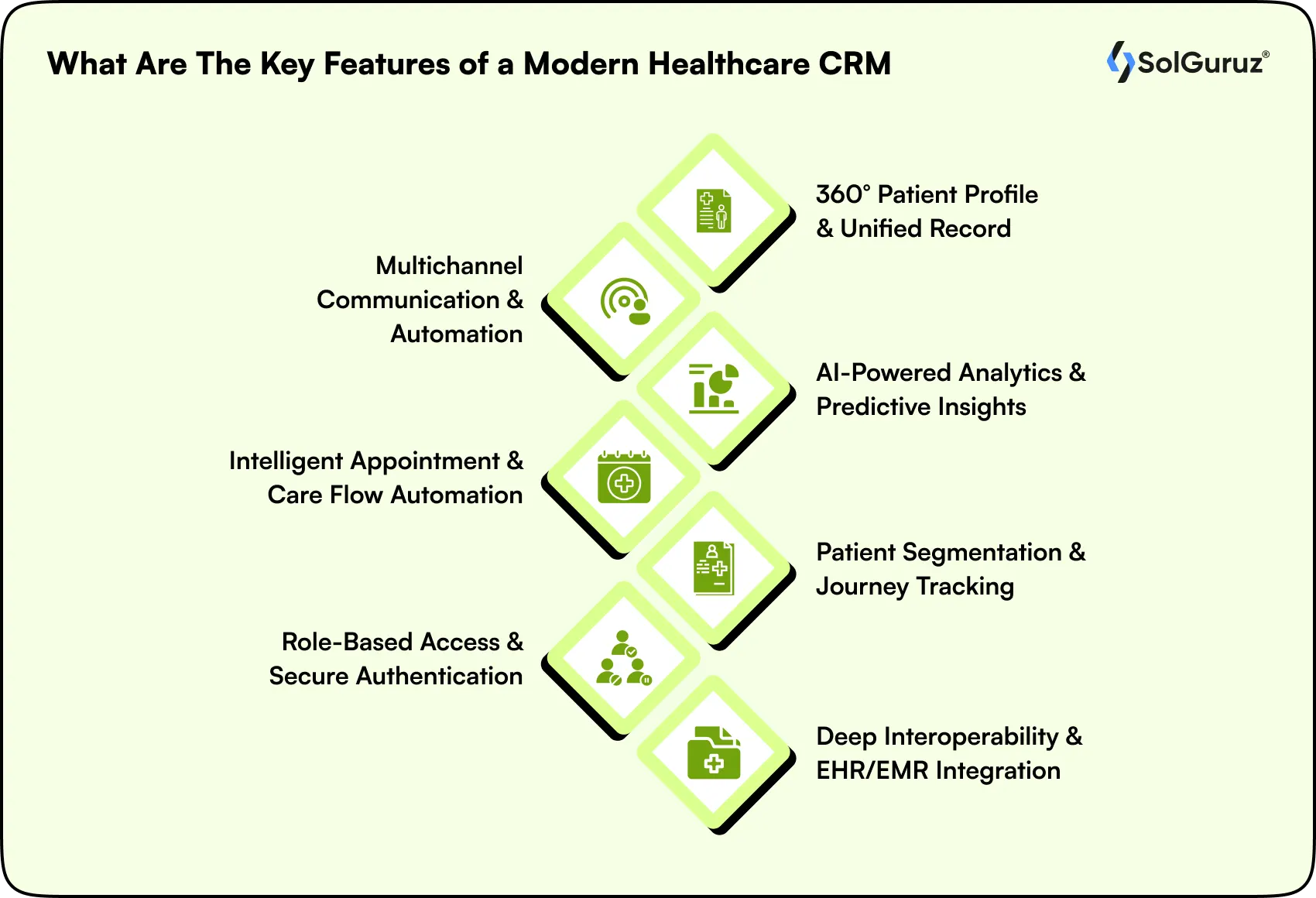
As healthcare continues to evolve, healthcare CRM development has moved far beyond basic contact management. With the change in time, the features and capabilities of CRM in healthcare have also changed. Let’s explore them:
Must have features
1. 360° Patient Profile & Unified Record
It combines all patient details, such as basic information, visits, communication, and history, into one unified place, helping care teams to properly understand patients more quickly.
2. Multichannel Communication & Automation
Various types of channels are used for communication purposes, for example, SMS, email, calls, chatbots, and app notifications, with automated reminders and follow-ups that improve user experience.
3. AI-Powered Analytics & Predictive Insights
AI helps in analysing the patient data to identify risks, forecast appointment no-shows, and detect engagement patterns. This helps care teams act actively and personalize communication for better patient outcomes.
4. Intelligent Appointment & Care Flow Automation
Fast bookings, rescheduling, reminders, and operational tasks can be done in more smart way. This minimizes admin workload and supports better patient experience.
5. Patient Segmentation & Journey Tracking
Targeted campaigns based on conditions, demographics, and life cycle are crucial for preventive programs and care continuity.
6. Role-Based Access & Secure Authentication
This feature creates a secure access layer between staff and clinicians, ensuring they can only view information relevant to their roles, helping protect patient privacy and meet essential compliance requirements.
7. Deep Interoperability & EHR/EMR Integration
Secure, standards-based integrations with systems like Epic, Cerner, and Athenahealth to eliminate manual data silos and disconnected workflows.
Advanced Healthcare CRM features
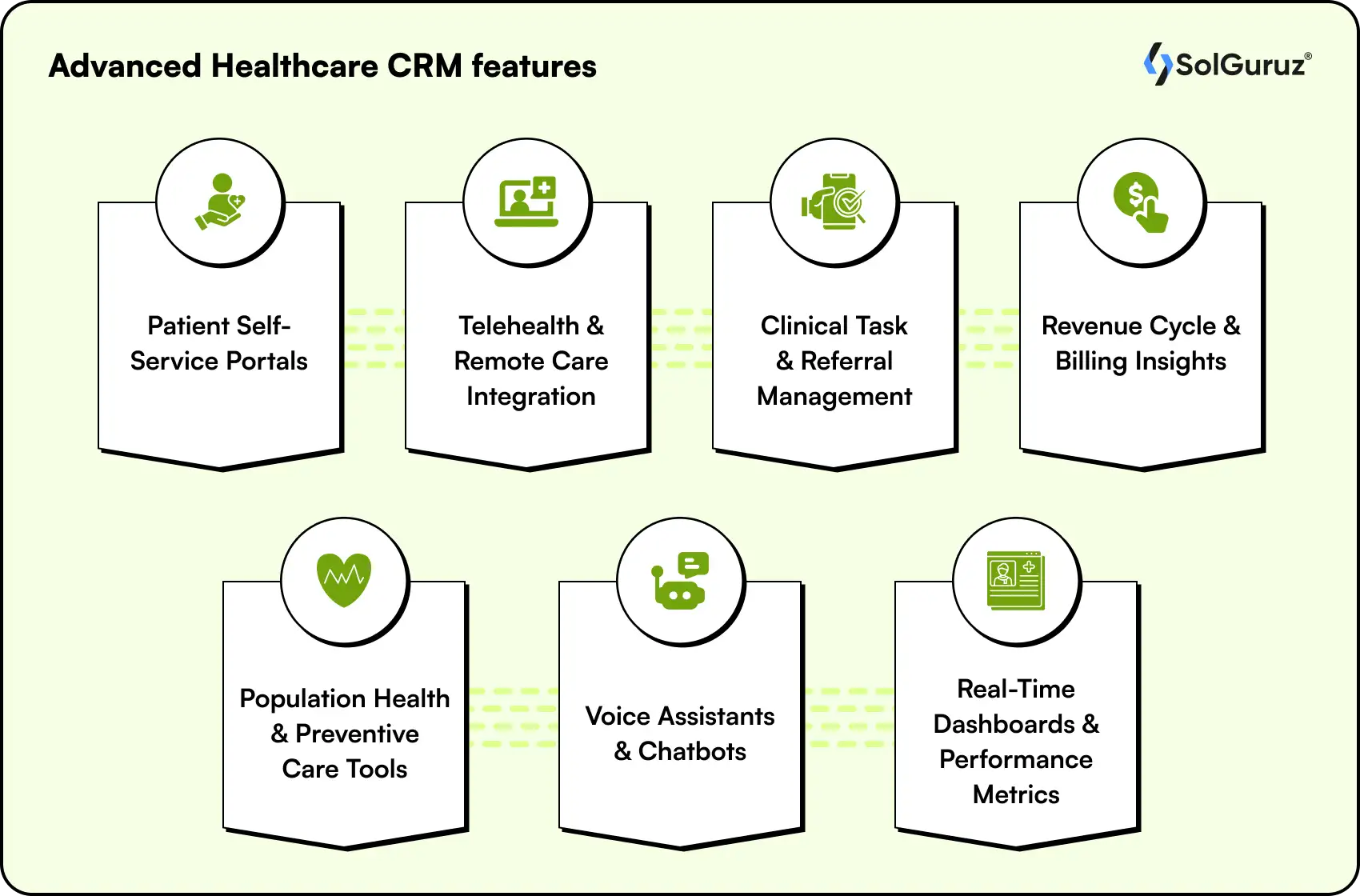
Modern healthcare CRM software goes beyond basic patient management to support digital care delivery, automation, and data-driven decision-making. Below are the advanced features shaping modern healthcare operations.
1. Patient Self-Service Portals
Patient self-service portals built by a healthcare-focused mobile app development company enable patients to book appointments, access medical records, and manage payments securely from mobile devices.
2. Telehealth & Remote Care Integration
New modern CRMs can integrate wearable data, remote monitoring tools, and virtual consultations into CRM workflows that are necessary for post-treatment follow-ups.
3. Clinical Task & Referral Management
Collaboration becomes easier within the care team by automating task assignments, referrals, follow-ups, and proper care coordination.
4. Revenue Cycle & Billing Insights
Doctors and administration get a detailed insight into patient billing and payments. It tracks outstanding balances and payment schedules, helping teams resolve issues more quickly.
5. Population Health & Preventive Care Tools
Helps medical professionals identify patient groups that are at risk, analyse preventive service gaps, and lead outreach programs for health screenings and continuing chronic disease management.
6. Voice Assistants & Chatbots
AI chatbots manage reminders, appointment scheduling, and frequently asked questions, increasing accessibility and decreasing call center traffic.
7. Real-Time Dashboards & Performance Metrics
Critical performance indicators for clinical and administrative teams are shown on dashboards that can be customised by healthcare organisations. These visual aids continuously monitor healthcare results, patient engagement levels, and the effectiveness of operational workflows.
Key Note: Healthcare businesses can achieve 20–30% higher patient engagement and significant administrative work reductions by using a modern healthcare CRM that emphasizes individualized patient interaction and process automation.
Types of CRM in Healthcare
Healthcare organizations use different CRM types based on their goals and scale:
| CRM Type | Purpose & Use Case |
| Patient Engagement CRM | This is focused towards patient portals, appointment reminders, follow-ups, and personalized communication to improve overall retention as well as communication. |
| Clinical CRM | This type of CRM provides help to medical teams to collaborate, manage tasks, coordinate treatment, and make referrals without taking the place of EHR features. |
| Operational & Administrative CRM | To increase efficiency, scheduling, billing, follow-ups, internal workflows, and reporting are all easily managed. |
| Marketing & Outreach CRM | It allows for preventive care campaigns, patient acquisition, and community outreach. |
| Enterprise Healthcare CRM | A single unified platform for all hospitals and large networks that combines analytics, patient interaction, system connectors, and more. |
What Are The Benefits of CRM Software In Healthcare
Now let’s see some of the advantages of CRM software in the healthcare sector:
1. Improved Patient Engagement & Experience
The CRM healthcare system provides you with transparent communication and automated appointment reminders, all of which help patients remain engaged with their care plans and follow-ups.
2. Centralized & Streamlined Data Management
CRMs remove disconnected data sources, reduce errors, and guarantee that physicians have fast access to rightful information by combining patient profiles, histories, communications, and treatment data on a unified platform.
3. Enhanced Care Coordination
With the help of CRM software, care coordination is improved, and work delays and misunderstandings within departments are minimized when teams have shared access to patient data.
4. Automation of Administrative Tasks
Everyday processes such as reminders, scheduling, billing follow-ups, and report generation are automated, making staff free so that they can focus on high-value care activities and reducing manual workload.
5. Data-Driven Decision Making & Analytics
Through CRM software in healthcare, advanced analytics provide detailed information about patient behavior, treatment outcomes, and operational trends, allowing experts to optimize services, allocate resources effectively, and track performance.
Healthcare CRM Software Development Process [Explained]
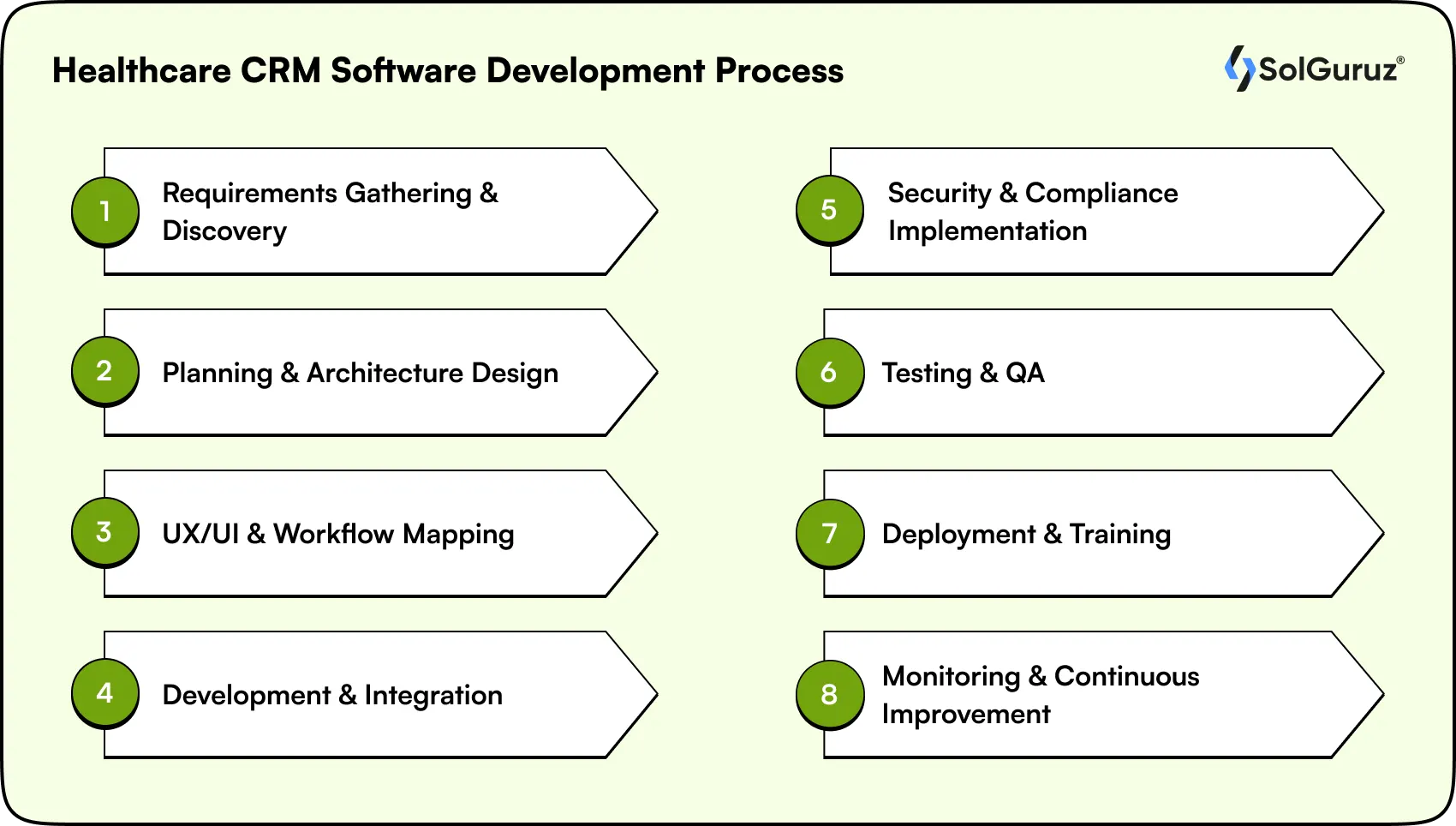
It is important to create a structured development lifecycle, as it ensures that the system is compliant with all clinical demands, regulatory standards, and user expectations. Below is the CRM software development process:
1. Requirements Gathering & Discovery
Clearly show business vision, clinical workflows, compliance specifications (e.g., HIPAA/GDPR), and stakeholder needs. This research ensures that the CRM is being developed as per real use cases.
2. Planning & Architecture Design
A detailed and systematic architecture system and development plan will be created with proper planning. Identify critical information about patient profiles, communications, analytics, and security levels, as well as connectors with EHR/EMR systems.
3. UX/UI & Workflow Mapping
Create workflows and user interfaces that are easy for staff, administrators, and clinicians to understand. Usability and low training friction are key factors in the adoption of healthcare CRM.
4. Development & Integration
Develop core modules and integrate with existing systems (EHRs, billing, telehealth, etc.). Interoperability ensures seamless data flow and unified patient records.
5. Security & Compliance Implementation
Build in security features such as encryption, role-based access, audit logs, and consent management to meet healthcare regulations. This is essential to protect sensitive health data.
6. Testing & QA
Conduct functional, performance, and security testing, including penetration tests where applicable. Testing ensures reliability before deployment.
7. Deployment & Training
Deploy the CRM in stages (e.g., pilot then full rollout) and train users across all departments. Change management helps drive adoption and minimize disruption.
8. Monitoring & Continuous Improvement
To enhance performance and value over time, gather feedback, track usage stats, and make iterations to features after launch. Continuous maintenance and enhancements guarantee that the CRM adapts to the demands of the company.
Remember: The foundation of a good healthcare CRM is usability and compliance, which are developed at ocntinous level. The system is being developed as per order, with changing clinical, regulatory, and corporate requirements, through continuous monitoring and development.
Healthcare CRM Implementation Challenges & Solutions
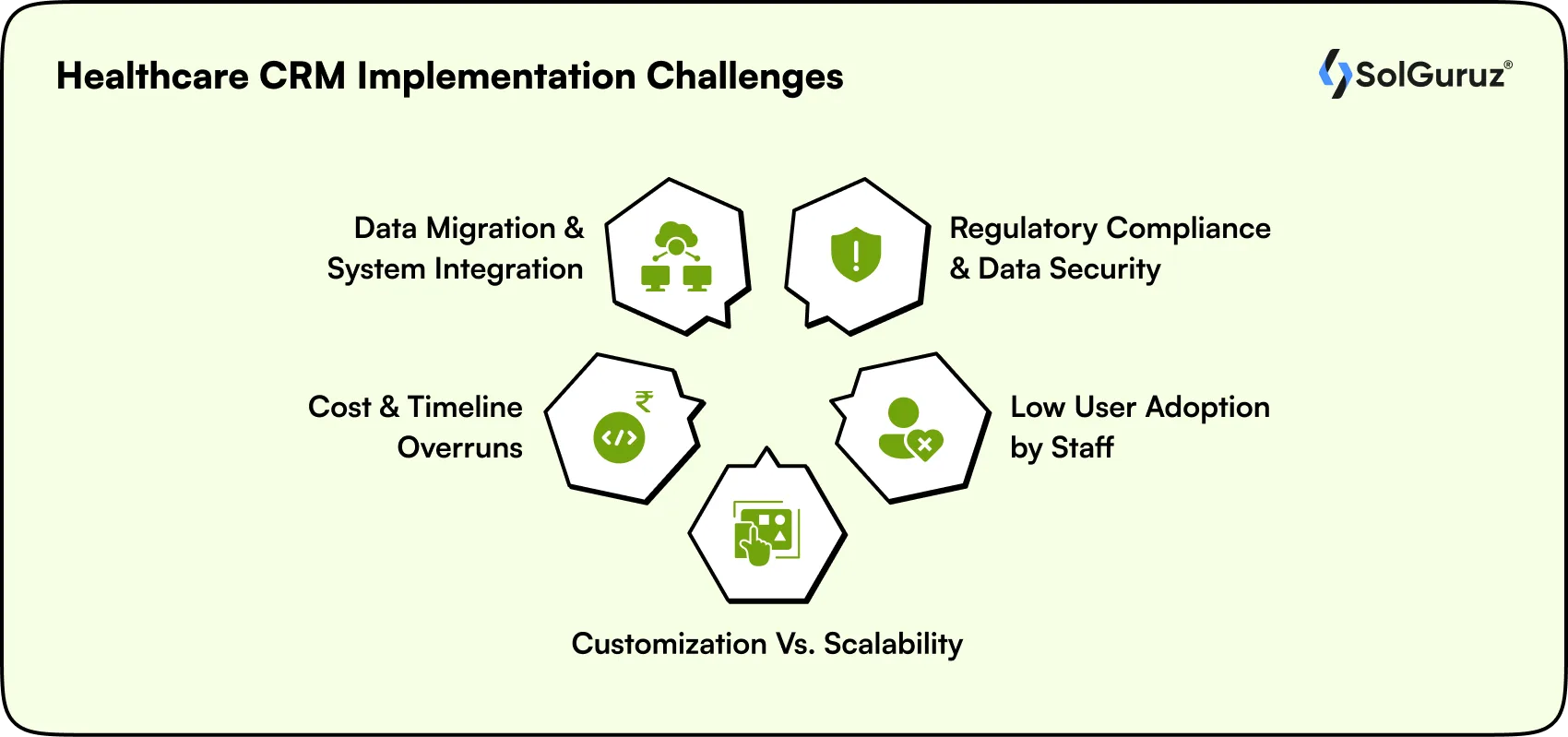
It is quite a challenging task to manage healthcare CRM in terms of technical and organisational areas. Solving these issues helps in smoother adoption and long-term success.
1. Data Migration & System Integration
Challenge: Data of patients is live within EHRs, billing systems, and other tools, making migration riskier.
Solution: To avoid this challenge, adopt data migration with HL7/FHIR standards, API-based integrations, and validation checks to ensure data accuracy and continuity.
2. Regulatory Compliance & Data Security
Challenge: Meeting HIPAA, GDPR, and regional healthcare regulations while managing sensitive patient credentials is a challenging task.
Solution: Build compliance into the architecture with encryption, role-based access, audit logs, and consent management from day one.
3. Low User Adoption by Staff
Challenge: Clinicians and administrative staff can avoid using new systems due to workflow disruption or a high level of complexity.
Solution: Design role-specific interfaces, provide hands-on training, and roll out the CRM in stages to encourage adoption.
4. Customization vs. Scalability
Challenge: Over-customization can make the CRM difficult to expand or upgrade over time.
Solution: Focus on using modular architecture and configurable workflows that allow customization without compromising long-term scalability.
5. Cost & Timeline Overruns
Challenge: Undefined clear requirements and scope can enhance overall development costs and also deployment.
Solution: Start with MVP, define KPI metrics, and adopt an agile development approach with regular stakeholder reviews.
To overcome these challenges effectively, many healthcare organizations choose to work with experienced development teams or hire mobile app developers who understand healthcare workflows, compliance requirements, and scalable system design.
Custom Healthcare CRM Development Cost Breakdown
Custom healthcare CRM development costs are not fixed, and the price depends on the system complexity, integrations, compliance requirements, and scalability. Let’ss get down to expanding the cost involved in the healthcare CRM development:
Typical Investment Range (2025–26)
Here’s the breakdown of the custom healthcare CRM development:
-
Basic MVP (Core Workflows): ~$10K–$40K+
Basic MVP involves patient profiles, appointment management, lead communication, and limited connectors, ideal for startups and clinics verifying their CRM approach.
-
Mid-Level Custom CRM Platform: ~$50K–$100K+
Adds EHR/EMR integration, automation, role-based access, reporting dashboards, and compliance features for growing healthcare organizations.
-
Enterprise-Grade Healthcare CRM: ~$120K+
It includes AI-driven analytics, advanced security, multi-system interoperability, and large-scale deployment assistance for hospitals and health care networks.
Quick guide
| CRM Tier | Estimated Cost (2025–26) | Best For |
| Basic MVP (Core Workflows) | ~$10K–$40K+ | Startups & clinics validating CRM needs |
| Mid-Level Custom CRM | ~$50K–$100K+ | Growing healthcare organizations |
| Enterprise-Grade CRM | ~$120K+ | Hospitals & large health networks |
Insight: Investing in the right CRM tier ensures you balance cost with scalability, helping healthcare organizations grow without overengineering or future rework.
How can Solguruz Manage Your Business Operations With a Custom CRM Software?
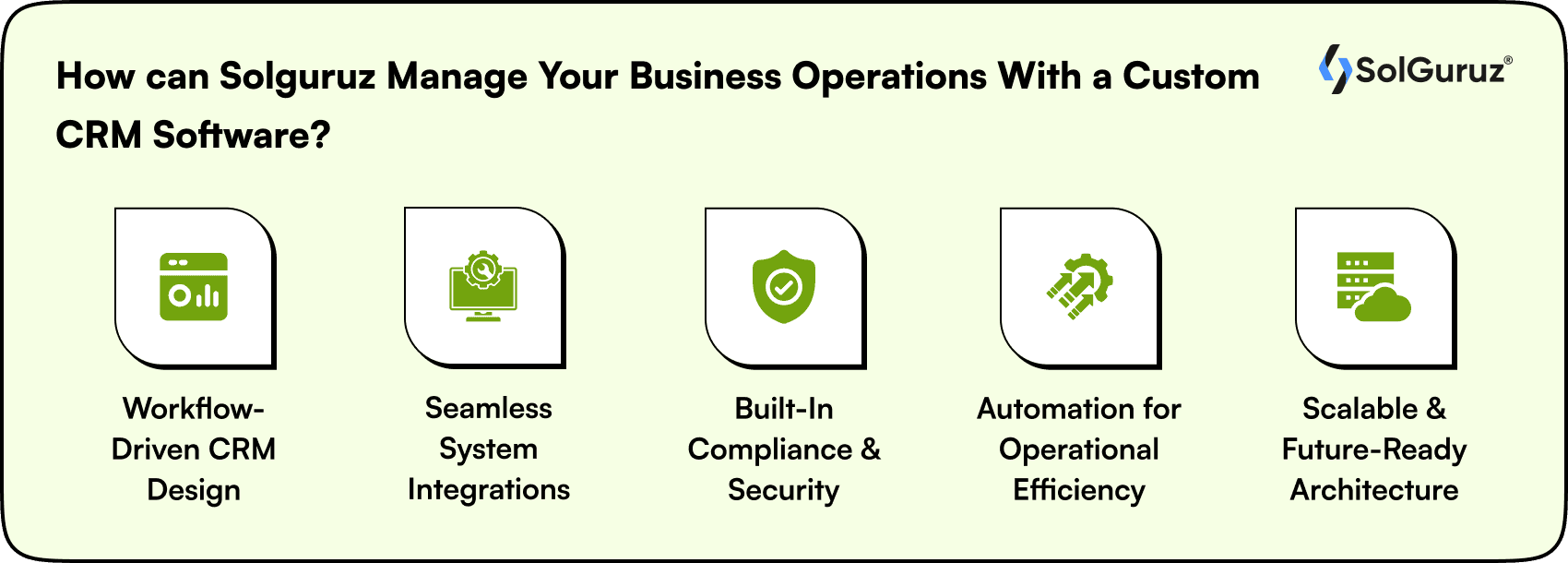
As a specialized Healthcare Software Development Company, SolGuruz helps healthcare organizations streamline operations, improve patient engagement, and maintain regulatory compliance through custom CRM software tailored to real clinical and administrative workflows. Our CRM solutions are secure, scalable, and built to deliver measurable ROI from strategy through deployment.
How SolGuruz adds value:
Do you really wanna know how our dedicated team adds value to you? Then, this is how Solguruz can be the best option for you:
1. Workflow-Driven CRM Design
We map your clinical and administrative processes to build a CRM that fits your operations, actions, not the other way around.
2. Seamless System Integrations
Our CRM is integrated without any lag with EHR/EMR, billing, telehealth, and third-party tools for unified data flow.
3. Built-In Compliance & Security.
HIPAA, GDPR, and role-based access controls are embedded into the architecture from day one.
4. Automation for Operational Efficiency
We automate scheduling, follow-ups, reporting, and repetitive tasks to reduce manual workload.
5. Scalable & Future-Ready Architecture
Our solutions are designed to scale with your organization, supporting growth, AI adoption, and evolving healthcare needs.
Final Thought
Custom healthcare CRM development is now essential for healthcare providers seeking better patient experience, streamlined operations, and regulatory compliance. A strong healthcare CRM development strategy enables unified data, automation, and scalable growth as digital healthcare evolves.
SolGuruz specializes in healthcare CRM development by building solutions around real clinical workflows, patient journeys, and care coordination, ensuring faster adoption, usability, and long-term scalability.
With built-in HIPAA and GDPR compliance and seamless EHR/EMR integrations using HL7 and FHIR standards, SolGuruz delivers secure, interoperable healthcare CRM solutions.
Connect with our experts to discuss your healthcare CRM requirements.
FAQs
1. What is healthcare, are CRM, and why is it important?
A healthcare CRM is specialised software designed to manage patient engagement, communication, and interactions across the care journey. When developed by an experienced healthcare staffing software development company, it enables providers to deliver personalised care, streamline operations, and maintain strict regulatory compliance.
2. How is a healthcare CRM different from an EHR?
Healthcare CRMs focus on patient interaction, communication, and operational procedures, whereas EHR systems save clinical records and medical history. CRMs enhance EHRs by integrating clinical data with patient outreach and administrative activities.
3. What features should a modern healthcare CRM have?
Unified patient profiles, multichannel communication, automated workflows, AI-powered analytics, extensive EHR/EMR connections, and secure, role-based access are all essential components of a contemporary CRM.
4. How much does custom healthcare CRM development cost?
Custom healthcare CRM development can range from around $10K–$40K for MVPs to $50K–$100K for mid‑tier systems and $120K+ for enterprise solutions, depending on features, integrations, and compliance needs.
5. Can small clinics benefit from a healthcare CRM?
Yes. Automating appointment reminders, managing patient communications, and increasing operational efficiency are all beneficial to even small clinics and frequently result in rapid return on investment.
From Insight to Action
Insights define intent. Execution defines results. Understand how we deliver with structure, collaborate through partnerships, and how our guidebooks help leaders make better product decisions.
 How we Work
Planning a Custom Healthcare CRM?
Get a clear roadmap, cost estimate, and compliance strategy before you start development.

Strict NDA

Trusted by Startups & Enterprises Worldwide

Flexible Engagement Models

1 Week Risk-Free Trial
Give us a call now!

+1 (724) 577-7737