

How Much Does Custom CRM Development Cost? [2026 Full Guide]
In 2026, custom CRM development typically ranges from $20,000 to over $100,000, shifting your budget from permanent SaaS debt to a high-ROI asset you fully own. This SolGuruz guide breaks down the true cost of ownership from AI-driven feature complexity to geographic market rates, helping you identify the exact break-even point for your scaling business.

Summarise with AI


If you are considering switching from off-the-shelf CRM Salesforce or HubSpot to a custom CRM, or just want to build your custom CRM directly, let’s talk about how much it will cost in 2026.
CRM development cost typically ranges from $20,000 to $100,000+, depending on the complexity of your workflows, the depth of AI integration, and the geographic location of your engineering team.
While a basic MVP for a small team can be launched for $20,000 to $25,000, enterprise-grade CRM systems cost upwards of $100,000 as they replace complex legacy software. For mid-market companies in the USA, UK, and Germany, the investment is no longer just about avoiding subscription bloat but also about owning the underlying IP and building a competitive advantage through data sovereignty.
Table of Contents
CRM Market Context & Why Custom CRM Is Worth Your Investment
In 2026, the global CRM market is projected to become the backbone of sales, reaching $126.17 billion, with North America and Europe leading demand for more sophisticated, high-performance CRM systems.
On average, businesses see a return of $8.71 for every dollar invested in CRM technology. Also, companies that successfully implement a CRM see lead conversion rates climb by up to 300%. However, these gains are difficult to achieve using standardized, off-the-shelf software.
Why Businesses are Choosing Custom CRM over Salesforce and HubSpot in 2026?
While platforms like Salesforce and HubSpot are good starting points, many scaling SMBs and enterprises in the USA, UK, and Germany are hitting a functional ceiling. Many businesses are choosing custom CRM development due to three specific reasons:
- The Per-Seat Tax: As your team grows from 50 to 500 users, subscription costs scale linearly, but your function does not. Custom CRMs stop the monthly licensing bloat.
- Workflow Rigidity: Off-the-shelf tools force you to adapt your business processes to their UI. Custom CRMs, on the other hand, are made for your specific sales cycles and operational issues.
- Data Sovereignty & Privacy: With strict GDPR in Europe and HIPAA in the US, black box SaaS data storage is a weakness. Custom-built CRM provides total control over where data is stored and who accesses it.
If you want to understand the complete process, architecture, and planning involved in building a CRM, read our custom CRM software development guide.
Who Is This CRM Development Pricing Guide For?
We’ve designed this guide specifically for decision makers around the globe who are responsible for technical ROI and operational efficiency:
- CTOs & VP Engineering: Comparing the build vs. buy trade-off and technical debt.
- Founders & CEOs: Wanting to maximize valuation by owning proprietary IP.
- Product Managers: Needing a tool that integrates deeply with internal product APIs.
- SMB Owners: Upgrading from spreadsheet chaos to a professional, scalable CRM system.
CRM Value Metrics (2026 Projections)
Let’s see some proven, data-backed benefits of having a Custom CRM so you can know exactly what you stand to gain from your investment.
|
Metric | Industry Benchmark |
Custom CRM Advantage |
| Average ROI | $8.71 per $1 spent | Increased due to the removal of license fees |
| Lead Conversion | +300% improvement | Higher via tailored automation |
| Data Accuracy | 76% report poor data | 99% via forced validation rules |
| Sales Cycle | Reduced by 8–14 days | Further reduced via deep API integrations |
Insight: Custom CRM systems improve key business metrics by aligning workflows, automation, and data rules with your exact operations. As a result, companies typically achieve higher ROI, faster sales cycles, and significantly better data accuracy compared to generic CRM platforms.
Custom vs. Off-the-Shelf: Long-term Cost Comparison
Choosing a CRM strategy is a high-stakes financial decision. In 2026, the market is no longer a simple binary of buy vs. build. Most businesses operate in a SaaS Debt cycle, where they pay for premium features they never use while simultaneously paying for developers to bridge the gaps those features leave behind.
What’s better in the long run? Custom or Off-the-shelf CRM?
Building a custom CRM is a front-loaded investment: you pay heavily in Year 1 for architecture and development, but costs drop to basic maintenance once you own the software.
On the other hand, off-the-shelf platforms use a per-user subscription model that scales with your headcount. While the initial buy-in is lower for subscriptions, a custom CRM often gives a better long-term ROI because you stop paying a “growth tax” as your team grows.
Decision Framework: When Should You Build Custom?
Before committing to a build, run through this architectural checklist. If you check three or more, custom development is likely the more cost-effective path:
In short, if your organization is scaling, relies on complex workflows, and wants full control over customer data, investing in a custom CRM can deliver stronger long-term value than relying on subscription-based platforms.
CRM Development Cost Overview by Business Size/Complexity
To budget accurately, you must categorize your project by its functional complexity. In 2026, complexity is no longer just about the number of screens; it is defined by data connectivity and the depth of integrated logic.
While a US-based agency might quote $150,000 for a mid-market system, SolGuruz uses a high-maturity offshore model to deliver an enterprise-grade CRM system at a significant cost advantage, typically reducing the base development cost by 40-60% without compromising on senior-level oversight.
Custom CRM Pricing & Timeline Tradeoff Matrix (2026)
To help you understand how scope impacts both budget and development time, the table below outlines typical custom CRM project tiers, including their core features, estimated costs, and timelines in 2026.
|
Project Tier | Best For | Key Features | Cost | Timeline |
Typical User Count |
| Basic CRM MVP | Startups / New Products | Lead capture, basic pipeline, task tracking, and single email sync. | $20,000 – $25,000 | 2–3 Months | 1–10 |
| SMB CRM | Scaling Teams | Automated follow-ups, role-based access, VoIP/WhatsApp sync, and custom reporting. | $25,000 – $50,000 | 4–6 Months | 11–50 |
| Enterprise CRM | Global Corps | AI-driven lead scoring, multi-language/region, HIPAA/GDPR compliance modules, legacy data migration, complex workflow automation, third-party integrations. | $50,000 – $100,000+ | 7-12 Months | 250+ |
Remember: These estimates vary depending on customization level, integration complexity, security requirements, and the development partner you choose.
The Complexity Multipliers: How is the Price of a CRM Decided?
If your requirements fall between tiers, consider these Multipliers that our architects use to calculate your specific estimate:
- Integration Density: Simple API hooks (e.g., Mailchimp) are standard. However, bidirectional synchronization with proprietary legacy ERPs or SAP can add 15–25% to the backend budget.
- Security & Compliance: For clients in the UK (GDPR) or USA (HIPAA), building in mandatory audit trails, data encryption at rest/transit, and SOC2-ready architecture adds roughly 20% to the QA and infrastructure cost.
- Mobile Requirements: A responsive web-app is standard. Building native iOS and Android apps alongside the web platform generally increases the total investment by 40–50%.
Pro Tip: We recommend starting with a Web-First approach for your MVP. By using a cross-platform tech stack (like React or Flutter), we can often deliver 90% of the mobile experience at a fraction of the native development cost.
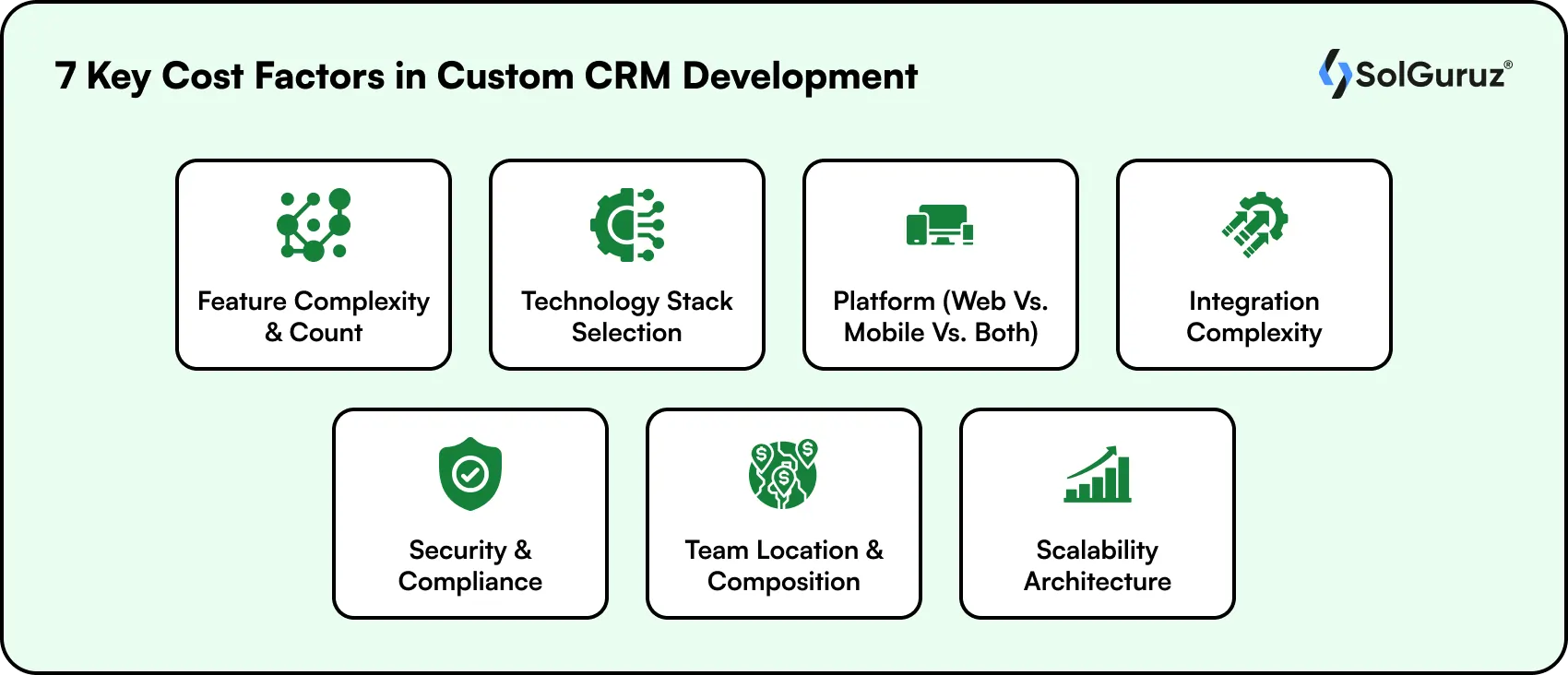
7 Key Cost Factors in Custom CRM Development
While development hours are the main expense, these eight factors determine exactly how many hours your specific vision requires. Let’s find out how much it costs to build a CRM system with the following features.
Factor 1: Feature Complexity & Count
Not all features are created equal. A basic Contact Record is a standard module, while an AI-Driven Lead Scorer needs a data pipeline and model training.
| CRM Feature | Development Complexity |
| Contact & Lead Management | Low (Standard CRUD) |
| Visual Sales Pipeline | Medium (Drag-and-drop UI) |
| Advanced Analytics/Dashboards | High (Complex Queries) |
| AI/ML Predictive Scoring | Very High (Data Science) |
Factor 2: Technology Stack Selection
Your choice of technology impacts both your initial custom CRM build cost and long-term maintenance. A modern, scalable stack is advisable to avoid technical debt:
- Frontend: React.js (for high-speed, responsive UIs).
- Backend: Node.js (for real-time updates) or Python (if AI/ML is a priority).
- Database: PostgreSQL or MongoDB (depending on data structure).
- Cloud: AWS or Azure (leveraging serverless architecture to reduce hosting OpEx).
Factor 3: Platform (Web vs. Mobile vs. Both)
In 2026, a web-based CRM is the baseline. However, if your sales team is in the field (common in the USA and Canada), mobile CRM is also necessary.
- Web Only: Baseline Budget.
- Mobile (Hybrid/Cross-platform): Adds 30–40% to the budget while maintaining a single codebase.
- Native iOS & Android: Adds 60–80% due to separate development requirements.
Factor 4: Integration Complexity
A CRM that doesn’t talk to your other tools is just a silo. Let’s see how different CRM integrations will affect custom CRM development cost:
| Integration Type | Examples | Cost |
| Standard API | Mailchimp, Slack, Gmail | Low |
| Financial/Accounting | QuickBooks, Xero, Stripe | Depends on 3rd party integration |
| Enterprise ERP | SAP, Oracle, Microsoft Dynamics | High due to complexity |
Factor 5: Security & Compliance (Geography Dependent)
Compliance isn’t just a checkbox; it requires specific architectural safeguards.
- USA: HIPAA (Healthcare) or SOC2 compliance.
- UK/Germany: Strict GDPR Right to be Forgotten and data residency logic.
- Canada: PIPEDA requirements.
Cost Impact: Expect a 15–20% increase in QA and Infrastructure costs for high-compliance environments.
Factor 6: Team Location & Composition
Where your code is written is the single biggest variable in your hourly burn rate.
- Western Market Teams: Hiring teams from high-cost regions like the USA or UK offer synchronous communication and direct alignment with specific corporate time zones. This model is often used for projects requiring immediate, real-time coordination. However, it involves the highest market rates due to regional labor laws, significant operational overhead, and a highly competitive talent landscape.
- Offshore/Hybrid Teams: This model uses global talent to provide high-end engineering expertise at a significantly more efficient price point. By adopting a hybrid approach, you secure experienced developers and round-the-clock productivity without the premium costs associated with Western market labor.
- Strategic Impact on Burn Rate: Changing from a high-cost regional model to a strategic offshore or hybrid partnership significantly extends your financial runway. This saved money can be reinvested into faster feature releases, aggressive marketing, or deeper R&D to maintain a competitive edge.
Factor 7: Scalability Architecture (Monolith vs. Microservices)
- Monolithic: Faster and cheaper to build initially (Best for MVPs).
- Microservices: Higher upfront cost, but allows you to scale specific modules (like the API or Search) independently. Essential for enterprises with 1,000+ concurrent users.
Hidden Costs That Increase CRM Cost if Unplanned
Beyond the initial development quote, successful platforms require a complete understanding of the total cost of ownership (TCO). Forgetting these attached costs is the leading cause of budget exhaustion mid-project.
| Hidden Cost | The Why (Context) | Mitigation Strategy (Planning) |
| Cloud Hosting | Infrastructure requirements scale non-linearly as user traffic and data storage increase. | Request tiered hosting estimates for current scale vs. 2x growth. Factor into the annual OpEx budget from Day 1. |
| Maintenance & Support | Software is dynamic; it requires security patches, API version updates, and regression testing. | Budget a fixed annual percentage of the total build cost. Formalize an SLA (Service Level Agreement) for ongoing support. |
| Data Migration | Legacy data often suffers from schema drift, making simple exports/imports technically impossible. | Conduct a Data Audit pre-development. Secure a quote based on record complexity and cleansing requirements. |
| Staff Training | The human element determines ROI; low adoption rates make even the best tech stacks useless. | Treat training as a core Project Deliverable. Define documentation and video handovers as necessary milestones. |
| Scope Creep | Unstructured feature requests during development use up the budget and delay the Time to Market. | Finalize a Detailed Requirements Document (SRS) before coding. Implement a formal Change Management Process so every change has to be checked before being added to the project. |
| Third-Party Fees | Modern apps rely on external APIs (e.g., Stripe, SendGrid, Twilio) that charge per-usage. | Audit all external dependencies and their billing structures. Include these Pass-Through Costs in your operational budget. |
3 Questions To Ask Your Development Partner
When you receive a development quote, ask three additional questions:
- What will hosting cost at my current scale, and what happens to that cost when we grow?
- What does an annual maintenance and support arrangement cost?
- Are there any third-party services this system depends on with ongoing fees?
A good CRM development agency like us will answer all three clearly. If they cannot, you should proceed with caution.
Feature-Level Cost Breakdown of Custom CRM Development
To get a truly accurate budget, you must look beyond the total project price and understand the unit cost of each module. You should always prioritize the high ROI features for your business and keep other features for the next development phases.
The following table shows the cost range of CRM features based on feature-complexity.
Detailed CRM Feature Cost Matrix (2026)
| Feature Category | Specific Module | Cost based on Complexity |
| Core CRM | Contact & Account Mgmt | Low |
| Visual Lead Pipeline | Medium | |
| Task & Activity Tracking | Low | |
| Shared Team Calendar | Medium | |
| Document Vault (e-Sign) | Medium | |
| Advanced | Marketing Automation | High |
| Custom Analytics/BI | High | |
| Multi-Currency/Region | Medium | |
| Customer Portal | High | |
| Advanced Search (Elastic) | Medium | |
| Integrations | Email/Gmail/Outlook Sync | Medium |
| VoIP & SMS (Twilio) | Medium | |
| Accounting/ERP Bridge | Very High | |
| AI/ML Modules | Predictive Lead Scoring | Very High |
| AI Sales Assistant (Chat) | High | |
| NLP Search/Query Engine | High | |
| Automated Sentiment Analysis | Medium |
The AI Premium Feature Cost in 2026
In 2026, we are seeing a trend where AI features are well-built functional features instead of being just experimental. For example, Predictive Lead Scoring uses historical data to tell your sales team exactly who to call first. While the initial investment is higher ($15k+), the increased sales speed typically pays for the module within the first two quarters of deployment.
Key Insight: We often recommend an AI-Light approach for initial CRM builds. By setting up the proper data architecture in Phase 1, we can integrate these advanced ML models in Phase 2 without rewriting your core database, saving you roughly 30% in refactoring costs.
Geographic Market Rates & SolGuruz’s Value Proposition
When budgeting for custom CRM software development, geography is one of the most significant variables in your total expenditure. A senior full-stack developer in San Francisco or London demands a vastly different rate than one in Bangalore, yet in 2026, the quality gap has effectively closed due to globalized DevOps standards and unified cloud architectures.
For businesses in the USA, UK, Germany, and Canada, the challenge is balancing cost-efficiency with the strict regulatory and cultural requirements of their local markets.
Why Geography No Longer Compromises CRM Development Quality
SolGuruz operates with Offshore Economics and Western Engineering Standards. We don’t just provide labor; we provide a localized partnership model:
- Timezone Compatibility: SolGuruz offers overlapping working hours for our clients in London, New York, and Toronto, ensuring daily stand-ups and real-time Slack/Teams communication.
- GDPR & UK Data Protection Act: For our UK and German clients, we implement Privacy by Design (PbD), ensuring data residency remains within EU/UK borders and all systems are compliant with Article 32 security standards.
- US Compliance: For North American firms, we prioritize SOC2-ready environments and, where applicable, HIPAA-compliant data silos for healthcare-adjacent CRMs.
The SolGuruz Value: Beyond the Hourly Rate
While our rates are 60-70% lower than local US or UK agencies, our value proposition is based on risk mitigation:
1. 1-Week Risk-Free Trial: Test our senior CRM developers on your actual project before committing to a long-term contract.
2. 99% Delivery Ratio: We avoid the common freelancer trap by providing dedicated, full-time engineering teams managed by senior project managers.
3. Direct Team Access: You communicate directly with the developers building your system without account manager filters that cause requirements to get lost in translation.
CRM ROI: What Return Should You Expect from Your Custom CRM?
Investing $100,000+ into a custom CRM isn’t an expense but a capital investment. To justify this to a board or a CFO, you need to look beyond ease of use. In 2026, the ROI of a custom CRM is measured by how effectively it speeds up your sales cycle and removes the SaaS Fees.
While industry benchmarks from Nucleus Research consistently report an average ROI of $8.71 for every $1 spent, custom CRM systems often exceed this by removing recurring licensing fees and automating niche-specific workflows that off-the-shelf tools can’t touch.
The CRM ROI Framework
You should track four primary Value Pillars to determine the success of a custom build:
| ROI Metric | How Custom CRM Improves It | Target Impact (Year 1) |
| Customer Acquisition Cost (CAC) | Automated lead routing and AI-driven scoring ensure reps only call high-intent prospects. | 15–20% Reduction |
| Sales Cycle Length | Integrated e-signatures and automated follow-up sequences remove manual friction. | 10–25% Faster Close |
| Customer Churn Rate | Predictive Health Scores alert account managers before a client leaves. | 5–10% Improvement |
| Operational Efficiency | Eliminating manual data entry across disparate tools (ERP, Email, CRM). | 150+ Hours Saved/mo |
With such quantifiable metrics in place, you can directly measure the impact of a custom CRM on your business.
10 Strategies to Reduce Custom CRM Development Cost Without Cutting Quality
A high-performance CRM doesn’t have to be very costly. Experienced in building custom CRMs, we present 10 specific strategies to keep your project under budget without sacrificing senior-level architecture.
1. Start with our 1-Week Risk-Free Trial: Don’t commit six figures to a maybe. Test our team’s output, communication, and technical logic for a week. If we aren’t the right fit, you don’t have to pay anything to us.
2. Prioritize the MVP (Minimum Viable Product): Focus on the 20% of features that generate 80% of your revenue. We help you identify Gold-Plated features that can be delayed to Phase 2.
3. Use an Open-Source Tech Stack: Avoid vendor lock-in and licensing fees by using robust frameworks like Node.js, Python, and PostgreSQL.
4. Adopt Agile Sprints: By working in 2-week intervals, we catch scope drift early, ensuring you never pay for 100 hours of work that doesn’t align with your goals.
5. Use a Hybrid/Offshore Model: Use SolGuruz’s India-based engineering team to get senior CRM developer quality at 40% of the cost of a local US/UK agency.
6. Fix Your Data Before Migration: Don’t pay developers to clean data. Cleaning your spreadsheets before CRM data migration starts can save $5,000–$10,000 in development time.
7. Phased Feature Rollout: Launch the core system for your sales team first. Add the marketing automation and AI modules only after the core system is generating data.
8. Clear Scope Documentation (PRD): We provide a detailed Product Requirements Document upfront. This removes the I thought it would do X surprises that lead to expensive change orders.
9. Staged Milestone Payments: Tie payments to verifiable deliverables. This keeps the development goal fixed on finishing rather than billing.
10. Direct Developer Communication: By removing layers of middle management and account executives, your budget goes directly toward code, not agency overhead.
FAQs
1. How much does it cost to build a custom CRM from scratch?
In 2026, a custom CRM typically ranges from $20,000 to $100,000+. A lean MVP starts at approximately $20,000, while feature-rich enterprise platforms with AI integrations and deep ERP syncing generally start at $50,000.
2. How long does custom CRM development take?
Development timelines depend on complexity. A standard MVP takes 3 months, a mid-market solution takes 6–9 months, and a fully-integrated enterprise ecosystem can take 10–12+ months to reach full deployment.
3. What is the difference between building and buying a CRM?
Buying (SaaS/Off-the-shelf CRM) offers a fast start but involves permanent per-seat licensing fees and rigid workflows. Building (Custom CRM) requires a higher upfront investment but results in zero licensing fees, 100% IP ownership, and a system built specifically around your proprietary business logic.
4. Can I build a CRM on a $50,000 budget?
Yes. A $50,000 budget is ideal for a High-Performance CRM. This typically includes core lead management, a visual sales pipeline, email integration, and a mobile-responsive dashboard for a team of 100+ users.
5. What technology stack is best for CRM development?
For 2026, we recommend a JavaScript/TypeScript-based stack for speed and scalability: React.js for the frontend, Node.js for the backend, and PostgreSQL for data. If your CRM requires heavy AI/predictive analytics, Python is integrated into the backend.
6. Is offshore CRM development reliable?
It is highly reliable when paired with Western-standard management. SolGuruz bridges this gap by providing senior developers, daily progress reports, and a 1-Week Risk-Free Trial to prove our code quality and communication standards before you commit.
7. How does SolGuruz price custom CRM development?
You should budget 15–20% of the initial development cost annually for maintenance. This covers cloud hosting (AWS/Azure), security patches, API updates for third-party tools, and minor feature iterations.
8. How does SolGuruz price custom CRM development?
We provide Fixed-Price quotes for defined MVPs and Time & Materials (Agile) pricing for evolving enterprise projects. Every quote is transparent, with no hidden project management fees or maintenance markups.

Written by
Paresh Mayani
Paresh Mayani is the Co-Founder and CEO of SolGuruz, a global custom software development and product engineering company. With over 17+ years of experience in software development, architecture decisions, and technology consulting, he has worked across the full lifecycle of digital products, from early validation to large-scale production systems. He started his career as an Android developer and spent nearly a decade building real-world mobile applications before moving into product strategy, technical consulting, and delivery leadership roles. Paresh works directly with founders, scaleups, and enterprise teams where technology choices influence product viability, scalability, and long-term operational success. He partners closely with founders and cross-functional teams to take early ideas and turn them into scalable digital products. His work revolves around AI integration, agent-driven workflow automation, guiding product discovery, MVP validation, system design, and domain-specific software platforms across industries such as healthcare, fitness, and fintech. Instead of solely focusing on building features, Paresh helps organizations adopt technology in a way that fits business workflows, teams, and growth stages. Beyond delivery, Paresh is also an active tech community contributor and speaker, contributing to global developer ecosystems through Stack Overflow, technical talks, mentorship, and developer community (Google Developers Group Ahmedabad and FlutterFlow Developers Group Ahmedabad) initiatives. He holds more than 120,000 reputation points on Stack Overflow and is one of the top 10 contributors worldwide for the Android tag. His writing explores AI adoption, product engineering strategy, architecture planning, and practical lessons learned from real-world product execution.





From Insight to Action
Insights define intent. Execution defines results. Understand how we deliver with structure, collaborate through partnerships, and how our guidebooks help leaders make better product decisions.
 How we Work
Considering a Custom CRM?
Increase your revenue by streamlining Sales processes with your Custom CRM tool.

Strict NDA

Trusted by Startups & Enterprises Worldwide

Flexible Engagement Models

1 Week Risk-Free Trial