

How to Hire a CRM Developer in 2026: Skills, Cost, Team Structure, and What to Actually Look For
Hiring the right CRM developer comes down to knowing what your project actually needs before you start looking. This guide covers the skills, team structure, cost benchmarks, and evaluation criteria to help you make that decision with confidence.

Summarise with AI


Table of Contents
Key Takeaways
- CRM impact: Businesses using CRM software report a 29% increase in sales productivity, according to industry research on CRM adoption.
- Role explained: A CRM developer is a specialist who customizes, integrates, and maintains CRM platforms so that a business can automate lead tracking, manage customer data, and improve sales workflows.
- In practice: Most CRM development engagements today involve a minimum team of three: AI assisted CRM developer, a business analyst, and a QA engineer. Solo freelancers rarely have the depth to handle API integrations, data migration, and platform customization simultaneously.
- AI prediction: By 2027, AI-powered CRM tools will shift developer requirements toward ML workflow design and predictive analytics configuration, making platform-specific experience more valuable than general programming knowledge alone.
Building a CRM that actually works for your business comes down to one decision made early: who builds it and how. Businesses using CRM software report a 29% increase in sales productivity and a 42% improvement in sales forecasting accuracy, according to research.
Those numbers only hold when the system is built correctly for the business using it. And building it correctly starts with hiring CRM developers with the right skills.
This guide covers the skills, team structure, and cost benchmarks you need to make that call with confidence.
What Does a CRM Developer Actually Do?
Quick Answer
A CRM developer is a software professional who designs, builds, and maintains customer relationship management systems for businesses. They handle platform configuration, API integrations, workflow automation, and data management so that your CRM system works in alignment with your specific sales process and industry requirements.
Most businesses come to us having already looked at their CRM options and realized something: the platform itself is only the starting point. Getting it to reflect how your sales team works, connect to the tools you already use, and handle your customer data correctly takes a different kind of work.
Our CRM services include everything from customization and API integrations to data migration, workflow automation, and ongoing performance monitoring. Research shows that companies using CRM tools effectively report up to a 27% increase in customer retention. But before getting into skills and team structure, it helps to clarify which type of CRM professional your project actually needs.
CRM Developer vs CRM Administrator vs CRM Consultant
One of the most common points of confusion when a business starts evaluating options is which type of CRM professional they actually need. These three roles are not interchangeable.
| CRM Developer | CRM Administrator | CRM Consultant | |
| Primary scope | Builds, customizes, and integrates the CRM at a code and configuration level | Manages and maintains the CRM after it has been built | Advises on CRM strategy, platform selection, and process design |
| Technical depth | High: writes code, configures APIs, designs data models | Moderate: manages users, updates settings, runs reports | Variable: deep on process, lighter on technical execution |
| When you need them | New CRM build, major customization, system integration, data migration | Ongoing system management after go-live | Platform selection decision, pre-project requirements work |
| Engagement type | Project-based or dedicated team retainer | Ongoing operational role | Advisory, often short-term |
| Works best with | Business analyst, QA engineer, project manager | End users, sales ops team | Stakeholders, CRM developer, implementation team |
If your CRM project involves any custom development, third-party integrations, or data migration from a legacy system, you need a developer, not just an administrator. If you are still deciding which platform to build on, a consultant is the right starting point. Most mid-market CRM development projects at SolGuruz begin with a discovery phase that covers both.
Key Responsibilities of a CRM Developer
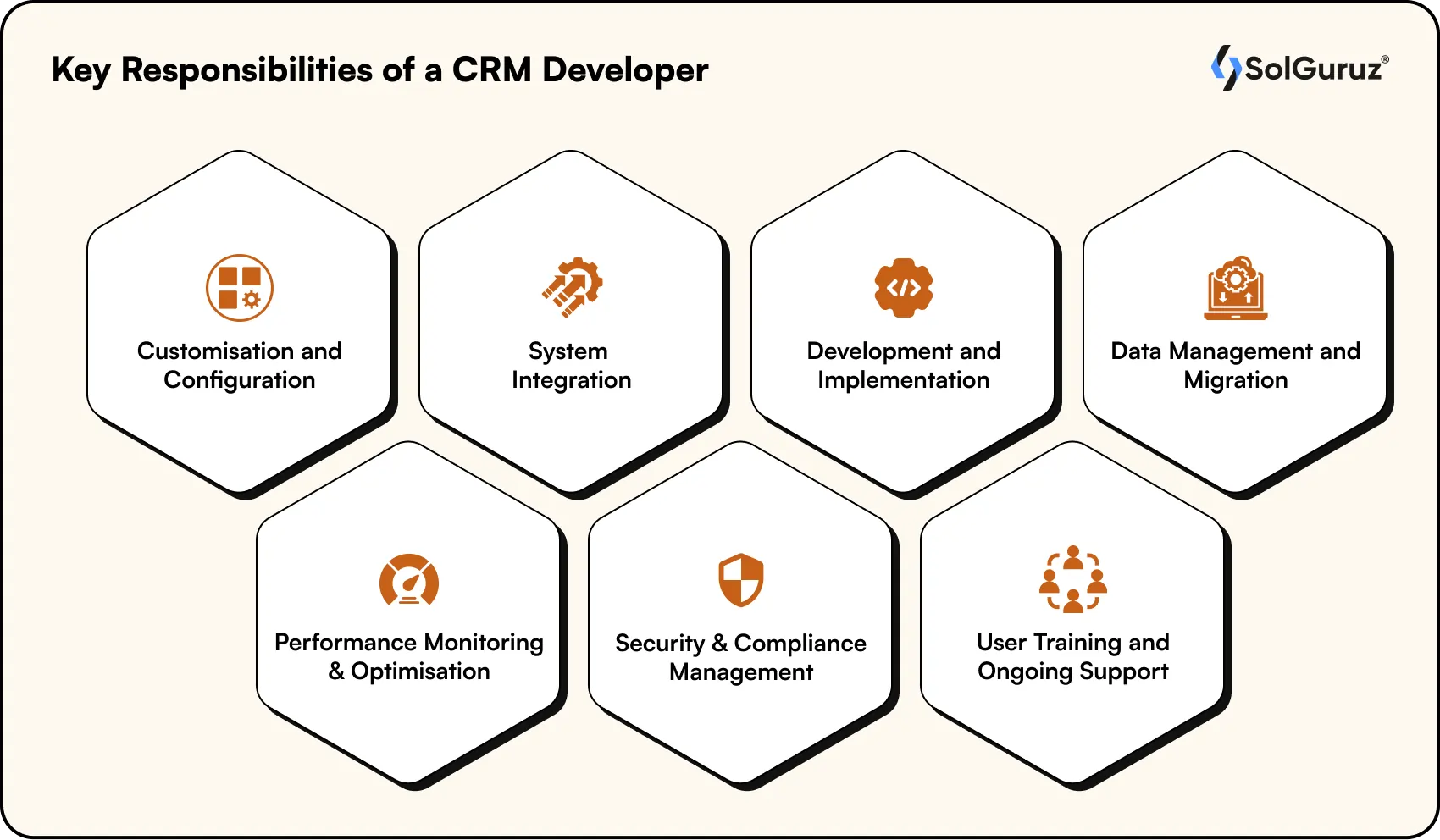
A CRM developer is accountable for the entire lifecycle of a CRM system, from mapping your business requirements at the start to keeping the system running cleanly after launch.
-
Customisation and Configuration:
Our developers configure your CRM around your specific workflows, whether that is patient follow-ups in healthcare, deal tracking in real estate, or enrollment management in education. Custom fields, pipeline stages, automation rules, and interfaces are all built to match how your team actually operates.
-
System Integration:
Our developers connect your CRM to the tools your business already uses, like invoicing software, marketing platforms, communication tools, and industry-specific systems. Data flows automatically between systems, so your team is not moving information by hand.
-
Development and Implementation:
Our developers build what the platform does not natively offer. Custom modules, plugins, and workflow logic that extend your CRM’s functionality to cover the specific processes your business needs.
-
Data Management and Migration:
Our developers handle the full migration process, including data auditing, deduplication, standardisation, and post-import validation. Clean data going in means accurate reporting and reliable records from day one.
-
Performance Monitoring and Optimization:
As data volumes grow, CRM systems slow down. An experienced CRM developer monitors system performance on an ongoing basis and address query inefficiencies, dashboard lag, and integration timeouts before they affect your team.
-
Security and Compliance Management:
Security is an architectural decision, not a final step. Our developers build access controls, data encryption, audit logging, and compliance documentation into the system from the ground up, covering HIPAA, GDPR, and other regulations relevant to your industry.
-
User Training and Ongoing Support:
Our engagements include handoff documentation and user training so your team can work confidently in the system from day one. Post-launch support covers troubleshooting, configuration updates, and questions that come up in real use.
Core CRM Developer Technical Skills
Every CRM developer needs these skills to build a truly efficient CRM.
-
Programming Languages (JavaScript, Python, C#, SQL)
The logic behind your automation rules, custom workflows, and data transformations is written in code. Our developers work across multiple languages and select the right one based on your CRM architecture.
-
Database Management (SQL Server, MySQL, Oracle)
Your CRM is only as reliable as the database underneath it. We design and optimise database schemas from the ground up, with query performance and long-term scalability built in from day one.
-
API Knowledge
How cleanly your CRM connects to external systems depends on how well your developer understands API architecture. Our developers build integrations that hold up as both systems evolve over time.
-
Web Development (HTML, CSS, JavaScript)
The CRM interface is what your team uses every day. We customise interfaces to reflect your actual workflow, not a default layout built for a different business.
-
Object-Oriented Design Patterns
CRM systems grow over time. Every custom module we build is structured for maintainability, so future development does not require rewriting the foundation.
-
Version Control (Git)
Our team operates on Git-based workflows with clear branching, review, and deployment processes so every change is tracked and reversible.
-
Security Principles
Security knowledge shapes how a system is designed, not just how it is deployed. Our developers bring working knowledge of HIPAA, GDPR, and data protection standards relevant to your industry.
-
Business Process Understanding
Our developers work closely with your business analyst during discovery to map requirements before a single line of code is written.
Insight: Business process understanding is the skill most technical hiring assessments miss entirely. A developer who cannot translate a sales workflow into a data model will build a system that works technically but fails operationally.
CRM Developer Skills by Industry: What Changes When You Hire for Healthcare, Real Estate, or Education
A CRM developer’s core technical foundation is the same across industries. What changes are the integration experience, data handling requirements, and compliance knowledge your project specifically needs? Here is what that looks like industry-wise.
| Industry | Additional Skills Required | Key Integrations | Compliance |
| Healthcare CRM | HIPAA architecture knowledge, HL7/FHIR API experience, patient data encryption | Patient management systems, telehealth platforms, and appointment scheduling tools | HIPAA, BAA agreements, SOC 2 |
| Real Estate CRM | MLS integration experience, property listing data management, and deal stage workflow design | MLS platforms, document signing tools, property valuation APIs, WhatsApp/SMS systems | Regional data privacy regulations |
| Education CRM | LMS integration experience, student lifecycle tracking, enrollment workflow design | Moodle, Canvas, Blackboard, payment gateways, and communication platforms | FERPA (US), GDPR (EU/UK) |
| Travel and Hospitality CRM | Booking system integration, loyalty programme data management, and multi-currency handling | GDS systems, property management platforms, OTA APIs, payment gateways | PCI DSS, GDPR |
Our developers at SolGuruz work across multiple industries, meeting their industry and country-specific compliance requirements.
What a CRM Development Team Actually Looks Like
Most businesses start a CRM project looking for a developer. What they actually need is a team. A single developer handling requirements gathering, custom development, third-party integrations, quality assurance, and project communication simultaneously is a setup that creates delays and gaps in delivery. The businesses that get the most out of a CRM engagement are the ones that come in with the right team structure from the start.
Here is how a properly structured CRM development team is composed and what each role is responsible for.
- Project Manager: Owns the delivery timeline, stakeholder communication, and scope management. Keeps the project on track when requirements shift, which they almost always do.
- UX Designer: Relevant for custom CRM builds where the interface is being built from scratch. Maps user journeys before development starts, reducing UI revisions after build.
- CRM Developer: Handles platform configuration, custom development, workflow automation, and integration implementation. The technical foundation every other role builds around.
- AI-Assisted CRM Developer: Configures AI-driven features within the CRM like predictive lead scoring, automated segmentation, intelligent workflow triggers, and natural language reporting. Our developers apply AI both as a build accelerator and as a functional layer that makes the system smarter over time.
- Business Analyst: Translates business requirements into technical specifications before development begins. The single most effective way to reduce scope changes mid-project is
- QA Engineer: Tests the system at every stage of the build. In regulated industries, they also validate compliance-related functionality like data handling, access controls, and audit trail behaviour.
- Integration Specialist: Manages connections between your CRM and external systems. Operates in parallel with the core development track on builds with multiple API connections.
Let’s find out how you can hire CRM developers and what it’s gonna cost you.
CRM Developer Cost in 2026: Hourly Rates and Hiring Models
Hiring a CRM developer in 2026 means choosing between significantly different cost structures depending on where your team is based and how you engage them. Here is what the numbers actually look like across regions and engagement models.
Hourly Rates by Region
India-based CRM developers bill at $25 to $35 per hour at a company, with CRM specialists typically running 20 to 30% above general development rates. Central and Eastern European developers range from $40 to $80 per hour, Western Europe from $50 to $110 per hour. In the US, the average CRM developer bills at $52 to $80 per hour, with senior specialists reaching $96 and above.
Hiring Models for CRM Developers
- Dedicated Developer (Full-time / Part-time): Works exclusively on your project like an in-house team member. Best for long-term builds with evolving requirements.
- Hourly Engagement: Pay-as-you-go for specific tasks, bug fixes, or short-term support. No upfront contracts.
- Team Augmentation: SolGuruz developers slot into your existing team and scale with your project needs.
- Fixed Scope Projects: Defined scope, budget, and timeline agreed upfront. Best when your requirements are fully documented.
Keep in mind that using AI-Assisted development, your CRM can be built with comparatively lower cost and in an accelerated time frame but it is dependent on the requirements.
What to Look for When Evaluating a CRM Developer
When you are comparing CRM developers or development partners, the decision comes down to two things: what they know technically and how they work in practice. Here is what to look for on both fronts.
| Hard Skills to Verify | Soft Skills to Assess |
| Programming languages (JavaScript, Python, C#, SQL) | Clear communication with both technical and non-technical stakeholders |
| Database management (SQL Server, MySQL, Oracle) | Problem-solving and critical thinking under shifting requirements |
| API integration and customisation | Attention to detail in data handling and testing |
| Web development (HTML, CSS, JavaScript) | Adaptability when business logic changes mid-build |
| Version control (Git) | Accountability for delivery timelines and quality |
| Data analysis and reporting | Analytical thinking applied to workflow design |
| CRM customisation and configuration | Collaboration across the developer, BA, and QA team members |
| AI-assisted CRM workflows and predictive analytics (lead scoring, automation, chatbots) | Strategic thinking in applying AI to real business use cases (not just features) |
| Data migration and integration | Customer focus and understanding the end-user before writing a line of code |
| Security and compliance best practices | Project management awareness across sprint cycles |
| Software development lifecycle knowledge | Continuous learning as CRM platforms and integrations evolve |
| Cloud computing and infrastructure | Empathy for how sales and ops teams actually use the system daily |
| Mobile CRM development | Leadership within a cross-functional delivery team |
| Business intelligence and reporting tools | Creativity in solving non-standard workflow requirements |
| Workflow automation design | Interpersonal skills for stakeholder alignment and user training |
When you are evaluating a CRM development partner rather than an individual hire, the soft skills column becomes a team-level question.
- Does the agency have a business analyst who maps workflows before development starts?
- Does the project manager communicate scope changes proactively or after the fact?
- Does the team ask detailed questions about your business during discovery, or do they move straight to a quote?
Those are the signals that tell you more about a delivery outcome than any skills list will.
Wrapping Up
Hiring the right CRM developer comes down to knowing what you need before you start looking. Choosing the right skills, team composition, and engagement model shapes the outcome before developers write a single line of code.
SolGuruz works with businesses across healthcare, real estate, education, and travel to scope, build, and maintain CRM systems that fit how your team actually operates. Now you have everything you need to make the right call, so start building your CRM.
FAQs
1. What is the difference between a CRM developer and a CRM administrator?
A CRM developer builds and customizes the system: they write code, configure APIs, and design workflows. A CRM administrator manages the system after it is built: they handle user access, update settings, and run reports. For a new CRM build or major customization, you need a developer. For ongoing system management, an administrator is often sufficient.
2. How much does it cost to hire a CRM developer?
India-based CRM developers bill at $15 to $50 per hour, with specialists running 20 to 30% above general development rates. Central and Eastern European developers range from $30 to $70 per hour, Western Europe from $50 to $110 per hour, and US-based developers from $52 to $80 per hour, with senior specialists reaching $96 and above. Project costs range from $20,000 for a basic CRM MVP to $100,000 or more for an enterprise build.
3. Do I need a full team or just one CRM developer?
For anything beyond a basic pipeline tracker, one developer is rarely enough. A typical mid-market CRM build needs at least three people: a CRM developer for the core build, a business analyst to map workflows before development starts, and a QA engineer to validate data integrity and integration behaviour.
4. How long does it take to build a custom CRM?
To build a custom CRM from scratch, the timeline depends on various factors like features and budget. A basic CRM MVP takes 2 to 3 months. An SMB-level CRM with automation and integrations takes 4 to 6 months. Enterprise-grade CRMs with legacy data migration and compliance modules take 7 to 12 months. Undiscovered requirements mid-project typically add 20 to 40% to both cost and timeline.
5. What CRM developer skills should I prioritise for a healthcare or regulated industry project?
Healthcare CRM developers need working knowledge of HIPAA-compliant architecture, HL7 and FHIR API standards, and patient data encryption requirements. For any regulated industry, security and compliance knowledge should be treated as a core technical requirement, not an optional add-on.
6. What is the difference between a fixed-scope project and a dedicated team engagement?
A fixed-scope project works when requirements are fully defined upfront, and you get a set timeline, deliverables, and cost. A dedicated team retainer works better for mid-market and enterprise builds where requirements evolve. The dedicated model gives you a consistent team, predictable monthly cost, and the flexibility to adjust scope as the project progresses.

Written by
Paresh Mayani
Paresh Mayani is the Co-Founder and CEO of SolGuruz, a global custom software development and product engineering company. With over 17+ years of experience in software development, architecture decisions, and technology consulting, he has worked across the full lifecycle of digital products, from early validation to large-scale production systems. He started his career as an Android developer and spent nearly a decade building real-world mobile applications before moving into product strategy, technical consulting, and delivery leadership roles. Paresh works directly with founders, scaleups, and enterprise teams where technology choices influence product viability, scalability, and long-term operational success. He partners closely with founders and cross-functional teams to take early ideas and turn them into scalable digital products. His work revolves around AI integration, agent-driven workflow automation, guiding product discovery, MVP validation, system design, and domain-specific software platforms across industries such as healthcare, fitness, and fintech. Instead of solely focusing on building features, Paresh helps organizations adopt technology in a way that fits business workflows, teams, and growth stages. Beyond delivery, Paresh is also an active tech community contributor and speaker, contributing to global developer ecosystems through Stack Overflow, technical talks, mentorship, and developer community (Google Developers Group Ahmedabad and FlutterFlow Developers Group Ahmedabad) initiatives. He holds more than 120,000 reputation points on Stack Overflow and is one of the top 10 contributors worldwide for the Android tag. His writing explores AI adoption, product engineering strategy, architecture planning, and practical lessons learned from real-world product execution.





From Insight to Action
Insights define intent. Execution defines results. Understand how we deliver with structure, collaborate through partnerships, and how our guidebooks help leaders make better product decisions.
 How we Work
Your CRM Partner Is Here
Share your requirements and get a scoped team recommendation today.

Strict NDA

Trusted by Startups & Enterprises Worldwide

Flexible Engagement Models

1 Week Risk-Free Trial