

Bespoke Software Development in 2026: What It Costs, How It Works, and When You Need It
This guide covers bespoke software development from start to finish. Learn what it costs in 2026, how the development process works, when custom software makes sense over off-the-shelf, and how to choose the right development partner.

Summarise with AI


You have tried three different SaaS platforms this year. None of them quite fit. Your team spends more time working around the software than working with it. Reports need manual exports, customer data lives in four different places, and every new workflow means another workaround.
This is the exact moment most businesses start thinking about bespoke software.
Bespoke software development is the process of building a custom application from scratch, designed specifically for your business processes, your users, and your goals. Unlike off-the-shelf tools that serve a broad audience, bespoke software fits how your company actually operates.
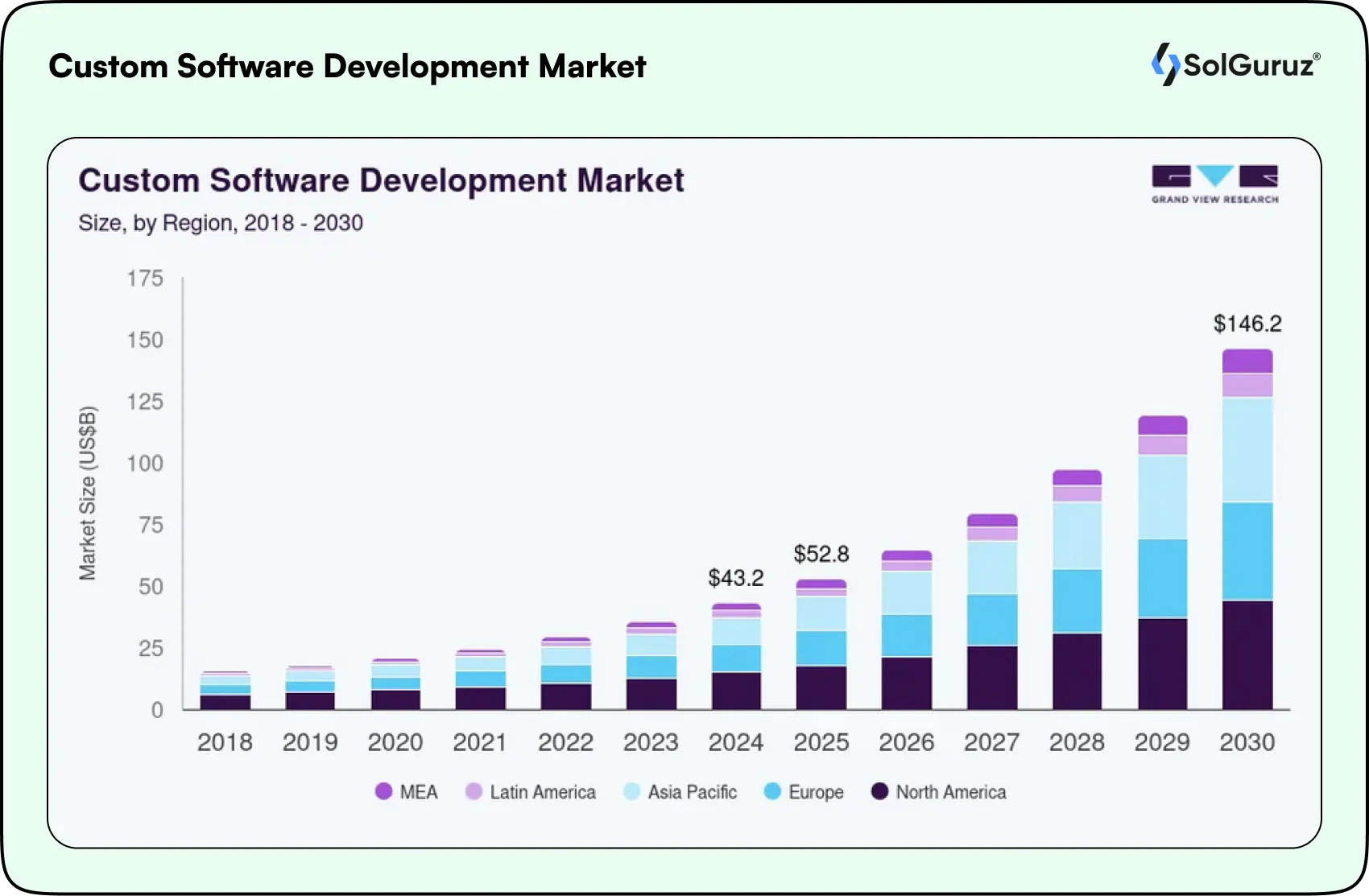
The global market for custom software development was valued at over $43 billion in 2024 and is projected to reach $146 billion by 2030, growing at a CAGR of 22.6%, according to Grand View Research.
This guide walks you through the full picture. You will learn the step-by-step development process, realistic cost ranges, how to decide between custom and off-the-shelf, and what to look for when choosing a development partner.
Whether you are a CTO evaluating your tech stack, a founder planning your first product, or a product leader modernizing legacy systems, this is your playbook.
TLDR
Bespoke software development builds custom applications tailored to your business, processes, and goals. Unlike off-the-shelf tools, it fits your workflow, scales with your growth, and enhances security and efficiency. Costs vary by complexity, but long-term savings and full ownership often outweigh SaaS alternatives. Choosing the right development partner ensures success through discovery, agile delivery, and ongoing support.
Table of Contents
How Bespoke Software Development Works: The 6-Step Process
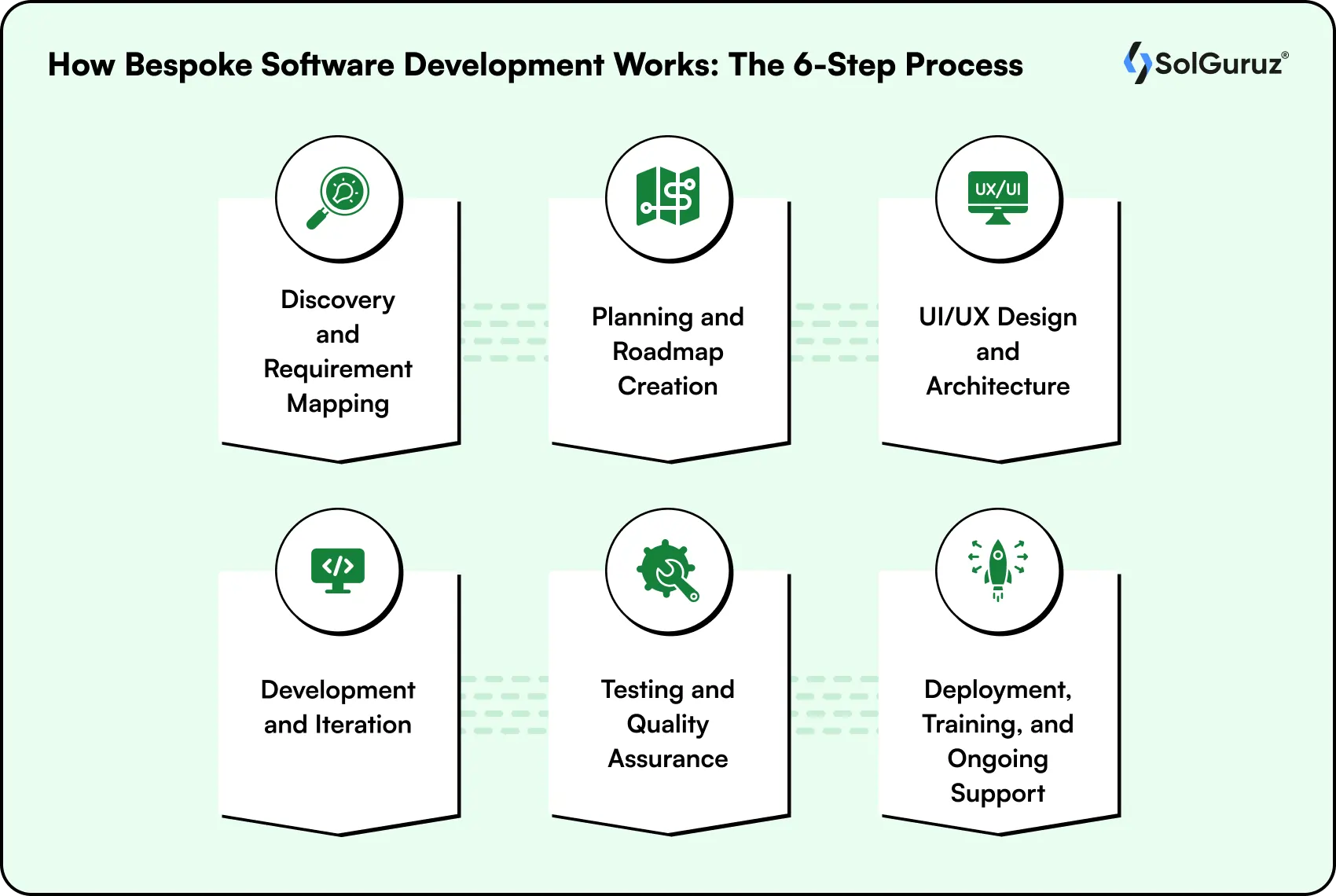
The best bespoke software projects follow a structured process. Skipping steps is how budgets balloon and timelines slip. Here is how it works when done right.
Step 1: Discovery and Requirement Mapping
This is where clarity gets created or lost. The development team works closely with your stakeholders to understand business goals, existing workflows, pain points, and constraints.
The output is not just a feature list. It is a shared understanding of what the software must do, who it serves, and how success will be measured. A beneficial discovery phase includes stakeholder interviews, process mapping, technical architecture planning, and competitive analysis.
For most projects, this phase takes 2 to 4 weeks and costs between $2,000 and $10,000, depending on complexity.
Step 2: Planning and Roadmap Creation
Once requirements are finalized, the team creates a clear roadmap. This means prioritizing features, setting timelines and budgets, identifying risks, and often building wireframes or prototypes to validate the experience before development begins.
Think of this step as the blueprint. You would not build a house without architectural plans, and you should not build software without a development roadmap either.
Step 3: UI/UX Design and Architecture
Designers build the interface while architects define the technical foundation. This includes choosing the tech stack, data structure, integrations, and infrastructure.
At this stage, the goal is to ensure the software looks and works correctly. Wireframes become clickable prototypes. Architecture decisions get locked in. This method is your last chance to make significant changes before code starts flowing.
At SolGuruz, our UI/UX design services focus on how real users think and behave. We create wireframes, layouts, and interactive prototypes so you can see how the product works before development starts.
Step 4: Development and Iteration
This is the longest phase. Developers write code based on the approved designs and architecture. Most teams today use agile methodology, building in short sprints (usually 2-week cycles) with regular demos and feedback loops.
Agile matters here. Research shows agile projects have a 42% success rate compared to just 13% for traditional waterfall approaches. The key protection is that at the end of each sprint, you have working, tested software. If the project stops for any reason, you still have something usable.
Development timelines vary widely. A simple internal tool might take 2 to 3 months. A mid-sized SaaS platform could take 6 to 9 months. Enterprise systems often run 12 months or longer.
Step 5: Testing and Quality Assurance
QA teams test functionality, performance, security, and usability using both automated and manual methods. In 2026, this phase goes beyond bug hunting. It is about making sure the product is stable, secure, and ready for real-world use from day one.
Testing typically includes functional testing, load and performance testing, security vulnerability scans, user acceptance testing (UAT), and cross-platform compatibility checks.
Step 6: Deployment, Training, and Ongoing Support
Once testing is complete, the software gets deployed to production. The development team supports the rollout, helps train users, and provides documentation.
But the job does not stop at launch. Bespoke software is a living system. Ongoing support covers bug fixes, performance improvements, security updates, and new features as your business needs change. Plan for 15% to 25% of the initial build cost annually for maintenance.
How Much Does Bespoke Software Development Cost in 2026?
Pricing depends on scope, complexity, integrations, team location, and technology choices. Here are realistic ranges based on 2026 market data:
| Project Type | Cost Range | Timeline |
| Simple Internal Tool | $50,000 – $100,000 | 2 – 4 months |
| Mid-Sized System (Portal, SaaS, Mobile App) | $150,000 – $450,000 | 4 – 9 months |
| Enterprise Platform (Multi-system, Compliance-heavy) | $750,000+ | 9 – 18+ months |
The sticker price is not the full picture. Key cost drivers include the number and complexity of integrations (CRM, ERP, payment gateways), choice of tech stack (AI and ML features add cost), team location (US/UK developers cost more than Eastern Europe or South Asia teams), and compliance requirements (healthcare, finance, and government projects need extra security layers).
Here is a perspective that changes the math: over a 5 to 7 year period, SaaS licensing and per-user costs can exceed the total cost of bespoke software by 3 to 4 times. You pay once for bespoke. You pay forever for SaaS.
Bespoke Software vs. Off-the-Shelf: How to Decide
This is the real question most businesses need answered. Not “what is bespoke software?” but “should we build or buy?”
Here is a practical comparison:
| Factor | Bespoke Software | Off-the-Shelf Software |
| Customization | Built around your exact workflows | Limited to vendor configuration options |
| Upfront Cost | Higher initial investment | Lower upfront, but recurring fees add up |
| Long-term Cost | You own it. No per-seat or licensing fees | Per-user pricing compounds as you scale |
| Time to Launch | 3-18 months, depending on the scope | Days to weeks for basic setup |
| Integration | Designed to fit your existing stack | May need middleware or manual workarounds |
| Scalability | Grows with your business on your terms | Limited by vendor roadmap and pricing tiers |
| Security | Custom security protocols for your needs | Generic security is shared across all users |
| Ownership | Full IP ownership | You license it. Vendor controls updates |
Choose off-the-shelf when the problem is common (payroll, basic accounting, email), speed matters more than fit, and your budget is limited for now.
Choose bespoke when the process is central to your competitive advantage, you have outgrown generic tools, workarounds are costing you real time and money, or you need tight integration with existing systems.
A practical decision framework: Calculate the real cost of your current workarounds. Multiply wasted hours per week by your team’s pay rate. Add in what you spend on multiple SaaS subscriptions that partially overlap. If that number exceeds the cost of bespoke software over 2 to 3 years, the investment makes financial sense.
Key Benefits of Bespoke Software Development
Now that you understand the process and costs, here is why businesses make this investment:
1. It Fits Your Business, Not the Other Way Around
Off-the-shelf software makes you adapt your processes to its limitations. Bespoke software adapts to you. Every feature, workflow, and screen is designed around how your team actually works. Around 70% of businesses report that custom applications improve their workflow efficiency.
2. Stronger Security and Compliance
Generic software uses one-size-fits-all security. Bespoke software lets you implement custom security protocols tailored to your industry. This is critical in finance, healthcare, and any sector handling sensitive data. Over 91% of organizations using APIs have experienced a security incident, often through vulnerabilities in shared commercial software.
3. You Own the Asset
With bespoke software, you get full intellectual property ownership. You’re not tied to a single vendor, so you avoid unexpected price increases and eliminate the risk of losing critical features if a SaaS provider changes direction. Your software is your asset, and it compounds in value as your business grows.
4. Scalability Without a Ceiling
SaaS pricing scales with you, but not always in your favor. Per-seat costs compound. Feature tiers get expensive. Bespoke software scales on your terms because you control the infrastructure, the features, and the roadmap.
5. Seamless Integration With Existing Systems
If your team currently uses an ERP, CRM, or accounting system, bespoke software can integrate directly with those tools. No middleware hacks. No manual exports. Data flows where it needs to go, automatically.
The Honest Downsides (And How to Handle Them)
Bespoke software is not always the right call. Here is what to watch for:
1. Higher upfront cost.
You are paying for design, architecture, development, and testing. This is a capital investment, not a monthly subscription. The way to manage this: start with an MVP. Build the core features first, launch, learn from real users, and expand from there.
2. Longer time to launch.
A SaaS tool can be live in days. Bespoke takes months. If you need something working next week, off-the-shelf is the answer. If you need something working well for the next five years, bespoke wins.
3. Ongoing maintenance responsibility.
You will need a plan for bug fixes, updates, and new features after launch. This can account for up to 70% of the software’s total lifetime cost. Either keep your development partner on retainer or build internal capacity.
4. Finding the right partner matters a lot.
A low-cost vendor who skips the discovery phase will cost you far more in overruns and rework. This brings us to how you choose a development team.
How to Choose a Bespoke Software Development Partner
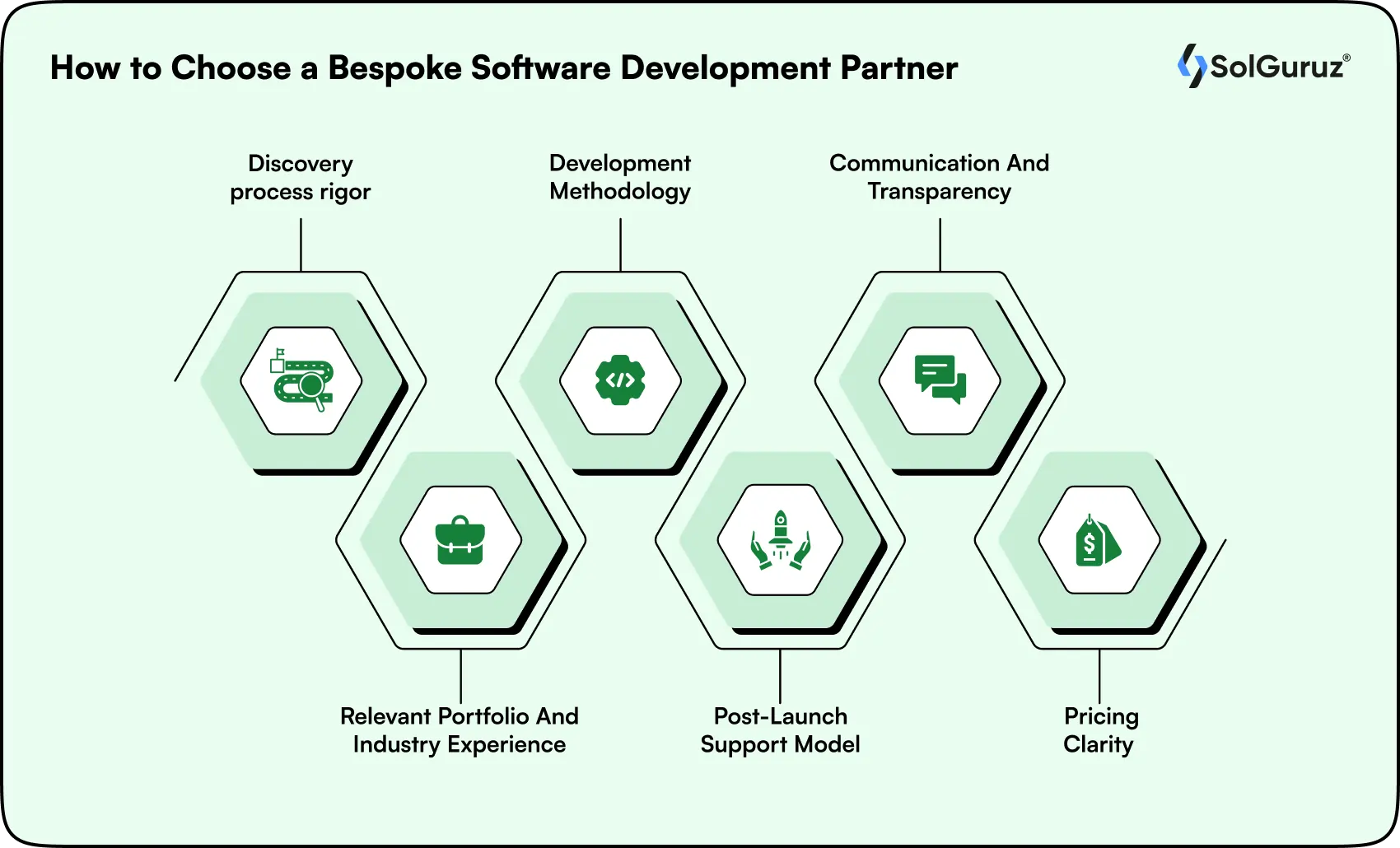
The partner you pick has more impact on success than the technology you choose. Here is what to evaluate:
1. Discovery process rigor.
Do they ask hard questions before writing any code? A good partner challenges your assumptions during discovery. If a vendor jumps straight to a quote without understanding your business, that is a red flag.
2. Relevant portfolio and industry experience.
Look for case studies in your industry or with similar technical complexity. Ask to speak with past clients.
3. Development methodology.
Agile with regular sprint demos means you see progress and can course-correct early. Make sure the team offers MVP development services so you can validate your idea before committing to a full build. Waterfall means you wait months and hope it turns out right.
4. Post-launch support model.
How do they handle bugs after deployment? What does ongoing maintenance look like? Get this in writing before you sign.
5. Communication and transparency.
Weekly standups, shared project boards (Jira, Asana, etc.), and clear escalation paths. You should never have to wonder what your dev team is working on.
6. Pricing clarity.
Milestone-based payments tied to deliverables protect both sides. Avoid vendors who want large upfront payments before showing any working software.
Industries Where Bespoke Software Delivers the Most Value
Bespoke software works in any industry, but it delivers outsized returns in sectors with complex workflows, regulatory requirements, or unique competitive dynamics:
1. Healthcare:
Custom patient management systems, HIPAA-compliant data platforms, and telemedicine applications that integrate with existing hospital systems. Generic tools rarely handle the compliance and data sensitivity requirements of healthcare.
2. Finance and Fintech:
Trading platforms, risk assessment tools, and regulatory reporting systems that need to handle high transaction volumes with rock-solid security.
3. Logistics and Supply Chain:
Route optimization, warehouse management, and real-time tracking systems that connect with inventory, CRM, and billing platforms simultaneously.
4. Real Estate:
Property management platforms, CRM systems for agents, and tenant portals that handle everything from listings to lease management in one place.
5. Retail and E-commerce:
Custom inventory management, personalized recommendation engines, and omnichannel sales platforms that connect online and physical stores.
What Makes Bespoke Development Different in 2026
The bespoke software landscape has shifted significantly. Here is what is different now compared to even two years ago:
1. AI and ML integration is becoming standard.
Businesses are building predictive analytics, intelligent automation, and personalized user experiences directly into their custom software. This is not a future trend. It is happening now.
2. Cloud-native architecture is the default.
Modern bespoke software is built on cloud infrastructure from day one, making it easier to scale, deploy, and maintain.
3. Low-code and no-code platforms are changing the build-or-buy calculus.
For simpler use cases, these tools can cut development time significantly. But for complex, business-critical systems, full custom development still delivers the best results.
4. The hybrid approach is gaining ground.
Most modern businesses use a mix. Standard SaaS tools for commodity functions (email, accounting) and bespoke software as the connecting layer that makes everything work together. Bespoke software increasingly serves as middleware that integrates your various systems seamlessly.
How SolGuruz Approaches Bespoke Software Development
At SolGuruz, we have built custom software for startups launching their first product, growing businesses replacing outgrown tools, and enterprise teams modernizing legacy systems.
Our approach starts with understanding why you are building, not just what you are building. Every project begins with a deep discovery phase in which we map your workflows, challenge assumptions, and define success metrics before a single line of code is written.
We follow agile development with 2-week sprints, regular demos, and transparent communication. You see progress every two weeks and can adjust direction based on real feedback.
Our custom software development services cover the full spectrum: UI/UX design, mobile app development for iOS and Android, web application development, legacy app modernization, and ongoing maintenance and support.
And we stand behind our work. Every engagement starts with a 7-day risk-free trial so you can experience how our team works, communicates, and delivers before making any long-term commitment.
Conclusion
Bespoke software development in 2026 is not a luxury. It is a strategic decision that directly impacts your efficiency, competitive position, and long-term costs.
The process works when you follow a structured path: thorough discovery, smart planning, iterative development, rigorous testing, and ongoing support. The investment pays off when the problem you are solving is central to your business and when generic tools are holding you back.
Start by calculating what your current workarounds actually cost. If the number surprises you, it might be time to build something that fits.
FAQs
1. What is bespoke software development?
Bespoke software development is the process of designing and building custom software from scratch to meet the specific needs of a single business or organization. It differs from off-the-shelf software, which is pre-built for a broad audience.
2. How much does bespoke software cost in 2026?
Costs range from $50,000 to $100,000 for simple internal tools, $150,000 to $450,000 for mid-sized platforms, and $750,000 or more for enterprise-grade systems. Ongoing maintenance typically runs 15% to 25% of the initial build cost per year.
3. How long does it take to build bespoke software?
Timelines depend on scope and complexity. Simple tools take 2 to 4 months. Mid-sized systems take 4 to 9 months. Enterprise platforms can take 12 months or longer. Agile development with phased delivery means you get usable software within the first few sprints.
4. What is the difference between bespoke and custom software?
5. When should I choose bespoke over off-the-shelf?
Choose bespoke when the problem you are solving is a core competitive advantage, when generic tools require too many workarounds, when you need tight integration with existing systems, or when SaaS per-user pricing will become more expensive than building your own over 3 to 5 years.
6. Can bespoke software include AI features?
Yes. In 2026, AI and ML features like predictive analytics, intelligent automation, chatbots, and personalized recommendations are commonly built into custom software. This adds to development cost and timeline, but can deliver significant ROI through improved efficiency and user experience.
7. Is bespoke software more secure than off-the-shelf?
It can be. Bespoke software allows you to implement security protocols specific to your industry and data requirements. Off-the-shelf software uses shared security models that may not address your specific risks. Custom security is particularly important in healthcare, finance, and government applications.
8. How do I find the right bespoke software development company?
Look for a partner with a strong discovery process, relevant industry experience, agile development methodology, clear post-launch support plans, and transparent pricing tied to milestones. Ask to see case studies and speak with past clients before signing.
From Insight to Action
Insights define intent. Execution defines results. Understand how we deliver with structure, collaborate through partnerships, and how our guidebooks help leaders make better product decisions.
 How we Work
Need Custom Software That Fits Your Business?
SolGuruz builds bespoke software around your workflows, your team, and your growth plans. No generic tools. No wasted features. Just software that works the way your business works.

Strict NDA

Trusted by Startups & Enterprises Worldwide

Flexible Engagement Models

1 Week Risk-Free Trial
Give us a call now!

+1 (724) 577-7737