

AI Agents in Healthcare: How They Work, Challenges, and Deployment
AI agents in healthcare are reshaping clinical and operational workflows by automating high-volume, repetitive tasks. This guide breaks down what AI agents actually do, real use cases, challenges, compliance risks, and how to deploy them safely without disrupting existing healthcare systems.

Summarise with AI


The irony is painful: healthcare collects more data than almost any industry.
Yet half the critical decisions are still delayed because people don’t have the time or tools to act on that data.
This is the gap AI agents are stepping into.
Not as chatbots.
Not as “assistants.”
But as autonomous workers who can handle routine clinical and administrative actions with zero drama and zero fatigue.
This is why AI agents are getting attention. It is not because they’re trendy, but because healthcare finally needs systems that do the work.
An AI agent doesn’t ask you to log in, review data, or export anything.
It observes what’s happening, decides what needs to be done, and executes.
This guide is for people who are done with buzzwords and want to understand the actual, operational value of AI agents in healthcare.
Table of Contents
What Are AI Agents and Why Are They Helpful in Healthcare?
If you’ve worked inside a hospital or even built for healthcare, you already know this: most “digital tools” don’t actually reduce work. They just reorganize it.
Dashboards expect you to interpret them. Workflows expect you to babysit them. “AI-powered” features expect you to still make the final call.
AI agents break this pattern completely.
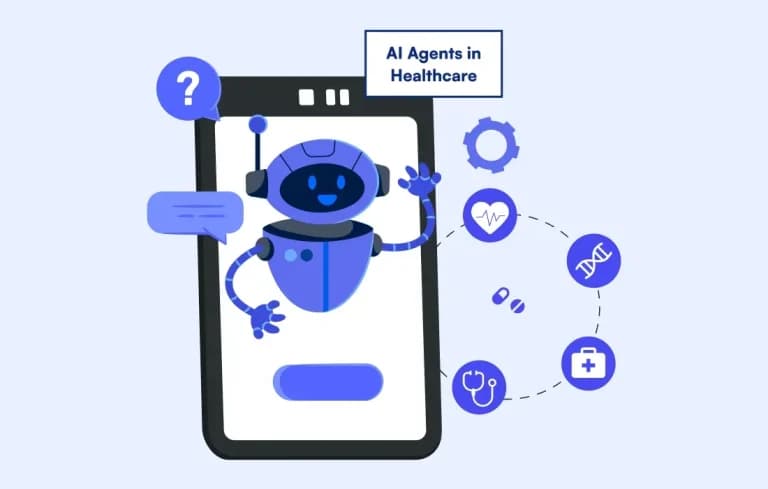
An AI agent is a system that can observe what’s happening, understand context, make decisions, and take action inside healthcare workflows, with or without a human stepping in.
It is like software workers who can handle the micro-tasks everyone hates, but the system depends on. The things that are too small to justify a full role, but too repetitive to ignore.
And here’s the truth, healthcare leaders don’t say out loud. The system isn’t failing because people are incompetent.
It’s failing because every workflow is built on manual steps, and the cost of “just adding more staff” is no longer sustainable.
AI agents help because they attack these hidden bottlenecks directly:
- They don’t get overwhelmed when volumes spike.
- They don’t forget protocol.
- They don’t introduce inconsistency.
- And they can operate across multiple systems faster than humans can switch tabs.
This doesn’t mean AI agents are risk-free. They require guardrails and clinical oversight.
But they finally offer something healthcare hasn’t had in decades: a way to scale operational output without scaling operational burden.
That’s why they matter. Not because they’re “the future of healthcare,” but because healthcare’s present desperately needs relief.
How Businesses Are Using AI Agents in Healthcare
Most healthcare organizations don’t adopt AI because they want to “innovate.”
They adopt it because something in their system is breaking.
AI agents are showing up as the first technology that can step directly into these failing workflows and do actual work.
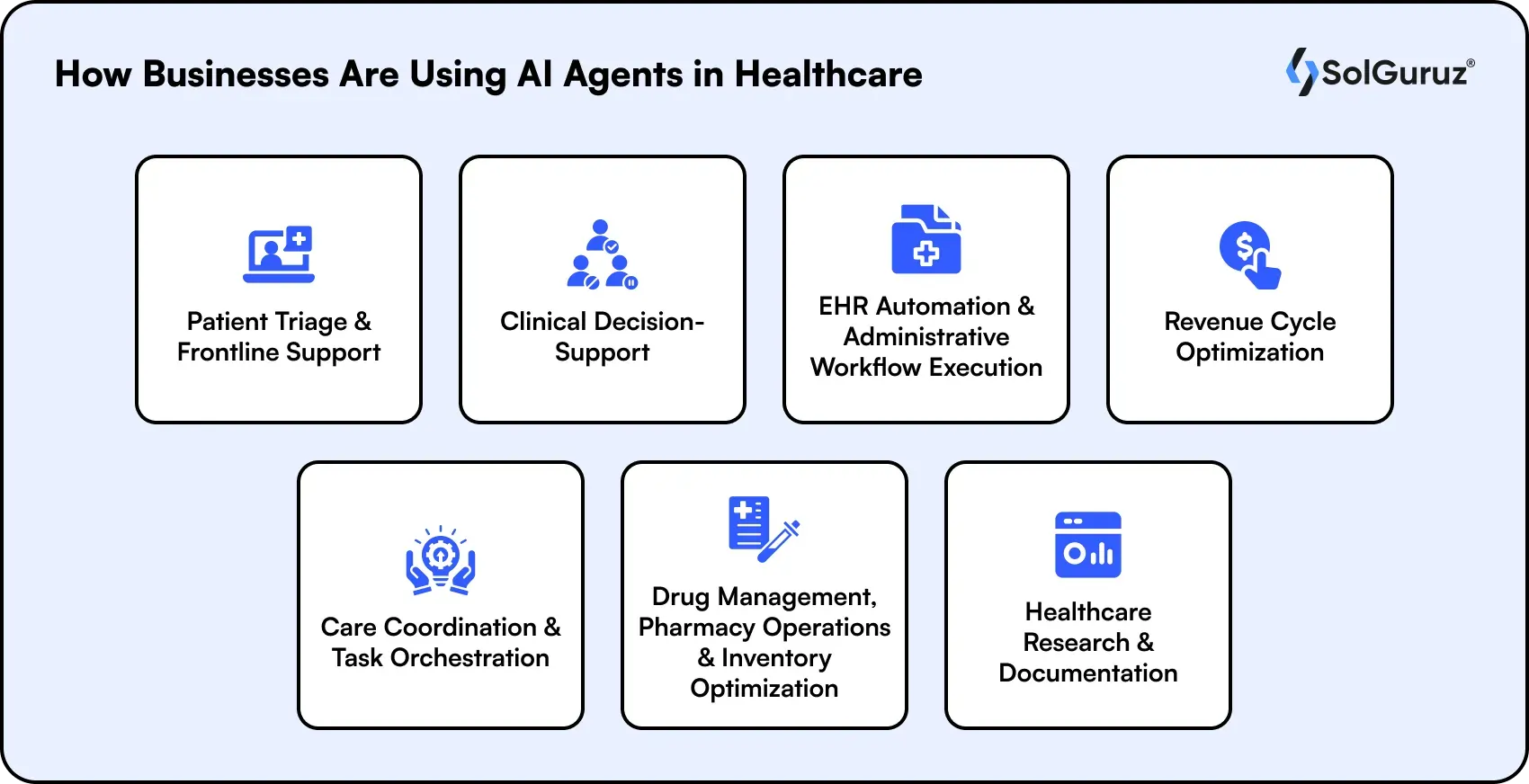
Here’s where they’re being used today, without the marketing gloss.
1. Patient Triage & Frontline Support (The Most Immediate Impact)
Hospitals are done drowning their staff in repetitive patient queries.
AI agents now handle:
- Symptom triage
- Souting to the right department
- Pre-visit questionnaires
- Automated follow-ups
- Medication reminders
The shift is subtle but powerful. Now, patients get faster responses. Clinicians stop wasting time on repetitive, low-complexity tasks every day.
2. Clinical Decision-Support (With Guardrails)
No, AI agents are not replacing clinicians.
But they are acting as intelligent assistants that gather information, surface relevant evidence, and recommend next steps.
They help with:
- Summarizing patient histories
- Retrieving guidelines or research
- Spotting potential risks or conflicts
- Suggesting diagnostic paths (with human approval)
Doctors don’t have time to scan every detail; agents fill that gap without slowing them down.
3. EHR Automation & Administrative Workflow Execution
This is where agents deliver ROI almost instantly. Everyone knows EHR work is a black hole for time and staff sanity.
Agents now:
- Update medical records
- Extract structured data
- Sync information across systems
- Place routine orders
- Trigger follow-up tasks
- Manage documentation workflows
In short, they remove the “EHR tax” that drags down every clinical encounter.
4. Revenue Cycle Optimization (The Quiet Money Saver)
If there’s one area where AI agents prove their worth fast, it’s RCM.
Health systems lose millions every year because of slow, manual bottlenecks.
Agents handle:
- Eligibility checks
- Coding support
- Claims creation
- Claims correction
- Denial management
- Payment reminders
This is the kind of automation that doesn’t just enhance productivity. It increases cash flow.
5. Care Coordination & Task Orchestration
Care coordination is a mess in most organizations. Too many handoffs, too many systems, too much confusion.
Agents improve this by:
- Assigning tasks to the right care teams
- Monitoring task completion
- Escalating delays
- Following up with patients
- Ensuring protocol compliance
They become the “always-on coordinator” humans shouldn’t be forced to be.
6. Drug Management, Pharmacy Operations & Inventory Optimization
Pharmacy teams are overstretched everywhere. AI agents now assist with:
- Prescription verification
- Drug interaction checks
- Locating alternative medications
- Automating refill reminders
- Tracking stock levels
This reduces errors (which is huge) and eliminates manual back-and-forth.
7. Healthcare Research & Documentation
Clinical researchers are using AI agents to:
- Scan datasets
- Summarize studies
- Generate structured insights
- Support trial documentation
- Help with regulatory paperwork
They don’t replace researchers. They remove 40% of the work that researchers hate doing.
Here’s a Common Pattern Across All Use Cases
AI agents don’t replace clinicians, admin teams, or support staff.
They replace the repetitive, low-context, time-draining tasks that stop those teams from doing the work they’re actually trained for.
That’s why adoption is growing. Not because AI is cool. Because healthcare is tired.
Challenges & Compliance You Should Know Before Using AI Agents in Healthcare
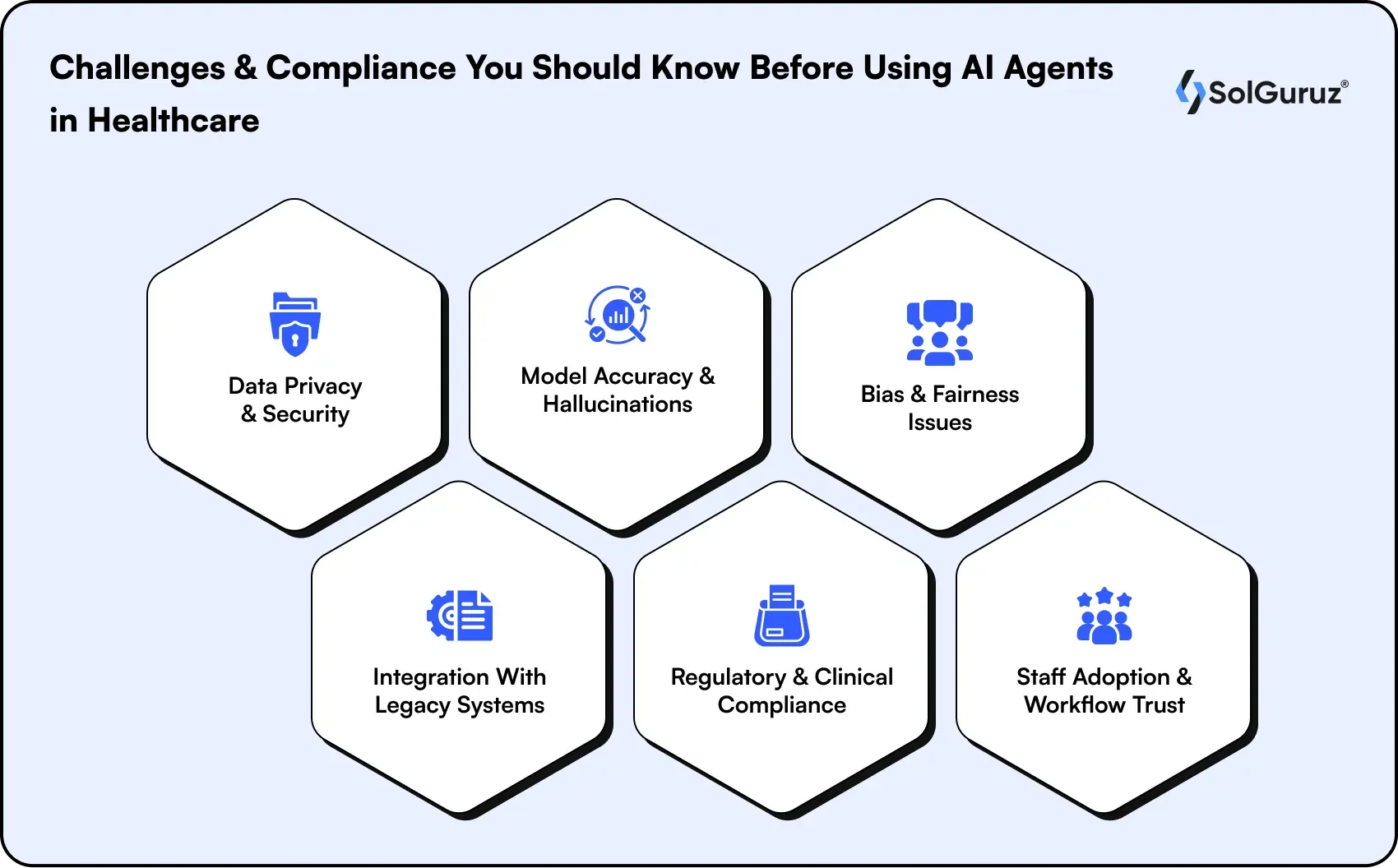
It’s easy to get excited about what AI agents can automate. That is, until you try deploying them inside a real healthcare environment.
The moment an agent touches patient data, integrates with an EHR, or influences a clinical workflow, the stakes change completely.
Healthcare doesn’t get the luxury of “move fast and break things.”
If anything breaks here, someone gets hurt.
That’s why this section matters more than every hype-filled AI announcement combined.
1. Data Privacy and Security
Healthcare loves to claim it’s “digitally advanced,” yet most systems fall apart the moment real data workflows are inspected.
AI agents amplify this reality. To do anything meaningful, agents need deep access to PHI. And that’s where the risk explodes.
If an agent reads more information than intended, store logs improperly.
The uncomfortable truth is this: unless you can map and control every single step of an agent’s data flow, you’re not deploying safely.
2. Model Accuracy and Hallucinations
In healthcare, an incorrect suggestion isn’t a UX bug; it’s a liability.
AI agents occasionally infer details that aren’t there or overconfidently offer wrong next steps.
That’s a problem when someone’s diagnosis, billing, or care pathway depends on it. Even “simple” administrative workflows can spiral when an agent automates a mistake at machine speed.
This is why serious deployments build guardrails first and features second.
Human oversight, strict task boundaries, and clear escalation rules aren’t nice-to-haves. They’re what prevent a technical experiment from becoming a clinical incident.
3. Bias and Fairness Issues
Everyone talks about AI bias. But in healthcare, it directly affects who is recommended for which treatment. And even get prioritized.
Most healthcare datasets carry decades of structural bias. And often, agents trained on them will quietly reproduce those patterns at scale.
The danger is in the subtlety: nothing breaks dramatically, but over time, the disparities grow. If you don’t have active bias monitoring and well-curated datasets, you’re automating inequality.
4. Integration With Legacy Systems
This is where most AI projects die. Hospitals run on a patchwork of legacy systems, outdated EHRs, and workflows held together by overworked staff improvising solutions.
AI agents don’t magically fix this. They collide with it.
The funny part? Building the agent is the easy part for healthcare developers. Making it survive inside a healthcare tech stack is the real test.
5. Regulatory and Clinical Compliance
The moment your agent even smells clinical decision-making, you enter a regulatory minefield.
HIPAA, GDPR, FDA SaMD classifications, and ISO frameworks are not gentle guidelines. They define exactly what your agent can do, how it logs actions, how it explains decisions, and how it’s audited.
Many teams assume compliance is paperwork. It isn’t. It’s architecture.
If you ignore it early, you’ll rebuild everything later under pressure, which is the worst way to ship anything in healthcare.
6. Staff Adoption and Workflow Trust
You can build the smartest AI agent in the world and still watch it fail because people simply don’t trust it.
Healthcare workers have lived through enough “digital transformations” that made their jobs harder, not easier.
If your agent feels like another black box shoved into their workflow, they’ll ignore it.
Adoption happens when staff understand what the agent does, what it doesn’t do, and who is accountable when something goes wrong.
Without that clarity, the agent becomes background noise. Or worse, a source of friction.
How to Implement AI Agents in Healthcare
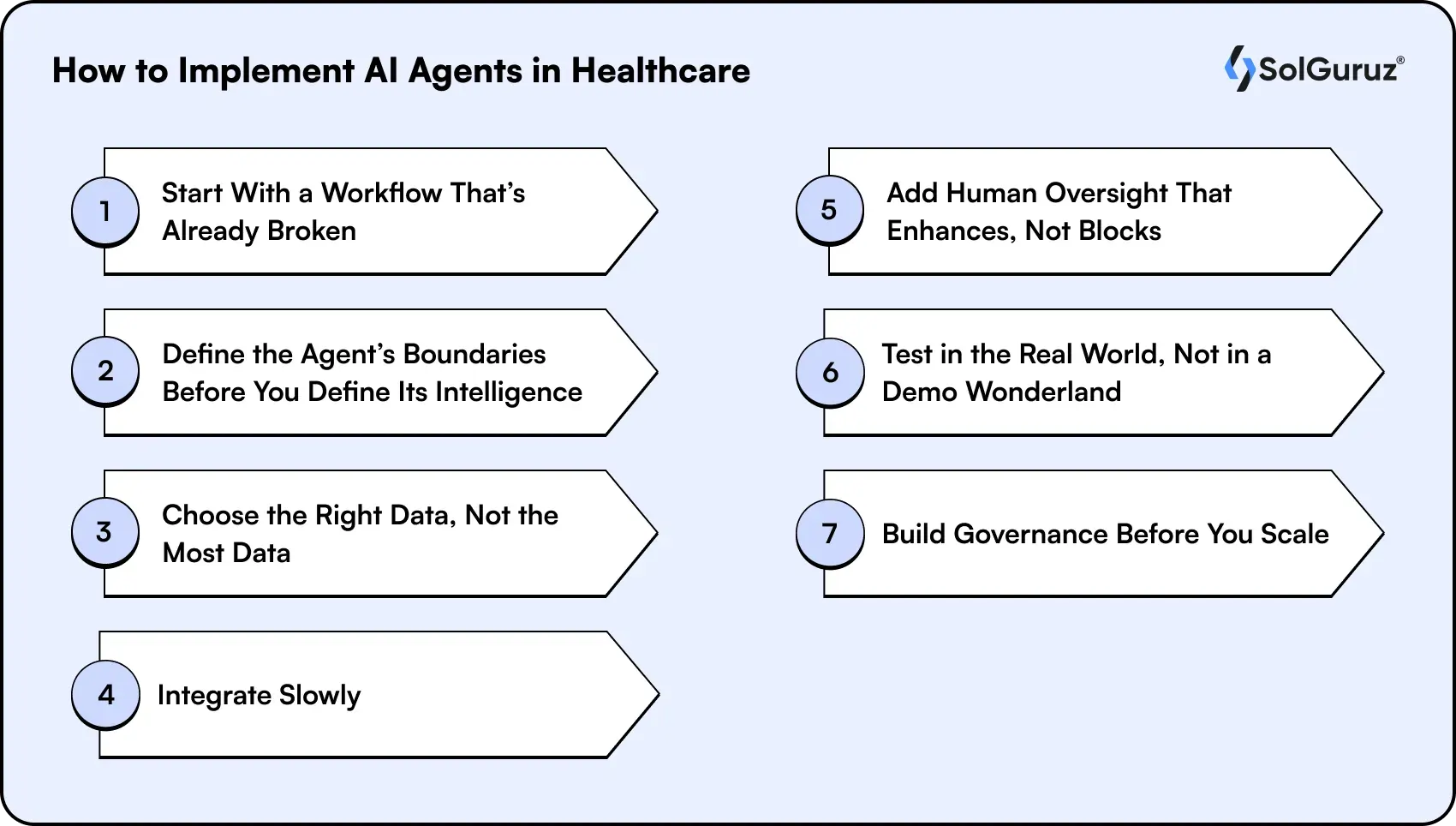
Alright, time for actionable insights and the workflow we follow when a client asks us to implement AI agents.
1. Start With a Workflow That’s Already Broken
Most AI failures in healthcare happen because teams try to “innovate” instead of solving a real operational problem.
Don’t start with the coolest use case. Start with the one that’s draining your staff, delaying patients, or eating your margins.
Identify a workflow where the outcome is predictable and the logic is clear.
If your team can’t describe how the workflow actually works, ain’t not ready for automation.
2. Define the Agent’s Boundaries Before You Define Its Intelligence
A mistake many teams make is letting the AI “do everything it seems capable of.” That’s exactly how you end up with hallucinations, unsafe actions, and regulatory headaches.
Instead, define strict boundaries:
- What can the agent see?
- What can it do?
- What must it escalate?
- What requires human approval?
You can think of it as a job description meets risk management. If you can’t articulate where the agent stops, the agent will eventually cross that line. And in healthcare, that costs you more than embarrassment.
3. Choose the Right Data, Not the Most Data
Healthcare has a bad habit of assuming “more data = better decisions.”
That’s not true for AI agents.
They don’t need oceans of EHR history to perform well. They need the right structured inputs tied to the task.
If you overload the agent with unnecessary PHI, it will increase risk.
Underloading it starves its reasoning. The sweet spot is giving it only the data it needs to complete the workflow without trying to recreate the entire patient record. Precision beats volume every time.
4. Integrate Slowly
This is where reality punches most teams in the face.
Instead of forcing a full integration upfront, run the agent in a constrained environment.
Let it read data before it writes. Let it simulate actions before executing them. Build wrappers that protect the agent from your legacy stack’s quirks.
At this point, you’re not just building AI. You’re building resilience around unstable infrastructure.
5. Add Human Oversight That Enhances, Not Blocks
Human-in-the-loop doesn’t mean dropping a clinician into a Slack channel and hoping they “monitor” the agent.
Good oversight is designed into the workflow. The agent should know exactly when to escalate and how to explain why they are asking for help.
By the way, you need to ensure that your team corrects edge cases. It will help you gradually increase trust in the system as it learns.
6. Test in the Real World, Not in a Demo Wonderland
Healthcare pilots fail because they’re tested in environments sanitized of real-world chaos.
You need real patient volumes, real messy data, real interruptions, and real EHR latency.
Agents behave differently when they meet the unpredictability of actual operations.
You don’t have to wait for a perfect model. Start small, fail safely. You refine gradually and expand only when you’ve proven the value.
7. Build Governance Before You Scale
Most teams scale prematurely. They deploy agents across departments without the guardrails to monitor behavior every day.
You need audit logs, drift detection, bias monitoring, and a clear way to trace any system action back to the agent or the human who approved it.
Quick Wrap-Up
AI agents are a practical response to a system that’s been overloaded for years.
The value comes from replacing the thousands of repetitive, low-context tasks that drain clinicians.
But they only work when implemented with clarity.
And for that, you need an experienced team that knows how to build the right thing.
If you need help with setting up the AI agents in your healthcare business, then get in touch with our team at SolGuruz.
FAQs
1. Are AI agents safe to use in healthcare?
They can be if you design them with strict boundaries and clinical oversight. An AI agent with no guardrails is unsafe. An agent with defined permissions, escalation triggers, and auditability is significantly safer than the manual workflows it replaces. Safety is not a feature; it's an implementation choice.
2. How much does it cost to implement AI agents?
Costs vary wildly depending on integration complexity, compliance requirements, and the workflows involved. The agent itself is rarely the expensive part. However, you can expect the cost to range from 8,000 to 25,000 USD, depending on complexity.
3. Do AI agents work with all EHR systems?
Technically yes, realistically no. Modern EHRs offer APIs, but many healthcare environments rely on older systems with limited integration support. Agents can still work, but you'll need connectors, wrappers, and safety layers. The EHR is usually the bottleneck, not the AI.
4. What's the biggest risk when deploying AI agents?
Letting the agent do more than it should. Overambitious autonomy creates blind spots and silent failures. The smartest teams deploy agents like junior staff: limited access at first, supervised, and gradually expanded as trust is earned.
5. How long does it take to see results?
Faster than most 'digital transformation' projects. If the workflow is well-defined and integrations are stable, you can see a measurable impact within weeks. The bottleneck is the organization's ability to clean up messy workflows and integrate responsibly.
6. Do healthcare regulators allow AI agents?
Yes, as long as you follow the rules. HIPAA, GDPR, FDA SaMD, ISO frameworks, and local health authorities don't block AI agents; they just restrict how much autonomy you can give them. Compliance shapes the agent's scope, not its potential.
7. What's the first workflow I should automate?
Choose the one that's painful, predictable, and expensive. Triage, revenue cycle tasks, care coordination, and EHR documentation are common starting points. If your staff is constantly patching a workflow manually, that's usually your best candidate.
From Insight to Action
Insights define intent. Execution defines results. Understand how we deliver with structure, collaborate through partnerships, and how our guidebooks help leaders make better product decisions.
 How we Work
Deploy Flawless AI Agents
Get experienced developers who know how to build and deliver on time.

Strict NDA

Trusted by Startups & Enterprises Worldwide

Flexible Engagement Models

1 Week Risk-Free Trial
Give us a call now!

+1 (724) 577-7737