

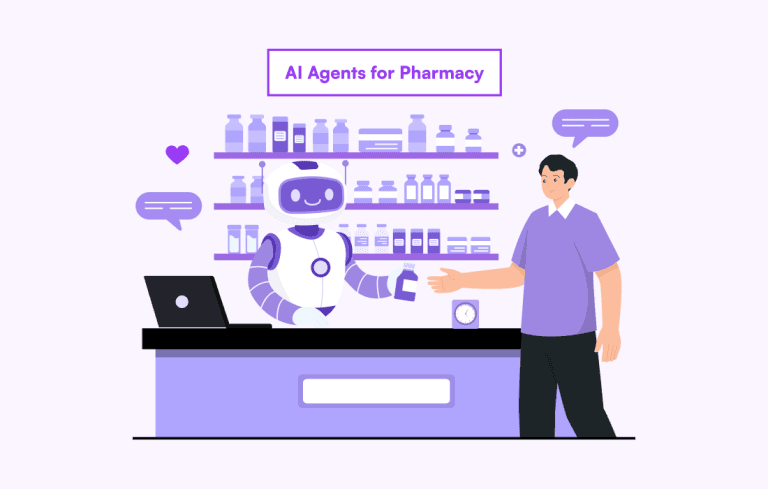
AI Agents for Pharmacy: Smarter Automation for Faster Medication Workflows
AI agents help pharmacies manage prescriptions, inventory, compliance, and patient communication more efficiently. By automating repetitive decisions and supporting pharmacists, these intelligent systems improve medication safety, operational efficiency, and patient experience across retail, hospital, and digital pharmacy environments.

Summarise with AI


Pharmacies have always made a place at the intersection of healthcare and operations.
Because they definitely deal with patients, doctors, insurers, suppliers, regulators, and inventory all at once during operations.
And yet, many pharmacies today still rely on fragmented systems, manual checks, phone calls, and overworked staff to keep things moving.
Now… this is exactly where AI agents for pharmacy are beginning to make a real difference.
Nope, I am not talking about any futuristic robots or experimental demos.
But quiet, intelligent software agents that handle repetitive decisions, monitor workflows, and support pharmacists so they can focus on what truly matters, patient safety and care.
Table of Contents
Decoding the Truth: Pharmacies are Under More Pressure Than Ever
Well, in 2026 and beyond, modern pharmacies are expected to do far more than dispense medicines.
They manage chronic care programs, handle online orders, coordinate with multiple clinic or hospital providers, ensure compliance, track inventory in real time, and respond to patients who expect Amazon-like convenience, all while avoiding even the smallest medication error.
This directly impacts strain in the day-to-day operations.
Pharmacists spend a large part of their day on tasks that don’t require clinical expertise: verifying data, chasing approvals, checking stock levels, responding to routine queries, and reconciling records across systems.
Well, practically, this is neither suitable nor safe.
AI agents will not act as any robots here, but yes, they will definitely eat up all the operational strains of the pharmacy stores.
What are AI Agents in a Pharmacy Context?

An AI agent is a software entity that can observe data, make decisions based on rules and learning models, take actions across systems, and continuously improve over time.
In a pharmacy, this means an agent that can:
- Monitor prescriptions as they arrive
- Flag anomalies or potential interactions
- Coordinate with inventory systems
- Trigger refills or reorder workflows
- Respond to routine patient questions
- Escalate only what truly needs human attention
Unlike traditional automation, AI agents are not limited to fixed scripts. They adapt based on context, historical patterns, and real-time inputs.
Think of them as digital pharmacy assistants that never get tired.
Where AI Agents Create the Most Impact in Pharmacies?
The value of AI agents becomes clear when you look at everyday pharmacy pain points.
In prescription processing, agents can automatically validate prescription data, cross-check drug interactions, verify dosage rules, and flag inconsistencies before a pharmacist even reviews the order. This reduces error risk while speeding up turnaround time.
In inventory management, AI agents continuously analyze demand patterns, seasonal trends, and supplier delays. Instead of reactive stock checks, pharmacies move to proactive replenishment. Stockouts drop. Expired medicines are reduced. Capital isn’t locked in excess inventory.
For patient communication, AI agents handle repetitive queries, such as order status, refill reminders, dosage instructions, and insurance coverage questions, via chat or voice interfaces. Patients get instant answers, while pharmacists regain time.
In compliance-heavy environments, agents can monitor logs, audit trails, and regulatory rules in the background, alerting teams before issues escalate into violations.
The pharmacy still controls decisions. The AI agent handles the noise.
AI Agents in Digital Pharmacy Platforms
For companies building pharmacy software or digital pharmacy platforms, AI agents unlock an entirely new level of product intelligence.
Instead of static dashboards, platforms become adaptive systems.
An AI agent can guide pharmacists through complex workflows, suggest next-best actions, and learn from usage patterns across thousands of transactions. It can detect bottlenecks in fulfillment, predict delays, and automatically adjust processes.
For online and omnichannel pharmacies, AI agents coordinate among ordering systems, logistics providers, payment gateways, and customer support, reducing friction throughout the patient journey.
This is where AI agents move from “feature” to product backbone.
Platforms built this way don’t just scale better; they feel smarter to users.
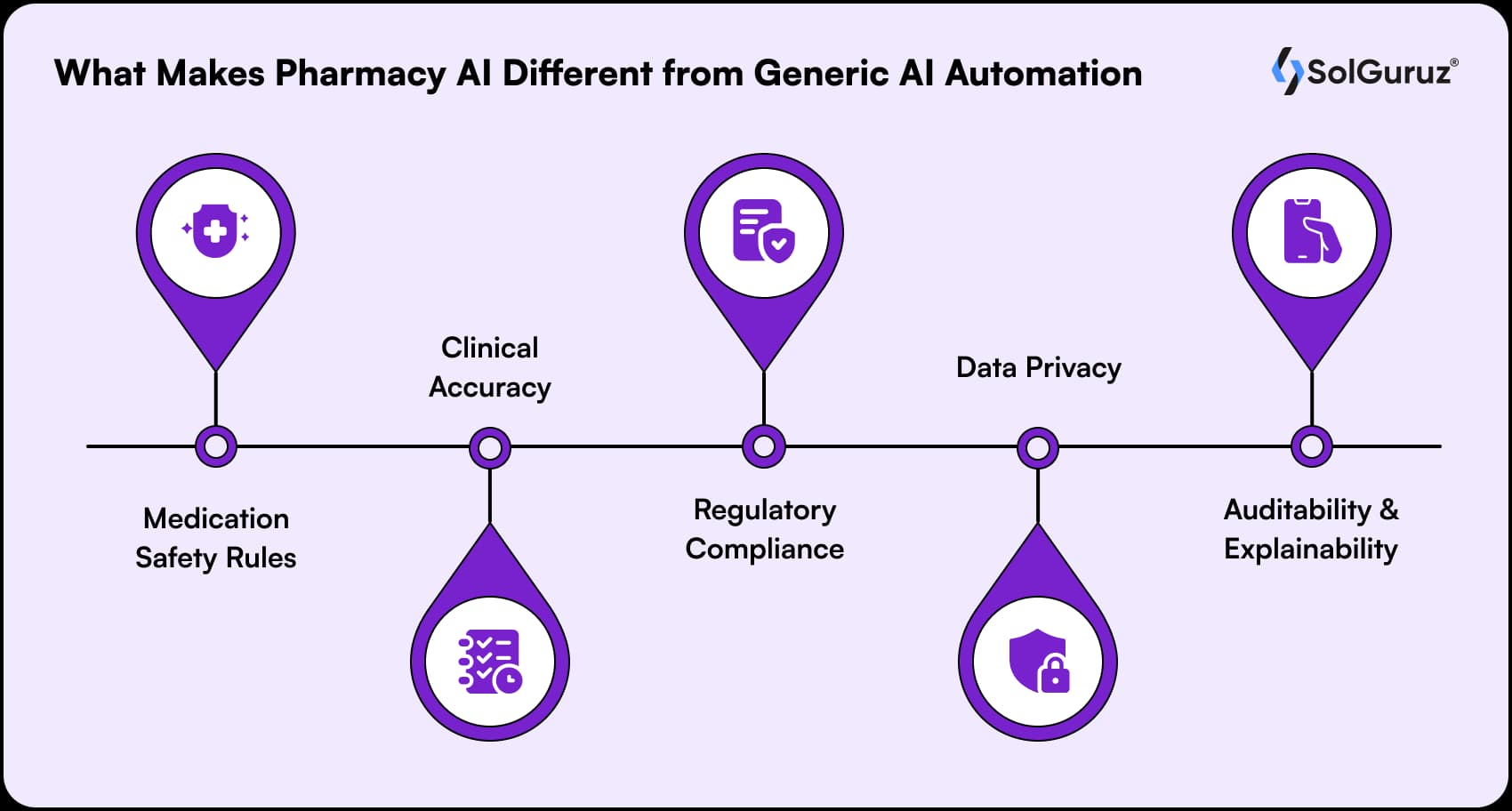
What Makes Pharmacy AI Different from Generic AI Automation
Healthcare is unforgiving.
Pharmacy even more so.
An AI agent in this space must operate within strict boundaries:
- Medication safety rules
- Clinical accuracy
- Regulatory compliance
- Data privacy (HIPAA, GDPR, NDHB, etc.)
- Auditability and explainability
This means AI agents for pharmacy are not black boxes.
They are carefully designed systems with:
- Human-in-the-loop decision points
- Transparent reasoning paths
- Fail-safe mechanisms
- Continuous monitoring
If……..
Done right, AI increases trust. Done poorly, it creates risk.
This is why pharmacy AI cannot be “plug-and-play.”
Common Misconceptions About AI Agents in Pharmacy
One common fear is that AI agents will replace pharmacists.
In reality, they replace interruptions, not professionals.
Another misconception is that AI agents require massive datasets to be useful. Many high-impact pharmacy use cases work well with structured operational data and rules-based intelligence enhanced by learning models.
There’s also the belief that AI agents are expensive and complex to maintain. In practice, when implemented incrementally, they often reduce operational costs far faster than expected.
The real risk isn’t adopting AI agents. It’s ignoring them while complexity continues to grow.
How Pharmacies Should Approach AI Agent Adoption?
The smartest pharmacies don’t start with technology. They start with workflow pain.
They ask:
- Where do errors occur most often?
- Which tasks consume time without adding clinical value?
- Where are patients waiting unnecessarily?
- Which processes break under scale?
AI agents are then introduced gradually, starting with low-risk, high-volume tasks and expanding as trust grows. This approach keeps disruption low and ROI visible.
How SolGuruz Builds AI Agents for Pharmacy
At SolGuruz, we approach AI agents as long-term operational assets, not quick demos.
Our work begins with understanding pharmacy workflows, such as retail, hospital, or digital, before writing a single line of code. We identify decision points, data flows, compliance needs, and user experience constraints.
From there, we design AI agents that integrate smoothly into existing systems, respect regulatory boundaries, and remain explainable to both pharmacists and auditors.
The goal is simple: AI that supports care, not complicates it.
Final Thoughts
Pharmacies don’t need more dashboards. They need fewer interruptions, fewer errors, and more time for care.
AI agents offer exactly that, not by changing what pharmacies stand for, but by quietly strengthening how they operate.
FAQS
1. What is the difference between AI agents and traditional pharmacy automation?
Traditional automation follows fixed rules. AI agents adapt, learn from data, and make context-aware decisions while still operating within defined safety limits.
2. Are AI agents safe for medication-related workflows?
Yes, when designed with human oversight, explainability, and compliance controls. AI agents assist decision-making rather than replacing clinical judgment.
3. Can small or independent pharmacies use AI agents?
Absolutely. Many AI agent use cases, like inventory optimization and patient communication, deliver strong ROI even for smaller pharmacies.
4. Do AI agents integrate with existing pharmacy systems?
Yes. AI agents are typically built to integrate with EHRs, pharmacy management systems, inventory tools, and digital platforms via secure APIs.
5. How long does it take to implement AI agents in a pharmacy?
Initial agents can often be deployed within a few months, depending on data readiness, system complexity, and compliance requirements.

Written by
Paresh Mayani
Paresh Mayani is the Co-Founder and CEO of SolGuruz, a global custom software development and product engineering company. With over 17+ years of experience in software development, architecture decisions, and technology consulting, he has worked across the full lifecycle of digital products, from early validation to large-scale production systems. He started his career as an Android developer and spent nearly a decade building real-world mobile applications before moving into product strategy, technical consulting, and delivery leadership roles. Paresh works directly with founders, scaleups, and enterprise teams where technology choices influence product viability, scalability, and long-term operational success. He partners closely with founders and cross-functional teams to take early ideas and turn them into scalable digital products. His work revolves around AI integration, agent-driven workflow automation, guiding product discovery, MVP validation, system design, and domain-specific software platforms across industries such as healthcare, fitness, and fintech. Instead of solely focusing on building features, Paresh helps organizations adopt technology in a way that fits business workflows, teams, and growth stages. Beyond delivery, Paresh is also an active tech community contributor and speaker, contributing to global developer ecosystems through Stack Overflow, technical talks, mentorship, and developer community (Google Developers Group Ahmedabad and FlutterFlow Developers Group Ahmedabad) initiatives. He holds more than 120,000 reputation points on Stack Overflow and is one of the top 10 contributors worldwide for the Android tag. His writing explores AI adoption, product engineering strategy, architecture planning, and practical lessons learned from real-world product execution.





From Insight to Action
Insights define intent. Execution defines results. Understand how we deliver with structure, collaborate through partnerships, and how our guidebooks help leaders make better product decisions.
 How we Work
Build Safe and Reliable AI Agents
From prescription workflows to digital pharmacy platforms, we design AI agents that improve accuracy, efficiency, & patient experience.

Strict NDA

Trusted by Startups & Enterprises Worldwide

Flexible Engagement Models

1 Week Risk-Free Trial