




What Are Multi-Agent Systems? A Complete Guide for Businesses in 2026
This blog explains multi-agent systems, how they work, key architectures, real-world use cases, and leading frameworks. It helps businesses understand how multiple AI agents collaborate to automate complex workflows and how SolGuruz builds scalable enterprise AI solutions.

Summarise with AI


Key Takeaway
|
The AI landscape has moved far beyond chatbots and single-model automation. Today, organizations across the USA, UK, and Australia are deploying multi-agent systems networks of specialized AI agents working together to complete tasks that no single model could tackle alone.
According to a 2025 McKinsey report, over 65% of enterprises that adopted agentic AI reported measurable gains in workflow efficiency within the first year. Gartner predicts that by 2027, more than 40% of enterprise AI deployments will involve multi-agent architectures.
Whether you are a CTO evaluating AI infrastructure, an engineering lead exploring LLM orchestration, or a business executive looking to automate complex operations, this guide breaks down everything you need to know about multi-agent systems in AI: what they are, how they work, their architecture types, real-world examples, limitations, and how to build one for your business.
1. What Is a Multi-Agent System (MAS)?
A multi-agent system (MAS) is a computational framework comprising multiple autonomous AI agents that interact within a shared environment to achieve individual or collective goals. Each agent perceives its surroundings, reasons over data, makes decisions, and takes actions independently or in coordination with other agents.
Unlike a single AI model that handles everything sequentially, a multi-agent system distributes tasks across specialized agents, enabling parallelism, redundancy, and deeper domain expertise within each sub-task.
| Definition A multi-agent system (MAS) is a network of autonomous, interacting AI agents situated in a shared environment, each equipped with its own reasoning capability, memory, and toolset, collaborating or competing to solve complex, multi-step problems at scale. |
Simple Example to Understand
Imagine an e-commerce company:
- One agent handles customer queries
- Another manages inventory
- One focuses on pricing optimization
- Another track fraud detection
Instead of one system doing all of these steps by step, these agents work in parallel, share information, and make faster, smarter decisions together.
The term "multi-agent" covers a wide spectrum, from two cooperating bots in a customer support pipeline to hundreds of specialized agents orchestrating a global supply chain.
Why Businesses & Enterprises Need a Multi-Agent System
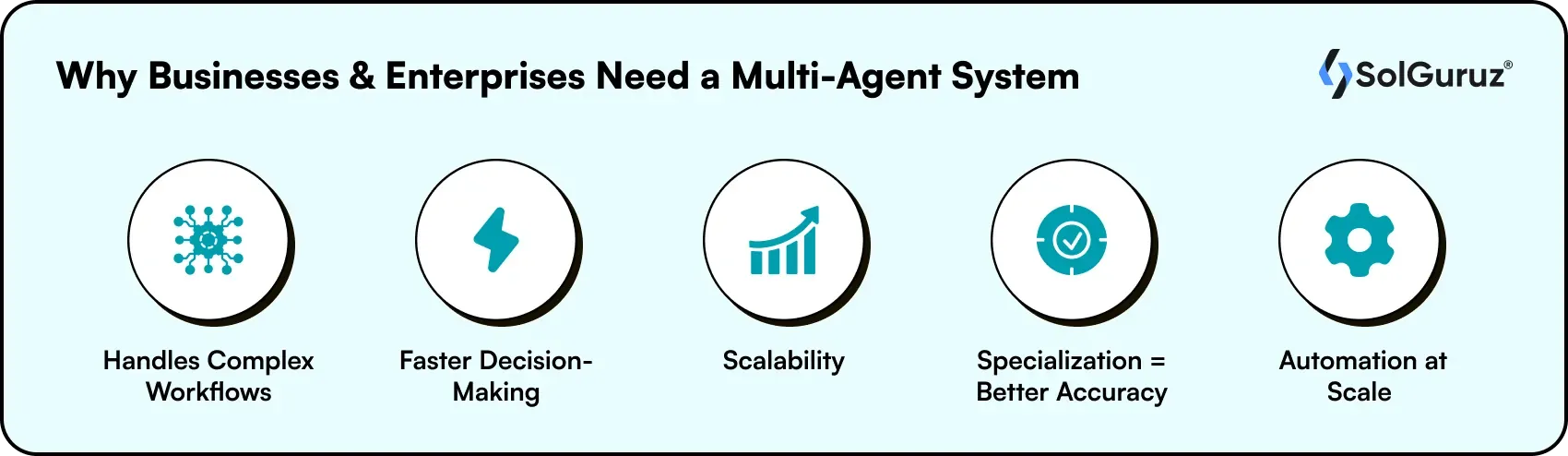
This is where MAS becomes powerful
1. Handles Complex Workflows
Modern business problems are not simple. They involve multiple steps, decisions, and data sources. MAS breaks these into manageable pieces.
2. Faster Decision-Making
Since agents work simultaneously, businesses get real-time responses instead of delays.
3. Scalability
You can add or remove agents as needed; there's no need to rebuild the entire system.
4. Specialization = Better Accuracy
Each agent is trained or designed for a specific task, leading to better outcomes than a general-purpose system.
5. Automation at Scale
From operations to customer service to analytics, MAS enables end-to-end automation without constant human intervention.
Think of MAS like a startup team:
- CEO → decision agent
- Developer → execution agent
- Analyst → data agent
- Support → communication agent
Individually smart, but together far more powerful.
2. Multi-Agent Systems vs. Single-Agent Systems
Understanding the difference between single-agent and multi-agent systems is crucial when planning custom AI development or deciding to hire AI/ML developers for scalable enterprise solutions.
| Dimension | Single-Agent System | Multi-Agent System (MAS) |
| Architecture | One agent, centralized control | Multiple agents, distributed control |
| Task Handling | Sequential, one task at a time | Parallel, concurrent task execution |
| Specialization | Generalist | Specialized agents per function |
| Scalability | Limited, bottleneck at a single model | Highly scalable, add agents as needed |
| Fault Tolerance | Single point of failure | Redundancy across agents |
| Best For | Simple, well-defined tasks | Complex, multi-step, enterprise workflows |
| Examples | GPT-4 answering a question | CrewAI is running a research + writing pipeline |
The choice is not always binary; many modern enterprise AI systems start with a single agent and evolve into multi-agent architectures as complexity grows.
Core Components of Multi-Agent Systems
Every multi-agent system is built on three foundational elements:
1. Agents
Agents are the autonomous decision-making entities within the system. Each agent has:
- A defined role and set of responsibilities (e.g., Researcher Agent, Coder Agent, Reviewer Agent)
- Perception capability: it reads inputs from its environment (text, data, API responses)
- Reasoning engine: typically a large language model (LLM) like GPT-4, Claude, or Gemini
- Memory: short-term (in-context) and optionally long-term (vector database)
- Tool access search, code execution, database queries, external APIs
2. Environment
The environment is the shared space where agents operate, perceive inputs, and exchange outputs. It can be:
- Virtual: a software pipeline, document workspace, or API network
- Physical: robotic systems, IoT devices, autonomous vehicles
- Hybrid: digital twin systems combining real-world data with virtual agents
3. Communication & Interaction Mechanisms
Agents need structured protocols to collaborate. Common interaction patterns include:
- Direct message passing: Agent A sends a structured message to Agent B
- Shared memory/state: agents read/write to a common data store
- Blackboard architecture: agents post and consume tasks from a shared task board
- Event-driven triggers: one agent's output fires the next agent's action
Modern frameworks like LangGraph, CrewAI, and AutoGen abstract this communication layer, letting developers focus on agent roles and workflows rather than low-level messaging.
How Do Multi-Agent Systems Work?
A multi-agent AI system follows a structured lifecycle for every task:
| Step | Phase | What Happens |
1 | Perception | Each agent monitors inputs user queries, database changes, API responses, sensor data |
2 | Reasoning | LLM-powered agents analyze the input, identify intent, and plan the next best action |
3 | Task Decomposition | An orchestrator agent (or planner) breaks the complex goal into sub-tasks and assigns them |
4 | Parallel Execution | Specialized agents execute their sub-tasks concurrently, dramatically reducing time-to-completion |
5 | Communication | Agents exchange results, pass context, request additional data, or escalate decisions |
6 | Aggregation | A synthesizer or final agent collects all sub-results and produces the consolidated output |
7 | Validation | Optional: a critic or review agent checks the output for accuracy, compliance, or policy violations |
This pipeline can be linear (sequential handoff), parallel (simultaneous execution), or graph-based (conditional branching depending on agent outputs).
Types of Multi-Agent Systems
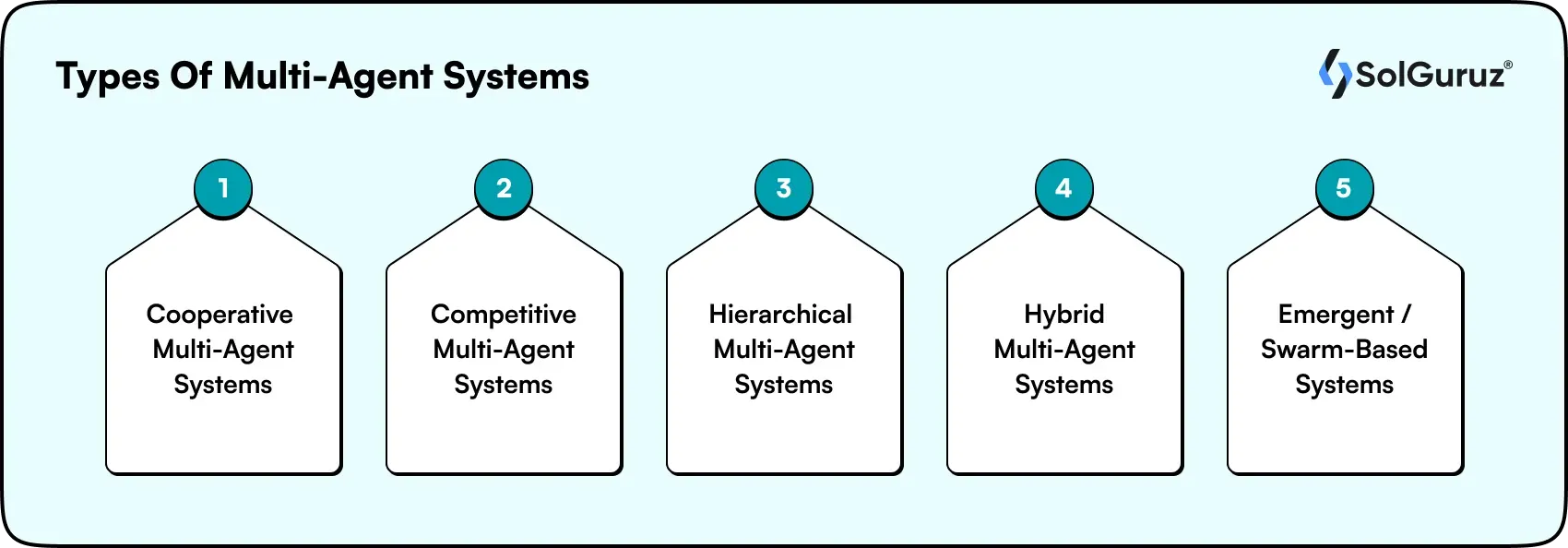
Not all multi-agent systems are built the same; modern AI agent development services use different architectures like cooperative, hierarchical, and agent orchestration models, depending on the use case.
1. Cooperative Multi-Agent Systems
Agents share a common goal and work together, pooling information and dividing labor. This is the most common model in enterprise AI automation.
Example: A content pipeline where one agent researches, another drafts, a third fact-checks, and a fourth formats output for publishing.
2. Competitive Multi-Agent Systems
Agents have individual goals and may compete for resources or outcomes. Common in simulations, game theory research, and financial modeling.
Example: Algorithmic trading platforms where multiple agents bid, hedge, and execute trades to maximize individual portfolio returns.
3. Hierarchical Multi-Agent Systems
A supervisor or orchestrator agent delegates tasks to sub-agents. The top-level agent maintains the goal; sub-agents handle execution.
Example: An enterprise project manager agent that assigns research, coding, testing, and documentation to specialized sub-agents.
4. Hybrid Multi-Agent Systems
Combines cooperative and competitive dynamics. Subgroups of agents cooperate internally while competing with other subgroups.
Example: Multi-cloud cost optimization agents; each cloud's agent cooperates internally but competes to offer the best resource allocation.
5. Emergent / Swarm-Based Systems
Simple rules governing individual agents produce complex collective behaviors, similar to ant colonies or bird flocking. Valuable for optimization, logistics routing, and distributed IoT management.
Example: Warehouse robot swarms that optimize pick-and-pack paths without centralized instruction.
Also read: Types of AI Agents
Multi-Agent Systems Trends [2026]
The multi-agent AI landscape is evolving rapidly. Here are the key trends shaping MAS development heading into 2026:
1. Agent-to-Agent (A2A) Protocols Standardization
Google's A2A protocol and Anthropic's Model Context Protocol (MCP) are gaining adoption as standards for how agents communicate across vendors and platforms. This enables multi-vendor MAS where agents from different providers interoperate seamlessly.
2. Agentic AI Moving from Pilots to Production
In 2024, most enterprise MAS deployments were experimental. In 2025/2026, Gartner reports that over 35% of Fortune 500 companies have at least one multi-agent system in production. The shift from POC to production is the defining trend.
3. Long-Context + Persistent Memory Agents
Models like Gemini 1.5 Pro (1M token context) and Claude 3.5 are enabling agents with dramatically longer memory horizons. Combined with vector database memory layers, agents can now maintain coherent context across days-long workflows.
4. Multi-Modal Multi-Agent Systems
Agents are no longer text-only. Multi-modal MAS can ingest images, PDFs, audio, and video, enabling use cases like automated insurance claim processing, medical imaging analysis, and multimedia content pipelines.
5. Relevance AI Limitations Multi-Agent Systems 2026
As MAS adoption grows, so does scrutiny of its limitations, particularly around reliability, auditability, and cost at scale. The multi-agent systems trends in 2026 point to a maturation phase: stronger guardrails, better tooling, and clearer ROI measurement frameworks.
Multi-Agent System Architecture Patterns
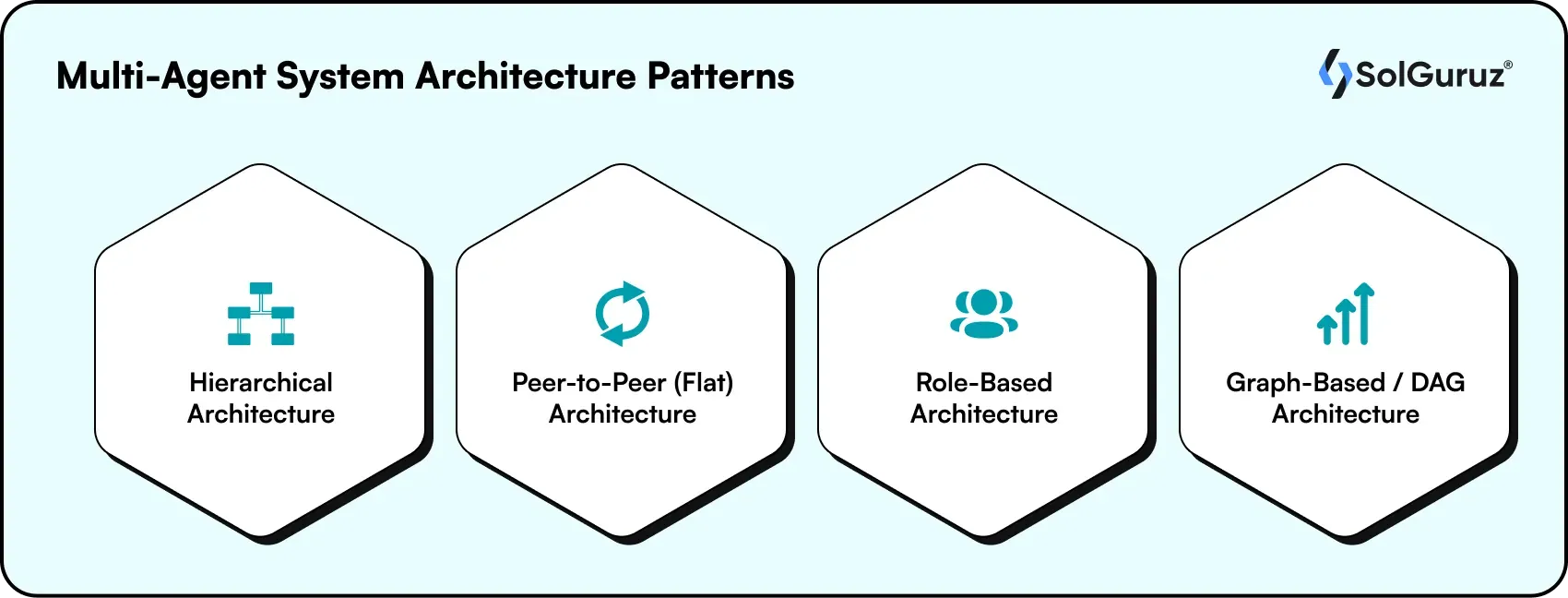
The architecture defines how agents are organized, how they communicate, and how tasks flow through the system. The three dominant patterns in 2025/2026 are:
Hierarchical Architecture
- A central orchestrator plans, delegates, and monitors
- Sub-agents execute discrete tasks and report back
- Best for: enterprise workflows with clear task boundaries (e.g., customer onboarding, report generation)
Peer-to-Peer (Flat) Architecture
- All agents operate at equal authority; no central controller
- Agents negotiate tasks directly using communication protocols
- Best for: decentralized systems, research pipelines, creative collaboration
Role-Based Architecture
- Agents are assigned static or dynamic roles (Planner, Executor, Critic, Memory Manager)
- Role assignment can shift based on task context
- Best for: complex enterprise use cases like legal document processing or multi-step data analysis
Graph-Based / DAG Architecture
- Tasks and agents are modeled as a Directed Acyclic Graph (DAG)
- Conditional routing outputs from one agent determine which agent runs next
- Used heavily in LangGraph and similar frameworks
- Best for: adaptive workflows with branching logic
At SolGuruz, our engineering team evaluates your business workflow complexity and selects the right architecture pattern before writing a single line of code, ensuring scalability from day one.
Multi-Agent Systems Examples in Real Life
Here are real-world multi-agent systems examples showing how enterprise AI automation and custom AI solutions deliver measurable business impact.
Example 1: Autonomous Customer Support (E-Commerce)
A US-based e-commerce company (Minimal AI) deployed a 4-agent system:
- The Intent Classifier Agent breaks queries into tasks like returns, shipping, or refunds.
- Order Lookup Agent fetches policies, order data, and FAQs from internal systems.
- Resolution Agent generates responses and performs actions like refunds or updates.
- Escalation Agent sends complex cases to humans, keeping only ~10% queries manual.
Result: 72% reduction in first-response time; 45% drop in tickets escalated to human agents.
Example 2: AI-Powered Financial Research (FinTech, USA)
A major US investment bank, JPMorgan Chase, has built a multi‑agent AI system to automate investment‑research workflows for thousands of financial products.
- Supervisor Agent breaks analyst queries into tasks like screening, metrics, and sentiment analysis.
- Data & Analysis Agents collect data from filings, markets, and news, then compute key financial metrics.
- Research Agent generates structured equity research reports with insights and commentary.
- Quality & Compliance Agent validates outputs and escalates high-risk cases to humans.
Result: Accuracy improved from ~50% to 90%+, and research time was reduced from hours to minutes.
Example 3: Clinical Documentation Automation (HealthTech, Australia)
An Australian‑based healthtech company, Medow Health, uses a multi‑agent AI approach to automate clinical documentation and medical reporting for doctors and specialists.
Their system can be framed as a multi‑agent pipeline
- Ambient-Transcription Agent converts consultations into structured clinical transcripts (with consent).
- Clinical-Reasoning Agent extracts diagnoses and creates ready-to-use medical notes and referrals.
- Billing & Workflow Agent aligns records with billing systems and speeds up coding processes.
- Compliance & Privacy Agent ensures approval and secure storage as per healthcare regulations.
Result: Medow Health reports that its AI‑scribe platform is already used in over 500 clinics across Australia, significantly reducing time‑on‑paperwork and improving documentation quality without compromising privacy.
Example 4: Supply Chain Intelligence (Manufacturing)
A mid‑market manufacturer in the US partnered with C3.ai to implement a multi‑agent AI system for supply‑chain intelligence across planning, production, and logistics.
The solution uses specialized agent roles, such as:
- Demand-Planning Agent analyzes sales and market data to forecast demand and set stock targets.
- Inventory-Optimization Agent balances stock across locations to prevent overstock or shortages.
- Logistics-Orchestration Agent optimizes shipment routes and adjusts for delays or constraints.
- Procurement & Risk Agent evaluates suppliers and automates purchase decisions within policy limits.
Result: 18% reduction in procurement costs; 25% improvement in on-time delivery rate.
Multi-Agent Systems in AI: Industry Use Cases
Multi-agent AI systems are already delivering measurable impact across industries by automating complex workflows, improving accuracy, and reducing operational costs at scale.
| Industry | Use Case | Business Impact |
| FinTech | Fraud detection, investment research, and regulatory reporting | Faster decisions, lower false-positive rates |
| HealthTech | Clinical documentation, drug interaction checking, and patient triage | Reduced admin burden, improved care quality |
| E-Commerce | Personalized recommendations, inventory management, returns automation | Higher conversion, lower COGS |
| Legal & Compliance | Contract review, policy extraction, due diligence automation | 80%+ time savings on document review |
| Enterprise SaaS | Customer onboarding, multi-step support, product analytics automation | Reduced churn, faster time-to-value |
| Manufacturing | Predictive maintenance, supply chain optimization, quality control | Lower downtime, better margins |
| Real Estate | Property valuation, lead qualification, document processing | Property valuation, lead qualification, document processing |
Why Do Multi-Agent LLM Systems Fail? (And How to Fix It)
This is one of the most searched questions among engineering teams actively building MAS: Why do multi-agent LLM systems fail? Here are the most common failure modes and how to mitigate them:
1. Context Window Overflow
- Problem: Agents lose critical information as conversations grow beyond LLM context limits.
- Fix: Implement structured memory management, use vector databases (Pinecone, Weaviate) for long-term retrieval and summarization agents for context compression.
2. Agent Hallucination Propagation
- Problem: One agent produces a hallucinated fact; downstream agents treat it as ground truth, compounding the error.
- Fix: Insert a Critic or Validation Agent between high-stakes agent steps; use retrieval-augmented generation (RAG) to ground agent outputs in verified data.
You might also like: How to Run LLM Locally
3. Uncontrolled Agent Loops
- Problem: Agents get stuck in recursive loops. Agent A asks Agent B, which asks Agent A again, consuming tokens and time indefinitely.
- Fix: Set maximum iteration limits; use graph-based routing (LangGraph) with explicit termination conditions.
4. Ambiguous Role Boundaries
- Problem: Two agents attempt the same task, producing conflicting outputs, or no agent claims ownership of a critical step.
- Fix: Define explicit system prompts with clear role boundaries; use a supervisor agent to manage handoffs.
5. Lack of Observability
- Problem: In production, it is impossible to debug why the system produced a particular output without trace-level visibility.
- Fix: Integrate AgentOps, LangSmith, or custom logging at every agent interaction. SolGuruz builds full observability pipelines as part of every multi-agent deployment.
How Multi-Agent Systems Improve Productivity
Research and enterprise case studies consistently show that multi-agent systems improve productivity across five key dimensions:
| Productivity Driver | How MAS Helps | Reported Improvement |
| Speed | Parallel task execution across multiple agents | Up to 10× faster than sequential processing |
| Accuracy | Specialized agents reduce generalist errors; critical agents catch mistakes | 35–60% reduction in output error |
| Scalability | Add agents to handle volume spikes without re-architecting | Linear scaling with agent count |
| Cost Efficiency | Automate high-volume repetitive tasks; reduce human-in-the-loop for routine work | 40–70% reduction in operational costs |
| Availability | Agents run 24/7 without fatigue or downtime (beyond infrastructure limits) | Near-100% operational uptime on standard cloud infra |
Top Multi-Agent AI Frameworks Compared
Choosing the right multi-agent systems framework is one of the most critical technical decisions. Here is how the leading frameworks compare in 2025/2026:
| Framework | Language | Architecture Style | Best For | Key Differentiator |
| CrewAI | Python | Role-Based, Hierarchical | Business workflows, content pipelines | Human-readable crew/role definitions; strong community |
| LangGraph | Python | Graph / DAG-Based | Complex branching logic, stateful agents | Fine-grained control over agent state and transitions |
| AutoGen (Microsoft) | Python | Conversational, Peer-to-Peer | R&D, code generation, multi-turn reasoning | LLM-native conversation loops; easy multi-model setup |
| LangChain Agents | Python / JS | Tool-Use, Sequential | RAG pipelines, tool-calling agents | Largest ecosystem of integrations and tools |
| Semantic Kernel | Python / C# / Java | Hierarchical, Plugin-Based | Enterprise .NET/Azure environments | Deep Microsoft/Azure integration; strong for enterprise |
| Google ADK / A2A | Python | Hierarchical + A2A Protocol | Google Cloud deployments, distributed MAS | Native A2A protocol; integrates with Gemini and Vertex AI |
SolGuruz engineers are proficient in all major multi-agent systems frameworks. We help you choose the right stack based on your existing infrastructure, team expertise, and long-term scalability requirements.
How to Build a Multi-Agent AI System with SolGuruz
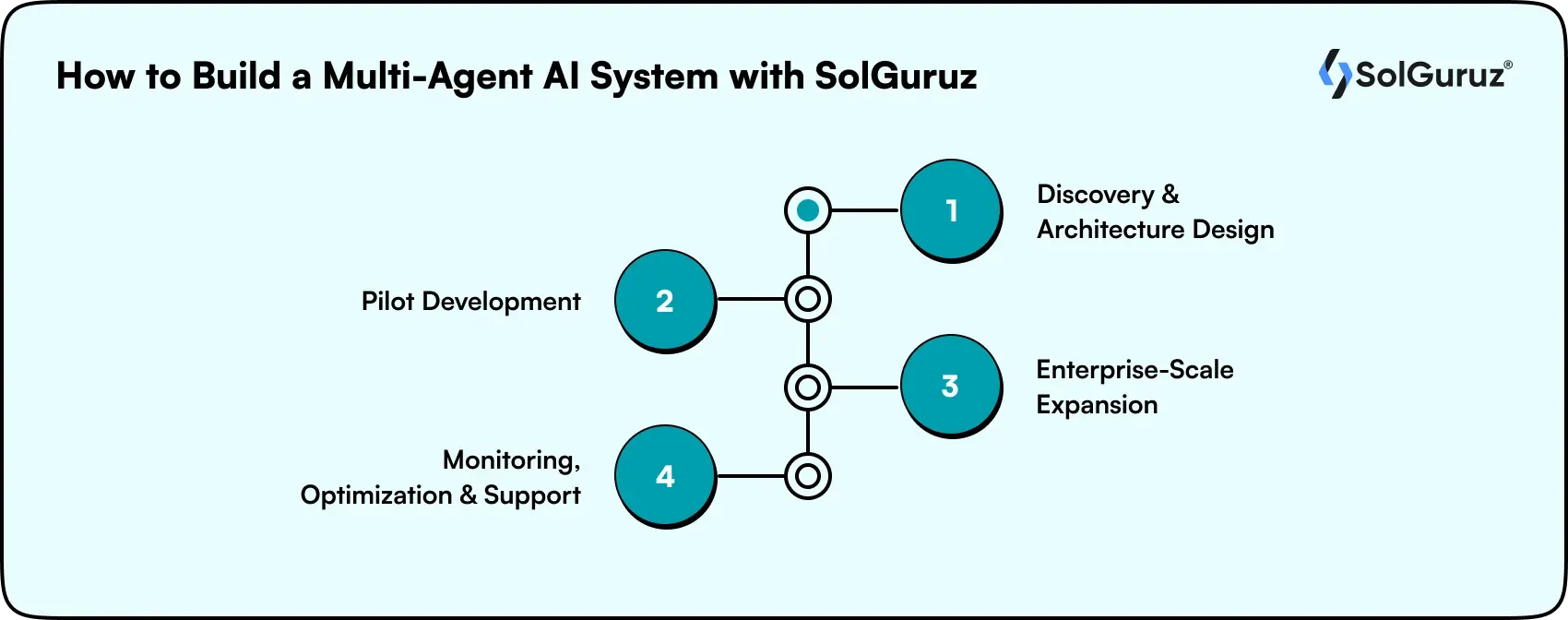
SolGuruz is a technology engineering company with a dedicated AI/ML practice helping enterprises across the USA, UK, and Australia design, build, and scale multi-agent AI systems. Here is our proven delivery framework:
Phase 1: Discovery & Architecture Design
- Map your existing workflows and identify automation opportunities
- Define agent roles, boundaries, and communication protocols
- Select the right framework and LLM backbone (OpenAI, Anthropic, Google, open-source)
- Design the memory layer, tool integrations, and observability stack
Phase 2: Pilot Development
- Build a focused 2–4 agent pilot targeting your highest-impact workflow
- Rapid iteration with weekly demos; engineering feedback loops built in
- Deliverable: a working, testable multi-agent system with baseline performance metrics
Phase 3: Enterprise-Scale Expansion
- Extend the pilot to full production scope with additional agents and integrations.
- Implement CI/CD pipelines for agent updates and model swaps
- Add compliance guardrails for regulated industries (HIPAA, GDPR, APRA CPS 234)
Phase 4: Monitoring, Optimization & Support
- Full AgentOps observability, trace every agent interaction in production
- Continuous performance tuning: latency, token efficiency, accuracy
- Dedicated SLA-backed support with SolGuruz engineers embedded in your team
Why SolGuruz for Multi-Agent AI Systems?
- 5+ years delivering production AI systems for enterprise clients in the US, UK & Australia
- Deep expertise across CrewAI, LangGraph, AutoGen, LangChain, and Semantic Kernel
- Cross-domain experience: FinTech, HealthTech, E-Commerce, Legal, SaaS
- Compliance-aware builds: HIPAA (USA), GDPR (UK/EU), APRA (Australia)
- 80+ engineers available for full-cycle AI product development
- Transparent, milestone-based pricing, no lock-in, no surprises
Conclusion
Multi-agent systems represent a fundamental shift in how AI is deployed at the enterprise level. Rather than asking a single model to do everything, MAS distributes intelligence across specialized agents, achieving speed, accuracy, and scalability that no monolithic AI system can match.
For businesses in the USA, UK, and Australia looking to automate complex workflows, reduce operational overhead, and gain a genuine competitive advantage through AI, multi-agent systems are no longer optional; they are the infrastructure of intelligent enterprise operations.
SolGuruz engineers have the deep expertise, proven delivery framework, and cross-domain experience to take your multi-agent AI system from architecture to production. Whether you are starting with a focused pilot or need to re-architect an existing AI stack, we are the technology partner built for this challenge.
FAQs
1. What is a multi-agent system in simple terms?
A multi-agent system is a group of AI programs (agents) that each handle specific tasks and work together like a team of specialists to complete a complex goal that a single AI could not handle efficiently on its own.
2. What are multi-agent AI systems used for?
Multi-agent AI systems are used across industries for workflow automation, customer service, financial research, clinical documentation, supply chain management, software development, legal document review, and much more. Any complex, multi-step process is a candidate for MAS.
3. What is the difference between multi-agent systems and single-agent AI?
Single-agent AI uses one model that handles tasks sequentially. Multi-agent systems use multiple specialized agents working in parallel, making them faster, more accurate, and more scalable for complex business workflows.
4. What are the best multi-agent systems frameworks in Python?
The leading multi-agent systems Python frameworks in 2025/2026 include CrewAI, LangGraph, AutoGen (Microsoft), and LangChain Agents. The best choice depends on your architecture needs, workflow complexity, and team expertise.
5. Why do multi-agent LLM systems fail?
Common reasons include context window overflow, hallucination propagation between agents, uncontrolled loops, ambiguous role boundaries, and lack of observability in production. These can all be mitigated with proper architecture, validation agents, and AgentOps tooling.
6. How long does it take to build a multi-agent AI system?
A focused pilot with 2–4 agents targeting a specific workflow can be built in 4–6 weeks. Full enterprise-scale systems with complex integrations typically take 3–6 months, depending on scope, data availability, and compliance requirements.
7. What is the cost of building a multi-agent AI system?
Costs vary widely based on scope, agent count, model selection, and infrastructure requirements. A well-scoped pilot can start at $15,000–$30,000 USD. Enterprise deployments range from $50,000 to $500,000+. SolGuruz provides transparent, milestone-based pricing tailored to your requirements.
8. Can multi-agent systems work with my existing software stack?
Yes. Modern multi-agent systems are designed to integrate with existing APIs, databases, CRMs, ERPs, and SaaS platforms. SolGuruz specializes in building MAS that plug into Salesforce, SAP, Shopify, AWS, Azure, Google Cloud, and custom enterprise infrastructure.
9. Are multi-agent systems compliant with GDPR and HIPAA?
Multi-agent systems can be architected to comply with GDPR (UK/EU), HIPAA (USA), and APRA CPS 234 (Australia). This requires careful data handling, access control, audit logging, and sometimes on-premise or private cloud deployment. SolGuruz has experience delivering compliance-aware MAS for regulated industries.
10. What industries benefit most from multi-agent AI systems in Australia?
Australian enterprises in HealthTech, FinTech, Resources & Mining, AgriTech, and Legal Services are among the fastest adopters. Compliance with APRA standards and the Australian Privacy Act is built into SolGuruz's delivery framework for Australian clients.
Looking for an AI Development Partner?
SolGuruz helps you build reliable, production-ready AI solutions - from LLM apps and AI agents to end-to-end AI product development.

Strict NDA

Trusted by Startups & Enterprises Worldwide

Flexible Engagement Models

1 Week Risk-Free Trial
Next-Gen AI Development Services
As a leading AI development agency, we build intelligent, scalable solutions - from LLM apps to AI agents and automation workflows. Our AI development services help modern businesses upgrade their products, streamline operations, and launch powerful AI-driven experiences faster.


Why SolGuruz Is the #1 AI Development Company?
Most teams can build AI features. We build AI that moves your business forward.
As a trusted AI development agency, we don’t just offer AI software development services. We combine strategy, engineering, and product thinking to deliver solutions that are practical, scalable, and aligned with real business outcomes - not just hype.
Why Global Brands Choose SolGuruz as Their AI Development Company:

Business - First Approach
We always begin by understanding what you're really trying to achieve, like automating any mundane task, improving decision-making processes, or personalizing user experiences. Whatever it is, we will make sure to build an AI solution that strictly meets your business goals and not just any latest technology.
Custom AI Development (No Templates, No Generic Models)
Every business is unique, and so is its workflow, data, and challenges. That's why we don't believe in using templates or ready-made models. Instead, what we do is design your AI solution from scratch, specifically for your needs, so that you get exactly what works for your business.
Fast Delivery With Proven Engineering Processes
We know your time matters. That's why we follow a solid, well-tested delivery process. Our developers follow AI-Assisted Software Development principles to move fast and stay flexible to make changes. Moreover, we always keep you posted at every step of the AI software development process.
Senior AI Engineers & Product Experts
When you work with us, you're teaming up with experienced AI engineers, data scientists, and designers who've delivered real results across industries. And they are not just technically strong but actually know how to turn complex ideas into working products that are clean, efficient, and user-friendly.
Transparent, Reliable, and Easy Collaboration
From day one, we keep clear expectations on timelines, take feedback positively, and share regular check-ins. So that you'll always know how we are progressing and how it's going.
Whether you’re modernizing a legacy system or launching a new AI-powered product, our AI engineers and product team help you design, develop, and deploy solutions that deliver real business value.

