




What Is AI Orchestration? A Complete Guide [2026]
AI orchestration is the process of coordinating multiple AI models, tools, agents, and data pipelines to work together seamlessly on complex, multi-step business tasks. In 2026, as AI adoption accelerates across enterprises, orchestration has become the critical layer between isolated AI experiments and scalable business transformation.

![What Is AI Orchestration? A Complete Guide [2026]](https://strapi.solz.me/uploads/what_is_ai_orchestration_b91e0568bf.svg)
Summarise with AI


Key Takeaway
|
Software teams in 2026 are not struggling to find AI tools. They are struggling to make those tools work together.
You may already be running a customer support AI, a document processing model, a demand forecasting system, and a code review assistant. But if none of them share context, pass tasks between systems, or adapt when something fails, you do not have a true AI strategy. You simply have a collection of disconnected tools.
That is exactly where AI agent orchestration comes in. Orchestration connects your AI models, tools, APIs, and data systems into coordinated workflows so they work together as one unified pipeline instead of running in isolation.
This guide covers everything you need to know about AI agent orchestration: how it works, the architecture patterns behind it, the best platforms and open-source frameworks available in 2026, real-world industry applications, and how to choose the right approach for your business.
What Is AI Orchestration?
AI orchestration is the coordination and management of multiple AI models, data pipelines, tools, APIs, and automated workflows so they function together as a unified, intelligent system.
Think of your AI systems as a team of specialized workers, one handles language processing, another retrieves data, a third processes documents, and another updates your CRM or analytics tools.
AI orchestration acts like an operations manager, deciding which system runs, in what order tasks happen, how data flows between components, and how errors are handled.
In simple terms, AI orchestration ensures the right system handles the right task at the right time, with the right context, and passes results smoothly to the next step.
Example: Customer Support Automation
When a customer sends a message, multiple AI systems work together to handle the request:
- Intent Detection Model – Identifies what the customer needs (refund, support, or order status).
- Knowledge Retrieval System – Finds relevant information from internal docs or databases.
- CRM Logging System – Records the interaction in the CRM.
- Escalation Workflow – Routes to a human agent if needed.
AI orchestration manages this entire flow, deciding the sequence, passing data between systems, and ensuring everything runs smoothly.
Simple Definition: AI orchestration connects all your AI tools so they work as one system. Instead of operating separately, they share data, hand off tasks, and complete workflows together, turning disconnected tools into a unified, intelligent solution. |
What Makes Something an AI Agent?
An AI agent is a software system that can perceive information from its environment, make decisions, and take actions using tools, APIs, or data sources to achieve a specific goal. In modern AI agent development, these agents are designed to handle complex workflows and interact with multiple systems autonomously.
Unlike a basic chatbot that simply responds to prompts, an AI agent can:
- Plan and execute multi-step tasks
- Interact with external tools, APIs, and databases
- Maintain memory across interactions
- Adapt its actions based on results or feedback
- Collaborate with other systems or agents to complete a workflow
What Makes Something Orchestration (Not Just Automation)?
Automation executes a fixed, predefined sequence. AI agent orchestration manages dynamic, adaptive workflows where tasks may be parallel, conditional, and interdependent. The distinction matters enormously at enterprise scale.
AI Orchestration vs. Workflow Automation: Key Differences
One of the most searched questions in 2026 is how AI orchestration differs from traditional workflow automation or Robotic Process Automation (RPA). While both aim to automate processes, they operate in fundamentally different ways.
| Dimension | Workflow Automation / RPA | AI Agent Orchestration |
| Decision Making | Follows predefined rules and scripts | Makes context-aware, dynamic decisions using AI models |
| Adaptability | Breaks when workflows or inputs change | Adjusts to new inputs, variations, and edge cases |
| System Coordination | Usually handles a single process per bot | Coordinates multiple AI models, tools, and services |
| Context Preservation | Limited context sharing between steps | Maintains shared context across the entire workflow |
| Failure Handling | Errors often require manual intervention | Can retry, reroute, or escalate automatically |
| Unstructured Data | Limited ability to process text, images, or voice | Handles text, PDFs, images, and speech natively |
| Governance | Primarily rule-based monitoring | Supports policies, audit trails, and human-in-the-loop |
AI agent orchestration does not replace workflow automation. In modern enterprise architectures, the two work together: orchestration handles tasks requiring reasoning and adaptability, while RPA manages structured, repetitive interactions with legacy systems.
Decision Guide: When to Choose Automation vs. Orchestration
Organizations often struggle to decide whether they need traditional workflow automation or a full AI agent orchestration system. The right choice depends on the complexity of the workflow, the type of data involved, and how much adaptability is required.
Choose Workflow Automation When:
- The process follows clear, fixed rules with predictable steps.
- Tasks involve structured data such as spreadsheets, CRM entries, or database records.
- There are a few system integrations and minimal decision-making required.
- The workflow rarely changes, and exceptions are minimal.
- The goal is to automate simple repetitive tasks like report generation, form processing, or email routing.
Example: Automatically moving data from a website form to a CRM and sending a confirmation email.
Choose AI Agent Orchestration When:
- The workflow involves multiple AI models or agents working together.
- Tasks require reasoning, decision-making, or contextual understanding.
- The process interacts with many tools, APIs, and data sources.
- The system must adapt dynamically when inputs or conditions change.
- You need failure recovery, monitoring, and governance for complex workflows.
Example: A customer support system where AI detects intent, retrieves knowledge base content, generates responses, updates the CRM, and escalates complex cases to human agents.
Quick Decision Framework: Automation OR Orchestration
| Scenario | Best Approach |
| Repetitive, rule-based workflows | Workflow Automation |
| Processes involving AI reasoning | AI Agent Orchestration |
| Simple integrations between apps | Workflow Automation |
| Multi-agent collaboration and tool usage | AI Agent Orchestration |
Why Single AI Agents Are Not Enough in 2026
A single AI model, no matter how advanced, cannot fully capture the complexity of real-world enterprise workflows. Models such as GPT-4, Claude, or Gemini are powerful at reasoning and generating content. However, they cannot independently access multiple business systems, enforce workflows, manage failures, and coordinate tasks across an entire technology stack.
| Problem | What Happens Without AI Agent Orchestration |
| Stale Data | Customer support agents answer using inventory data from yesterday because no real-time refresh triggers sync live data sources. |
| Lost Alerts | A document model flags a contract clause for legal review, but the alert disappears into an unmonitored Slack channel. |
| Doubled Token Costs | Redundant LLM calls across uncoordinated agents inflate expenses; optimizations can cut costs by 60%, implying high baseline waste. |
| Agent Collisions | Two agents attempt to write to the same database record simultaneously, silently corrupting data. |
| No Failure Recovery | If an AI task fails (document parsing or API timeout), the workflow stops without retries, fallback logic, or escalation. |
Insight: These challenges show why enterprises are moving beyond standalone AI tools toward coordinated systems. Without orchestration, even powerful models operate in isolation and create operational gaps. AI agent orchestration solves this by connecting models, tools, and workflows into a unified system.
How AI Orchestration Works: Step by Step
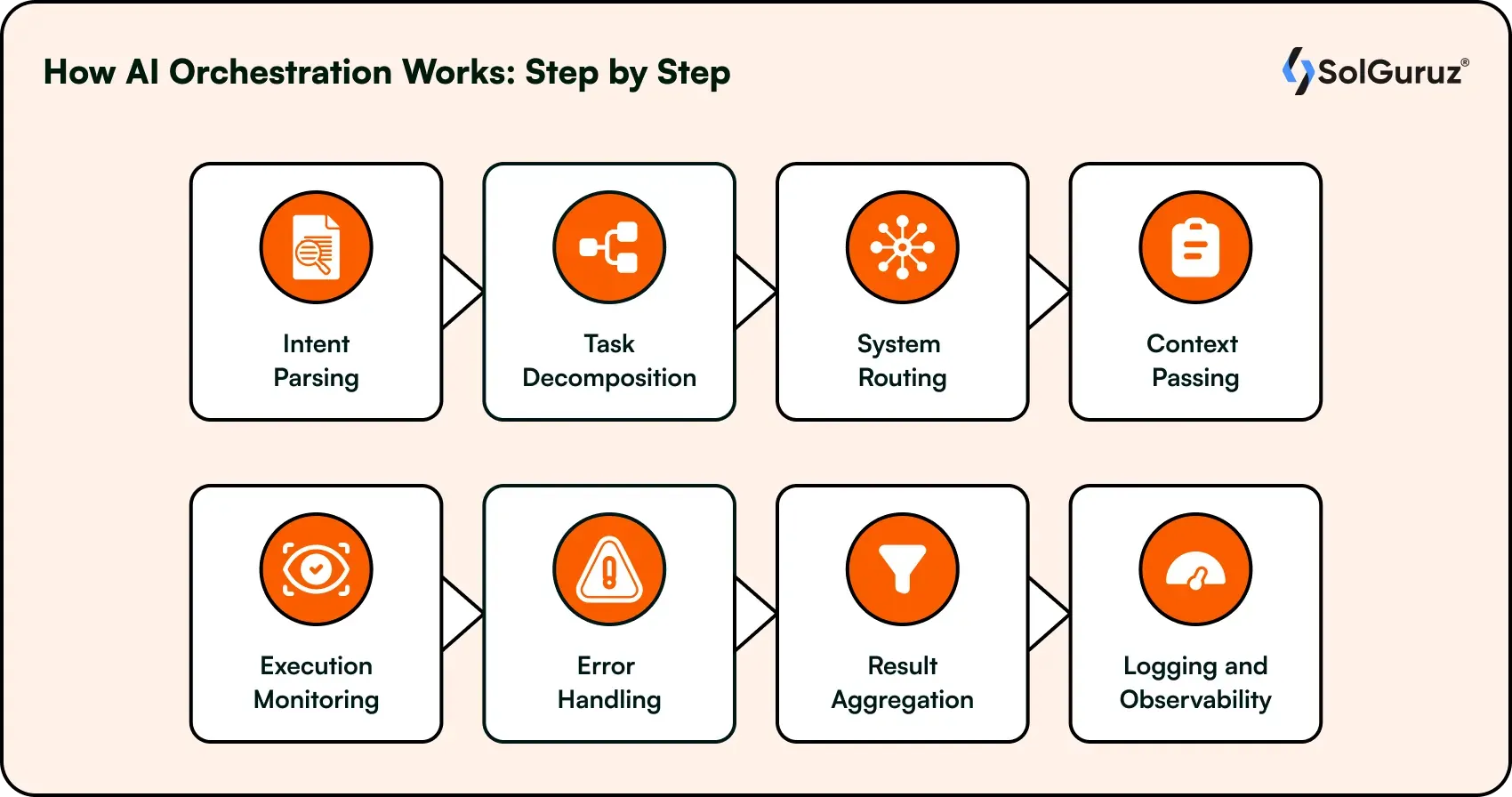
At the architectural level, AI agent orchestration follows a structured control flow that coordinates multiple AI models, tools, and systems to complete complex tasks.
Step 1 - Intent Parsing:
The orchestration layer receives a user request or system trigger and determines what action or workflow needs to be executed.
Step 2 - Task Decomposition:
The request is broken down into smaller tasks so different AI models or services can handle each part efficiently.
Step 3 - System Routing:
Each task is routed to the most appropriate AI model, tool, or service based on capability, availability, and priority.
Step 4 - Context Passing:
When one system finishes, the orchestration layer passes the output, along with relevant context, to the next component in the workflow.
Step 5 - Execution Monitoring:
The orchestrator tracks the progress of each step in real time, monitoring for failures, delays, or unexpected outputs.
Step 6 - Error Handling:
If a component fails, the orchestrator can retry the task, reroute it to another system, or escalate to a human operator.
Step 7 - Result Aggregation:
Outputs from all systems are combined to produce the final response or action.
Step 8 - Logging and Observability:
The platform records every step, creating a full audit trail of decisions, data usage, and system interactions.
Key Components of an AI Orchestration Layer
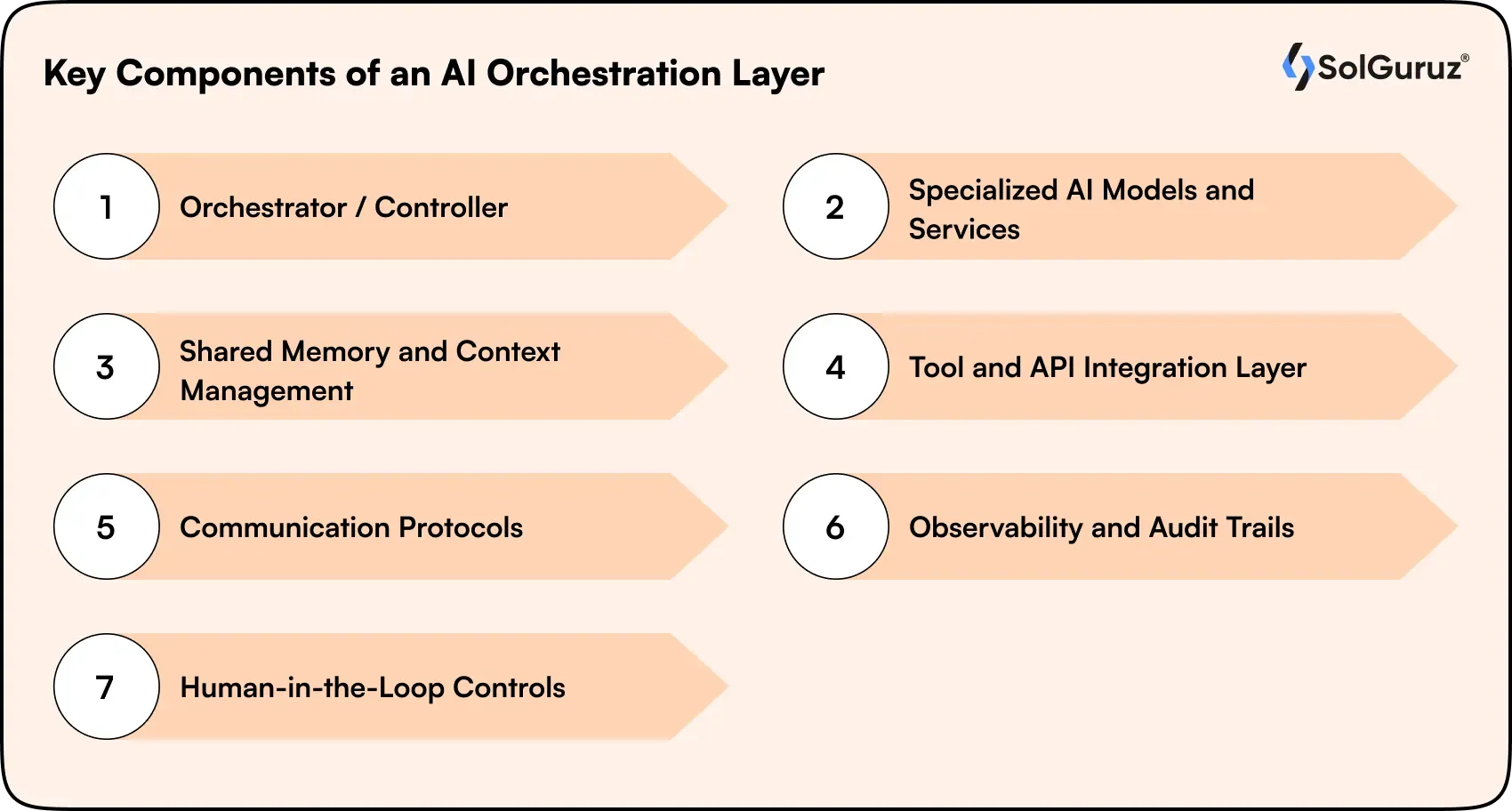
To successfully implement AI orchestration, organizations must build a structured architecture that coordinates multiple AI models, tools, and workflows. The following components form the foundation of a reliable orchestration layer.
1. Orchestrator / Controller
The orchestrator acts as the central control layer. It receives high-level goals, breaks them into smaller tasks, assigns those tasks to the appropriate AI models or services, manages the execution order, and handles failures.
2. Specialized AI Models and Services
AI orchestration systems rely on multiple specialized models, each designed to perform a specific task: generating natural language responses, retrieving data, performing classification, document processing, or executing code. In many enterprise systems, these models are optimized through prompt engineering services to improve accuracy, reliability, and task-specific performance.
3. Shared Memory and Context Management
Shared memory ensures that every component in the workflow has access to the same context and task history. Without centralized context management, systems may repeat tasks, miss information, or generate inconsistent outputs.
4. Tool and API Integration Layer
The integration layer connects AI workflows with external systems such as CRMs, ERPs, databases, payment platforms, cloud storage, and third-party APIs.
5. Communication Protocols
Communication protocols define how different AI systems exchange information reliably. Model Context Protocol (MCP), introduced by Anthropic, is emerging as the standard connectivity layer for tool and API integration in 2026.
6. Observability and Audit Trails
Production AI orchestration systems require detailed monitoring and logging. This visibility is essential for debugging, optimization, and regulatory compliance.
7. Human-in-the-Loop Controls
For high-impact or sensitive decisions, orchestration systems must know when to pause automation and involve human judgment.
Also read: What Are AI Agents
AI Orchestration Architecture Patterns
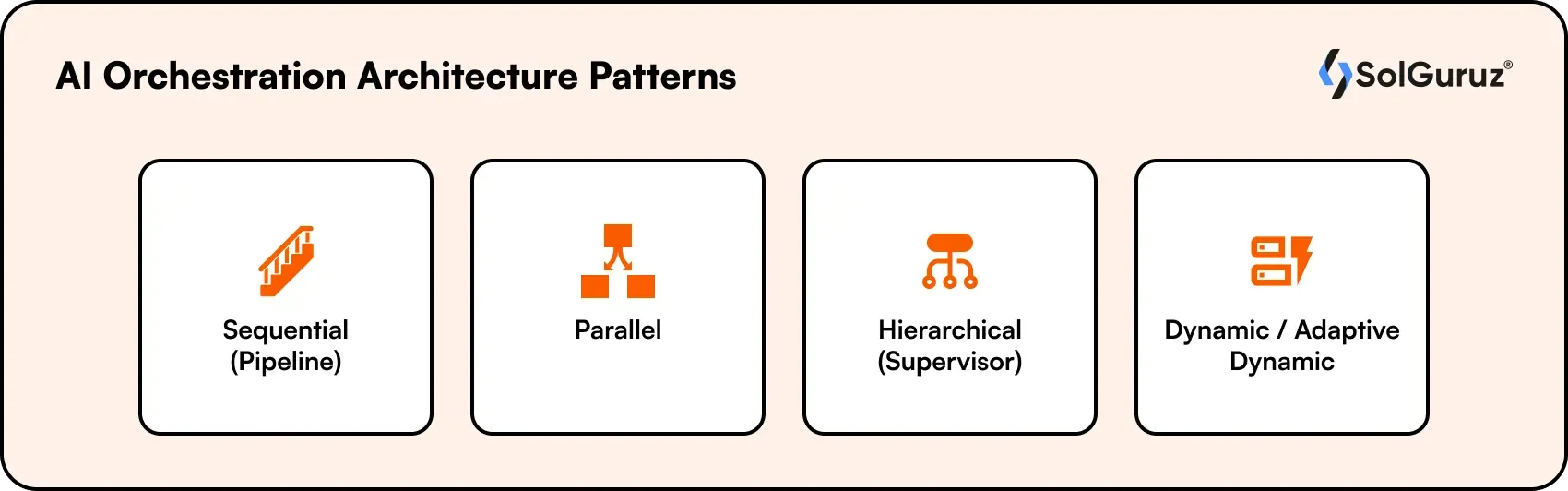
Before implementing AI orchestration, it is important to understand the common architecture patterns used to coordinate multiple AI systems effectively.
1. Sequential (Pipeline)
In a sequential architecture, tasks run step by step in a fixed order, where the output of one agent becomes the input for the next. This pattern works well for workflows like document processing, compliance checks, and data validation. However, because tasks execute one after another, overall speed can be slower for time-sensitive workflows.
2. Parallel
In a parallel architecture, multiple AI agents execute tasks simultaneously, allowing faster processing and analysis. It is commonly used for research workflows, large-scale data analysis, and report generation, where different agents gather insights from multiple sources. The main challenge is resolving conflicts when different agents produce overlapping or contradictory results.
3. Hierarchical (Supervisor)
The hierarchical pattern uses a supervisor agent to coordinate multiple specialized agents and manage task distribution. It is often used in enterprise environments where workflows span multiple departments or systems. While powerful, it requires clear task delegation and stronger system design to manage agent communication.
4. Dynamic / Adaptive
Dynamic orchestration allows the system to decide workflows in real time instead of following predefined steps. The orchestrator selects the right agents and tools based on the context of each request. This pattern powers advanced enterprise assistants and autonomous AI systems, but requires more complex infrastructure and governance.
| Pattern | Best For | Trade-Off |
| Sequential (Pipeline) | Document processing, compliance checks | Slower for time-sensitive workflows |
| Parallel | Research, data analysis, reporting | Requires conflict resolution logic |
| Hierarchical (Supervisor) | Enterprise multi-department workflows | More complex to design and maintain |
| Dynamic / Adaptive | General-purpose enterprise assistants | The highest infrastructure cost and complexity |
Key note: No single architecture pattern fits every AI system. Most enterprise AI solutions use a hybrid orchestration approach, combining sequential pipelines for structured workflows, parallel execution for speed, and hierarchical or dynamic patterns for complex decision-making. Choosing the right architecture depends on workflow complexity, scalability requirements, and system integrations.
AI Orchestration Open-Source: Best Frameworks in 2026
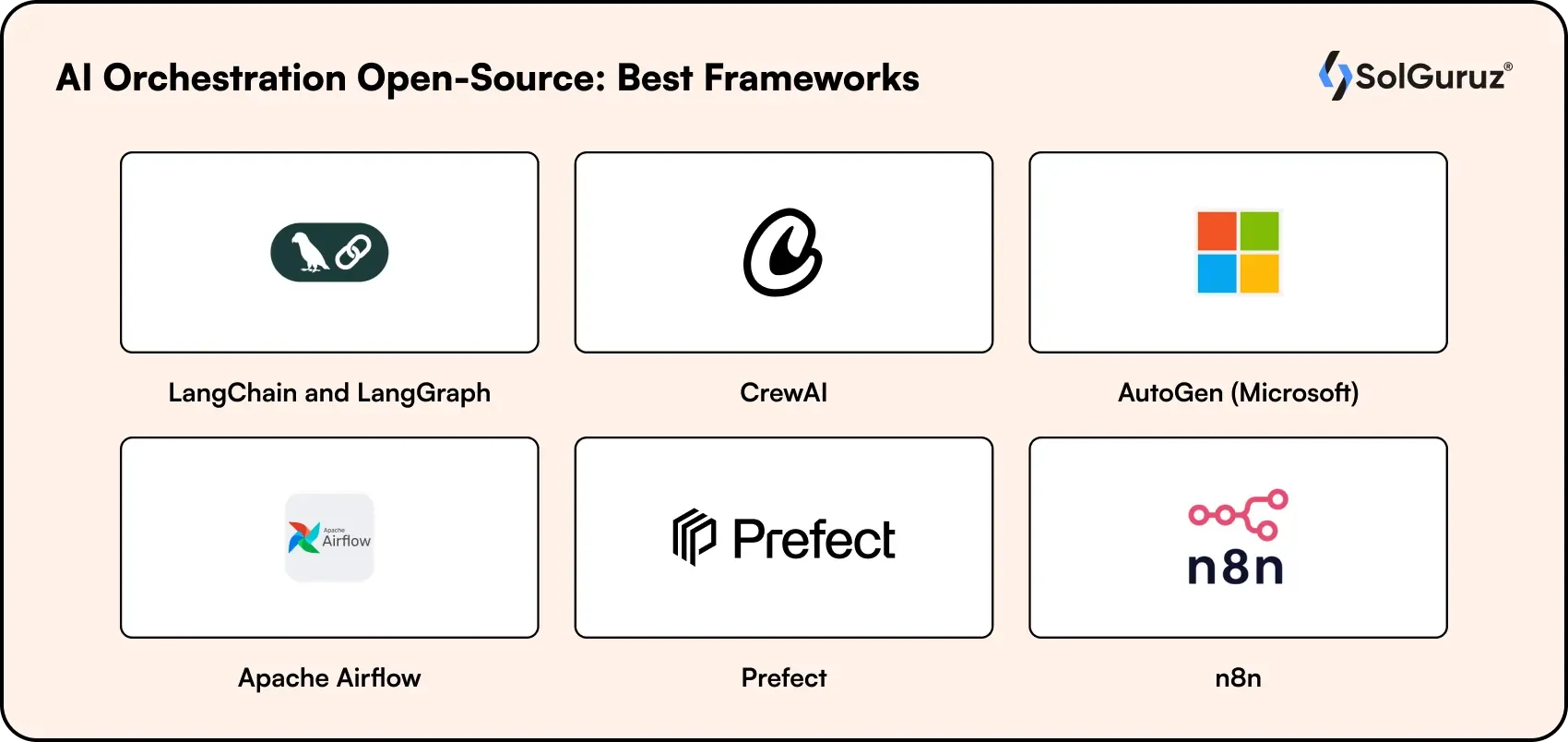
For teams that want full control over their orchestration infrastructure, open-source AI orchestration frameworks are the most widely adopted starting point. These tools are free to use, community-backed, and flexible enough to support everything from small prototypes to enterprise-scale production systems.
1. LangChain and LangGraph
LangChain remains one of the most widely adopted open-source AI orchestration frameworks for building AI-powered workflows and tool integrations. It supports Python and JavaScript, with 1,000+ integration possibilities including APIs, webhooks, and databases. LangGraph extends it with graph-based workflows, enabling complex conditional logic, loops, cycles, and persistent state management.
It is the strongest open, engineer-controlled option for predictable, auditable, and recoverable workflows.
- Best for: General-purpose AI pipelines, RAG workflows, chatbots
- Open source: Yes | GitHub stars: 90,000+
2. CrewAI
crewAI is a Python-based open-source AI orchestration framework for orchestrating role-playing autonomous AI agents into collaborative teams. It enables teams to define collaborative AI workflows where specialized components work together to complete multi-step tasks.
It also integrates with enterprise AI platforms such as IBM WatsonX.
- Best for: Role-based AI collaboration, research automation, content generation pipelines
- Open source: Yes
3. AutoGen (Microsoft)
AutoGen is an open-source framework from Microsoft that supports conversational workflows where multiple AI systems interact, review, and refine outputs collaboratively. It is particularly useful for software engineering workflows such as code generation, code review, and debugging automation.
- Best for: Code review and development workflows, multi-agent conversational systems
- Open source: Yes
4. Apache Airflow
Apache Airflow is the industry standard open-source platform for orchestrating complex data and AI workflows. It organizes workflows as Directed Acyclic Graphs (DAGs), making dependencies clear and execution transparent. Originally designed to manage data pipelines, it is now widely used to coordinate ML training jobs, AI model deployments, and retrieval-augmented generation (RAG) workflows.
- Best for: Data engineering and ML operations teams, scheduling and monitoring complex pipelines
- Open source: Yes | Pricing: Free
5. Prefect
Prefect is an open-source AI orchestration platform built around a hybrid architecture that separates control from execution. Its open-source core has over 18,000 GitHub stars, 372+ contributors, and 6 million monthly downloads as of early 2026. All AI workflows and data processing remain within your private infrastructure, ensuring sensitive workflow code, API keys, and training data never leave your network.
- Best for: Secure, private AI orchestration; data sovereignty requirements
- Open source: Yes (core) | Managed cloud available
6. n8n
n8n is an open-source workflow automation tool that empowers developers and small businesses to automate tasks and connect different apps and services. Its node-based interface simplifies connecting different services, and the platform's flexibility lets you modify and extend functionalities to adapt to evolving needs. n8n v2 now ships native MCP nodes.
- Best for: Open-source automation, custom workflows, no-restrictions environment
- Open source: Yes
| Framework | Type | Best For | Open Source |
| LangChain / LangGraph | AI workflow framework | General-purpose AI pipelines | Yes |
| crewAI | Multi-agent orchestration | Role-based AI collaboration | Yes |
| AutoGen (Microsoft) | Multi-agent system framework | Code review and dev workflows | Yes |
| Apache Airflow | Workflow orchestration | Data engineering and ML ops | Yes |
| Prefect | Hybrid orchestration platform | Secure, private AI workflows | Yes (core) |
| n8n | Workflow automation | Custom open-source automations | Yes |
| AWS Kiro | AI dev environment | Enterprise-regulated environments | No |
| IBM Watsonx Orchestrate | Enterprise orchestration platform | Large organizations, compliance | No |
| MCP (Anthropic) | Integration protocol | Connecting AI models with tools | Open Standard |
Best AI Orchestration Platform: How to Evaluate and Choose
With multiple options competing for attention in 2026, selecting the best AI orchestration platform for your organization requires evaluating five key criteria, not just feature lists. Many organizations also work with AI consulting partners to assess their infrastructure, workflow complexity, and long-term AI strategy before choosing a platform.
1. Team Size and Technical Expertise
Open-source frameworks like LangChain, crewAI, and Apache Airflow are well-suited for engineering teams with strong Python expertise and the capacity to manage infrastructure. Enterprise platforms like IBM Watsonx Orchestrate or AWS Kiro are better suited for larger organizations that need out-of-the-box governance, compliance controls, and vendor support.
2. Complexity of Your Workflows
For straightforward sequential pipelines, a lightweight framework such as LangChain is sufficient. If your workflows involve parallel execution, dynamic routing, or multi-department coordination, consider LangGraph or a hierarchical architecture with a dedicated supervisor layer.
3. Compliance and Regulatory Requirements
If your organization operates in regulated industries such as healthcare, financial services, or government, prioritize orchestration tools with built-in audit logging, role-based access controls, and data residency options. AWS Kiro and IBM Watsonx Orchestrate are purpose-built for these environments.
4. Integration with Existing Systems
Evaluate how well each platform connects with your current tech stack. Review available connectors for your CRM, ERP, databases, and cloud providers. MCP (Model Context Protocol) is becoming the standard integration layer and should be a strong consideration for teams building for long-term interoperability.
5. Total Cost of Ownership
Open-source frameworks are free to use but require engineering investment for setup, maintenance, and scaling. Enterprise platforms include licensing fees but reduce operational overhead. Factor in both direct costs and the engineering time needed to maintain the orchestration layer over time.
| Platform | Best For | Pricing Model | Open Source |
| LangChain / LangGraph | Developers, general-purpose | Free + LangSmith from $39/mo | Yes |
| Apache Airflow | Data and ML teams | Free (open-source) | Yes |
| crewAI | Role-based agent teams | Free | Yes |
| Prefect | Secure private workflows | Free core + cloud plans | Yes (core) |
| IBM Watsonx Orchestrate | Large enterprise | Custom enterprise pricing | No |
| AWS Kiro | Regulated enterprise teams | AWS pricing model | No |
| Zapier | No-code business teams | From $19.99/month | No |
| n8n | Developer automation | Free (self-hosted) | Yes |
Real-World Use Cases and Industry Applications
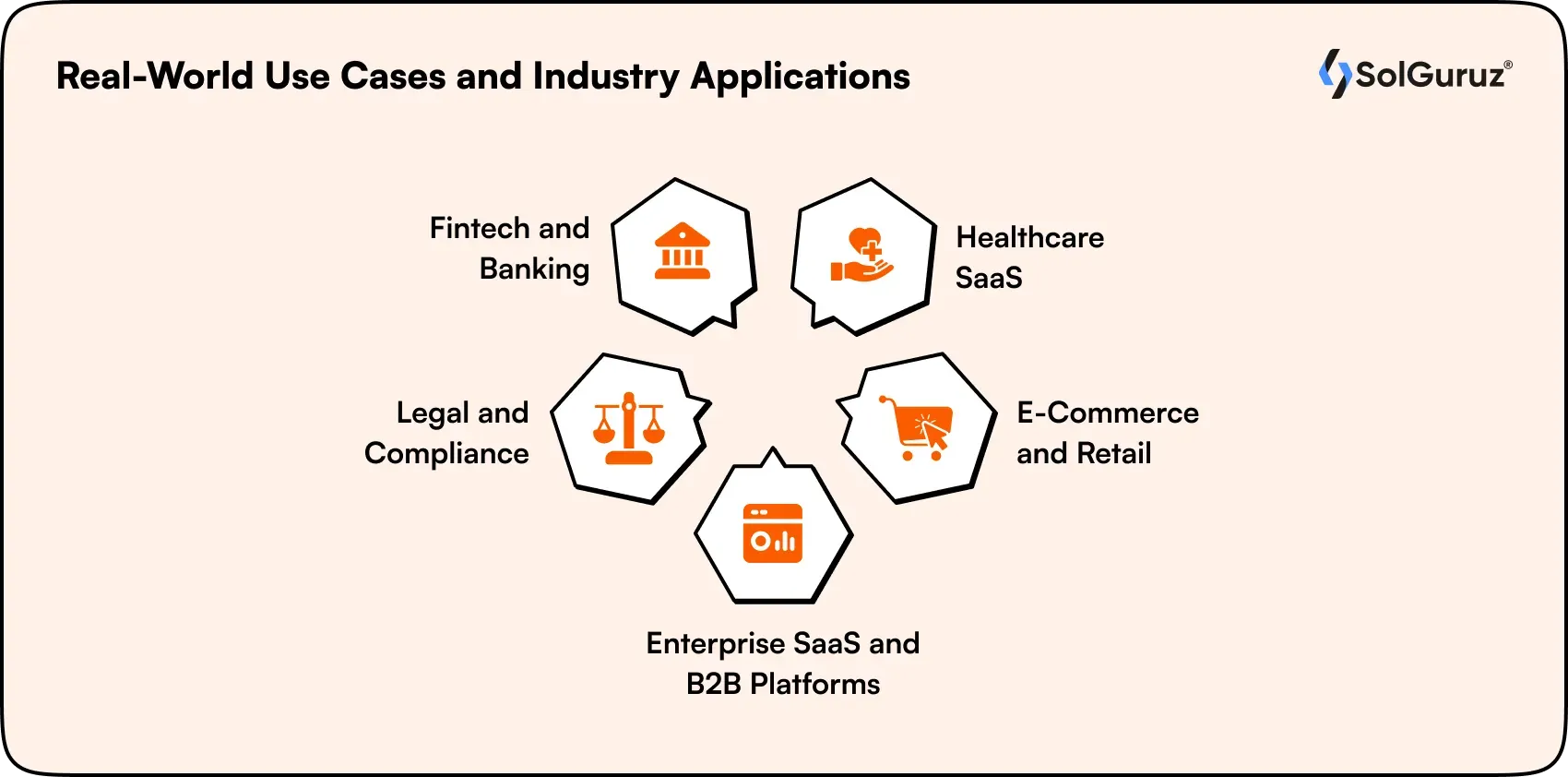
The impact of AI agent orchestration can be seen across multiple industries. Below are some real-world examples showing how organizations apply it in practice.
1. Fintech and Banking
Payment processing teams use AI agent orchestration to coordinate compliance checks, fraud detection, duplicate-check agents, and transaction logging in real time.
- OpenAPI contract specs prevent breaking changes to payment APIs
- UK FCA and US FinCEN compliance rules translate directly into executable agent constraints
- Multi-agent systems reduce fraud detection false-positive rates significantly
2. Healthcare SaaS
HIPAA and NHS data governance requirements map naturally to orchestration constraints. Every AI-generated data access function is validated against a specification that enforces data minimization, audit logging, and access control rules.
- HL7 FHIR API contracts serve as executable agent specifications
- Orchestration reduces manual documentation time by 40-60%
3. E-Commerce and Retail
Retail AI orchestration platforms coordinate demand forecasting agents, inventory management, dynamic pricing models, and personalized recommendation engines to create responsive, real-time customer experiences.
- Logistics orchestration systems have cut fulfillment delays by up to 40%
- Customer support orchestration reduces call transfer rates by up to 60%
4. Enterprise SaaS and B2B Platforms
Enterprise teams deploy orchestrated AI agent systems to automate complex sales workflows, customer success monitoring, multi-repository codebase analysis, and cross-functional reporting.
- Sales AI agents coordinate prospecting, qualification, outreach, and CRM updates.
- Orchestrated reporting agents pull data from 10+ sources and produce consistent, governed output.s
5. Legal and Compliance
Legal teams use multi-agent AI orchestration to process contracts, flag risky clauses, cross-reference regulatory databases, assign review priorities, and track outstanding action items.
- Contract analysis agents process hundreds of documents in parallel
- Human-in-the-loop triggers ensure attorney review before any binding action
Note: Every industry example above shares one thing in common: the results only happen when agents are coordinated, not just deployed. Orchestration is what turns individual AI capabilities into outcomes your business can actually measure.
Key Benefits of AI Orchestration
Let's now discuss some of the key benefits of AI Orchestration:
1. End-to-End Process Automation
AI orchestration enables organizations to automate complete workflows from start to finish rather than automating isolated steps. Processes that previously required multiple tools and manual handoffs can now run as a single coordinated system.
2. Faster Process Execution
Organizations implementing AI agent orchestration consistently report 30-50% process time reductions. Logistics teams reduce fulfillment delays, while customer support teams shorten response times by automating request handling and information retrieval.
3. Reduced API and Compute Costs
An orchestration layer routes simple tasks to lightweight models and complex reasoning tasks to advanced models. This intelligent routing prevents unnecessary model calls and can reduce overall compute costs by up to 60%.
4. Enterprise-Grade Governance and Compliance
AI orchestration platforms provide detailed logs of system actions, data access, and workflow decisions. This visibility is critical for regulated industries and helps organizations maintain compliance with internal policies and external regulations.
5. Resilience and Failure Recovery
Production orchestration systems handle failures gracefully. If one component fails, the orchestrator can retry the task, reroute it to another service, or escalate to a human reviewer without disrupting the entire workflow.
6. Scalable AI Systems
AI agent orchestration allows organizations to scale their AI capabilities without significantly increasing operational complexity. For companies focused on AI/ML development, this makes it easier to integrate new models, tools, or services into existing workflows without redesigning the entire system.
Challenges and How to Overcome Them
While AI orchestration offers significant benefits, implementing it at scale can introduce technical and organizational challenges. Understanding these common issues and their solutions helps organizations build more reliable and efficient orchestration systems.
| Challenge | Solution |
| System Sprawl | Implement an AI orchestration platform that centralizes workflow control, policy enforcement, permissions, and monitoring across all AI systems. |
| Context Loss Between Components | Use centralized shared memory and standardized context-passing mechanisms so all models and services operate with the same task history. |
| Governance Gaps | Embed compliance rules, access controls, and audit logging directly into the orchestration layer rather than adding them later. |
| Cost Management | Use a multi-model strategy: advanced models for complex reasoning and smaller, efficient models for routine tasks. |
| Debugging Complexity | Implement strong observability practices, including detailed logging of model inputs, outputs, decisions, and workflow steps. |
| Team Skill Gaps | Work with experienced AI engineering teams or invest in training so internal developers can design, deploy, and maintain orchestration architectures. |
The Future of AI Orchestration
The trajectory of AI agent orchestration in 2026 and beyond is clear from every major analyst and technology leader.
1. Gartner Forecast
By 2028, 33% of enterprise software applications will include agentic AI, up from less than 1% in 2024. Gartner also predicts 40% of enterprise applications will feature task-specific AI agents by the end of 2026.
2. Deloitte Projection
Deloitte states that market estimates place the autonomous AI agent market at US$35 billion by 2030 (from US$8.5 billion in 2026). They predict orchestration-focused enterprises could boost this by 15-30% through better agent coordination, reaching up to US$45 billion by 2030
3. MCP and A2A Protocol Standards
The AI orchestration platform market reached approximately $11.1 billion in 2025, growing at a CAGR of around 22% into 2026 and beyond. MCP (Model Context Protocol) standardizes AI agent connections to external tools, data, and resources via a client-server model using JSON-RPC, while A2A (Agent-to-Agent) enables interoperability and collaboration between agents across platforms like LangGraph and Semantic Kernel
4. Shift to Human-on-the-Loop
The transition from human-in-the-loop to human-on-the-loop orchestration is accelerating, driven by maturing governance and improved agent reliability. Organizations are moving from approving every decision to monitoring AI systems at a strategic level.
5. Domain-Specific Agents
Domain-specific agents tailored for industry rules and compliance are gaining traction over generic models in regulated sectors, supported by Gartner's emphasis on agentic AI in enterprise workflows.
How SolGuruz Implements AI Agent Orchestration
SolGuruz has been building production software for clients across the US, UK, Australia, and Germany for over a decade. As one of the product engineering firms specializing in AI agent orchestration, our team has developed a proven, specification-anchored approach that delivers reliable, governed, and scalable results.
Our AI Agent Orchestration Delivery Framework
Here are the points to consider:
Discovery and Specification Workshop:
We translate business requirements into executable agent specifications before a single line of code is written.
Architecture Design:
We document agent roles, communication protocols, tool integrations, failure handling logic, and governance constraints in a structured architecture plan.
Agent Implementation:
We build each specialized agent with clearly defined inputs, outputs, memory requirements, and tool access permissions.
Orchestration Layer Build:
We implement the orchestrator logic covering task routing, context passing, execution monitoring, failure recovery, and human-in-the-loop triggers.
CI/CD Validation Pipeline:
We build automated validation gates that catch specification violations before any agent change reaches production.
Observability and Governance Setup:
We implement full audit logging, performance dashboards, and governance controls aligned to your compliance requirements.
Why Clients Trust SolGuruz for AI Agent Orchestration
- 5+ years building production software for Fintech, Healthcare, E-commerce, and Enterprise SaaS clients
- Full-stack AI ecosystem experience: LangChain, crewAI, LangGraph, AutoGen, AWS Kiro, Claude Code, and GitHub Copilot
- Proven track record delivering orchestration for both greenfield projects and complex existing codebases
- Cross-regulatory experience with US, UK, and EU compliance requirements (HIPAA, FCA, GDPR)
- Deep expertise across mobile, web, and backend AI-integrated systems
Final Words
AI orchestration is no longer optional for enterprises serious about AI; it is the difference between tools that impress in demos and systems that deliver results in production. The complexity is real, and building it right the first time matters.
That is exactly what SolGuruz exists to do. With years of production software experience across Fintech, Healthcare, E-Commerce, and Enterprise SaaS, we design and build AI orchestration systems that are governed, scalable, and built to your exact compliance requirements, not generic templates.
If you are ready to move beyond disconnected AI tools and build an orchestration system that actually works, let's talk. SolGuruz will map your workflows, define your architecture, and ship it to production.
FAQs
1. What is AI agent orchestration?
AI agent orchestration is the coordination and management of multiple AI agents, models, tools, and data pipelines so they work together to complete complex, end-to-end business tasks. It acts as the control layer that routes tasks, manages context, handles failures, and ensures every agent operates with the right information at the right time.
2. What is the best AI orchestration platform in 2026?
The best AI orchestration platform depends on your team and requirements. For developers, LangChain and LangGraph are the most widely adopted open-source options. For enterprise teams with compliance needs, IBM Watsonx Orchestrate and AWS Kiro are purpose-built solutions. For no-code business teams, Zapier leads with 8,000+ app integrations. For data and ML teams, Apache Airflow remains the industry standard.
3. Which AI orchestration open-source frameworks are most popular?
The most popular open-source AI orchestration frameworks in 2026 are LangChain, LangGraph, crewAI, AutoGen (Microsoft), Apache Airflow, Prefect, and n8n. LangChain has 90,000+ GitHub stars and is the most widely used. Apache Airflow is the industry standard for ML and data pipeline orchestration. Prefect's open-source core has over 18,000 GitHub stars and 6 million monthly downloads.
4. Which AI orchestration companies are leading the market?
The leading AI orchestration companies in 2026 include LangChain (open-source frameworks), Microsoft (AutoGen, Azure ML), IBM (Watsonx Orchestrate), AWS (Kiro, Bedrock), Apache Foundation (Airflow), Prefect, and Zapier. On the product engineering side, firms like SolGuruz specialize in implementing custom AI agent orchestration architectures for enterprise clients.
5. How is AI agent orchestration different from RPA?
Traditional Robotic Process Automation (RPA) follows fixed, rule-based scripts and breaks when processes change. AI agent orchestration is dynamic: it makes context-aware decisions, handles unstructured data, adapts when inputs change, and coordinates multiple intelligent agents. In 2026, the best enterprise architectures use both together.
6. How much does AI agent orchestration cost to implement?
Open-source frameworks (LangChain, Airflow, crewAI) are free but require engineering investment. Enterprise platforms like IBM Watsonx Orchestrate typically cost $70,000+/year. Custom implementation by a product engineering firm varies based on workflow complexity, the number of agents involved, integration requirements, and compliance needs. Organizations consistently report 30-50% process time reductions post-implementation. Contact SolGuruz for a no-obligation assessment.
7. Is AI agent orchestration suitable for small and mid-size businesses?
Yes. While orchestration architecture is most commonly discussed in enterprise contexts, open-source frameworks like LangChain and crewAI are accessible for smaller teams. The key is to start narrow: automate one high-value workflow end-to-end before expanding. Companies starting with a focused orchestration implementation report 31-44% efficiency gains in the first 90 days.
8. How does SolGuruz approach AI agent orchestration?
SolGuruz uses a specification-anchored delivery framework: discovery and specification workshop, agent architecture design with defined roles and governance constraints, individual agent build and testing, orchestration layer implementation, CI/CD validation pipelines, and full observability and audit logging. We have delivered AI agent orchestration for Fintech, Healthcare SaaS, E-Commerce, and Enterprise SaaS clients across the US, UK, and Australia.
Looking for an AI Development Partner?
SolGuruz helps you build reliable, production-ready AI solutions - from LLM apps and AI agents to end-to-end AI product development.

Strict NDA

Trusted by Startups & Enterprises Worldwide

Flexible Engagement Models

1 Week Risk-Free Trial
Next-Gen AI Development Services
As a leading AI development agency, we build intelligent, scalable solutions - from LLM apps to AI agents and automation workflows. Our AI development services help modern businesses upgrade their products, streamline operations, and launch powerful AI-driven experiences faster.


Why SolGuruz Is the #1 AI Development Company?
Most teams can build AI features. We build AI that moves your business forward.
As a trusted AI development agency, we don’t just offer AI software development services. We combine strategy, engineering, and product thinking to deliver solutions that are practical, scalable, and aligned with real business outcomes - not just hype.
Why Global Brands Choose SolGuruz as Their AI Development Company:

Business - First Approach
We always begin by understanding what you're really trying to achieve, like automating any mundane task, improving decision-making processes, or personalizing user experiences. Whatever it is, we will make sure to build an AI solution that strictly meets your business goals and not just any latest technology.
Custom AI Development (No Templates, No Generic Models)
Every business is unique, and so is its workflow, data, and challenges. That's why we don't believe in using templates or ready-made models. Instead, what we do is design your AI solution from scratch, specifically for your needs, so that you get exactly what works for your business.
Fast Delivery With Proven Engineering Processes
We know your time matters. That's why we follow a solid, well-tested delivery process. Our developers move fast and stay flexible to make changes. Moreover, we always keep you posted at every step of the AI software development process.
Senior AI Engineers & Product Experts
When you work with us, you're teaming up with experienced AI engineers, data scientists, and designers who've delivered real results across industries. And they are not just technically strong but actually know how to turn complex ideas into working products that are clean, efficient, and user-friendly.
Transparent, Reliable, and Easy Collaboration
From day one, we keep clear expectations on timelines, take feedback positively, and share regular check-ins. So that you'll always know how we are progressing and how it's going.
Whether you’re modernizing a legacy system or launching a new AI-powered product, our AI engineers and product team help you design, develop, and deploy solutions that deliver real business value.

