





Summarise with AI


Key Takeaway
|
Think of a standard AI assistant like a very capable search engine. You type a question, it gives you an answer, and the interaction ends. Agentic AI is different. It is more like an intelligent coworker who takes a task, figures out the steps involved, uses whatever tools are available, and works through the problem until the job is done.
Let’s get some more clarity on what Agentic AI is, how it works, and how it can benefit you.
What is Agentic AI
Quick Answer: What Does Agentic AI Mean? Agentic AI refers to an AI system that’s capable of making autonomous decisions based on both past performance and its current assessment of what’s needed to accomplish a task, operating with minimal human oversight. |
It is a type of artificial intelligence that can plan multi-step tasks, make decisions, use external tools, and take autonomous actions to achieve a defined goal. Unlike reactive AI that responds to a single input, agentic AI reasons through problems and adapts its approach based on what it observes along the way.
The word 'agentic' comes from 'agency', meaning the ability to act independently toward a goal. An agentic AI system does not just respond to prompts but also sets sub-goals, decides what actions to take, monitors its own progress, adjusts based on what it finds, and loops until it has completed the task or reached a meaningful stopping point.
This is a meaningful shift from how most people currently use AI tools. When you ask a large language model to write a product description, that is generative AI doing one task in response to one instruction. Agentic AI, on the other hand, can research a new lead, qualify them against your criteria, draft a personalized outreach email, schedule a follow-up, and log everything in your CRM without you asking each time.
Agentic AI is already being used in healthcare to help manage patient intake workflows, in real estate to qualify leads and schedule property viewings, in education to personalize learning paths, and in travel to handle booking, rebooking, and itinerary adjustments autonomously. Let us look at how it actually works.
How Does Agentic AI Work
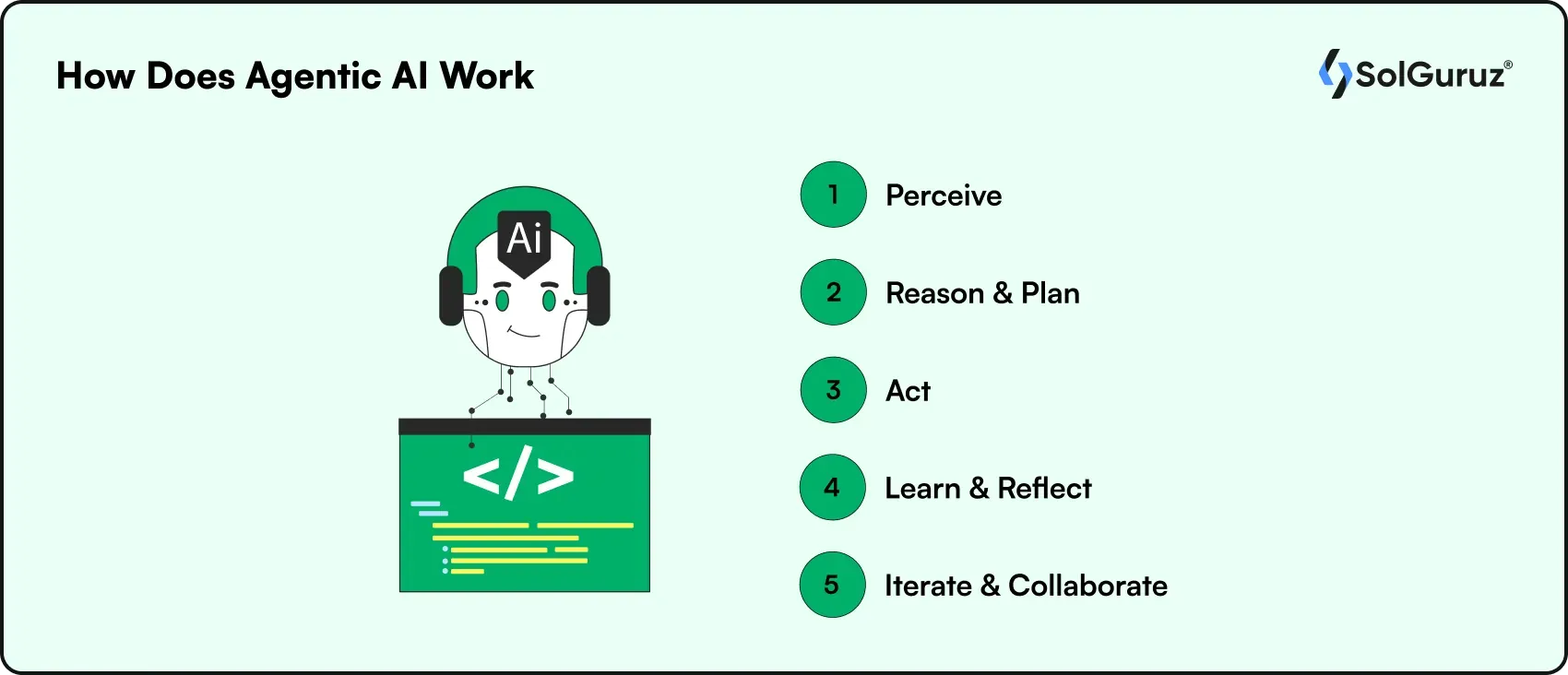
Agentic AI operates through a continuous loop, not a single input-output exchange. This is commonly called the agent loop or observe–plan–act cycle. The system receives a goal, breaks it down into steps, takes action, observes what happened, and adjusts until the task is complete.
This loop is what separates agentic AI from a standard generative AI tool that responds to one prompt and stops.
Here is how that loop works in practice:
1. Perceive
The agent starts by gathering information from its environment: user prompts, connected databases, APIs, sensor data, or live system feeds. This gives it the context it needs to understand the current state of things before deciding what to do next.
2. Reason and Plan
The LLM acts as the agent’s reasoning engine, interpreting the goal and breaking it into smaller steps. It decides what actions need to be taken and in what order before using any tools. Modern agent systems often depend on tool-calling and structured planning to organize these steps, while the model’s step-by-step reasoning (like chain-of-thought) is usually handled internally.
3. Act
The agent executes each step by connecting to external systems through APIs: querying databases, running code, sending emails, updating CRM records, triggering workflows, or interacting with any other tool it has been given access to. Built-in guardrails regulate what actions the agent is permitted to take, so a customer service agent might resolve claims up to a certain value autonomously while flagging higher-value decisions for human review.
4. Learn and Reflect
After each action, the agent observes the outcome and compares it against the goal. If the result does not meet the expected quality or accuracy, it revises its approach and tries again. This self-correction mechanism is what makes agentic AI genuinely autonomous rather than just automated. Over time, as the system processes more interactions, it refines its models through a continuous feedback loop and keeps getting better at handling similar tasks the more it runs them.
5. Iterate and Collaborate
In complex tasks, a single agent may not be enough. Multi-agent systems assign specialized agents to different parts of the workflow, one for research, one for data analysis, one for writing, one for quality checking, with an orchestrating agent coordinating the full process. Each agent handles its defined role while sharing context with the others, allowing the system as a whole to tackle problems that would be too large or complex for a single agent working alone.
Key Characteristics of Agentic AI
Understanding what makes agentic AI distinct comes down to two things: how it behaves as a system, and what it can actually do. Here are the characteristics that define it.
Autonomy and Proactivity
Agentic AI operates independently toward a goal rather than waiting for step-by-step human instructions. It decides what needs to happen next, takes action, and keeps going, which is what separates it from every other category of AI tool currently in use.
Contextual Understanding
Agentic systems analyze real-time data and interpret evolving situations dynamically. Rather than applying fixed rules to fixed inputs, they assess what is happening right now and adjust their actions accordingly. Large language models are central to this as they allow the system to understand natural language inputs and generate context-aware responses and decisions.
Goal-Oriented Planning
Given a high-level objective, agentic AI breaks it down into a sequence of smaller, actionable steps and works through them in order. Each decision is made with the overall goal in mind, and each step informs the next, which is what allows the system to handle multi-step workflows without human coordination at each stage.
Adaptability and Self-Learning
Agentic AI evaluates the outcomes of its own actions and adjusts its strategy based on what it observes. Over time, this feedback loop allows the system to improve its decision-making and optimize performance without needing to be retrained from scratch every time conditions change.
Collaboration
Agentic AI does not always work alone. In multi-agent architectures, individual agents collaborate with each other, with software platforms, and with human users to complete complex processes that no single agent could handle independently. This collaborative capacity is what makes agentic systems genuinely scalable for enterprise workflows.
Agentic AI Architecture: The Core Components and System Types
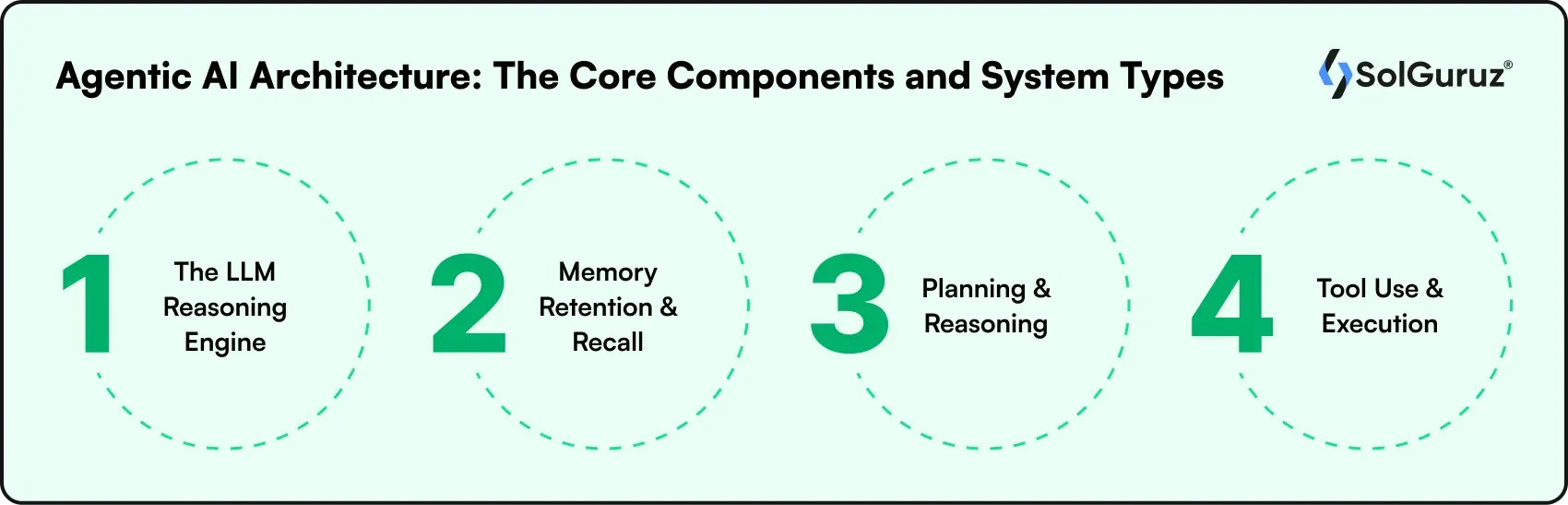
Understanding agentic AI architecture means understanding two things: the foundational components every agent system is built on, and the different ways those systems can be structured depending on the complexity of the task.
Four Key Capabilities of Agentic AI
No matter what Agentic AI you use, these are the 4 core capabilities it has to work autonomously and train itself to improve every day.
1. The LLM Reasoning Engine
The large language model is the brain of the agent. It processes the goal, interprets results from tools, decides what to do next, and steers every step of the process. The LLM in an agentic system goes beyond generating text and acts as an ongoing reasoning layer that coordinates the entire workflow from start to finish.
2. Memory Retention and Recall
Agentic AI systems need to remember what they have done and what they have learned across the course of a task. Short-term memory holds the context of the current workflow, like what has been tried, what worked, and what failed. Long-term memory allows the agent to use stored information from past sessions or connected knowledge bases, such as a customer's history or a company's internal documentation. Memory is what allows an agent to maintain coherence across a multi-step task rather than treating each action as a fresh start.
3. Planning and Reasoning
The planning layer is what allows the agent to break a high-level goal into a sequence of executable steps. Rather than reacting to a single prompt, the agent thinks ahead and maps out what needs to happen, in what order, and with which tools. Techniques like chain-of-thought prompting play an important role here, letting the model reason through each step before committing to an action.
4. Tool Use and Execution
An agentic AI system is only as capable as the tools it can access. These tools can include web search APIs, code execution environments, CRM integrations, calendar systems, database connectors, email platforms, and more. The tool use layer is what connects the agent's reasoning to real-world actions and makes agentic AI useful for business operations rather than just conversation.
Types of Agentic AI Systems
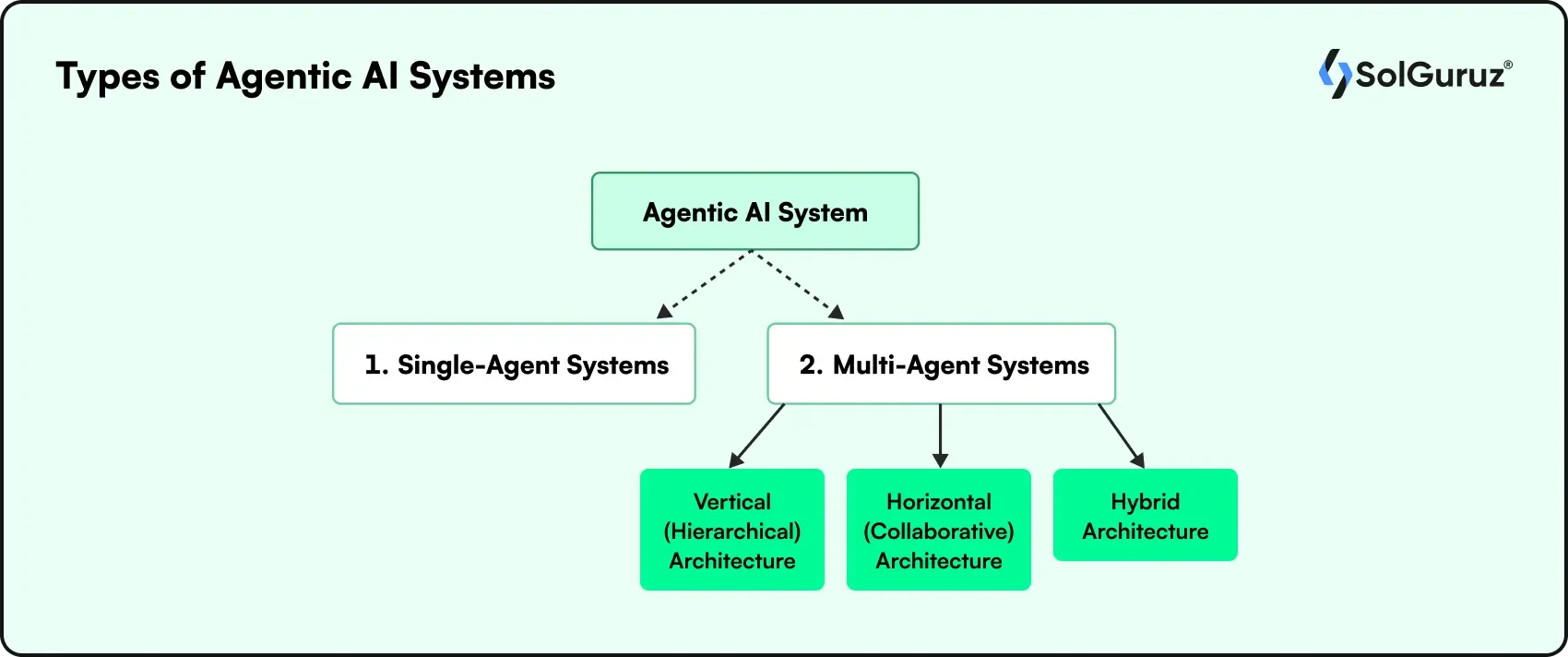
The components above are consistent across agentic systems. What changes is how those systems are structured and specifically, how many agents are involved and how they coordinate with each other.
1. Single-Agent Systems
A single-agent system involves one AI agent handling an entire task on its own, using the LLM's reasoning capability and whatever tools it has been given access to. The agent creates a plan, executes each step, and compiles the outputs into a final result.
Single-agent systems are simpler to build, easier to debug, and more predictable in behavior since there is no coordination overhead between multiple agents. They work well for focused, well-defined tasks like drafting a document, querying a database, or managing a specific workflow step. The tradeoff is scalability: as tasks grow in complexity or volume, a single agent can become a bottleneck.
2. Multi-Agent Systems
Multi-agent systems involve several AI agents working in parallel, each specializing in a specific part of a larger task. One agent might handle web research, another processes and summarizes findings, a third generates a report, and a fourth handles delivery. Each agent brings a focused capability to the workflow, and together they can tackle problems that would overwhelm a single agent working alone.
Multi-agent systems are more scalable, so additional agents can be integrated as demands grow without redesigning the entire system. They also offer built-in fault tolerance: if one agent fails, others continue operating. Frameworks like CrewAI, LangGraph, and AutoGen are commonly used to build and orchestrate multi-agent systems.
a. Vertical (Hierarchical) Architecture
In a vertical architecture, a lead orchestrator agent oversees a team of sub-agents, assigning tasks, collecting outputs, and maintaining alignment with the overall goal. Sub-agents report back to the orchestrator, which gathers results and decides what happens next. This structure works well for sequential, multi-step workflows where clear accountability and task order matter, for example, consider tasks like document generation pipelines, multi-stage approval workflows, or complex research tasks. The tradeoff is that the system depends heavily on the orchestrator, which can become a bottleneck or single point of failure.
b. Horizontal (Collaborative) Architecture
In a horizontal architecture, agents operate as peers in a decentralized system, collaborating freely without a fixed hierarchy. All agents share context and contribute to decisions collectively. This structure supports parallel processing and dynamic problem solving as multiple agents can work on different parts of a task simultaneously, which speeds up completion and allows more diverse outputs. The challenge is coordination as without a clear leader, decision-making can slow down if agents produce conflicting outputs that need to be reconciled.
c. Hybrid Architecture
Hybrid systems combine both models, using structured leadership for phases of a task that require clear sequencing and shifting to collaborative peer dynamics for phases that benefit from parallel exploration. Leadership adapts based on what the task demands at each stage. This makes hybrid architectures the most preferable option for complex, multi-phase tasks. Keep in mind that it is also the most demanding to build and manage, since balancing centralized control with distributed collaboration requires robust orchestration logic.
Popular Agentic AI Frameworks
If you are working with a development team to build an agentic AI system, you will likely hear about one or more of these frameworks.
Here is what each one means in plain language.
| Framework | Core Focus | Best For | Beginner Usability |
| LangGraph | State Management | Handles complex, non-linear workflows and "loops" within the LangChain ecosystem. | Moderate (Steep learning curve if new to LangChain) |
| CrewAI | Role-Based Collaboration | Orchestrates multiple agents with specific "personas" (e.g., Researcher, Writer) to solve tasks. | High (Very intuitive, "human-like" team structure) |
| AutoGen | Conversational Logic | Scenarios where agents need to "debate" or critique each other's work. | Moderate |
| LlamaIndex | Data Intelligence | Best-in-class for agents that need to query, index, and reason over massive datasets. | Moderate |
| Agno | Lightweight Speed | Focused on memory and tool usage without the "bloat" of larger frameworks. | High (Clean abstractions and easy to prototype) |
| Pydantic AI | Type Safety & Validation | Ensures agent outputs are structured and predictable using Python type hinting. | Moderate (Best for devs who prioritize "clean code") |
Choosing the right framework depends on whether you need a specialized data researcher like LlamaIndex or a collaborative agent team like CrewAI. Ultimately, these tools allow your developers to stop coding every single step and instead build a system that can think, adapt, and solve problems on its own.
Agentic AI vs Generative AI: What is the Difference
Most people encounter generative AI first. It’s simple- you type a prompt, the model produces something, and the interaction ends. Agentic AI works differently. You give it a goal, and it figures out the steps, picks the right tools, takes action, checks the results, and keeps going until the job is done. No prompt needed at each stage. Here is how the two compare across the dimensions that matter most:
| Feature | Generative AI | Agentic AI |
| Primary Function | Creates content based on a prompt: text, images, code, video | Pursues a goal independently through planning, reasoning, and action |
| Autonomy Level | Low; needs a human to prompt every output | High: decomposes goals into tasks and adapts as it goes |
| Dependency | Draws on patterns from training data | Reason through problems using planning logic and feedback |
| Tool Access | Operates on its own with no live connection to external systems | Dynamically selects and uses any available tool: CRMs, databases, APIs, code environments |
| Learning Capability | Trained on historical data; does not update in real time | Adjusts its approach within a task based on what it observes |
| Workflow Style | Only responds when asked | Proactively monitors, plans, acts, and course-corrects on its own |
| Example Use Case | Drafting an article, generating a design, writing code | Researching trip options, booking the best one, and updating the traveler's calendar without being asked |
| Example Tools | ChatGPT, DALL-E, Midjourney | AutoGPT, Devin AI, Gemini 2.0 with planning capabilities |
The simplest way to put it: generative AI is a skilled assistant that works when you tell it to. Agentic AI is an intelligent coworker that takes ownership of a task and sees it through.
You might also like: What is Generative AI and How Does It Work
Agentic AI vs. AI Agents vs. Chatbots: Learn the difference
Chatbots, AI agents, and agent AI are often used interchangeably, but they represent three meaningfully different levels of capability. A chatbot answers questions. An AI agent executes specific tasks it has been configured for. Agentic AI plans, reasons, and works toward a goal on its own without a script and a human directing each step. Here is how they compare side by side.
| Aspect | Chatbots | AI Agents | Agentic AI |
| Primary Function | Conversational interface | Task execution | Goal-driven autonomous execution |
| Complexity | Low | Medium | High |
| Autonomy | None; human drives | Partial; predefined rules | High; self-directed |
| Planning Ability | None | Limited | Advanced multi-step planning |
| Tool Access | None or basic | Some API calls | Dynamic tool selection and chaining |
| Learning | Static | Limited adaptation | Learns from outcomes and memory |
| Example | FAQ bot on a website | Reflex-based agent, scheduling bot | AI that manages your entire sales pipeline autonomously |
The jump from chatbot to AI agent is largely about automation. The jump from AI agent to agentic AI is about autonomy, which is a much bigger shift. An agentic system does not just do what it is told; it decides what needs to be done, figures out how to do it, and handles the unexpected along the way. For businesses evaluating where AI fits into their operations, understanding this difference helps them choose what AI they want to best grow their business.
How Does Agentic AI Differ from Traditional AI
Traditional AI, which has been around for decades, is built to do specific things within narrow boundaries. A traditional AI model might analyze transaction data to flag fraud or recognize faces in images. It is trained for one purpose and does not deviate. Here is how agentic AI compares:
| Dimension | Traditional AI | Agentic AI |
| Task scope | Single, narrow, predefined task | Broad, multi-step, flexible goal pursuit |
| Adaptability | Fixed; can only do what it was trained for | Adaptive; adjusts its approach based on feedback and results |
| Decision-making | Rule-based or model-based within fixed parameters | Autonomous goal-directed reasoning across open-ended situations |
| Tool integration | Usually, a standalone model | Designed to connect with and orchestrate external tools and systems |
| Supervision required | Requires a human to interpret and act on outputs | Can complete full workflows with minimal human checkpoints |
| Example | Image classifier, fraud detection model, recommendation engine | Autonomous research assistant, AI-powered sales development rep, healthcare intake agent |
Remember: It is very important for business owners and working professionals to understand this difference so they can level up by using agentic AI for automated workflows and independent decision-making instead of wasting their time training traditional AI and having to act as a human judge after every output.
Benefits of Agentic AI
Agentic AI can help your business grow and optimize your workflow in many ways. It is already used in various industries with substantial results.
Let’s take a look at some of the most common benefits of Agentic AI.
1. Handles Complex, Multi-Step Work Automatically
Agentic AI manages entire workflows end-to-end without a human guiding each stage. In supply chain management, for example, an agentic system can monitor inventory, forecast demand, identify bottlenecks, and coordinate with suppliers to trigger restocking within a single automated run.
2. Self-Learning and Continuous Improvement
Unlike traditional automation that runs the same logic every time, agentic AI continuously analyzes feedback from its own actions and refines its approach over time. The system gets better at handling similar tasks the more it runs them, making them highly adaptable to evolving requirements.
3. Scales Without Adding Headcount
Traditional automation systems need manual upgrades to keep up with growing demand. Agentic AI scales by design, combining cloud infrastructure, APIs, and LLMs to handle increasing workloads without a drop in performance. In a multi-agent architecture, additional specialized agents can be added as task complexity grows, keeping operations agile without proportional increases in staffing.
4. Proactive Problem-Solving
Agentic AI does not wait to be told something has gone wrong. It interprets real-time data, detects issues as they emerge, and takes corrective action autonomously. A logistics agent monitoring a supply chain can detect a shipping delay, assess the full impact, and adjust delivery schedules before the issue reaches the customer.
5. Frees People Up for Higher-Value Work
By absorbing repetitive, routine tasks like scheduling, data entry, status updates, and routine inquiries, agentic AI gives employees time back for work that requires human judgment and creativity. Industry research shows that knowledge workers spend roughly 60% of their time on coordination tasks rather than the substantive work they were hired to do. Agentic AI changes that ratio meaningfully.
6. Supports Better Human Decision-Making
By processing large volumes of data and surfacing relevant patterns and anomalies in real time, agentic systems give decision-makers better information faster. In financial services, an agentic system monitoring market conditions can deliver real-time investment analysis to analysts, compressing hours of research into an on-demand insight layer.
7. Delivers Personalized Experiences at Scale
Agentic AI analyzes user data, preferences, and behavior in real time to deliver personalized responses at a scale no human team could match. In customer service, agents can pull relevant customer history, understand the context of an inquiry, and either handle the interaction autonomously or equip a human agent with everything they need before the conversation even starts.
Agentic AI Use Cases Across Industries
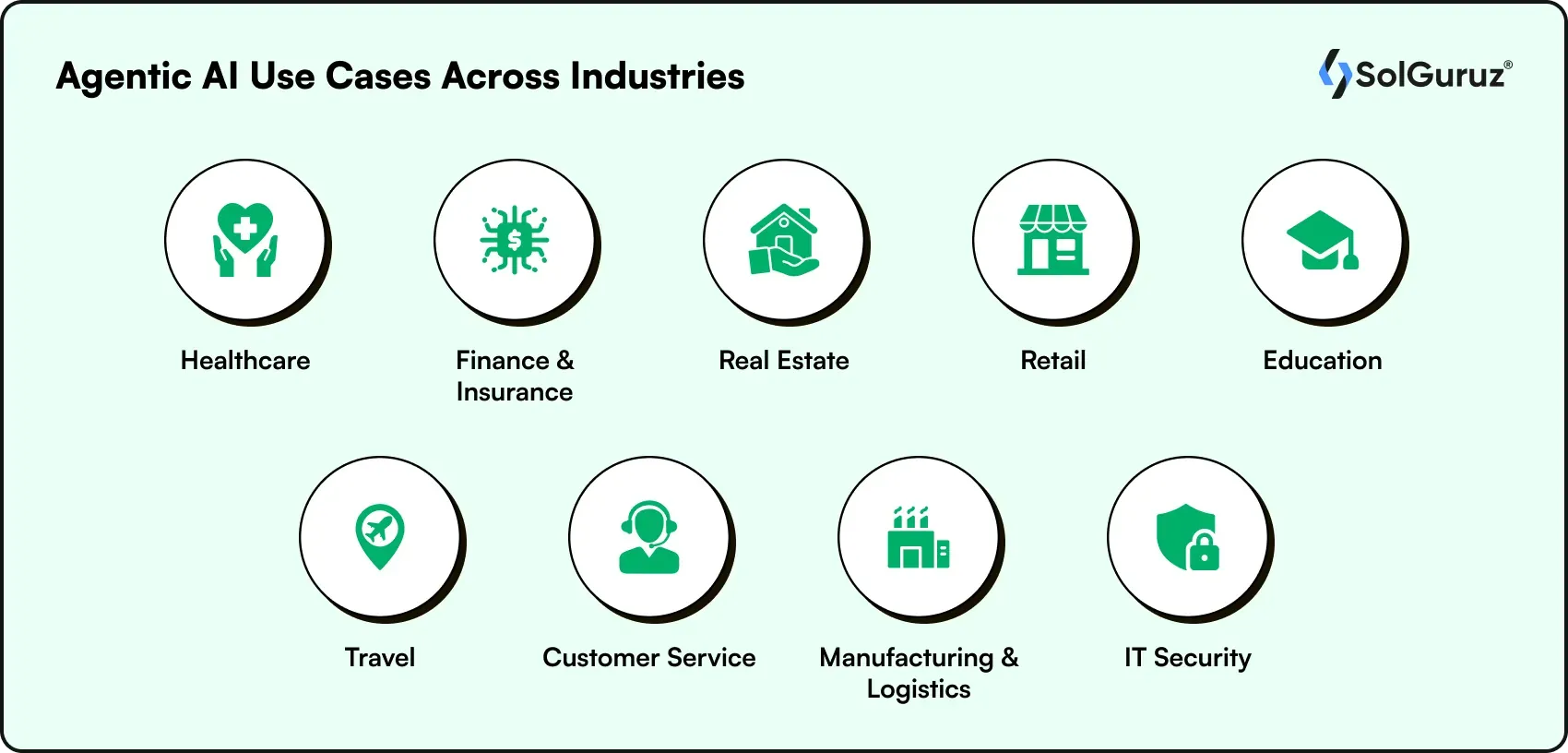
The clearest way to understand what agentic AI actually does is to look at where it is already working. Across healthcare, finance, retail, education, and more, businesses are using agentic systems to take over multi-step workflows that previously required human coordination at every stage. Let us go through them one by one.
1. Healthcare
Nuance Communications reported that physicians using their DAX Copilot agent saved 50% of their time on clinical documentation. Genentech built the gRED Research Agent to automate drug discovery literature searches, and Valtech highlights agents acting as a second set of eyes for medical image scanning and patient case prioritization.
2. Finance and Insurance
3. Real Estate
Agencies are using agentic AI to handle the full lead qualification and scheduling workflow: receiving an inquiry, matching it against buyer criteria, pulling relevant listings, and booking a viewing, all within minutes of initial contact.
4. Retail
Walmart's inventory agent cut out-of-stock events by 30% within six months. Amazon and Shopify use AI agents for personalized shopping experiences, including autonomous responses to cart abandonment that factor in browsing history and pricing signals.
5. Education
Stanford's Virtual Lab runs AI scientist agents on active research projects. Research shows AI-personalized learning paths in STEM courses have increased student engagement by 34% and reduced dropout rates by 41%.
6. Travel
Expedia has built agentic planning capabilities that handle multi-city itineraries, track price changes, and suggest rebooking options proactively. Studies show that the global AI in the travel market is projected to grow at around 26% annually through 2030.
7. Customer Service
Dialpad and Moveworks are using agents to autonomously handle routine queries, track orders, and route complex tickets, with both reporting measurable improvements in response times across enterprise deployments. In call centers, too, agentic AI now manages multiple tasks simultaneously during a single customer interaction.
8. Manufacturing and Logistics
Moxo documents how agents automate dynamic route planning during supply chain disruptions in real time. Accenture and NVIDIA reported 25% fewer defect rates after deploying agentic AI in their manufacturing processes.
9. IT Security
Exabeam notes that autonomous agents are detecting, hunting, and mitigating cybersecurity threats in real time by continuously analyzing network traffic, user behavior, and endpoint activity, and initiating automated responses the moment anomalies are detected. Unlike static rule-based tools, agentic security systems adapt as attack patterns evolve, which is increasingly important as threats grow more sophisticated.
Challenges and Limitations of Agentic AI
Agentic AI is genuinely powerful, but it comes with real challenges that businesses need to plan for before deploying it in production.
1. Hallucination and Reliability
When an LLM hallucinates inside a multi-step agentic workflow, the error affects subsequent steps. Techniques like RAG and grounding help reduce this risk, but validation checkpoints remain essential for high-stakes tasks.
2. Security and Privacy
Autonomous agents that access databases, APIs, and external systems introduce new attack surfaces like prompt injection, tool misuse, and data leaks. Any agentic system touching sensitive data needs guardrails built into the architecture from the start, not added as an afterthought.
3. Transparency and Explainability
Many LLMs operate as black boxes, making it difficult to understand how an agent arrived at a specific decision. This is particularly problematic in regulated industries like healthcare and finance, where auditability is not optional.
4. Cost Management
Each planning step, tool call, and observation cycle involves an LLM inference call that costs money and takes time. Running multiple agents with multiple tool calls per task adds up quickly, and cost optimization is increasingly a first-class architectural concern alongside performance.
5. Observability and Debugging
When something goes wrong in a multi-agent workflow, tracing the source of the failure is genuinely difficult. Logging, tracing, and real-time monitoring are non-negotiable for any agentic system running in production.
6. Human-in-the-Loop Balance
Finding the right level of autonomy is an ongoing calibration. Too little human oversight and you lose the efficiency gains that make agentic AI worthwhile. Too much autonomy and you risk unintended actions in systems where errors are costly to reverse.
7. Governance and Ethics
Managing a decentralized landscape of autonomous agents requires strict governance policies that cover what actions agents are permitted to take, how decisions are logged, and how algorithmic bias is monitored and addressed over time.
Examples of Agentic AI in the Real World
Real companies are already running agentic AI in production across a wide range of industries. Here is what that actually looks like.
- Google Jules built an asynchronous coding agent that works in the background of a developer's workflow. A developer assigns it a task, Jules creates a plan, executes it, runs the tests, and comes back with a completed pull request without step-by-step supervision needed.
- LinkedIn's Hiring Assistant is a multi-agent system where a supervisory agent coordinates sub-agents handling job description drafting, candidate sourcing, outreach messaging, and applicant ranking. The recruiter sets the goal; the agent orchestrates the full workflow from there.
- Capital One's Chat Concierge helps auto dealership customers ask questions about vehicles and schedule test drives. According to Capital One's head of enterprise AI, the tool is 55% more successful at converting interactions into appointments compared to their previous approach.
- Ramp, the corporate finance platform used by over 40,000 businesses, launched an AI finance agent that reads company policy documents, audits expenses autonomously, flags violations, generates reimbursement approvals, and coordinates with procurement systems to verify vendor compliance, removing the need for someone to make every transaction manually.
- Uber's on-call copilot Genie layers multiple AI agents into its retrieval pipeline: one reformulates ambiguous queries, one narrows the document pool, and one cleans up retrieved context before the answer is generated. The result was a 27% increase in acceptable answers and a 60% drop in incorrect advice compared to their standard RAG setup.
- Insurance claims processing is another area seeing multi-agent architectures at scale. One notable system uses seven specialized agents, covering policy verification, weather event confirmation, fraud detection, payout calculation, and audit, collaborating to process a single claim end-to-end, compressing a four-day manual process into an automated run.
- Booking.com deployed an agent that handles the constant flow of messages between accommodation partners and guests. When a message comes in, the agent retrieves relevant templates, pulls reservation context, and decides whether to return a template answer, generate a custom response, or hold back if context is insufficient, keeping it running as a scalable microservice across multiple languages.
How SolGuruz Delivers Agentic AI Services
We help businesses go from passive automation to autonomous growth by integrating agentic AI that follows their unique workflows and automates their tasks with full efficiency.
- Custom Agentic AI Development: Building an autonomous AI system that can plan, reason, and execute complex business tasks.
- Seamless AI Integration: Connecting agentic AI with your existing APIs, databases, and third-party software.
- Scalable Solutions: Hiring dedicated AI engineers to design, deploy, and maintain secure, goal-oriented agentic frameworks.
Bringing It Together
Agentic AI represents a meaningful evolution in what AI systems can do for a business. Moving from AI that responds to AI that acts opens up an entirely different category of use cases and an entirely different scale of operational impact. Whether the application is in healthcare, real estate, education, travel, or finance, the businesses that get the architecture, tooling, and governance right will have a real advantage.
Consider how Agentic AI can help your business. Start planning. Make use of our Generative AI Wiki.
Your growth in this digital landscape depends on you knowing the latest AI developments and using them to your advantage.
See you in the next article with more AI innovations!
FAQs
1. Is ChatGPT Agentic AI?
In 2026, ChatGPT is considered a hybrid system. While the standard chat remains a reactive assistant, new features like "Agent Mode" and "Operator" provide true agentic capabilities by allowing it to navigate the web, control desktop apps, and execute multi-step workflows autonomously.
2. How does agentic AI differ from traditional AI?
Traditional AI systems are narrow and task-specific. A fraud detection model can only flag suspicious transactions. An image recognition model can only classify images. Agentic AI is broader as it can pursue open-ended goals, switch between tools and approaches, and handle tasks that span multiple steps, systems, and decisions. The key difference is autonomy and adaptability.
3. What is the difference between agentic AI and generative AI?
Generative AI produces content in response to a prompt like text, images, code, or audio. It handles one input and produces one output. Agentic AI uses generative AI as its reasoning engine but adds planning, memory, tool use, and the ability to loop through multi-step tasks. Generative AI is a component inside many agentic AI systems, not the same thing.
4. What is the difference between an agentic AI and a chatbot?
A chatbot responds to a user's message with a relevant reply. It handles one turn at a time and has no ability to take actions beyond the conversation. Agentic AI can initiate actions, use external tools, complete multi-step workflows, and operate entirely without an ongoing human conversation. The difference is between a system that talks and a system that acts.
5. What industries are using agentic AI right now?
Healthcare, financial services, customer service operations, software engineering, real estate, education platforms, and travel management are among the industries seeing active agentic AI deployment. In healthcare, agents manage patient intake and clinical documentation. In real estate, they handle lead qualification and scheduling. In financial services, they automate accounts payable and compliance monitoring.
6. What frameworks are commonly used to build agentic AI systems?
The most commonly used frameworks include LangGraph for orchestrating LLM-powered workflows, CrewAI for multi-agent collaboration, and AutoGen from Microsoft for multi-agent conversational systems. Each framework has its strengths depending on the complexity of the task and the team's technical preferences.
7. What are real-life examples of Agentic AI?
- Customer Support: Agents that autonomously process refunds, track lost packages, and update databases without human intervention.
- Personal Productivity: "Operator" style agents that book flights, schedule meetings across multiple calendars, and research/purchase products based on your preferences.
- Software Development: "Vibe coding" agents that not only write code but also fix their own bugs, set up servers, and deploy functional apps.
Looking for an AI Development Partner?
SolGuruz helps you build reliable, production-ready AI solutions - from LLM apps and AI agents to end-to-end AI product development.

Strict NDA

Trusted by Startups & Enterprises Worldwide

Flexible Engagement Models

1 Week Risk-Free Trial
Next-Gen AI Development Services
As a leading AI development agency, we build intelligent, scalable solutions - from LLM apps to AI agents and automation workflows. Our AI development services help modern businesses upgrade their products, streamline operations, and launch powerful AI-driven experiences faster.


Why SolGuruz Is the #1 AI Development Company?
Most teams can build AI features. We build AI that moves your business forward.
As a trusted AI development agency, we don’t just offer AI software development services. We combine strategy, engineering, and product thinking to deliver solutions that are practical, scalable, and aligned with real business outcomes - not just hype.
Why Global Brands Choose SolGuruz as Their AI Development Company:

Business - First Approach
We always begin by understanding what you're really trying to achieve, like automating any mundane task, improving decision-making processes, or personalizing user experiences. Whatever it is, we will make sure to build an AI solution that strictly meets your business goals and not just any latest technology.
Custom AI Development (No Templates, No Generic Models)
Every business is unique, and so is its workflow, data, and challenges. That's why we don't believe in using templates or ready-made models. Instead, what we do is design your AI solution from scratch, specifically for your needs, so that you get exactly what works for your business.
Fast Delivery With Proven Engineering Processes
We know your time matters. That's why we follow a solid, well-tested delivery process. Our developers follow AI-Assisted Software Development principles to move fast and stay flexible to make changes. Moreover, we always keep you posted at every step of the AI software development process.
Senior AI Engineers & Product Experts
When you work with us, you're teaming up with experienced AI engineers, data scientists, and designers who've delivered real results across industries. And they are not just technically strong but actually know how to turn complex ideas into working products that are clean, efficient, and user-friendly.
Transparent, Reliable, and Easy Collaboration
From day one, we keep clear expectations on timelines, take feedback positively, and share regular check-ins. So that you'll always know how we are progressing and how it's going.
Whether you’re modernizing a legacy system or launching a new AI-powered product, our AI engineers and product team help you design, develop, and deploy solutions that deliver real business value.

