




Nirmitee 2.0: How SolGuruz Teams Used AI to Deliver 9 Working Products
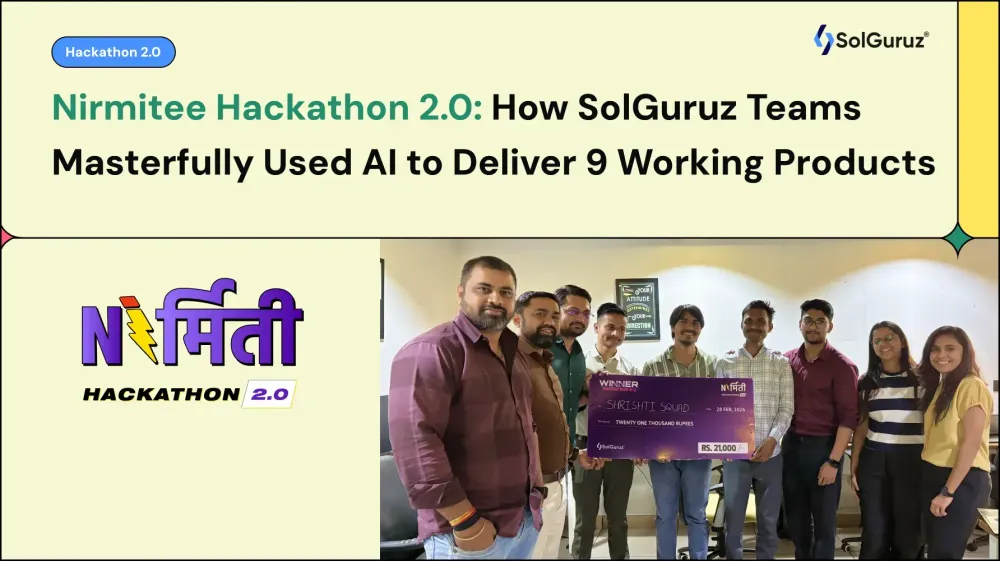
At SolGuruz, we believe in constantly learning new things and testing the boundaries of our own knowledge. We never stop being curious about what we can do, and that is why all the teammates of SolGuruz enthusiastically took part in a 24-hour Hackathon. This was not limited to only technical departments such as design, development, and QA, but also Sales and Marketing.
The Goal Behind a 24-Hour Hackathon
The purpose of this Hackathon was for inter-department collaboration and, more importantly, discovering the whole process of a product being made and executing it. Every person involved walked away with enhanced knowledge of product development and is now more confident in their skills of communication and collaboration.
Additionally, most of our teammates used their critical thinking and problem-solving skills with AI and solved their problem statements even if they had no previous experience with coding. That’s right- even our business analysts were able to create brilliant frontend and backend architecture just using AI and deliver a successful demo!
The 9 Teams of SolGuruz Nirmitee 2.0 Hackathon @2026!
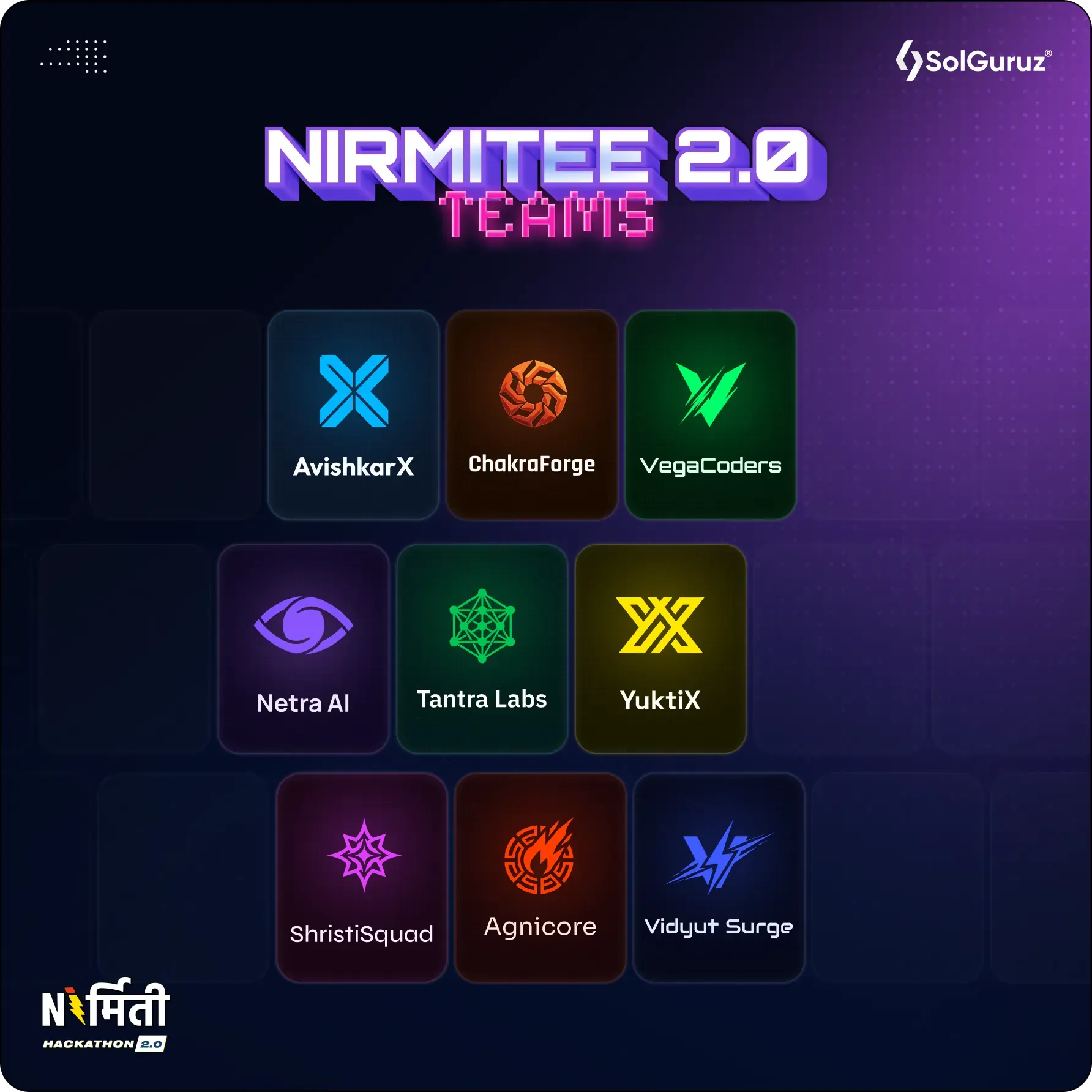
Let us quickly introduce you to all the participating teams of Nirmitee 2.0 Hackathon and showcase their final products. There’s going to be one winner and one runner-up, so read along and place your bets on who you’d like to see win!
1. Shristi AR: Video Shopping Agent; AR-Powered Visual Commerce Assistant
Made by: ShristiSquad
The e-commerce business has a big problem- customers don’t trust the products they can’t try on. This "confidence gap" is a direct drain on bottom-line revenue for retailers. Shristi AR, developed by ShristiSquad during the Nirmitee Hackathon 2.0, presents a solution to this problem by merging Augmented Reality (AR) with hands-free voice and gesture controls.
The Problem: High Costs of Visual Uncertainty
Traditional online shopping depends on static images that don’t properly show scale, fit, or real-world appearance, leading to a 40% cart abandonment rate. This lack of visualization forces a "buy-to-try" behavior that results in a staggering 30% return rate in fashion and accessories. For retailers, this means high operational costs, lost margins, and logistical inefficiency because of consumer uncertainty.
Traditional online shopping depends on static images that don’t properly show scale, fit, or real-world appearance, leading to a 40% cart abandonment rate. This lack of visualization forces a "buy-to-try" behavior that results in a staggering 30% return rate in fashion and accessories. For retailers, this means high operational costs, lost margins, and logistical inefficiency because of consumer uncertainty.
The Solution: Hands-Free Virtual Try-On (VTO)
Shristi AR provides a multi-platform engine that allows users to "Try Before You Buy" through real-time 3D product projection. Unlike standard AR tools, it introduces Voice-Enabled Commerce, allowing users to navigate catalogs with commands like "Next" or "Add to Cart" without touching their screens. This frictionless experience uses high-precision face landmark tracking to ensure accessories like sunglasses and jewelry sit naturally on the user in real-time.
Project Breakdown:
- Target Industry: Retail & E-commerce (Fashion, Jewelry, Eyewear, and Home Décor).
- Unique Selling Proposition (USP): Voice and gesture integration via hands-free "live trial" and navigation for a natural shopping flow.
- Competitive Advantage: Works instantly in-browser or via app with a multi-category AR engine.
- Revenue Model: SaaS Subscription: Tiered monthly subscription plus performance-based add-ons per AR-assisted purchase.
Streamlined Tech Stack
Web (Desktop & Mobile Browser)
- Core: React (TypeScript) + Vite
- AR Engine: Three.js (3D rendering) & MediaPipe (Face tracking)
- State & Styling: Zustand & Tailwind CSS
Mobile (Native App)
- Framework: Flutter + GetX (State & Routing)
- 3D/Voice: Google 3D Model Viewer & Speech-to-Text AI
3D Asset Modeling: SketchFab (Sourcing) & Blender (Customization)
Hosting: Vercel
2. SolDocs Knowledge Hub: Centralized AI Document & Knowledge Agent
Made by: ChakraForge
In high-velocity development environments, information silos are the silent killers of productivity. ChakraForge, developed during the Nirmitee Hackathon 2.0, introduced SolDocs, a centralized AI-driven knowledge agent designed to transform static company documentation into an interactive, searchable, and generative asset.
The Problem: Fragmented Knowledge and Wasted Hours
Engineering and product teams often struggle with "Document Drift," where critical information is scattered across various platforms and folders. This leads to new joiners feeling overwhelmed, teams repeatedly recreating SRS and technical documents from scratch, and, most critically, significant time wasted searching for answers instead of building features. Without a centralized organization, the "cost of curiosity" remains high, slowing down the entire development lifecycle.
The Solution: An AI Copilot for Your Documentation
SolDocs acts as a project-wise Knowledge Hub that does more than just store files; it understands them. By utilizing an AI Copilot (Q&A Chatbot), users can query their project workspace and receive instant, context-aware answers. Beyond retrieval, the system features an AI Document Generator that can produce full SRS documents or technical drafts from simple text prompts. This ensures that documentation stays live, accessible, and integrated into the daily workflow.
Project Breakdown: Target Industry & Strategy
- Target Industry: IT Services & Product Teams (Agencies, Startups, Enterprises).
- Unique Selling Prop (USP): Searches for keywords in the context of the intent of your technical queries.
- Competitive Advantage: Covers everything from initial SRS generation to real-time member Questions & Answers within one hub.
- Future Roadmap: Planned sync with GitHub, Jira, and Google Drive for automated knowledge ingestion.
Streamlined Tech Stack
- Languages: TypeScript (Type-safety for complex doc structures), JavaScript.
- Frontend & Backend: React (UI), Node.js (Server-side logic).
- AI Engine: ChatGPT (OpenAI API) for intent classification and document generation.
- Vector Architecture: Advanced chunking strategies and vector search to ensure accuracy in long-form technical documents.
3. TestArchitect.ai: AI Test Architect Agent
Made by: YuktiX
In the high-pressure window before a product launch, Quality Assurance (QA) often becomes the ultimate bottleneck. TestArchitect.ai, developed by Team YuktiX during the Nirmitee Hackathon 2.0, is an automation agent designed to remove manual testing delays and ensure bug-free deployments at scale.
The Problem: The "Launch-Day" QA Bottleneck
As development cycles shrink, QA teams are often buried under a mountain of new tickets just hours before a scheduled launch. Manual test case generation is slow, prone to human error, and struggles to keep pace with rapid code changes. When testing can't keep up with development, companies are forced to choose between delaying the launch or releasing software with potential "showstopper" bugs, both of which carry heavy financial and reputational risks.
The Solution: Intelligent Autonomous Testing
TestArchitect.ai automates the most tedious parts of the QA lifecycle by instantly creating comprehensive test cases with clear pass/fail criteria. The platform understands OpenAPI specifications and Pull Request (PR) diffs, meaning it can automatically identify what has changed in the code and create relevant tests immediately. With features like "Ask AI" for custom test logic and a centralized dashboard for all testing jobs, it changes QA from a manual problem into a high-speed automated asset.
Project Breakdown: Target Industry & Strategy
- Target Industry: Software Development & QA (SaaS Companies, Fintech, Enterprise IT).
- Unique Selling Prop (USP): Automatically builds tests by reading PR diffs and API documentation.
- Competitive Advantage: Bridges the gap between developers and testers by interpreting code changes in real-time.
- Primary Benefits: Increases testing coverage and accuracy, ensuring a more stable and confident launch.
Streamlined Tech Stack
Intelligence & AI Orchestration
- LLM Ensemble: Claude, ChatGPT, & Gemini AI for code analysis; Perplexity & Antigravity for technical research.
- Logic: Python-based parsing of OpenAPI specs and PR diffs into automated pass/fail criteria.
Backend & Infrastructure
- Core: Fastify (API), Prisma ORM (Data), and Docker (Containerization).
- Persistence: Integrated Chat History and job tracking for full testing audit trails.
Frontend & Management
- Interface: Next.js and Tailwind CSS for a high-speed admin dashboard.
- Portals: Centralized "All Jobs" hub and "Ask AI" conversational QA assistant.
4. MarqAI Studio: Proactive AI Marketing Intelligence & Workflow Agent
Made by: Vidyut Surge
Content marketing is often a fragmented process involving half a dozen disconnected tools and dozens of manual hours per article. MarqAI Studio, built in just 18 hours during the Nirmitee Hackathon 2.0, is an all-in-one AI platform that unifies keyword research, content generation, and multi-channel publishing into a single, intelligent workflow.
The Problem: Fragmented Tools and Content Decay
Marketing teams are currently "drowning" in manual handoffs. A single article typically requires 6+ tools (SEMrush, Jasper, WordPress, Trello, etc.), leading to over 40+ hours of work per piece. Beyond the initial build, "Content Decay" often goes unnoticed, with pages silently losing their Google rankings because teams lack real-time monitoring and an automated way to refresh outdated information.
The Solution: A Unified "Research-to-Publish" Engine
MarqAI Studio replaces the fragmented stack with an automated pipeline that speeds up the content cycle by 10x. It has an AI Content Architect that handles keyword clustering and competitor research, followed by a generator that scores drafts against Google’s EEAT signals before they go live. With 10+ CMS integrations (Webflow, Shopify, HubSpot) and automated social media distribution, it makes sure that once a strategy is set, the execution is largely autonomous.
Project Breakdown:
- Target Industry: Digital Marketing & E-commerce (Agencies, SaaS Marketing Teams, Content Publishers).
- Unique Selling Proposition (USP): Automatically alerts teams or refreshes content when search rankings drop by >10 positions.
- Competitive Advantage: Multi-channel automation with one-click publishing across Web, Social (Instagram/X), and Email Newsletters.
- Revenue Model: Multi-tenant SaaS platform with white-label options specifically for marketing agencies.
Streamlined Tech Stack
Core Automation & Intelligence:
- Orchestration: n8n (Backend workflow engine) for multi-tool API sequences.
- Content AI: GPT-4 for high-intent drafting and SEO scoring.
- Visual AI: DALL-E 3 & Midjourney API for automated, context-aware graphics.
Frontend & CMS Integration
- Dashboard: JavaScript/TypeScript for multi-tenant management.
- CMS Connectors: 10+ native hooks including Webflow, Shopify, HubSpot, and Ghost.
- Social Distribution: API triggers for X, Instagram, Medium, and Threads.
Infrastructure
- Security: Enterprise SSO (SAML/Okta) and compliance controls.
- Monitoring: Real-time rank tracking to trigger "Content Refresh" workflows.
5. SolSwarm: Multi-Agent Development Orchestrator
Made by: Vega Coders
In high-pressure engineering environments, developers often spend more time on coordination than on actual coding. SolSwarm, developed by Vega Coders at the Nirmitee Hackathon 2.0, solves this by deploying a "swarm" of specialized AI agents that autonomously manage the Software Development Life Cycle (SDLC).
The Problem: The 40% Context-Switching Tax
Modern development has a lot of manual overhead, with developers wasting 40% of their time switching between coding, testing, documenting, and deploying. This fragmentation creates knowledge silos, slows down release cycles, and leads to developer burnout. Without a unified ecosystem to bridge these stages, the journey from "feature idea" to "production-ready code" remains a slow, manual bottleneck.
The Solution: Natural Language to Production-Ready Code
SolSwarm introduces an orchestration layer where users describe features in plain English, and a specialized team of agents takes over. The Code Agent writes the implementation, the Test Agent generates self-healing tests, and the Docs Agent automatically syncs READMEs and API specs. By keeping a "Human-in-the-Loop" for creative control while automating the repetitive "grunt work," SolSwarm ensures that documentation and tests never fall behind the implementation.
Project Breakdown:
- Target Industry: Software Engineering & DevOps (SaaS Startups, Enterprise IT, Fintech).
- Unique Selling Proposition (USP): Agents automatically adapt tests and docs the moment the code changes.
- Competitive Advantage: Has Agent Orchestration which manages the entire workflow from PR to deployment.
- Market Potential: Good because 42% of enterprises are projected to use AI agents in production by 2026.
Streamlined Tech Stack
- Languages: Python (AI Logic), JavaScript (React.js Frontend).
- AI Orchestration: Anthropic Claude with LangGraph for complex agent state management.
- Architecture: Microservices-based design for independent agent scaling.
- Integrations: GitHub API and GitHub Actions for automated CI/CD triggers.
Dive Deeper into AI Agents: Types of AI Agents in 2026: Which Agent Model Works Best?
6. Performa: Actor's Toolkit & Audition Prep
Made by: Netra AI
In an industry where self-tape auditions have become the global standard, actors often struggle with the lack of immediate, objective feedback. Performa, developed by Team Netra AI during the Nirmitee Hackathon 2.0, is an AI-driven acting coach designed to bridge the gap between solo rehearsal and professional performance.
The Problem: The "Silent" Audition Struggle
Aspiring actors face a significant barrier to entry: 70% of audition failures are attributed to under-rehearsal rather than a lack of talent. Traditional training is prohibitively expensive (costing upwards of ₹2.65L–4L), and finding a reliable scene partner for late-night rehearsals is nearly impossible. This leads to inconsistent self-tapes and subjective self-assessment in a massive market of 3M+ aspiring actors who currently lack specialized AI tools.
The Solution: A 24/7 Virtual Acting Coach
Performa functions as an AI scene partner that gives character voices to rehearse with and a partner to rehearse with. Beyond simple lines, the platform uses computer vision and audio analysis to provide a Callback Prediction Score, evaluating emotion, pacing, and projection. By offering real-time feedback on lighting, blocking, and delivery, it helps actors optimize their self-tapes before submission.
Project Breakdown: Target Industry & Strategy
- Target Industry: Media & Entertainment (Aspiring Actors, Casting Directors, Acting Institutes).
- Unique Selling Proposition (USP): Real-time AI scoring on the nuances of a performance, not just the lines.
- Competitive Advantage: A data-driven callback probability score that helps actors refine their takes based on industry standards.
Streamlined Tech Stack
Core AI & Analysis
- Computer Vision: Python-based real-time facial tracking and sentiment analysis.
- NLP: Script-pacing algorithms and intent detection for dialogue rehearsal.
- Audio Intelligence: Voice synthesis for AI scene partners and acoustic projection scoring.
Frontend & Mobile
- Mobile: Flutter for high-performance cross-platform rehearsal tools.
- Web: JavaScript for browser-based dashboards and analytics.
Infrastructure
- Processing: Scalable cloud architecture for high-res video frame analysis.
- Analytics: Proprietary "Self-Tape Optimizer" for lighting and blocking feedback.
7. Vigil.AI: Automated Customer Success Agent
Made by: Tantra Labs
In the competitive SaaS landscape, user churn often happens silently. By the time a support ticket is raised, the user has usually already decided to quit. Vigil.AI, developed by Team Tantra Labs during the Nirmitee Hackathon 2.0, is an automated Customer Success agent that intervenes in real-time to prevent "rage-quitting" before it happens.
The Problem: The "Silent" Onboarding Failure
Software companies lose significant revenue to "Day 0" churn. Users often get stuck during onboarding with no immediate assistance, leading to frustration. Traditional help documentation is generic and non-contextual, and support teams are typically reactive because they reach out only after a user has already abandoned the flow. This lack of proactive guidance results in poor feature discovery and high abandonment rates.
The Solution: Real-Time Struggle Detection & Intervention
Vigil.AI acts as an "always watching" guardian of the user experience. It uses behavioral triggers to detect Rage Clicks, Dead Clicks, and Hover Hesitation (long pauses indicating confusion). Once a struggle pattern is identified, the AI triggers immediate, contextual interventions such as smart tooltips, 15-second video snippets of the exact task, or interactive walkthroughs. This helps users instantly without them ever needing to open a support tab.
Project Breakdown: Target Industry & Strategy
- Target Industry: SaaS & Product-Led Growth (PLG) (B2B Software, Fintech, EdTech).
- Unique Selling Proposition (USP): Does behavioral interventions, like moving from reactive support to proactive assistance based on "rage-click" detection.
- Competitive Advantage: Expanding struggle detection to iOS and Android apps beyond web interfaces.
- Future Vision: Expanding struggle detection to iOS and Android apps beyond web interfaces.
Streamlined Tech Stack
Core AI & Analysis
- Intelligence: Claude and Gemini for intent classification and generating contextual help.
- Tracking: Custom event listeners for Rage Clicks, Dead Clicks, and Navigation Loops.
- Logic: Python-based behavioral analysis to detect "hover hesitation" and abandonment patterns.
Frontend & Integration
- Capture Engine: JavaScript for real-time event tracking and UI element injection.
- UI Delivery: Dynamically rendered tooltips and interactive walkthrough overlays.
- Search: Perplexity API for surfacing real-time, accurate documentation answers.
Infrastructure
- Monitoring: Live dashboard tracking session frustration levels and churn risk distribution.
- Future Scale: Planned Mobile SDK for iOS/Android and Slack/Teams alerting.
8. Clarix: AI-Powered Feedback Management Agent SDK
Made by: AvishkarX
Client review cycles are notoriously broken, often full of subjective comments that stall development. Clarix, developed by Team AvishkarX during the Nirmitee Hackathon 2.0, is a Client Review Intelligence Platform designed to bridge the communication gap between non-technical stakeholders and engineering teams.
The Problem: The "Broken" Feedback Loop
Development teams are frequently paralyzed by "feedback fog," aka vague client comments like "this looks weird" or "make it pop," that lack page context, URLs, or reproduction steps. Currently, developers spend hours manually triaging mixed issues (where three distinct bugs are buried in one paragraph) and chasing clients for screenshots. This manual interpretation leads to miscategorized tasks, wasted sprint capacity, and friction during the UAT (User Acceptance Testing) phase.
The Solution: Automated Triage and Intelligence
Clarix introduces a three-layer system that captures, interprets, and categorizes feedback with zero manual effort. An embedded SDK widget automatically detects console errors and failed API calls the moment a client opens the staging app. Using Natural Language Processing (NLP), Clarix splits compound feedback into individual, structured tickets, assigns a priority level (P0–P3) based on sentiment, and routes them to the responsible team (Frontend, Backend, or QA) instantly.
Project Breakdown: Target Industry & Strategy
- Target Industry: Software Development Agencies & Product Teams (B2B Services, SaaS).
- Unique Selling Proposition (USP): Automatically breaks down a single, complex feedback comment into multiple structured Jira-ready tickets.
- Competitive Advantage: Bundles screenshots with console logs, network errors, and URL states without client intervention to create a technical context.
- Workflow Impact: Features a built-in Kanban Ticket Board with "Open → In Progress → Resolved" lanes for immediate action.
9. Blueprint IQ: AI Product Requirements Agent + Proposal, SOW Drafter
Made by: AgniCore
Software development moves fast, but the gap between a "great idea" and a "technical specification" is where most projects lose momentum. Blueprint IQ, developed by Team AgniCore during the Nirmitee Hackathon 2.0, is an AI-driven requirement analysis engine that automates the creation of professional technical documentation from simple natural language inputs.
The Problem: The Documentation Slowdown
Today, organizations are trapped in a cycle of manual documentation that is both slow and prone to errors. Project managers and architects often spend days repeatedly writing similar SRS documents, searching through old files for references, and struggling to maintain version consistency. This manual bottleneck not only delays project kick-offs but often leads to inconsistencies between natural-language requirements and the final technical architecture.
The Solution: From Vision to Specification in Minutes
By reading natural language inputs, the system autonomously extracts features, identifies necessary modules, and understands the full project scope. It then generates a comprehensive suite of "Launch-Ready" assets, including SRS documents, architecture diagrams, project proposals, timelines, and cost estimates. This allows teams to skip the "blank page" phase and move directly to review and execution.
Project Breakdown: Target Industry & Strategy
- Target Industry: IT Consultancies & Software Agencies (Product Teams, Startup Founders).
- Unique Selling Proposition (USP): Provides full-suite generation and goes beyond text to generate architecture diagrams and visual timelines automatically.
- Competitive Advantage: Consistency Engine: Ensures that the proposal, timeline, and SRS are perfectly aligned with the identified scope.
Streamlined Tech Stack
Core AI & Analysis
- LLM Engine: Claude AI & ChatGPT for requirement extraction and module identification.
- Logic: Python-based processing to convert natural language into project scopes and timelines.
Design & Documentation
- Visuals: Figma for automated UI/UX blueprinting and layout prototyping.
- Outputs: Automated generation of SRS documents, architecture diagrams, and cost estimates.
Development Environment
- IDE: VS Code for system integration and rapid prototyping.
- Scalability: Modular architecture designed to eventually ingest voice meetings and call recordings.
Meet the Winning Champions!
The anticipation and excitement were palpable in the air! With teams working and innovating at full steam, with well-deserved breaks and fun times during dinner and early morning breakfast, the whole SolGuruz team came together to see all 9 teams' product demos and see who were declared winners.
…Drumroll please🥁🥁🥁
Winner - ShristiAR by ShristiSquad 🎊

This was a fan-favourite because of the sheer attractiveness and functionality of the product. Most of us shop online now, and would love to have AR try-ons to make our shopping decisions easier. The fact that ShristiSquad was able to present a successful demo on a web browser as well as a mobile app is a testament to their efforts.
Runner-up- BlueprintIQ by AgniCore 🎉
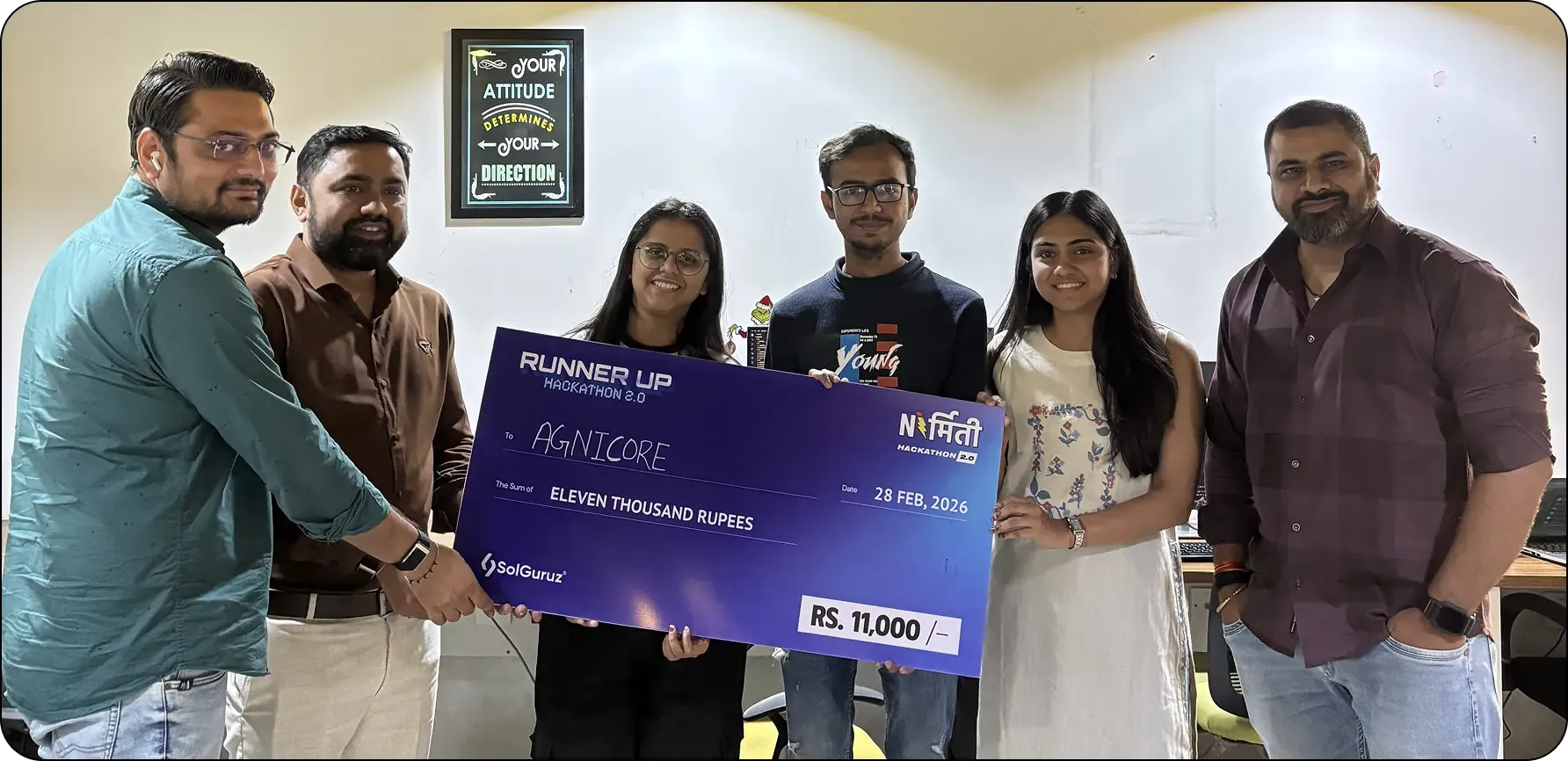
It’s one of the most useful products for the service and product industry. When you just wanted to get started with the project, but you gotta take a few days to make documents manually is a bummer. With BlueprintIQ, you can give a natural language input and get a whole bundle of professional AND technical documents like SRS, Technical Architecture, Proposal, and more.
We congratulate both of these teams for their brilliant work and also give a shout-out to all other teams for their enthusiastic and innovative spirit!
P.S.: Most of us have already started gearing up for Nirmitee 3.0 🤭

28 February 2026

12:00 PM

SolGuruz, Ahmedabad